海尔智家

Search documents
年集有新意
Xin Lang Cai Jing· 2026-02-20 23:48
Group 1 - The "Xiamen Year · Tong'an Flavor" New Year Goods Fair features over 130 stalls across nine themed exhibition areas, showcasing a blend of new consumer trends and traditional festive flavors [1] - During the Spring Festival, the local government launched the "Buy and Save" campaign, distributing over one million yuan in consumer vouchers through the "Cloud Flash Payment" platform, benefiting various sectors including supermarkets and popular restaurants [1] - A local vendor reported daily foot traffic exceeding 100 customers and sales surpassing 600,000 yuan during the festival, highlighting the positive impact of government initiatives on consumer spending [1] Group 2 - The "Buy and Save" campaign is part of a year-round consumer brand initiative, with plans for seasonal activities around major holidays to create a new consumption ecosystem that boosts local market activity [2] - Xiamen is enhancing its 2026 Consumer Festival with nearly a thousand online and offline promotional activities, targeting key tourist attractions, unique dining experiences, and cultural products [2] - The city is leveraging artificial intelligence to develop new consumption scenarios and has introduced innovative tax refund models to improve services for international tourists, aiming to enhance their shopping experience during the Spring Festival [2]
科技新贵上位,大模型双雄智谱、MiniMax市值突破3000亿港元大关,智谱一日之内涨出一个B站, 携程、快手、京东市值相继被超过 ,恒科已成“老登股”?
Jin Rong Jie· 2026-02-20 10:51
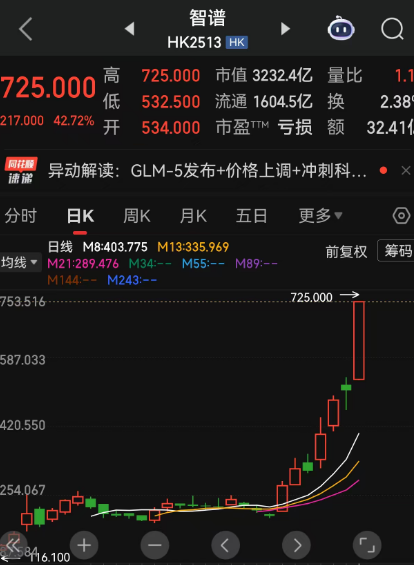
Core Insights - The Hong Kong stock market saw significant gains for AI companies Zhiyuan and MiniMax, with both surpassing a market capitalization of 300 billion HKD, indicating a rise of new tech leaders in the market [1][3] - On the first trading day of the Lunar New Year, while the Hang Seng Tech Index fell nearly 3%, Zhiyuan and MiniMax stood out with substantial price increases, with Zhiyuan's stock price reaching a peak of 739 HKD per share, marking a rise of over 45% [1] - MiniMax also performed well, closing at 970 HKD per share, reflecting a gain of over 14% on the same day, and a total increase of 487.88% since its listing on January 9 [3] Company Performance - Zhiyuan's market capitalization increased by over 96.7 billion HKD in one day, reaching 323.24 billion HKD, with a total increase of over 256% since February 9 [1] - MiniMax's market capitalization reached 304.23 billion HKD, with a significant rise since its IPO [3] Market Dynamics - The market landscape for tech stocks in Hong Kong has shifted, with Zhiyuan and MiniMax surpassing the market capitalizations of major companies like Ctrip, Kuaishou, and JD, and approaching the valuation of Baidu at 350 billion HKD [5] - The performance of these AI companies is seen as a reflection of the growing interest and investment in AI technologies, particularly in light of recent developments in the industry [10] Industry Trends - The rapid iteration of large models is leading to a restructuring of the internet value chain, shifting focus from traditional traffic scale to behavior execution and result-based business models [10] - The AI application sector is experiencing simultaneous technological breakthroughs and intensified commercialization, supported by national strategies promoting AI development [10] Future Outlook - Despite the strong performance of Zhiyuan and MiniMax, concerns remain regarding the overall tech sector in Hong Kong, with analysts predicting continued weakness in the market due to investor apprehension about major companies like Alibaba and Baidu [11]


里昂:维持海尔智家“跑赢大市”评级 目标价升至32港元
智通财经网· 2026-02-20 07:47
Core Viewpoint - Credit Lyonnais maintains a "Outperform" rating for Haier Smart Home (06690), raising the A-share target price from 32 RMB to 34 RMB and the Hong Kong stock target price from 30 HKD to 32 HKD, supported by strong recovery in overseas demand [1] Group 1: Domestic Market Outlook - The impact of the appliance replacement policy is expected to diminish, leading to a slowdown in Haier's revenue growth in China to low single digits by 2026 [1] - Confidence remains high regarding the expansion of Haier's domestic market gross margin, as the company continues to streamline product models and enhance channel efficiency [1] Group 2: International Market Outlook - The U.S. market presents significant uncertainties; however, if new policy changes successfully stimulate housing supply, revenue growth could accelerate significantly [1] - Haier's revenue growth in the U.S. market is projected to increase from low single digits in 2025 to mid single digits in 2026 [1]

里昂:维持海尔智家(06690)“跑赢大市”评级 目标价升至32港元
智通财经网· 2026-02-20 07:40
Core Viewpoint - Credit Lyonnais maintains a "Outperform" rating for Haier Smart Home (06690), raising the A-share target price from 32 RMB to 34 RMB and the Hong Kong stock target price from 30 HKD to 32 HKD, supported by strong recovery in overseas demand [1] Group 1: Domestic Market Outlook - The impact of the appliance replacement policy is expected to diminish, leading to a slowdown in Haier's revenue growth in China to low single digits by 2026 [1] - Confidence remains high regarding the expansion of Haier's domestic market gross margin, as the company continues to streamline product models and enhance channel efficiency [1] Group 2: International Market Outlook - The U.S. market presents significant uncertainties; if new policy changes successfully stimulate housing supply, revenue growth could accelerate substantially [1] - Haier's revenue growth in the U.S. market is projected to increase from low single digits in 2025 to mid single digits in 2026 [1]
春节后首日,港股跳水,百度、阿里、网易、腾讯、京东下跌!智谱大涨
Mei Ri Jing Ji Xin Wen· 2026-02-20 02:36
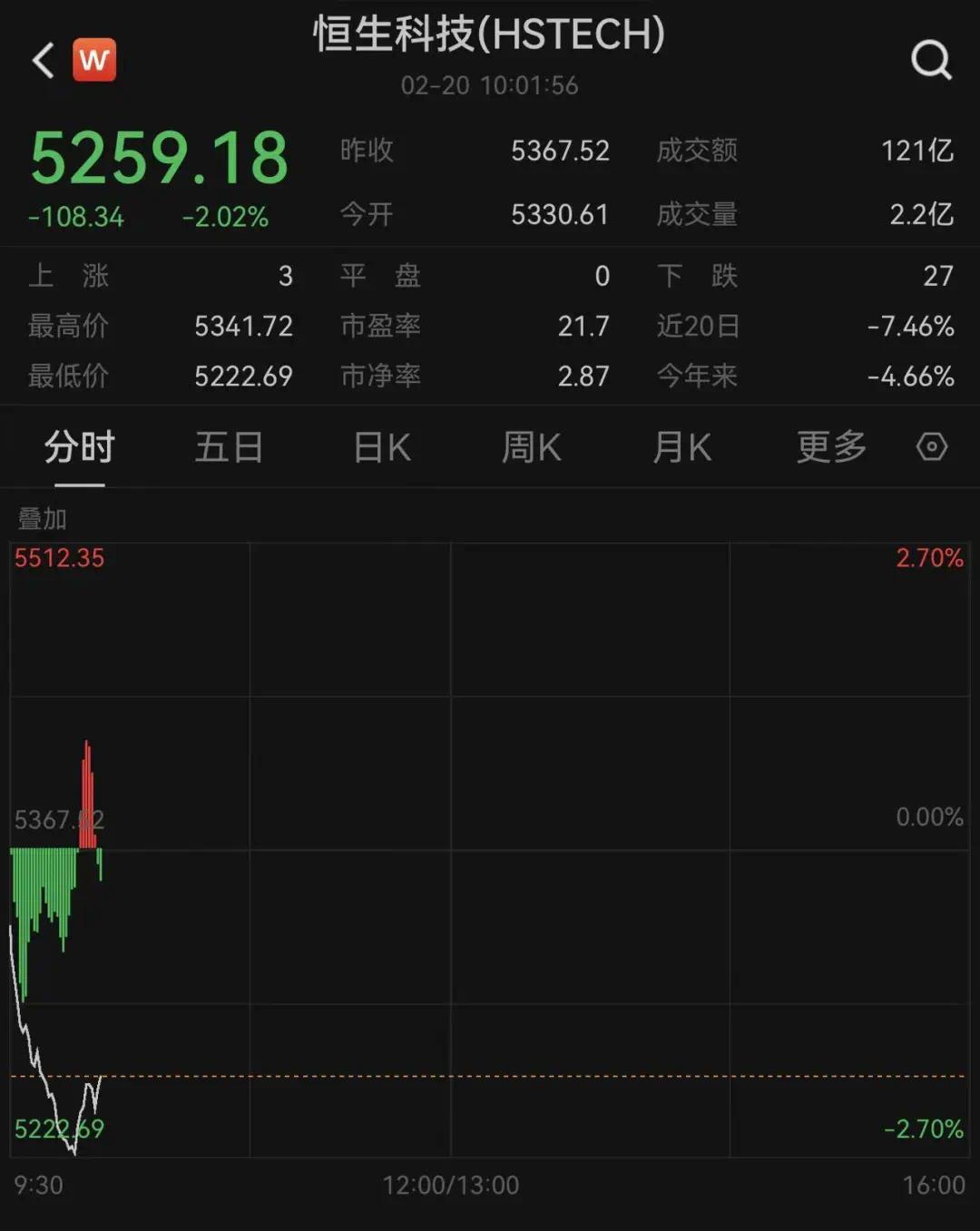
Market Overview - The Hang Seng Index and Hang Seng Tech Index opened lower, with the Hang Seng Index dropping by 1.31% at one point and currently down by 0.68% [1] - The Hang Seng Tech Index saw a decline of 2.7% at its lowest, now down by 2.02% [1] Hang Seng Tech Index Details - The Hang Seng Tech Index opened at 5330.61, with a current value of 5259.18, reflecting a decrease of 108.34 points or 2.02% [2] - The trading volume for the day is 2.2 billion, with a market capitalization rate of 21.7 [2] Hang Seng Index Details - The Hang Seng Index opened at 26657.84, currently at 26524.99, down by 180.95 points or 0.68% [3] - The trading volume is reported at 23.4 billion, with a market capitalization rate of 12.1 [3] Notable Stock Movements - Hai Zhi Technology Group (2706.HK) surged by 19.25%, while MINIMAX-WP (0100.HK) increased by 11.63%, and Zhi Pu (2513.HK) rose by 18.31%, with a total market capitalization reaching 268 billion HKD [3] - Victory Securities (8540.HK) saw a rise of 13.12% following the approval of its virtual asset trading platform [7][8] - Bitcoin-related stocks, such as Xing Tai Chain Group (0399.HK), increased by 46.67% amid news of upcoming stablecoin licenses in Hong Kong [8] Declines in Tech Stocks - Major tech stocks experienced declines, with Kingdee International and Baidu Group dropping over 5%, and Alibaba and Bilibili falling over 4% [10] - Other notable declines include Netease down by 3.95%, and Tencent Holdings down by 2.25% [10][11] Gains in Other Sectors - Midea Group, Horizon Robotics, and SenseTime saw increases, with Midea Group rising by 1.47% [12]
春晚广告位争夺战:四十年国民记忆与商业暗流
凤凰网财经· 2026-02-19 10:54
Core Viewpoint - The evolution of the Spring Festival Gala sponsorship reflects the transformation of China's economy and consumer behavior over the past 40 years, showcasing the shift from material scarcity to technological innovation and brand storytelling [4][5]. Group 1: 1980s to Early 1990s - The Era of Material Scarcity - The transition from a planned economy to a market economy in the 1980s led to a scarcity of goods, making items like watches and bicycles symbols of wealth and status [6][7]. - The first brand to sponsor the Spring Festival Gala was Kambas watches in 1984, which used 3,000 quartz watches as payment, marking the beginning of brand sponsorship in the event [7][9]. - Kambas became a household name, with production reaching 1.26 million units by 1987 and over 2 million by 1991, highlighting the impact of the Gala on brand visibility and market demand [9][10]. Group 2: Mid-1990s to Early 2000s - The Rise of Consumerism - The late 1990s saw a surge in consumer spending, with households moving from basic necessities to larger purchases like televisions and refrigerators [12][14]. - In 1995, Shandong Kongfu Banquet Wine became the first "advertising king" of the Spring Festival Gala, paying 30.79 million yuan, initiating a trend among liquor companies [12][14]. - The sales of Qin Pool Wine skyrocketed from 180 million yuan in 1995 to 950 million yuan in 1996 after winning the sponsorship, demonstrating the immediate impact of Gala advertising [17]. Group 3: 2000s to 2010s - The Era of Brand Awareness - The early 2000s marked a shift towards household appliances as the main consumer focus, with Midea becoming a prominent sponsor, securing 16 sponsorships from 2003 to 2019 [18][20]. - The cost of advertising during the Gala increased significantly, with Midea's sponsorship rising from 6.8 million yuan in 2005 to 57.2 million yuan in 2011, reflecting the growing value of the event [20]. - Brands began to focus on storytelling and emotional connections with consumers, as seen with Haier and Gree, indicating a maturation of brand marketing strategies [21]. Group 4: Mid-2010s to Present - The Digital Economy and Technological Innovation - The rise of internet companies has transformed the Spring Festival Gala into a platform for digital engagement, with WeChat's "red envelope war" in 2015 significantly increasing viewer interaction [24][26]. - The Gala has become a battleground for tech giants, with platforms like Douyin and Kuaishou participating in interactive sponsorships, showcasing the shift towards a two-way communication model [29]. - The introduction of robots and AI technologies in recent Galas reflects China's transition from manufacturing to intelligent manufacturing, highlighting the importance of innovation in the economy [31].


春晚广告位争夺战:四十年国民记忆与商业洪流
Xin Lang Cai Jing· 2026-02-19 07:21
Core Insights - The evolution of the CCTV Spring Festival Gala sponsorship reflects the transformation of Chinese society and economy over the past 40 years, showcasing the changing consumer demands and emerging industries [20][21]. Group 1: 1980s to Early 1990s - The Era of Scarcity - In the 1980s, as China transitioned from a planned economy to a market economy, consumer goods were scarce, leading to a high demand for basic commodities [22]. - The first brand to sponsor the Spring Festival Gala was Kambas watches in 1984, which used 3,000 quartz watches as payment, marking the beginning of brand sponsorship in the gala [22][23]. - Kambas became a household name, with production reaching 1.26 million units in 1987 and over 2 million by 1991, despite the high price of its watches relative to average incomes [23][24]. Group 2: Mid-1990s to Early 2000s - The Rise of Consumerism - The mid-1990s saw a shift in consumer spending from basic goods to electronics, with Shandong Kongfu Banquet Wine becoming the first "advertising king" by paying 30.79 million yuan for sponsorship in 1995 [26]. - The competition among liquor brands for sponsorship reflected the rise of "social consumption," where premium liquor became a status symbol for social gatherings [28]. - After winning the Spring Festival sponsorship, Qin Pool Wine's sales skyrocketed from 180 million yuan in 1995 to 950 million yuan in 1996, demonstrating the immediate impact of gala sponsorship [29]. Group 3: 2000s to Early 2010s - The Home Appliance Boom - The early 2000s marked a shift towards home appliances as the primary consumer focus, with Midea becoming the most frequent sponsor, securing 16 sponsorships from 2003 to 2019 [30]. - The cost of advertising during the gala increased significantly, with Midea's sponsorship fee rising from 6.8 million yuan in 2005 to 57.2 million yuan in 2011, an increase of 840% [30]. - Midea's revenue grew from 17.5 billion yuan in 2003 to over 140 billion yuan in 2014, reflecting the effectiveness of its gala sponsorship strategy [12][30]. Group 4: Mid-2010s to Present - The Digital Economy and Technological Innovation - The rise of internet companies has transformed the Spring Festival Gala into a platform for digital engagement, with WeChat's "red envelope war" in 2015 significantly boosting viewer interaction [15][35]. - The gala's advertising has evolved from one-way promotion to interactive engagement, with platforms like Douyin and Kuaishou participating in sponsorships [16][35]. - The presence of technology companies has increased, with innovations such as AI and robotics showcased during the gala, indicating a shift from traditional advertising to technology-driven marketing [19][37].

2025年中国家用冷柜(家用冷冻箱)产量为2784.8万台 累计下降0.9%
Chan Ye Xin Xi Wang· 2026-02-19 01:39
Core Viewpoint - The report highlights the trends and investment opportunities in the Chinese home freezer market from 2026 to 2032, indicating a slight decline in production in 2025 but a positive growth forecast for 2026 and beyond [1] Industry Summary - According to the National Bureau of Statistics, the production of home freezers in China reached 2.98 million units in December 2025, reflecting a year-on-year increase of 7% [1] - The cumulative production of home freezers for the entire year of 2025 was 27.848 million units, showing a slight decline of 0.9% compared to the previous year [1] - The report is published by Zhiyan Consulting, a leading industry consulting firm in China, which specializes in providing in-depth industry research and investment analysis [1] Company Summary - Listed companies in the home freezer sector include Midea Group (000333), Haier Smart Home (600690), Aucma (600336), and Hisense Home Appliances (000921) [1]

智通AH统计|2月18日
智通财经网· 2026-02-18 08:20
Group 1 - The article highlights the top three companies with the highest AH premium rates: Northeast Electric (00042) at 785.25%, Beijing Jingcheng Machinery Electric (00187) at 291.45%, and Sinopec Oilfield Service (01033) at 284.04% [1] - The bottom three companies with the lowest AH premium rates are CATL (03750) at -16.62%, WuXi AppTec (02359) at -6.17%, and China Merchants Bank (03968) at -3.27% [1] - The article provides a detailed ranking of the top ten and bottom ten AH stocks based on their premium rates and deviation values, indicating significant disparities in market valuations between A-shares and H-shares [1][2] Group 2 - The top three companies with the highest deviation values are Beijing Jingcheng Machinery Electric (00187) at 23.16%, Dongjiang Environmental Protection (00895) at 18.78%, and Zhongzhou Securities (01375) at 16.54% [1] - Conversely, the companies with the lowest deviation values include Morning Paper (01812) at -52.60%, Junda Co., Ltd. (02865) at -34.18%, and Changfei Optical Fiber Cable (06869) at -34.18% [1][2] - The article emphasizes that the deviation value represents the difference between the current premium rate and the average premium rate over the past 30 days, providing insights into market trends [2]

春晚40年赞助商变迁史,从康巴丝到机器人见证中国经济跃迁
Sou Hu Cai Jing· 2026-02-18 02:17
Group 1 - The article discusses the evolution of sponsorship in the CCTV Spring Festival Gala over the past 40 years, reflecting changes in Chinese society and consumer behavior [2][3] - The first sponsor, 康巴丝 (Kambas), set a precedent in 1984 by using 3,000 quartz watches as payment, marking the beginning of brand sponsorship in the gala [6][8] - The transition from watches to bicycles as the next major sponsor in 1995 illustrates the shift in consumer goods that represented status during the era of material scarcity [10][12] Group 2 - The late 1990s saw a surge in consumer spending on new household appliances, with 山东孔府宴酒 (Shandong Confucius Banquet Wine) becoming the first "mark king" of the gala in 1995, paying 30.79 million yuan [10][12] - The rapid growth of the liquor industry during this period was fueled by "human consumption," where premium liquor became a social currency [12][14] - The article highlights the consequences of over-reliance on advertising without maintaining product quality, as seen in the case of 秦池酒 (Qin Pool Wine), which faced a significant drop in sales after quality issues emerged [14][15] Group 3 - From the early 2000s, the focus shifted to home appliances, with 美的 (Midea) becoming a prominent sponsor, securing 16 sponsorships from 2003 to 2019 [17][19] - The cost of advertising during the gala increased significantly, with Midea's sponsorship fee rising from 6.8 million yuan in 2005 to 57.2 million yuan in 2011, reflecting the growing viewership [17][19] - The brand storytelling approach adopted by companies like 海尔 (Haier) and 格力 (Gree) during this period indicates a shift towards building emotional connections with consumers [20] Group 4 - The rise of internet companies post-2010 transformed the gala's advertising landscape, with platforms like WeChat leveraging the event for massive user engagement through interactive features like the "red envelope battle" [21][23] - The article notes that the 2015 Spring Festival Gala saw WeChat's user engagement peak, with over 10.1 billion red envelopes sent, showcasing the event's potential as a digital marketing platform [21][23] - The involvement of tech giants in the gala reflects a broader trend of digital economy reshaping traditional advertising methods, with companies like 快手 (Kuaishou) and 抖音 (Douyin) entering the sponsorship arena [25][27] Group 5 - The article concludes by emphasizing the transition from showcasing products to highlighting technological advancements, as seen with the introduction of robots in recent galas [27] - This shift signifies a broader change in China's economic landscape, moving from manufacturing to innovation-driven growth, with a focus on high-tech industries [27] - The future of the Spring Festival Gala sponsorship landscape remains uncertain, raising questions about which industries will dominate the next decade [27]