巨子生物

Search documents





豪赌“童颜针”!东方妍美赴港IPO:估值15亿却称可能永远不赚钱
凤凰网财经· 2025-05-30 12:32
Core Viewpoint - The article discusses the financial struggles and risks faced by Dongfang Yanmei, a medical aesthetics company attempting to go public in Hong Kong, despite the booming beauty industry in China. The company is heavily in debt and has reported significant losses, raising questions about its future profitability and the viability of its core product, XH301, which is still awaiting regulatory approval [2][12]. Group 1: Company Overview - Dongfang Yanmei, established in 2016, focuses on regenerative medical devices and special medical foods, and has recently submitted its IPO application to the Hong Kong Stock Exchange [3]. - The leadership team, averaging over 50 years of age, consists of veterans from traditional pharmaceutical companies who have shifted their focus to the medical aesthetics sector [4]. Group 2: Financial Performance - In 2023, Dongfang Yanmei reported total assets of 148.9 million RMB and total liabilities of 116.6 million RMB, resulting in a debt-to-asset ratio of 78%. By 2024, total liabilities are projected to rise to 195.8 million RMB, increasing the debt-to-asset ratio to 123% [6]. - The company has incurred losses exceeding 69.38 million RMB in 2024, with a gross margin of only 2.6% [7][9]. - Operating cash flow for 2024 is expected to be just 1.587 million RMB, while the net loss is projected at 69.38 million RMB, indicating severe liquidity issues [8]. Group 3: Product and Market Potential - The core product, XH301, is a regenerative medicine injectable designed to stimulate collagen regeneration, commonly referred to as "童颜针" (youthful needle) in the aesthetics market [10][11]. - The market for such products is growing, with XH301 showing promising clinical trial results, but competition is intensifying as several similar products are set to launch in the coming years [11][14]. Group 4: Risks and Challenges - The company acknowledges significant risks in its IPO prospectus, including the possibility of never achieving profitability, with a detailed risk factor section spanning 60 pages [12][14]. - Dongfang Yanmei's reliance on external financing and high R&D expenditures, which exceed 300% of its revenue, poses a fundamental conflict between technological aspirations and financial realities [9][10].

可复美遭“打假”,巨子生物7天市值蒸发180亿港元,护肤品卖出白酒毛利率
Xin Hua Cai Jing· 2025-05-30 12:21
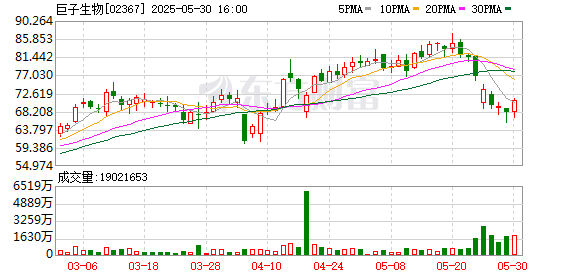
Core Viewpoint - The stock price of Giant Bio has dropped 19.80% over 7 trading days, resulting in a market value loss of nearly 18 billion HKD due to allegations regarding the collagen content in its skincare products [2] Company Overview - Giant Bio operates in the professional skincare industry based on bioactive ingredients, with its brand "Kefumei" accounting for 87.04% of total revenue in 2024 [2] - The company reported a revenue of 5.539 billion CNY and a net profit of 2.062 billion CNY in its 2024 annual report, with a gross margin of 82.09% [4] Controversy and Response - On May 24, a beauty blogger, "Dr. Big Mouth," questioned the collagen content in Kefumei's core product, claiming it was only 0.0177% and lacked glycine, a key component [2] - Giant Bio responded by stating the allegations were "seriously inaccurate" and provided self-test results showing collagen content exceeding 0.1% [2] - The company has not yet released third-party test results despite claims of having engaged multiple authoritative testing agencies [2] Testing Methods - The blogger's team used high-performance liquid chromatography (HPLC) combined with amino acid quantification, while Giant Bio employed methods from the Chinese Pharmacopoeia and industry standards [3] - The blogger raised concerns about the testing methods used by Giant Bio, suggesting they may lead to inflated results due to the presence of polyglutamic acid [3] Market Impact - Market regulatory authorities are currently investigating the situation, which could negatively affect consumer sentiment and the performance of Kefumei during the upcoming 618 promotional event [4]
「618」在即,700亿重组胶原巨头被指「成分造假」|焦点分析
36氪· 2025-05-30 10:55
Core Viewpoint - The article discusses the controversy surrounding the collagen product "胶原棒" from 巨子生物, highlighting concerns about the actual content of recombinant collagen being lower than advertised, which could impact consumer trust and company performance [4][6][15]. Company Analysis - 巨子生物's flagship product, "胶原棒," is projected to generate 4.5 billion yuan in revenue for 2024, representing a 62.9% year-on-year growth and accounting for 80% of the company's total revenue [4][15]. - The controversy began when a social media influencer claimed that the actual recombinant collagen content in "胶原棒" was only 0.0177%, significantly below the stated minimum of 0.1% [6][7]. - The company asserts that their products meet the industry standard, with multiple tests showing collagen content above 0.1% [6][7]. Industry Context - The issue of low recombinant collagen content points to broader challenges in the industry, including production limitations and the need for clearer regulatory standards for testing [8][9]. - The market for recombinant collagen has seen significant growth, with companies like 巨子生物 and 锦波生物 achieving substantial valuations due to the high demand for these products [10][11]. - The controversy could lead to a decline in consumer confidence, especially with the upcoming "618" shopping festival, which is crucial for sales [13][15]. Market Dynamics - The sales of "胶原棒" have been strong, with over 5.15 billion units sold since its launch, and the introduction of a new version is expected to further boost sales [15]. - Major players in the cosmetics and medical beauty sectors are increasingly investing in recombinant collagen products, indicating a trend towards expanding this market [15][16]. - The trust crisis surrounding recombinant collagen could have far-reaching implications for the entire industry, affecting not just 巨子生物 but also other companies involved in this segment [17][18].
玻尿酸龙头炮轰胶原神话!医美三巨头“成分大战”背后:业绩集体失速,概念炒作退潮
Hua Xia Shi Bao· 2025-05-30 09:07
Core Viewpoint - The recent controversy surrounding hyaluronic acid and recombinant collagen products has led to significant scrutiny and volatility for leading companies in the medical beauty biotechnology sector, including Huaxi Biological, Juzhi Biological, and Jinbo Biological [2][11]. Group 1: Controversy and Market Reactions - Huaxi Biological publicly criticized brokerage reports for promoting the "hyaluronic acid is outdated" narrative, suggesting that the recombinant collagen concept is being overly hyped [3][11]. - Juzhi Biological faced public backlash due to a report indicating that its product "Kefumei" contained only 0.0177% recombinant collagen, below the legal threshold of 0.1% [4][11]. - Jinbo Biological's stock price was affected by the overall negative sentiment in the collagen sector, experiencing a significant drop of 17.23% from its peak [5][7]. Group 2: Financial Performance - Huaxi Biological reported its worst performance since going public in 2024, with revenue of 5.371 billion yuan, a year-on-year decrease of 11.61%, and a net profit of 174 million yuan, down 70.59% [9][10]. - Juzhi Biological achieved a revenue of 5.539 billion yuan in 2024, a year-on-year growth of 57.2%, but its core product's growth rate has been declining for four consecutive years [9][10]. - Jinbo Biological reported a revenue of 1.443 billion yuan in 2024, a year-on-year increase of 84.92%, but its growth rate has also shown signs of slowing down [10]. Group 3: Industry Dynamics - The ongoing "ingredient dispute" highlights the competition between hyaluronic acid and recombinant collagen technologies, with Huaxi Biological emphasizing the scientific value of hyaluronic acid [11][13]. - The controversy may intensify competition in technology development, market promotion, and brand building within the medical beauty industry, pushing for more emphasis on product efficacy and scientific validation [13].

食饮吾见 | 一周消费大事件(5.26-5.30)
Cai Jing Wang· 2025-05-30 08:04
Group 1: Company Strategies and Developments - JiuGuiJiu has reduced its SKU by 50%, eliminating low-sales and non-growth potential products, and is focusing on a "2+2+2" strategic product system [1] - BaiGuoYuan Group has submitted an application to the China Securities Regulatory Commission for H-share full circulation, converting approximately 85.45 million non-listed shares into H-shares [2] - XiWang Food is committed to improving its sports nutrition business despite recent underperformance, citing long-term market potential and brand recognition [3] Group 2: Financial Performance and Projections - Vitasoy International expects a profit increase of approximately 94% to 111% for the fiscal year ending March 31, 2025, driven by improved operating profits in mainland China and Hong Kong [6] - NaiXue's Tea opened its 8th store in Southeast Asia in Chiang Mai, generating nearly 3.5 million Thai Baht (approximately 770,000 RMB) in its first month [9] Group 3: Market Reactions and Consumer Engagement - Luckin Coffee denied reports of price reductions, stating that it is offering promotional coupons for the Dragon Boat Festival and Children's Day instead [8] - WuFangZhai is gifting zongzi gift boxes to shareholders to promote traditional culture and gather feedback on its products [4] Group 4: Regulatory and Legal Matters - SanZhiSongShu has submitted its H-share issuance application to the Hong Kong Stock Exchange, which has been accepted by the China Securities Regulatory Commission [7] - DaRunFa clarified that it has restructured its operational zones from five to four, denying any plans to eliminate the Northeast region [12] - WanChen Group announced that its chairman, Wang JianKun, has had his detention lifted and is resuming his duties [13]
“追着捶巨子生物”的大嘴博士与华熙生物持股同一公司?个人账号多次测评推荐华熙旗下产品
Xin Lang Zheng Quan· 2025-05-30 07:08
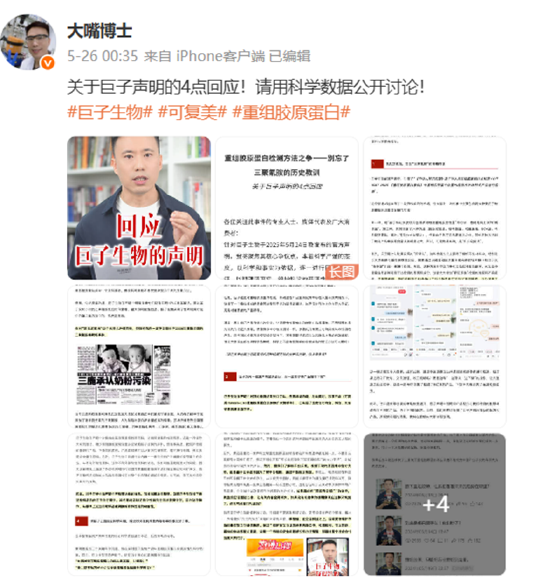
Core Viewpoint - The controversy surrounding Giant Bio's product "Recombinant Collagen Essence" has raised questions about its collagen content, leading to a significant decline in the company's stock price following allegations of false labeling and exaggerated claims [1][6]. Group 1: Product Allegations - Beauty blogger "Big Mouth Doctor" (Hao Yu) reported that the collagen content in Giant Bio's "Recombinant Collagen Essence" was only 0.0177%, which is below the national standard of 0.1% for non-trace components [1]. - The report also indicated that the core amino acid "glycine," essential for collagen, was not detected in the product, suggesting potential false labeling and exaggeration of claims [1]. Group 2: Company Response - In response to the allegations, Giant Bio issued a statement denying the claims, asserting that multiple self-test results showed collagen content greater than 0.1%, contradicting the reported data [1]. - The company emphasized that its testing methods adhered to the "Pharmacopoeia of the People's Republic of China" and industry standards, and it has commissioned a third-party organization for retesting [1]. Group 3: Stock Market Impact - Following the allegations, Giant Bio's stock price experienced a continuous decline over four days, indicating a significant market reaction to the controversy [6]. - The situation was exacerbated by a lengthy article from Huaxi Bio, which criticized Giant Bio's marketing strategies and its comparison of collagen to hyaluronic acid [8]. Group 4: Connections and Recommendations - There are notable connections between Huaxi Bio and Big Mouth Doctor, as both have indirect stakes in Shanghai Liuye Medical Technology Service Co., Ltd., suggesting potential conflicts of interest [8]. - Big Mouth Doctor has previously recommended products from Huaxi Bio, indicating a possible bias in the ongoing criticism of Giant Bio [9].
“618”在即,700亿重组胶原巨头被指“成分造假”|焦点分析
3 6 Ke· 2025-05-30 02:25
临近年中电商大促,"重组胶原蛋白第一股"巨子生物却陷入巨大争议。 近日,一位自称为香港大学化学博士、前欧莱雅中国科学传播负责人的社交媒体博主"大嘴博士"连续发 文称,经检测,巨子生物旗下品牌可复美的核心产品"胶原棒(Human-Like重组胶原蛋白肌御修护次抛 精华)"中的重组胶原蛋白实际含量低于宣传口径。 作为巨子生物的收入王牌,可复美系列在2024年大赚45亿元、同比增长62.9%,占公司总收入的80%。 其中,以"胶原棒"为核心的功效型护肤品品类又为可复美贡献了近八成的收入。 在小红书等社交媒体上,不少质疑声因此认为,如果连头部企业都可能存在"造假"现象,作为普通消费 者,还能不能何信任和选择重组胶原蛋白产品? 重组胶原用得少,是"产量跟不上"? 最初的争议源于一组数字。 按照"大嘴博士"选择的高精度HPLC高效液相色谱氨基酸定量检测法,"胶原棒"中的重组胶原蛋白实际 含量仅为0.0177%,远低于产品中标注的"成分"添加(≥0.1%),或构成配方表造假。对此,可复美则 表示,按照国内重组胶原蛋白辅料"YY/T 1947-2025"行业标准,多批次产品检测结果的胶原蛋白含量均 大于0.1%。 双方随后的 ...
巨子生物胶原蛋白“缺量罗生门”追踪
Hua Er Jie Jian Wen· 2025-05-29 14:50
Core Viewpoint - The controversy surrounding the collagen content in the product "Human-Like Recombinant Collagen" from the brand Kefu Mei, owned by the company Giant Bio, has raised significant concerns regarding product integrity and testing methods [1][2][3]. Group 1: Controversy Details - KOL "Dr. Big Mouth" (Hao Yu) claimed that tests showed the collagen content in Kefu Mei's product was only 0.0177% using HPLC amino acid quantification [1]. - Giant Bio responded by stating their tests indicated collagen content greater than 0.1%, contradicting the claims made by Hao Yu, but third-party test results are still pending [2]. - Hao Yu further questioned Giant Bio's testing methods, suggesting that the use of the biuret method could lead to inflated results due to the presence of sodium polyglutamate in the product [3]. Group 2: Previous Issues and Impact - This is not the first controversy for Kefu Mei in 2023, as the brand was previously accused of illegally adding epidermal growth factor (EGF), which led to a public trust crisis [4][5]. - The Shaanxi Provincial Drug Administration investigated the previous claims and found no violations after sampling [6]. - The outcome of the current controversy is crucial for Giant Bio's future performance, as Kefu Mei is projected to generate revenue of 4.542 billion yuan in 2024, contributing over 80% to the company's total revenue [6]. Group 3: Market Reaction - Despite the unresolved testing results, the controversy has significantly impacted Giant Bio's stock price [7]. - As of May 29, Giant Bio's market capitalization was 72.9 billion HKD, having lost 12.8 billion HKD since early May [8].
华熙生物“大战”巨子生物,这场公关战到底有多惨烈?
阿尔法工场研究院· 2025-05-29 13:40
Core Viewpoint - The public relations battle between Huaxi Biological and Juzhi Biological has led to a significant market value loss for Juzhi Biological, amounting to 17.4 billion yuan in just 10 days [4]. Group 1: Public Relations Battle - Huaxi Biological publicly criticized the capital market's behavior of favoring collagen while disparaging hyaluronic acid, directly naming Juzhi Biological and several brokerage firms [3][4]. - Juzhi Biological's market value dropped from 90.9 billion yuan to 73.5 billion yuan within 10 days, a decrease of 17.4 billion yuan [4]. - The negative publicity may impact consumer sentiment and Juzhi Biological's performance during the upcoming 618 promotional event [4]. Group 2: Controversial Testing Methods - The primary controversy revolves around the testing methods used to assess the collagen content in Juzhi Biological's products [5][6]. - A beauty blogger claimed that the actual collagen content in Juzhi Biological's product was only 0.0177%, significantly below the stated standard of ≥0.1% [9]. - Juzhi Biological defended its testing methods, stating that the blogger's approach lacked industry standards and that they were involved in formulating these standards [11]. Group 3: Timeline of Events - On May 17, Huaxi Biological published a critical article targeting Juzhi Biological and brokerage firms [18]. - Juzhi Biological did not respond initially, leading to perceptions of a "pillow fight" in the public relations battle [18]. - The timeline of events suggests a coordinated effort by the blogger to raise questions about Juzhi Biological's products, particularly before the 618 sales event [22][23]. Group 4: Industry Implications - The incident serves as a cautionary tale for other beauty and skincare brands regarding the importance of protecting their core assets, particularly product ingredients and their efficacy [33]. - Companies are urged to establish robust standards and testing methods to safeguard against potential public relations crises [34]. - The need for a credible third-party testing framework is emphasized, as the absence of such standards can lead to consumer distrust and brand damage [30].