平安银行

Search documents
2025年11月黄金集体降价,这次到底能省多少
Sou Hu Cai Jing· 2025-11-02 10:34
Group 1 - The recent decline in gold prices has attracted attention from consumers and investors, with prices for gold jewelry and investment bars dropping significantly [1][3] - Major jewelry brands have reduced their prices, with gold prices for various brands ranging from 1165 to 1203 yuan per gram, down from previous highs of 1230 to 1240 yuan [1][3] - The decrease in gold prices has led to increased consumer interest, with many people visiting stores to purchase gold jewelry [1] Group 2 - Investment gold bars have also seen price reductions, with prices for bank gold bars ranging from 915.4 to 949 yuan per gram, making them more accessible for investors [3] - Factors contributing to the decline in gold prices include fluctuations in international gold prices, a rising US dollar, and changes in market expectations [3][4] - The current price drop is viewed as a temporary adjustment, as gold is considered a stable asset that typically does not experience prolonged volatility [4] Group 3 - When purchasing gold, consumers should differentiate between buying for personal use (jewelry) and investment purposes, as the considerations for each are different [6] - For jewelry purchases, consumers should be aware of additional costs such as processing fees, which can vary significantly between retailers [6] - For investment purposes, it is advisable to buy from reputable banks and to understand the terms of buyback policies, as these can differ among institutions [6][7] Group 4 - The long-term investment perspective is crucial when dealing with gold, as it is not suitable for short-term trading [7] - The emotional value of gold, such as its significance in weddings and family heirlooms, adds another layer to its worth beyond just market price [9] - The current price drop presents an opportunity for consumers to purchase gold at lower prices, which can be beneficial if approached with a rational mindset [9]

银行2025年三季报业绩综述:业绩和息差好于预期
ZHESHANG SECURITIES· 2025-11-02 08:59
Investment Rating - The industry rating is maintained as "Positive" [3] Core Views - The performance of listed banks in Q1-Q3 2025 shows resilience, with state-owned banks achieving positive results across the board, and the improvement in net interest margins for joint-stock and city commercial banks exceeding expectations [4] - The revenue growth rate for listed banks is stable at 0.9% year-on-year, while profit growth has increased to 1.6% [4] - The non-interest income growth rate for listed banks has narrowed, with a year-on-year increase of 5.0% [4] Summary by Sections Performance Overview - Listed banks' revenue growth is stable at 0.9%, and net profit growth has improved to 1.6% in Q1-Q3 2025, slightly slowing from H1 [4] - The net interest margin for listed banks has shown marginal improvement, with a quarterly increase of 0.3 basis points to 1.37% [4] Revenue and Profit Drivers - The asset scale growth for listed banks is 9.3% year-on-year, with a decrease in loan growth to 7.7% and an increase in financial investment growth to 15.8% [4][11] - The non-interest income growth rate has decreased by 2.0 percentage points compared to the previous quarter [4] Risk and Asset Quality - The average non-performing loan (NPL) ratio for 42 sample banks remains stable at 1.23%, while the average attention rate has increased by 2 basis points to 1.69% [5] - Retail loan risks continue to rise, with notable increases in NPL ratios for retail loans at certain banks [5] Dividend Trends - More banks have disclosed mid-term dividend plans for 2025, with some banks increasing their mid-term dividend rates compared to 2024 [6] Investment Recommendations - The report suggests that bank stocks may rebound in Q4, with a focus on small and medium-sized banks in economically developed regions and stable high-dividend large banks [6]






11月1日黄金价格全解析,各大品牌首饰和银行金条对比
Sou Hu Cai Jing· 2025-11-01 21:13
Core Insights - Recent fluctuations in gold prices have been observed, particularly in the context of RMB gold and various brand gold bars, indicating significant price differences among brands [1][9][14] Brand Gold Prices Comparison - Major jewelry brands such as Chow Tai Fook, Tse Sui Luen, King Fook, and Chao Hong Ji have gold prices around 1198 RMB per gram, with platinum at 650 RMB per gram and gold bars at approximately 1058 RMB per gram [1] - Chow Sang Sang's gold is priced at 1203 RMB per gram, with gold bars at 1124 RMB per gram [2] - Lao Feng Xiang's gold is priced at 1200 RMB per gram, with gold bars at 1150 RMB per gram [3] - Cai Bai's gold is cheaper at 1168 RMB per gram, with gold bars at 1022 RMB per gram [3] - China Gold offers gold at 1118 RMB per gram, making it a lower entry point for potential investors [3] Financial Institutions Gold Prices - Prices for gold bars from banks are generally lower than those from jewelry stores, with China Construction Bank's Long Ding gold bars priced at 915.4 RMB per gram, and Agricultural Bank's Chuan Shi Zhi Bao at 918.3 RMB per gram [6] - The Shanghai Gold Exchange lists gold bars at 915 RMB per gram, while China Gold's investment gold bars are the highest at 960 RMB per gram [7] Reasons for Recent Price Decline - The recent drop in gold prices is primarily influenced by international market factors, including the US dollar's performance, global economic data, and geopolitical issues [9] Buying Recommendations and Strategies - For short-term buyers, November's prices are relatively low compared to previous months, making it a good time to consider purchasing jewelry or small gold bars [10][14] - For long-term investments, a strategy of phased purchases is recommended to mitigate risks associated with price volatility [10][14] - It is advised to focus on banks and exchanges for gold bars due to their higher purity and transparent pricing [10][14] Summary - Overall, domestic gold prices have slightly decreased, with minor differences in jewelry prices but significant disparities in gold bar prices. Financial institutions offer more affordable and reliable options for gold bars [14]

多家银行合计被罚超2亿元,回应来了
Zhong Guo Ji Jin Bao· 2025-11-01 13:39
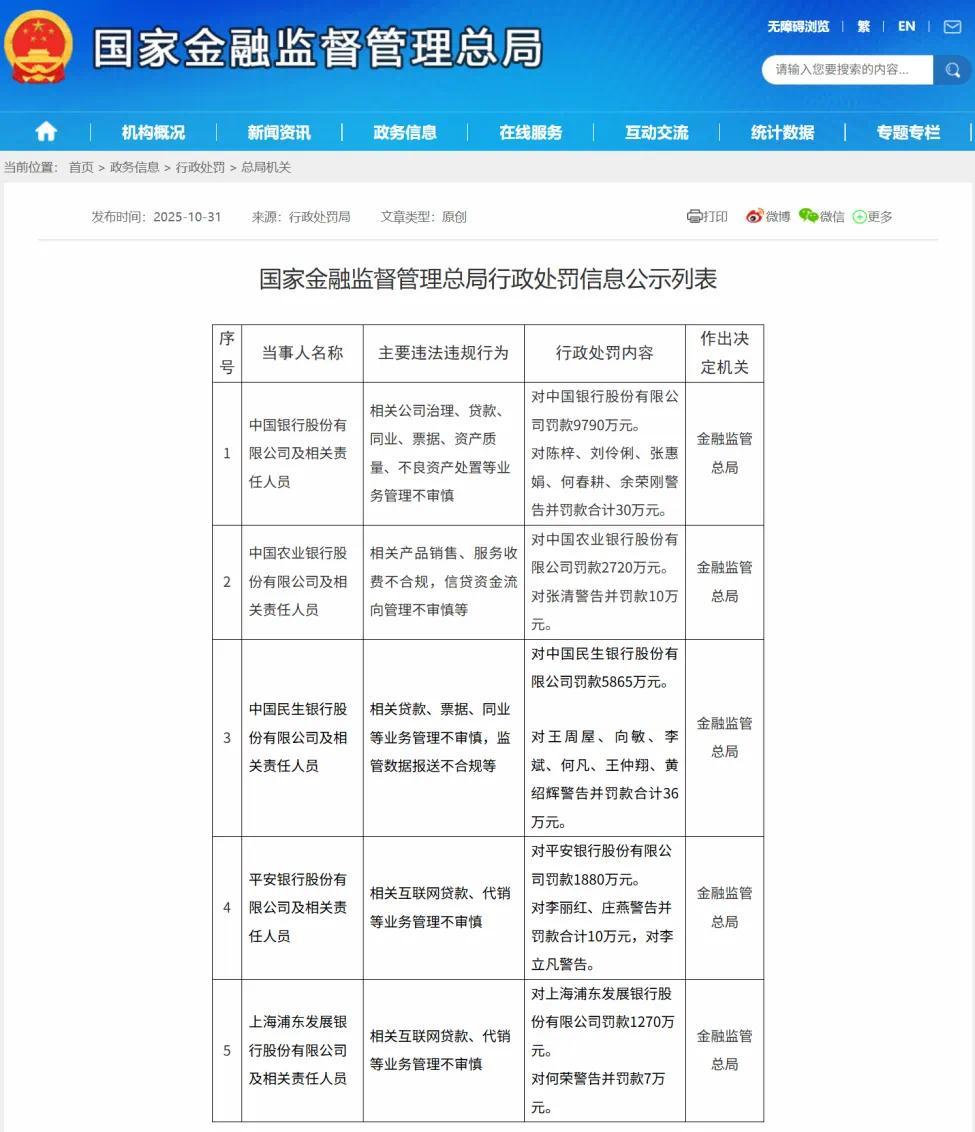
Core Points - The National Financial Regulatory Administration announced significant fines totaling over 215 million yuan for five major banks in China, including China Bank, Agricultural Bank, Minsheng Bank, Ping An Bank, and Shanghai Pudong Development Bank, due to various regulatory violations [1][4]. Group 1: China Bank - China Bank was fined 97.9 million yuan for issues related to corporate governance, loan management, interbank transactions, bill management, asset quality, and non-performing asset disposal [4]. - Five responsible personnel received warnings and fines totaling 300,000 yuan [4]. - The bank emphasized its commitment to rectifying the identified issues and improving risk management and internal controls [4]. Group 2: Agricultural Bank - Agricultural Bank faced a fine of 27.2 million yuan for non-compliance in product sales, service fees, and improper management of credit fund flows [5]. - One responsible individual was warned and fined 100,000 yuan [5]. - The bank stated that the penalty was a follow-up to previous inspections and highlighted its efforts in addressing the regulatory concerns [5]. Group 3: Minsheng Bank - Minsheng Bank was fined 58.65 million yuan for imprudent management of loans, bills, and interbank transactions, as well as non-compliance in data reporting [5]. - Six responsible personnel received warnings and fines totaling 360,000 yuan [5]. - The bank had previously been fined 5.9 million yuan in September for issues related to system management and operational controls [5]. Group 4: Ping An Bank and Shanghai Pudong Development Bank - Both Ping An Bank and Shanghai Pudong Development Bank were fined for imprudent management of internet loans and agency sales [5]. - Ping An Bank was fined 18.8 million yuan, with two personnel receiving warnings and fines totaling 100,000 yuan [5]. - Shanghai Pudong Development Bank was fined 12.7 million yuan, with one personnel receiving a warning and a fine of 70,000 yuan [5].
中行、农行、民生、平安、浦发五家银行合计被罚超2.15亿元
Jing Ji Guan Cha Bao· 2025-11-01 07:34
Core Viewpoint - The tightening of financial regulation is leading to increased scrutiny and penalties for major banks in China, highlighting compliance failures and internal control weaknesses across the industry [2][8][9]. Group 1: Regulatory Actions - Five major banks, including Bank of China, Agricultural Bank of China, Minsheng Bank, Ping An Bank, and Pudong Development Bank, were collectively fined over 215 million yuan for various violations [2][4]. - The penalties reflect a broader trend of intensified regulatory oversight aimed at improving risk management and compliance within the banking sector [3][8]. Group 2: Specific Bank Penalties - Bank of China received the highest fine of 97.9 million yuan, with penalties against responsible individuals totaling 300,000 yuan, primarily due to issues identified during a risk management inspection [4][5]. - Agricultural Bank of China was fined 27.2 million yuan, with a focus on non-compliance in product sales and loan management practices [5]. - Minsheng Bank faced a fine of 58.65 million yuan, with violations related to loan management and regulatory data reporting [6]. - Ping An Bank was penalized 18.8 million yuan for issues in internet lending and product distribution management [6]. - Pudong Development Bank was fined 12.7 million yuan, primarily for similar issues in internet lending and product distribution [6]. Group 3: Industry Implications - The penalties indicate a systemic issue within the banking sector, where even large institutions struggle with compliance and internal controls, particularly in the context of rapidly evolving financial products [7][9]. - The regulatory environment is shifting towards a model where compliance is becoming a core competitive advantage for financial institutions, necessitating proactive risk management strategies [9].



多家银行,合计被罚超2亿元!回应来了
Zhong Guo Ji Jin Bao· 2025-11-01 06:53
Core Viewpoint - Five banks in China received significant fines totaling over 215 million yuan due to various regulatory violations, highlighting ongoing issues in risk management and compliance within the banking sector [1][4]. Group 1: Fines and Violations - China Bank was fined 97.9 million yuan for imprudent management in areas such as corporate governance, loans, and asset quality, with five responsible personnel receiving warnings and fines totaling 300,000 yuan [2][3]. - Agricultural Bank was fined 27.2 million yuan for non-compliance in product sales and service fees, with one responsible person receiving a warning and a fine of 100,000 yuan [2][4]. - China Minsheng Bank faced a fine of 58.65 million yuan for imprudent management in loans and data reporting, with six responsible personnel receiving warnings and fines totaling 360,000 yuan [2][4]. - Ping An Bank and Shanghai Pudong Development Bank were both fined for imprudent management in internet loans and agency sales, with Ping An Bank fined 18.8 million yuan and Shanghai Pudong Development Bank fined 12.7 million yuan [2][5]. Group 2: Responses and Remedial Actions - China Bank emphasized its commitment to rectifying issues identified during a 2023 risk management inspection and has reportedly completed most of the necessary corrections [4]. - Agricultural Bank stated that the fine was a follow-up to previous inspections and that it has addressed most issues promptly, adhering to a principle of comprehensive remediation [4]. - Minsheng Bank acknowledged previous fines and has taken steps to address regulatory concerns, indicating a proactive approach to compliance [5].
多家银行,合计被罚超2亿元!回应来了
中国基金报· 2025-11-01 06:48
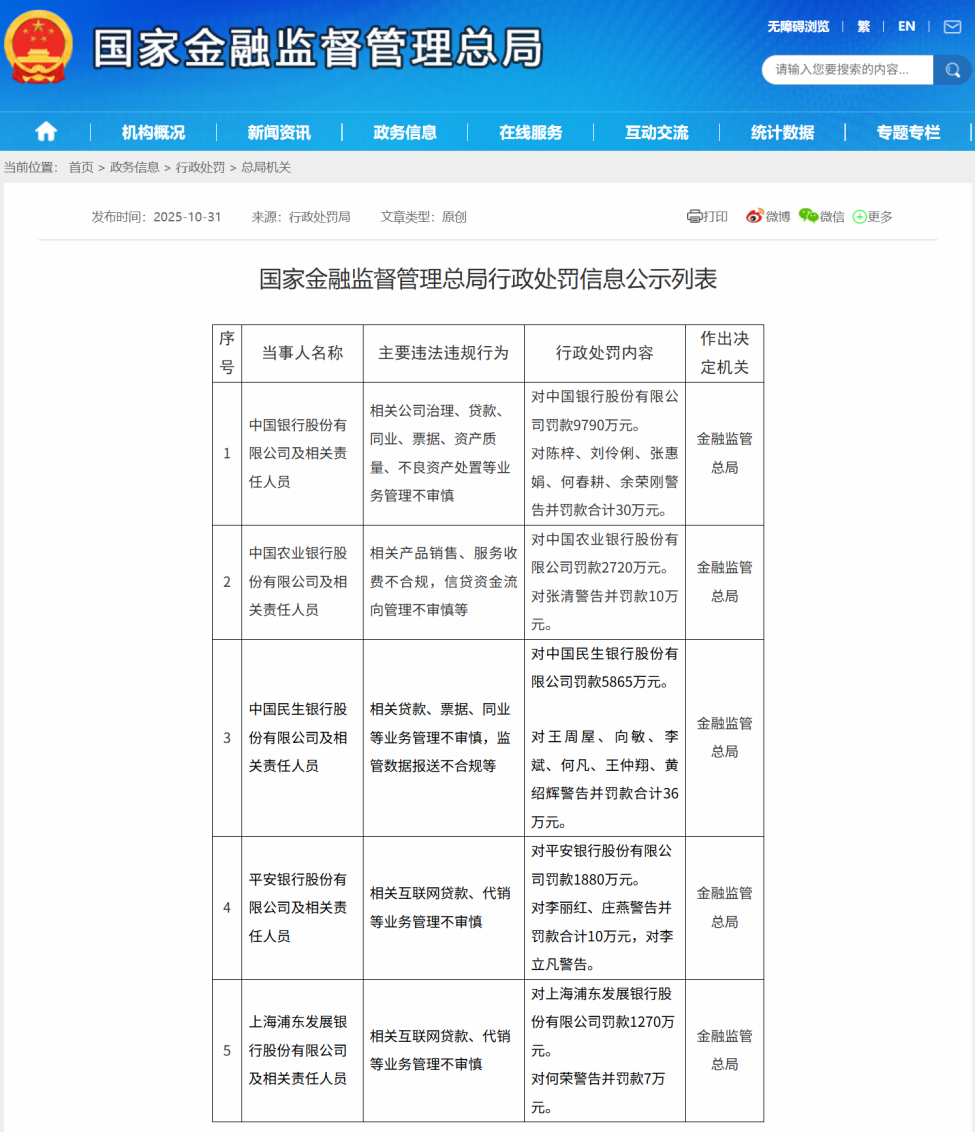
Summary of Key Points Core Viewpoint - Five banks in China received significant fines totaling over 215 million yuan, highlighting ongoing regulatory scrutiny in the banking sector [2]. Group 1: Regulatory Actions and Penalties - China Bank was fined 97.9 million yuan for imprudent management in areas such as corporate governance, loans, and asset quality, with five responsible individuals receiving warnings and fines totaling 300,000 yuan [3][4]. - Agricultural Bank faced a penalty of 27.2 million yuan due to non-compliance in product sales and service fees, with one individual fined 100,000 yuan [5]. - China Minsheng Bank was fined 58.65 million yuan for imprudent management in loans and data reporting, with six individuals receiving warnings and fines totaling 360,000 yuan [5]. - Ping An Bank and Shanghai Pudong Development Bank were both fined for imprudent management in internet loans and related services, with Ping An Bank fined 18.8 million yuan and Shanghai Pudong Development Bank fined 12.7 million yuan [6]. Group 2: Responses from Banks - China Bank emphasized its commitment to rectifying issues identified during regulatory inspections and improving risk management and internal controls [4]. - Agricultural Bank stated that it has addressed most issues raised by regulators and is focused on systematic rectification [5]. - China Minsheng Bank acknowledged previous penalties and has taken steps to address regulatory concerns [5].
股份制银行三季报分化加剧 光大银行盈利下滑幅度超同业
Jing Ji Guan Cha Wang· 2025-11-01 05:28
Core Insights - The performance of China’s listed commercial banks shows a clear divide, with some banks like Shanghai Pudong Development Bank (SPDB) demonstrating strong profit growth, while China Everbright Bank (CEB) faces significant declines in both revenue and net profit [3][4]. Financial Performance - SPDB reported a net profit of 38.819 billion yuan for the first three quarters, a year-on-year increase of 10.21%, while CEB's revenue and net profit fell by 7.94% and 3.63%, respectively [3][4]. - In Q3 alone, CEB's revenue and net profit saw declines of 13.01% and 10.99%, contrasting sharply with the stable or growing performance of peers like SPDB [3][4]. Comparative Analysis - CEB's revenue decline of 7.94% is significantly worse than peers such as China Merchants Bank (-0.51%) and SPDB (+1.88%) [4][5]. - CEB's net profit decline of 3.63% ranks it among the lowest in the sector, while SPDB leads with a 10.21% increase [4][5]. Revenue and Profit Drivers - CEB's net interest income decreased by 5.11%, reflecting a narrowing net interest margin due to falling loan rates and rigid funding costs [6]. - Non-interest income showed volatility, with a significant drop in investment income, which shifted from a net gain of 3.758 billion yuan to a net loss of 4.982 billion yuan [6]. Asset Quality Concerns - CEB's non-performing loan ratio slightly increased to 1.26%, and its provision coverage ratio decreased by 11.67 percentage points to 168.92%, indicating potential risks and profit erosion [6]. Strategic Challenges - CEB is investing heavily in technology finance, green finance, and digital transformation, which has led to increased short-term costs and pressure on profit margins [7]. - The bank's shift towards lower-priced policy-oriented credit assets has further exacerbated the narrowing net interest margin [7]. Industry Context - The banking sector is facing a critical challenge as traditional interest margin benefits diminish, raising questions about future profitability [8]. - CEB's struggles reflect a broader industry trend where banks must adapt quickly to find sustainable business models amid changing economic conditions [8].



赵宇龙任保险业协会党委书记;邱智坤拟接任董事长;赵雪军辞任总经理;第四套生命表自2026年1月1日起实施;|13精周报
13个精算师· 2025-11-01 04:03
Regulatory Dynamics - Five departments are promoting the implementation of a long-term care insurance system, supporting the inclusion of qualified medical and nursing institutions as designated service providers [6] - As of the end of September, the cumulative balance of three social insurance funds reached 9.85 trillion yuan, with total income of 6.69 trillion yuan and total expenditure of 6.04 trillion yuan for the first nine months [7] - The Financial Regulatory Bureau announced that the fourth set of life tables will be implemented starting January 1, 2026, which includes various tables for different insurance products [9] - The Financial Regulatory Bureau supports domestic insurance companies in issuing "sidecar" insurance-linked securities in the Hong Kong market [10] - The Financial Regulatory Bureau expects insurance premium income to reach 6 trillion yuan this year [24] Company Dynamics - Ping An Life increased its stake in China Merchants Bank H-shares to 18.02% [30] - China Life plans to invest 2 billion yuan in a private equity investment plan focusing on semiconductors, digital energy, and smart electric vehicles [31] - China Life reported a strong growth of 41.8% in new business value for the first three quarters [32] - China Ping An's net profit attributable to shareholders grew by 45.4% year-on-year in the third quarter [33] - China Reinsurance achieved a net profit of 51.97 billion yuan, a significant increase of 131.49% year-on-year [39] - AIA Group's new business value rose by 25% to 1.476 billion USD in the third quarter [40] Industry Dynamics - The five major insurance companies in A-shares collectively earned over 426 billion yuan in net profit for the first three quarters, a year-on-year increase of 33.5% [53][54] - The first report on reinsurance business in China showed that the ceded business exceeded 200 billion yuan, covering 14 countries and regions [55] - The insurance industry is expected to see a gradual stabilization or decrease in premium rates for new energy vehicle insurance in the short to medium term [26] - The insurance sector is exploring a comprehensive grading system for insurance models to reduce costs across the entire lifecycle of vehicles [26] - The comprehensive expense ratio of the property insurance industry reached a 20-year low, while the comprehensive cost ratio hit a 10-year low in the first nine months of this year [27]






合计被罚超2亿元!5家银行领千万级罚单
Zhong Guo Zheng Quan Bao - Zhong Zheng Wang· 2025-10-31 15:14
Core Points - Five banks in China, including Bank of China, Minsheng Bank, Agricultural Bank of China, Ping An Bank, and Shanghai Pudong Development Bank, were fined a total of 215.25 million yuan for various violations [1][4] - The violations involved multiple business areas such as non-performing asset disposal, product sales, loan management, and regulatory data reporting [1][4] Summary by Bank - **Bank of China**: Fined 97.9 million yuan for issues related to corporate governance, loans, interbank transactions, bills, asset quality, and non-performing asset disposal. Five responsible personnel received warnings and fines totaling 300,000 yuan [2][4] - **Agricultural Bank of China**: Fined 27.2 million yuan for non-compliance in product sales, service charges, and imprudent management of credit fund flows. One responsible personnel, Zhang Qing, received a warning and a fine of 100,000 yuan [4] - **Minsheng Bank**: Fined 58.65 million yuan for imprudent management of loans, bills, interbank transactions, and non-compliance in regulatory data reporting. Six responsible personnel received warnings and fines totaling 360,000 yuan [3][4] - **Ping An Bank**: Fined 18.8 million yuan for imprudent management of internet loans and agency sales. Two responsible personnel received warnings and fines totaling 100,000 yuan, and one received a warning [4] - **Shanghai Pudong Development Bank**: Fined 12.7 million yuan for imprudent management of internet loans and agency sales. One responsible personnel, He Rong, received a warning and a fine of 70,000 yuan [4] Regulatory Context - The China Banking and Insurance Regulatory Commission emphasized its focus on key issues affecting financial stability, key individuals causing major financial risks, and key behaviors disrupting market order during the "14th Five-Year Plan" period [4]