
中国人民银行

Search documents
存款存在卡上好,还是存单好?银行人员说出实情!
Sou Hu Cai Jing· 2025-10-23 03:15
Core Insights - The article discusses the increasing trend of saving money among Chinese citizens, highlighting that in the first half of 2024, deposits in banks increased by 9.27 trillion yuan, indicating a shift towards more conservative financial behavior [1][3]. Group 1: Reasons for Increased Savings - Citizens are prioritizing financial stability, saving for emergencies, children's education, and retirement, as the investment landscape has become more volatile with fluctuating stock markets and less reliable real estate investments [3][4]. - Personal anecdotes illustrate this trend, such as individuals who have shifted from investing in funds to solely saving in banks after experiencing losses [3][4]. Group 2: Young People's Preference for Bank Cards - Young people favor bank cards for their convenience, allowing for 24/7 access to funds and easy transactions through mobile payment apps [4][5]. - The ability to manage finances digitally, including automatic bill payments and investment options, makes bank cards appealing to the younger demographic [7][8]. Group 3: Drawbacks of Bank Cards - Security concerns arise with bank cards, as they are susceptible to fraud and theft, especially if a mobile device is lost or compromised [8][9]. - The intangible nature of bank card funds can lead to overspending, as users may not feel the impact of their expenditures as acutely as with physical cash [10]. Group 4: Older Generation's Preference for Deposit Certificates - The older generation prefers deposit certificates due to their tangible nature and perceived stability, as they offer fixed interest rates and guaranteed returns [11][12]. - Deposit certificates serve as a form of enforced savings, preventing premature withdrawals and ensuring funds are available for long-term goals [13][14]. Group 5: Limitations of Deposit Certificates - Deposit certificates lack liquidity, making it difficult to access funds without incurring penalties, which can lead to missed investment opportunities [15][16]. - The older generation may miss out on potentially higher returns from other investment avenues due to the rigidity of deposit certificates [17]. Group 6: Recommendations Based on Demographics - For young individuals, bank cards are recommended for their flexibility, but with an emphasis on security measures to protect against fraud [20][21]. - Older individuals are advised to prioritize deposit certificates for their stability while also maintaining a small amount in bank cards for everyday transactions [20][21]. - Those with long-term financial goals are encouraged to use a combination of both bank cards and deposit certificates to balance security and accessibility [22]. Group 7: Conclusion on Saving Strategies - The article concludes that the ultimate goal of saving is to make money work for individuals, regardless of the method chosen, emphasizing the importance of aligning financial strategies with personal goals and circumstances [23][24].


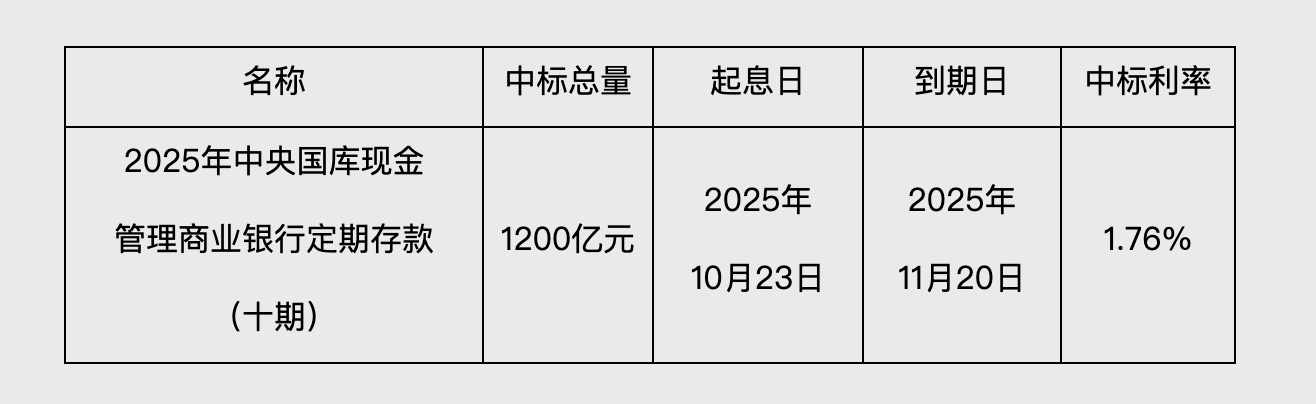
2025年中央国库现金管理商业银行定期存款(十期)招投标结果出炉
Zheng Quan Shi Bao Wang· 2025-10-23 01:50
人民财讯10月23日电,财政部、中国人民银行于2025年10月23日以利率招标方式进行了2025年中央国库现金管理商业银行定期存款(十期)招投标。中标总量 1200亿元,中标利率1.76%。 | 名称 | 中标总量 | 起息日 | 到期日 | | --- | --- | --- | --- | | 2025年中央国库现金 管理商业银行定期存款 | 1200亿元 | 2025年 | 2025年 | | (十期) | | 10月23日 | 11月20日 | ...
深化金融业高水平开放 积极参与全球金融治理 ——《金融时报》访中国人民银行国际司(港澳台办公室)负责人
Jin Rong Shi Bao· 2025-10-22 09:37
Core Insights - The financial sector's opening is a crucial part of China's reform and opening-up strategy, with accelerated steps during the "14th Five-Year Plan" period, enhancing the international competitiveness and influence of the financial industry [1] Group 1: Global Financial Governance - The People's Bank of China (PBOC) actively participates in global financial governance through platforms like G20, IMF, and regional mechanisms such as ASEAN+3, aiming to create a fairer global financial governance structure [1][2] - Continuous cooperation with the IMF includes pushing for quota reforms and establishing an IMF Shanghai Center [2] - The PBOC has proposed principles for cross-border digital currency infrastructure, emphasizing "no loss, compliance, and interoperability" [2] Group 2: International Monetary System Reform - Post-2008 financial crisis, discussions on reforming the international monetary system have intensified, focusing on reducing reliance on a single sovereign currency and promoting a multipolar currency system [2][3] - The RMB's international status has steadily improved, contributing to a more balanced and equitable international monetary system [3] Group 3: Hong Kong Financial Cooperation - The PBOC has implemented measures to deepen financial cooperation between the mainland and Hong Kong, enhancing Hong Kong's status as an international financial center [3][4] - Hong Kong serves as the largest offshore RMB business hub, with policies to support the development of the offshore RMB market and facilitate RMB bond issuance [4] - The "Bond Connect" program has been established to facilitate cross-border investment in bond markets, with significant growth in transaction volumes [5] Group 4: Payment Systems and Cross-Border Transactions - The "Cross-Border Payment Link" launched in June 2025 enhances real-time small cross-border remittances between the mainland and Hong Kong, significantly improving remittance efficiency [6] - As of July 2025, over 700,000 transactions have been processed through this system, involving a total amount exceeding 4 billion RMB [6]
人均存款出炉!家庭存款“达标表”公布,你处于哪个阶层?
Sou Hu Cai Jing· 2025-10-22 04:58
Core Insights - The average household savings in China is reported to be close to 150,000 yuan, but this figure can be misleading due to significant disparities in wealth distribution among different households [1][3] - The article emphasizes the importance of understanding personal financial needs rather than comparing oneself to the average savings figure [4] Group 1: Understanding Average Savings - The term "average savings" includes all age groups, many of whom do not contribute to savings, leading to a skewed perception of financial health [3] - The distribution of savings is highly unequal, with the top 20% of savers holding approximately 60% of total household savings [3] Group 2: Household Savings Standards - Households are categorized into four tiers based on savings and financial stability: 1. **Basic Reserve Tier**: Savings of 50,000 to 150,000 yuan, primarily for emergencies [5] 2. **Stable Middle Class Tier**: Savings of 150,000 to 500,000 yuan, allowing for some discretionary spending and low-risk investments [6] 3. **Middle-Class Threshold Tier**: Savings of 500,000 to 1,000,000 yuan, enabling risk management and asset allocation [7] 4. **Affluent Comfort Tier**: Savings exceeding 1,000,000 yuan, focusing on diversified investments and quality of life [8] Group 3: Savings Habits and Financial Planning - Key habits influencing savings include prioritizing savings before spending, distinguishing between needs and wants, and managing debt effectively [9][10][11] - The average disposable income in China is reported to be 39,000 yuan annually, highlighting that many individuals have similar income levels, making savings habits crucial for financial health [12] Group 4: Tailored Savings Recommendations - For households with savings below 50,000 yuan, the focus should be on building an emergency fund before considering investments [13] - Households in the stable middle-class tier should allocate savings into emergency funds, stable investments, and flexible short-term savings [14] - Middle-class households should diversify their savings into various investment types to balance risk and returns [15] - Affluent households should adopt a flexible investment strategy, ensuring a mix of low, medium, and high-risk investments while enjoying life [16]

央行今日开展1382亿元7天期逆回购操作
Zheng Quan Shi Bao Wang· 2025-10-22 02:19
人民财讯10月22日电,2025年10月22日中国人民银行以固定利率、数量招标方式开展了1382亿元7天期 逆回购操作。操作利率1.40%,与此前持平。 ...
中国人民银行:完善反洗钱规章制度 实现从“规则为本”向“风险为本”转变
Bei Jing Shang Bao· 2025-10-21 14:26
Core Viewpoint - The People's Bank of China emphasizes the importance of improving the legal system and financial regulatory framework, highlighting a shift from "rule-based" to "risk-based" anti-money laundering regulations [1] Group 1: Legal and Regulatory Framework - The People's Bank of China is working on enhancing the legal system and financial regulatory framework, indicating a progressive approach to governance [1] - There is a focus on improving anti-money laundering regulations, transitioning from a "rule-based" to a "risk-based" approach [1] - The bank aims to strengthen the institutional framework in the payment sector to better protect users' legitimate rights and interests [1] Group 2: Credit Management and Administrative Procedures - The implementation of the "Credit Industry Management Regulations" is underway, with plans to develop detailed management methods and complaint handling procedures [1] - The People's Bank of China is compiling a list of responsibilities and administrative licensing guidelines to clarify boundaries and establish clear approval standards and processes [1] - This initiative aims to solidify the institutional guarantees for lawful performance of duties [1]
货币市场日报:10月21日
Xin Hua Cai Jing· 2025-10-21 13:35
Group 1 - The People's Bank of China conducted a 7-day reverse repurchase operation of 159.5 billion yuan, with a bid amount and winning amount of 159.5 billion yuan, and the operation rate remained at 1.40% [1] - The Shanghai Interbank Offered Rate (Shibor) for short-term products showed a slight increase, with overnight Shibor unchanged at 1.3170%, 7-day Shibor rising by 0.80 basis points to 1.4260%, and 14-day Shibor increasing by 3.60 basis points to 1.5040% [1][2] Group 2 - In the interbank pledged repo market, the weighted average rates for 7-day and 14-day products showed slight divergence, with DR001 and R001 rates unchanged at 1.3141% and 1.3632%, respectively, while DR007 and R007 rates increased by 1.0 basis points and decreased by 0.9 basis points, respectively [5] - The trading volume for DR001 increased by 69.9 billion yuan, while that for R001 decreased by 133.8 billion yuan [5] Group 3 - The overall funding situation was balanced and slightly loose, with overnight transactions showing a weighted average rate of 1.40% and 7-day transactions at 1.43% [10] - As of 5:30 PM on October 21, there were 109 interbank certificates of deposit issued, with an actual issuance amount of 187.36 billion yuan [10][11]
中国人民银行:完善反洗钱规章制度,实现从“规则为本”向“风险为本”转变
Bei Jing Shang Bao· 2025-10-21 12:36
Core Viewpoint - The People's Bank of China emphasizes the importance of enhancing the legal framework and financial regulatory system, transitioning from a "rules-based" to a "risk-based" approach in anti-money laundering regulations [1] Group 1: Legal and Regulatory Framework - The People's Bank of China is working on improving the legal system to ensure better financial regulation [1] - There is a focus on enhancing the anti-money laundering regulations, shifting towards a risk-based approach [1] - The bank aims to strengthen the institutional framework in the payment sector to protect users' legitimate rights and interests [1] Group 2: Credit Management and Administrative Procedures - The implementation of the Credit Industry Management Regulations is underway, with plans to develop detailed management methods and complaint handling procedures [1] - The People's Bank of China is compiling a list of responsibilities and administrative licensing guidelines to clarify boundaries and standards for approval processes [1] - This initiative aims to solidify the institutional guarantees for lawful performance of duties [1]
中国人民银行:做到金融监管“无事不扰”而又“无处不在”
Bei Jing Shang Bao· 2025-10-21 12:36
Core Viewpoint - The People's Bank of China emphasizes the need for strict, standardized, fair, and civilized law enforcement to enhance regulatory effectiveness [1] Regulatory Approach - The regulatory approach will focus on a "risk-based" directive, strengthening enforcement checks and promoting corporate supervision, comprehensive law enforcement, and precise inspections [1] - There will be an increased enforcement effort in key areas that directly affect the public's interests, ensuring that financial regulation is both pervasive and non-intrusive [1] Administrative Penalties - The establishment of administrative penalty guidelines will adhere to the principle of "proportionality," with a zero-tolerance policy for illegal activities [1] - The management of administrative law enforcement personnel will be strengthened to improve the professionalism of enforcement [1] Legal Education and Outreach - The implementation of the "Eighth Five-Year Plan" for popularizing laws will be prioritized, alongside extensive financial legal education initiatives [1] - Regular activities such as "Financial Law for the People" outreach programs will be conducted to promote legal awareness in rural areas [1]
中国人民银行:票据法和外汇管理条例等制定修订工作取得积极进展
Bei Jing Shang Bao· 2025-10-21 10:06
Core Viewpoint - The People's Bank of China (PBOC) has been enhancing the financial legal system since the 14th Five-Year Plan, focusing on key responsibilities and legislative progress in the financial sector [1] Legislative Progress - Significant advancements have been made in financial legislation, including the promotion of a financial law and the revision of the People's Bank of China Law to strengthen the legal foundation of the central bank system [1] - The Financial Stability Law (draft) has undergone two reviews by the Standing Committee of the National People's Congress, aiming to establish a long-term mechanism for financial risk prevention and resolution [1] - Revisions to the Commercial Bank Law are underway to improve bank governance and their ability to serve the real economy [1] - Progress has also been made in the drafting and revision of the Negotiable Instruments Law, Foreign Exchange Management Regulations, and Company Bond Management Regulations [1]