巨子生物

Search documents
800亿市值巨头被质疑造假,创始人刚成陕西新首富
凤凰网财经· 2025-05-25 13:30
Core Viewpoint - The article discusses allegations of potential fraud regarding the collagen content in a product from Juzhibio, specifically questioning the accuracy of the ingredient labeling and the detection methods used to measure collagen levels [1][2]. Group 1: Allegations and Testing - A social media influencer raised concerns about the collagen content in Juzhibio's product, claiming that the detected amount of collagen was significantly lower than what was stated on the label [1][2]. - The influencer used high-precision HPLC amino acid quantification methods and reported that the detected collagen content was only 0.0177%, while the product label suggested that collagen should be present in amounts greater than 0.1% [2]. - The influencer highlighted that glycine, a key amino acid in collagen, was not detected in the sample, which contradicts established knowledge that glycine constitutes one-third of collagen's amino acid residues [2]. Group 2: Company Response - In response to the allegations, Juzhibio's brand, Kefu Mei, issued a statement asserting that multiple tests conducted in accordance with industry standards showed collagen content exceeding 0.1% [5][7]. - The company provided testing results from five samples taken on May 24, showing collagen levels of 0.27% to 0.28% [7]. - Kefu Mei criticized the influencer's testing methods as not being recognized by industry standards and claimed that the influencer did not request the original collagen raw materials for testing [9]. Group 3: Background and Financial Performance - Juzhibio, known as the "first stock of recombinant collagen," has rapidly grown to become the largest beauty and skincare company in Hong Kong by market capitalization, reaching HKD 82.1 billion as of May 23 [11]. - The company's revenue for 2024 was reported at CNY 5.539 billion, reflecting a year-on-year growth of 57.17%, while net profit reached CNY 2.062 billion, up 42.06% [14]. - The founders of Juzhibio recently became the richest individuals in Shaanxi province, with a combined stock value exceeding CNY 45 billion [13].

始祖鸟Q1新增门店为零;亚瑟士单季首破百亿元;娃哈哈农夫山泉回应代工问题丨品牌周报
36氪未来消费· 2025-05-25 13:29
Group 1: Amer Sports Financial Performance - Amer Sports reported Q1 revenue of $1.473 billion, a 23% year-over-year increase, with a 26% increase at constant exchange rates [2] - Operating profit grew by 97% to $214 million, while adjusted operating profit increased by 79% to $232 million [2] - The Asia-Pacific region showed significant growth, with Greater China revenue up 43% to $446 million [2] Group 2: Brand Performance and Strategy - The three main business segments (outdoor, mountain, and ball sports equipment) all experienced growth, with increases of 28%, 25%, and 12% respectively [2] - The CEO highlighted the high-end technical brand portfolio's role in capturing market share in the global sports and outdoor market [2] - Arc'teryx, despite no net new store openings in Q1, plans to add approximately 25 stores globally this year [2] Group 3: Asics Financial Performance - Asics reported Q1 net sales of 203.8 billion yen (approximately $100 billion), a 20% year-over-year increase [5] - The Greater China region continued to be a growth engine, with sales up 21.5%, outpacing the overall group growth [5] - Asics has separated its professional sports line and retro trend line to target different audiences effectively [5] Group 4: Asics Brand Strategy - The sub-brand Onitsuka Tiger saw a 50% increase in global sales, primarily driven by the Chinese market [6] - Asics is expanding its channel network and engaging with local communities through events and collaborations [5] Group 5: Wahaha and Farmer Spring Controversy - Wahaha faced scrutiny over outsourcing its bottled water production to Jinmailang due to increased market demand [7] - The controversy raised concerns about brand trust and supply chain management in the beverage industry [8] Group 6: 52TOYS IPO and Market Position - 52TOYS submitted its IPO application to the Hong Kong Stock Exchange, focusing on IP toy products [15] - The company relies heavily on licensed IP products, which accounted for over 64% of total revenue in recent years [15][16] - 52TOYS struggles with brand recognition compared to competitors like Pop Mart, which has a more distinct IP strategy [16] Group 7: Convenience Store Market - Meiyijia leads the Chinese convenience store market with 37,943 stores and plans to add 4,000 more in 2024 [12] - The company has a low franchise threshold and focuses on community services to drive growth [12][13] - Meiyijia's supply chain capabilities contribute significantly to its profitability and market position [13] Group 8: Starbucks and Tea Market - Starbucks launched two tea latte products, marking its entry into the tea coffee market [22] - The company emphasizes local strategies and consumer preferences to enhance its market position in China [23] Group 9: Miniso Financial Performance - Miniso reported Q1 revenue of 4.427 billion yuan, an 18.9% year-over-year increase, but faced a 28.8% decline in net profit [25] - The company opened 978 new stores, increasing its total to 7,768 [25]

21解读|华熙生物怒怼9家券商台前幕后:六家研报仍在线可查!“对比研究”是否踩线合规各执一词
2 1 Shi Ji Jing Ji Bao Dao· 2025-05-25 11:00
Core Viewpoint - The article discusses the controversy surrounding Huaxi Biological's rebuttal of the claims made by nine brokerage firms regarding hyaluronic acid being "outdated" and the promotion of recombinant collagen as a superior alternative, highlighting the impact of these claims on the market and the industry [2][4][9]. Group 1: Company Actions - Huaxi Biological publicly refuted the claims about hyaluronic acid and named nine brokerage firms for misleading reports, which has led to some brokerages retracting their reports and issuing apologies [2][8]. - The company received support from two industry associations before making its statement and has reported the matter to the China Securities Regulatory Commission [2][8]. - As of May 23, three of the ten reports mentioned have been removed from public access, while the remaining seven are still available for viewing [8][9]. Group 2: Industry Context - The medical beauty industry is characterized by a high overlap between capital market participants and enterprise users, making capital evaluations significantly impactful on the competitive landscape, which explains Huaxi Biological's strong response [2][4]. - The article emphasizes that the claims made in the brokerage reports lack scientific basis and are driven by speculative capital, which could harm a key industry in China [6][9][24]. Group 3: Scientific Claims - Huaxi Biological argues that the reports promoting recombinant collagen over hyaluronic acid are misleading and lack substantial scientific evidence, asserting that both substances have their unique benefits and should not be directly compared [23][24]. - The company highlights that the regulatory approvals for hyaluronic acid products far exceed those for recombinant collagen, indicating a stronger safety profile for hyaluronic acid [25][26]. Group 4: Regulatory Environment - The article notes that the regulatory environment for brokerage reports is tightening, with recent inspections revealing issues in compliance and the need for better management of report quality and information sources [18][20]. - There is a growing concern about the potential for misleading information in brokerage reports, which could lead to regulatory actions against the firms involved if found to be in violation of established guidelines [21][22].

胶原蛋白精华里“不含胶原”?巨子生物“可复美”否认造假
Nan Fang Du Shi Bao· 2025-05-25 07:47
Core Viewpoint - The beauty blogger "Dr. Big Mouth" accused Giant Biological (02367.HK) of serious fraud regarding its Kefu Mei collagen essence, claiming that the actual content of recombinant collagen is only 0.0177% in the best-selling product, and that the key component "glycine" is missing [2][3][10]. Group 1: Accusations and Responses - The blogger questioned the legality of labeling recombinant collagen as a non-trace component when its actual content is below the regulatory threshold of 0.1% [3][10]. - Giant Biological issued a statement firmly denying the allegations, asserting that multiple tests showed collagen content greater than 0.1%, contradicting the blogger's claims [12][14]. - The company emphasized its adherence to scientific ethics and regulatory compliance, stating that all products are rigorously tested and verified [12][14]. Group 2: Product Composition Concerns - The blogger raised concerns about the absence of glycine in a product claiming to contain recombinant collagen, questioning the validity of calling it "recombinant collagen" [5][9]. - There were also questions about the marketing of a dipeptide molecule as "Mini small molecule collagen," suggesting potential misuse of scientific terminology [7]. Group 3: Market Performance and Investor Sentiment - Despite the controversies, Giant Biological has seen significant growth, reporting a revenue of 5.539 billion yuan in 2024, a year-on-year increase of 57.07%, and a net profit of 2.062 billion yuan, up 42.06% [22]. - The company has gained substantial attention from investors, with several funds heavily investing in its stock, indicating strong market confidence [24].
巨头涉嫌严重造假?最新回应!
证券时报· 2025-05-25 06:51
Core Viewpoint - The article discusses the controversy surrounding Giant Biological's brand, Kefu Mei, which has been accused of fraud regarding the content of recombinant collagen in its products. The company firmly denies these allegations and asserts compliance with regulatory standards [1][3]. Group 1: Company Response - Giant Biological issued a statement refuting claims of serious fraud and the inability to detect recombinant collagen in its products, emphasizing that all product development and production adhere to relevant regulations [3]. - The company conducted multiple tests on its products, confirming that collagen content exceeds 0.1%, contradicting claims of a mere 0.0177% [3]. - The company has experienced organized smear campaigns since mid-April and plans to pursue legal action against those spreading false information [5]. Group 2: Market Position and Financial Performance - Giant Biological is recognized as a leader in the recombinant collagen market, with its brands including Kefu Mei, Keli Jin, and Xin Gan, offering a range of skincare products [8]. - The company went public on the Hong Kong Stock Exchange in 2022 and has shown consistent revenue growth from 1.19 billion in 2020 to an expected 5.54 billion in 2024, with net profits increasing from 826 million to 2.06 billion in the same period [8].

巨子生物可复美陷“造假门”,争议背后的技术标准博弈
Mei Ri Jing Ji Xin Wen· 2025-05-25 05:19
Core Viewpoint - The controversy surrounding the collagen product "Kefumei" from Giant Biological has escalated due to allegations of ingredient falsification, leading to a crisis of trust among investors and consumers [5][6][10]. Company Summary - Dr. Hao Yu published a report claiming that the collagen content in "Kefumei" is only 0.0177%, significantly below the stated minimum of 0.1%, and that key component glycine was not detected [5][10]. - Giant Biological quickly responded to the allegations, asserting that their products comply with regulatory standards and that they have commissioned multiple third-party testing agencies to verify the collagen content [12][15]. - The company emphasized that their products have passed strict regulatory reviews and that the testing methods used by Dr. Hao Yu are not recognized by industry standards [15][12]. - As of May 25, "Kefumei" has sold over 1 million units, contributing significantly to the company's revenue, with sales projected to reach 27.88 billion yuan and 45.42 billion yuan in 2023 and 2024, respectively [17][19]. Industry Summary - The incident highlights a broader issue within the recombinant collagen industry, where there is currently no unified testing standard, leading to discrepancies in results from different testing methods [22]. - The controversy reflects a struggle between technical standards and commercial interests, with the ultimate resolution depending on consumer trust and regulatory oversight [22]. - The need for transparency in testing and a shift from marketing-driven to technology-driven strategies is critical for the long-term success of companies in the recombinant collagen sector [22].
知名医美巨头涉嫌严重造假?回应来了
新华网财经· 2025-05-25 04:43
Core Viewpoint - The company "可复美" (Kefumei) strongly denies allegations regarding the lack of recombinant collagen protein in its products, asserting compliance with relevant regulations and standards [1][2][3]. Group 1: Company Response to Allegations - Kefumei refutes claims of serious fraud and emphasizes that all product development and production adhere to the "Cosmetics Supervision and Administration Regulations" and related laws [1]. - The company confirms that all products undergo a three-tier verification system, including raw material checks, production quality control, and finished product testing, ensuring product safety and reliability [1]. - Initial internal testing showed collagen protein content exceeding 0.1%, contradicting the alleged 0.0177% [1][2]. Group 2: Regulatory Compliance and Standards - According to the National Medical Products Administration's "Cosmetics Labeling Management Measures," ingredients must be listed in descending order based on their content, with those below 0.1% labeled as "other trace ingredients" [2]. - The product in question has a soluble collagen content greater than 0.1%, thus it is listed as a main ingredient, further disputing the claims of low content [2]. Group 3: Third-Party Testing and Industry Standards - To address consumer concerns, Kefumei has engaged multiple authoritative third-party testing agencies to conduct further testing, which will be reported once available [3]. - The company notes that the testing methods used by the accusers are not recognized by industry standards, rendering their results unreliable [3]. - The National Medical Products Administration is working on establishing industry standards for recombinant collagen protein testing, and Kefumei is actively participating in this initiative [3]. Group 4: Company Performance - Kefumei, a brand under the publicly listed company 巨子生物 (Giant Bio), reported sales revenue exceeding 4.5 billion yuan, marking a 62.9% year-on-year increase [4]. - As of May 23, the market capitalization of Giant Bio exceeded 80 billion Hong Kong dollars [4].
被重组胶原蛋白“带飞”的可复美否认成分造假:含量尚无国标
Nan Fang Du Shi Bao· 2025-05-25 04:42
Core Viewpoint - The skincare brand Kefu Mei, under Giant Biological, strongly denies allegations of false advertising regarding the content of recombinant collagen in its products, asserting that the claims made by a beauty blogger are unfounded and based on non-standard testing methods [2][3][6]. Group 1: Allegations and Responses - A beauty blogger named "Big Mouth Doctor" accused Kefu Mei of having only 0.0177% of recombinant collagen in its product, which should theoretically be above 0.1% for non-trace ingredients, questioning the product's compliance with regulations [3][10]. - Kefu Mei responded by stating that their products undergo a three-tier verification system for quality control, ensuring no ingredient fraud or concealment occurs [6][9]. - The company presented its own testing results showing collagen content between 0.27% and 0.28%, contradicting the blogger's claims [6][7]. Group 2: Industry Standards and Legal Actions - Kefu Mei highlighted that there are currently no industry or national standards for the content of recombinant collagen, and the blogger's testing methods are not recognized by industry standards [8][9]. - The company plans to initiate legal action against the blogger for defamation, asserting that the allegations challenge the authority of regulatory bodies [9][10]. Group 3: Company Performance and Market Context - Giant Biological has experienced significant growth, with 2024 revenues reaching 5.54 billion yuan, a 57.2% increase year-on-year, and net profits of 2.06 billion yuan, up 42.4% [10]. - Kefu Mei's contribution to revenue exceeds 80%, with a year-on-year growth of 62.9%, positioning Giant Biological as one of the fastest-growing companies in the domestic beauty industry [10].
800亿市值巨头被质疑造假,公司深夜6页长文回应,创始人刚成陕西新首富
21世纪经济报道· 2025-05-25 04:06
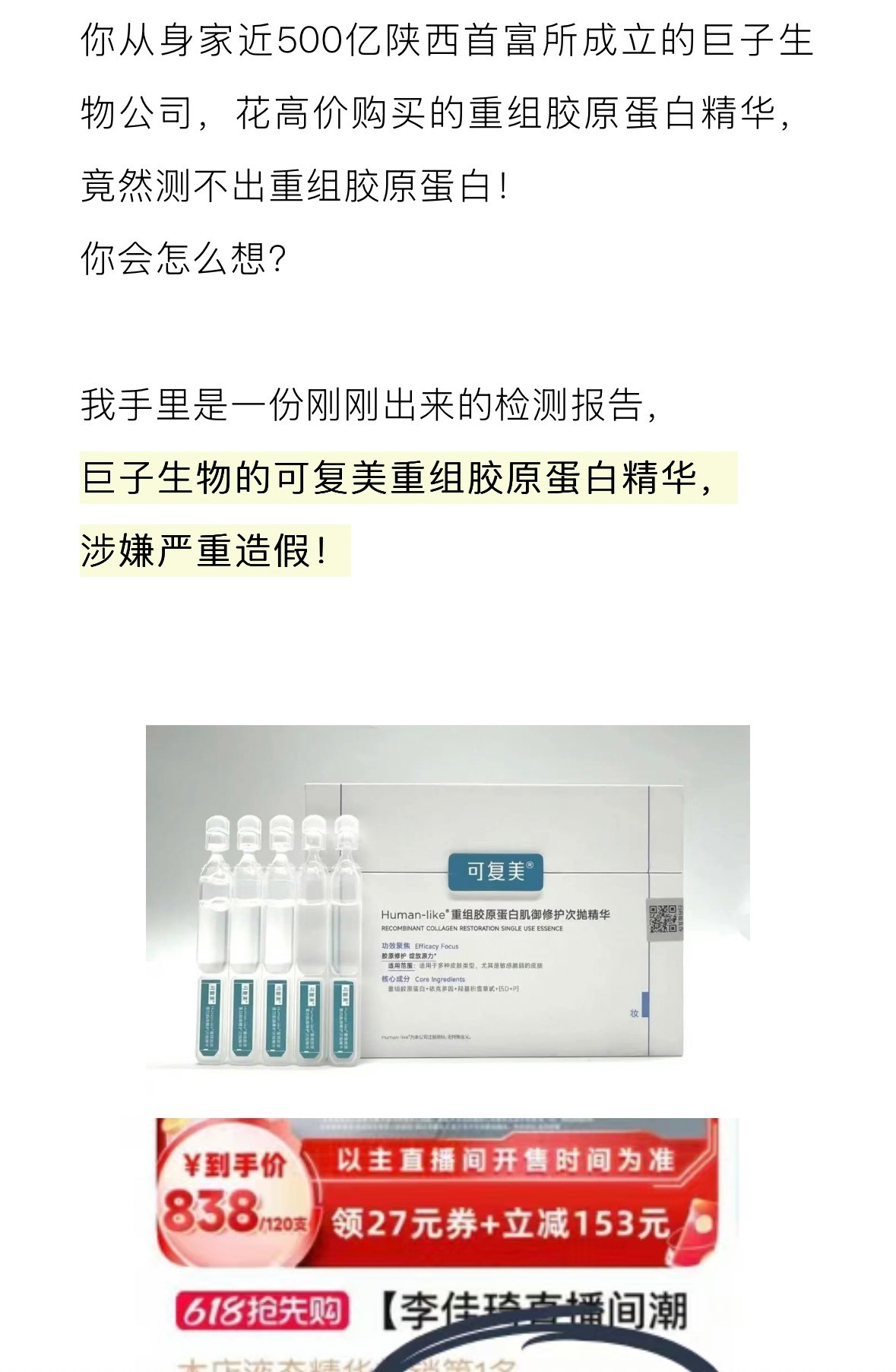
Core Viewpoint - The article discusses allegations against Juzhi Biotechnology regarding potential falsification of collagen content in their product, specifically the "Human-Like Recombinant Collagen" serum, following a social media post by a blogger who claims to have conducted tests revealing significantly lower collagen levels than stated on the product label [1][2]. Group 1: Allegations and Testing - A social media influencer conducted tests using high-precision HPLC methods and reported that the detected collagen content was only 0.0177%, which raises questions about the accuracy of the product's ingredient label [1][2]. - The blogger highlighted that the product's ingredient list includes "soluble collagen" as a primary component, which should be above 0.1% according to cosmetic labeling regulations, yet the test results suggest otherwise [2]. - The absence of glycine, a key amino acid in collagen, in the test results further supports the allegations of misrepresentation [2]. Group 2: Company Response - Juzhi Biotechnology's brand, Kefu Mei, issued a statement claiming that multiple tests conducted in accordance with industry standards showed collagen content exceeding 0.1%, with specific results of 0.27%, 0.27%, and 0.28% from samples taken on May 24 [5][8]. - The company criticized the blogger's testing methods as not being recognized by industry standards and stated that the blogger did not request the original collagen material for testing [9]. - Kefu Mei announced plans to engage multiple authoritative third-party testing agencies for further verification of their products [9]. Group 3: Background and Market Position - Juzhi Biotechnology, known for its brands Kefu Mei and Keli Jin, has become the largest beauty and skincare company in Hong Kong by market capitalization, reaching HKD 82.1 billion as of May 23 [13]. - The company reported a revenue of CNY 5.539 billion for 2024, reflecting a year-on-year growth of 57.17%, with a net profit of CNY 2.062 billion, up 42.06% [15]. - The founder of Juzhi Biotechnology recently became the richest person in Shaanxi province, with a stock value exceeding CNY 450 billion [15].

商贸零售行业周报:2025年4月社零+5.1%,期待消费回暖趋势继续维持-20250525
KAIYUAN SECURITIES· 2025-05-25 04:01
Investment Rating - The industry investment rating is "Positive" (maintained) [1] Core Viewpoints - The report highlights a steady recovery in social consumption, with April 2025 retail sales showing a year-on-year increase of 5.1%, and a total retail sales amount of 1618.45 billion yuan for the first four months of 2025, reflecting a 4.7% year-on-year growth [4][25] - The report suggests that the overall social consumption is expected to maintain stable growth due to effective policy measures aimed at boosting domestic demand, with a focus on the high-growth segments of gold jewelry and cosmetics [4][31] Summary by Sections Retail Market Overview - The retail industry index closed at 2110.59 points, down 1.61% for the week, underperforming the Shanghai Composite Index, which fell by 0.57% [6][15] - The jewelry sector showed the highest growth among retail segments, with a weekly increase of 7.56% and a year-to-date increase of 18.83% [17][20] Social Consumption Trends - In April 2025, the retail sales of consumer goods increased by 5.1%, driven by favorable consumption policies and the Qingming holiday effect [28][31] - Online retail sales for the first four months of 2025 reached 4741.9 billion yuan, growing by 7.7%, with physical goods online retail accounting for 24.3% of total retail sales [28][29] Investment Recommendations - Investment focus on high-growth segments under emotional consumption themes, particularly in gold jewelry and cosmetics [7][39] - Recommended companies in the gold jewelry sector include Laopuhuangjin, Chaohongji, and Zhou Dasheng, which are expected to benefit from differentiated product offerings and consumer insights [39][41] - In the cosmetics sector, recommended brands include Proya, Shangmei, and Juzi Biological, which are positioned to capitalize on the ongoing trend of domestic brand growth [39][41] Company Performance Highlights - Proya reported a 28.9% year-on-year increase in net profit for Q1 2025, driven by new product launches [40] - Chaohongji achieved a 25.4% year-on-year revenue growth in Q1 2025, indicating strong brand momentum [40] - Zhou Dasheng's revenue for Q1 2025 was down 47.3% year-on-year, highlighting challenges in the current market environment [40]