智谱

Search documents
国产AI登顶全球!智谱+华为联手
Ke Ji Ri Bao· 2026-01-17 00:19
Core Insights - GLM-Image, a multimodal image generation model jointly developed by Zhipu and Huawei, has topped the Trending chart on Hugging Face, breaking the long-standing dominance of foreign models in the open-source space [2] - The model is the first state-of-the-art (SOTA) multimodal model trained entirely on domestic chips, showcasing a significant breakthrough in the domestic AI industry chain [2][5] Group 1: Model Architecture and Performance - GLM-Image employs a self-innovated "autoregressive + diffusion decoder" hybrid architecture, enabling the integration of image generation and language models, marking an important exploration in the new generation of "cognitive generation" technology [3] - The model excels in generating text-heavy content, achieving the top rank in the CVTG-2K and LongText-Bench benchmarks, demonstrating superior accuracy in generating multiple text areas within images and rendering long texts [3][6] Group 2: Cost and Efficiency - The model offers high cost-effectiveness, with the API call cost for generating an image being only 0.1 yuan, and a speed-optimized version is set to be released soon [4] Group 3: Domestic Chip Utilization - GLM-Image represents a deep exploration and validation of the domestic computing ecosystem, with all processes from data preprocessing to large-scale pre-training conducted on Huawei's Ascend Atlas 800T A2 devices [5] - This model's development on domestic hardware and frameworks addresses the critical issue of dependency on foreign chips, validating the feasibility of training cutting-edge models on a fully domestic computing stack [5][6] Group 4: Industry Implications - The success of GLM-Image is seen as a result of the collaborative capabilities of the domestic AI industry chain, which can enable small and medium enterprises in China to access AI tools at lower costs and promote domestic AI technology on a global scale [6]

北京大模型再登国际榜单第一
Xin Lang Cai Jing· 2026-01-16 21:10
Core Insights - The GLM-Image model, developed by Zhiyuan and Huawei, has topped the trends list on Hugging Face, marking a significant achievement in the global AI community and validating the feasibility of training cutting-edge models on domestic computing power [1][2] Group 1: Technological Advancements - The "domestic computing power base" established by Huawei is crucial for the "national chip training national model" initiative, allowing GLM-Image to be trained entirely on Huawei's Ascend Atlas 800T A2 chips and MindSpore framework, eliminating reliance on foreign chips [2] - GLM-Image employs an innovative "autoregressive + diffusion decoder" hybrid architecture, enabling the model to understand complex instructions and accurately generate detailed images, achieving the highest accuracy in Chinese text generation among open-source models [2] Group 2: Market Reaction and Industry Impact - Following the announcement of GLM-Image's open-source status, Zhiyuan's stock price surged over 16%, reflecting investor confidence in the long-term value of the "domestic chip + self-developed model" combination [3] - The rise of GLM-Image is seen as a result of the collaborative efforts across the entire domestic AI industry chain, which not only allows smaller domestic companies to access top-tier AI tools at lower costs but also positions Chinese AI technology for global expansion [3] - The open-source availability of GLM-Image on platforms like GitHub and Hugging Face allows global developers to use it for free, indicating a shift in the industry where Chinese models are gaining traction, with usage on platforms like OpenRouter expected to rise from 1.2% to nearly 30% by 2025 [3]

智谱与MiniMax登陆港股 引爆2026年AI上市潮?
Xin Lang Cai Jing· 2026-01-16 20:08
Core Insights - The recent IPOs of domestic AI model companies, Zhipu (02513.HK) and MiniMax (00100.HK), have attracted significant investor interest, showcasing different business models and market performances [1][2] Company Analysis - Zhipu focuses on the MaaS (Model as a Service) and B-end market, with a revenue increase of 325% year-on-year in the first half of 2025, where local deployments contribute over 80% of its income [1][2] - MiniMax targets the C-end market with a global approach, surpassing one million paid users and achieving over 70% of its revenue from overseas, with a shift from negative to positive gross margins [1][2] - Zhipu's strategy emphasizes "model as a channel," with a significant portion of its 8,000 enterprise clients coming from the internet sector, projected to exceed 50% by 2024 [2][3] Market Trends - The IPOs of Zhipu and MiniMax have revitalized the Hong Kong tech sector, with the AI application index experiencing a single-day increase of over 4%, breaking the pessimistic expectations of a "capital winter" [6][7] - There has been a surge in IPO activities in the tech sector, with over 60 companies pursuing IPOs in the past six months, indicating a strong focus on AI and related technologies [6][7] Financial Performance - Both Zhipu and MiniMax are currently operating at a loss, indicating that traditional valuation metrics like PE and PB are not applicable for pricing these AI model companies [4][5] - The market is expected to develop a clearer classification valuation system as more AI companies go public, with revenue, gross margins, and cash flow becoming key comparative metrics [5][6] Industry Outlook - The focus of policy support is shifting from developing the strongest models to enhancing industrial capabilities and application implementation, which is expected to boost market confidence and liquidity [7] - The competition in artificial intelligence is seen as a core battleground for the restructuring of the global tech landscape, with the success of Zhipu and MiniMax marking the beginning of a new journey for China's AI industry [7]
AI进化速递 | 美团上线首个开源并可体验的“重思考”模型
Di Yi Cai Jing· 2026-01-16 12:48
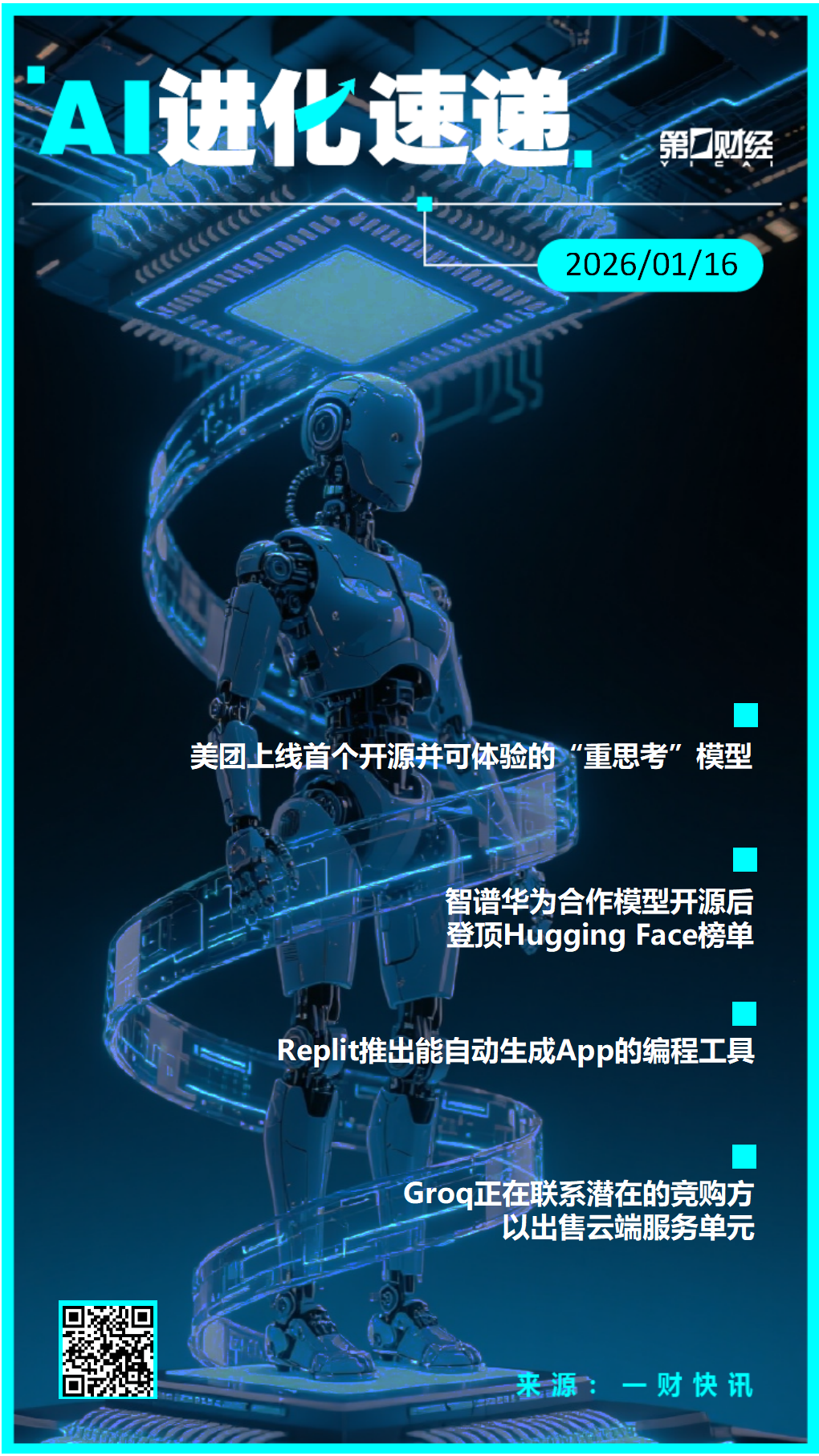
Group 1 - The collaboration model between Zhipu and Huawei has been open-sourced and has reached the top of the Hugging Face leaderboard [1] - Meituan has launched its first open-source and experiential "Reconsideration" model [1] - Replit, an American AI company, has introduced a programming tool that can automatically generate applications [4] Group 2 - Groq is in contact with potential buyers to sell its cloud services unit [4]

AI日报丨智谱华为合作模型开源后登顶全球第一,亚马逊阻挠Saks百货破产融资的首次尝试宣告失败
美股研究社· 2026-01-16 12:34
Group 1 - The core viewpoint of the article emphasizes the rapid development of artificial intelligence (AI) technology, which presents extensive opportunities in the market [3] - UBS analysts believe that the probability of an AI bubble emerging in China in the short term is low compared to the U.S., highlighting investment opportunities in the semiconductor and humanoid robot upstream supply chain [5] - OpenAI is seeking to strengthen its hardware supply chain in the U.S. and is looking for partners to expand into consumer devices, robotics, and cloud data centers, indicating a significant product expansion plan [6] Group 2 - Kuaishou Technology is promoting its first offshore bond issuance to raise funds for AI activities, planning to issue 5-year and 10-year U.S. dollar bonds with initial price guidance above U.S. Treasury rates by approximately 85 and 100 basis points, respectively [7] - The GLM-Image model, co-developed by Zhiyu and Huawei, has quickly risen to the top of the global AI open-source community Hugging Face within 24 hours of its release, marking a significant achievement for domestically trained models [8] - NVIDIA has quietly corrected an error in its previous copper demand forecast for data centers, which may require a reevaluation of future copper supply and demand dynamics [10]
AI里的明争暗斗:马斯克的甜言蜜语,和我们20%的胜率
美股研究社· 2026-01-16 12:34
Core Viewpoint - The article discusses the contrasting perspectives on China's AI development from domestic experts and international tech leaders, highlighting the significant challenges and risks involved in the competition between China and the U.S. in AI technology [4][7][10]. Group 1: AI Development Perspectives - Domestic AI experts express skepticism about China's ability to surpass the U.S. in AI, with Lin Junyang estimating only a 20% chance of success due to substantial computational power disparities [6][10]. - In contrast, international figures like Elon Musk and Jensen Huang predict that China will lead in AI capabilities, with Musk suggesting that China will far exceed global AI computing power by current trends [7][10]. - The article emphasizes the need to critically assess these differing viewpoints, suggesting that domestic experts have a more realistic understanding of the current technological landscape [10][12]. Group 2: Computational Power Disparities - The article highlights that the U.S. has a significant advantage in computational power, estimated to be 10 to 100 times greater than that of China, which limits Chinese developers' ability to innovate [10][12]. - Chinese AI developers are often forced to focus on immediate profit-generating applications rather than long-term exploratory research due to limited computational resources [12][13]. - The need for a cultural shift towards risk-taking and innovation in China’s AI sector is emphasized, as many developers prefer stable, quantifiable outcomes over high-risk projects [12][13]. Group 3: Foreign Capital Risks - The article outlines a trend where foreign capital is acquiring Chinese AI companies, posing a risk to domestic technological assets and talent [15][20]. - The acquisition of Manus by Meta for $2 billion is cited as a case where foreign investment leads to the loss of core technology and talent from China [16][20]. - The article warns that such acquisitions can result in a significant brain drain, where top talent moves to foreign companies, undermining China's AI development capabilities [24][26]. Group 4: Strategies for Improvement - To address the computational power gap, the article suggests that China should focus on developing its own chips and optimizing existing computational resources [31][33]. - It advocates for increased domestic investment in AI, encouraging local capital to support key areas such as chip development and core algorithms [34][36]. - The establishment of an "AI Innovation Consortium" is proposed to foster collaboration between academia, industry, and capital, ensuring a coordinated approach to overcoming technological challenges [36][37].

开年的AI狂欢,是利好还是隐忧?
3 6 Ke· 2026-01-16 11:45
Core Insights - The article discusses the significant role of AI in the financial sector, emphasizing that failure to launch AI products that generate profits for clients could be detrimental for financial professionals in 2026 [1] - The current investment climate is favorable for AI, with notable companies like Meta acquiring AI firms, leading to a surge in interest across various industries [1][3] - Despite the hype, the actual penetration of AI in most industries remains low, typically between 10% and 30%, indicating that many sectors are still in the early stages of AI adoption [3][4] Industry Analysis - The AI frenzy has led to a proliferation of vertical applications, which may obscure essential technological breakthroughs necessary for industry advancement [4][6] - The competitive landscape for new technologies is intense, with historical examples illustrating that initial competition can lead to significant challenges for innovators [6][8] - Open-source models like Llama and DeepSeek are disrupting traditional closed-source models, making it harder for companies to monetize new technologies effectively [7][9] Market Sentiment - There is a dichotomy in sentiment towards AI, with industry participants feeling the pressure of rapid changes while observers exhibit enthusiasm despite the lack of immediate profits [8][10] - The fear of missing out (FOMO) is prevalent, with some experts suggesting that AI could represent a new type of bubble, akin to historical financial bubbles [9][10] - The current AI landscape is characterized by lower leverage compared to previous technological bubbles, which may mitigate some risks associated with over-speculation [11] Recommendations for Engagement - Ordinary individuals are advised to engage with AI technologies within their capabilities, focusing on personal experience and understanding rather than speculative investments [12][13] - Emphasizing the importance of high-quality information sources, the article suggests that understanding the broader context of AI, including its integration with other technologies, is crucial for informed participation [12][13] - The potential benefits of AI extend beyond financial returns, offering opportunities for efficiency improvements and new career possibilities for individuals [13]
全球大模型第一股,盘中再创新高
Zhong Guo Ji Jin Bao· 2026-01-16 11:26
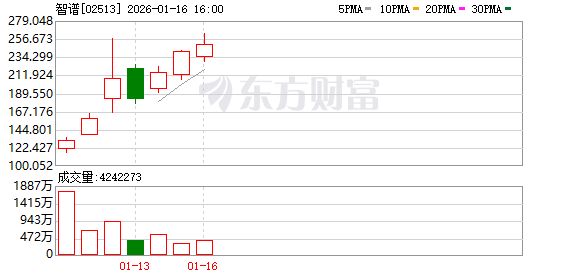
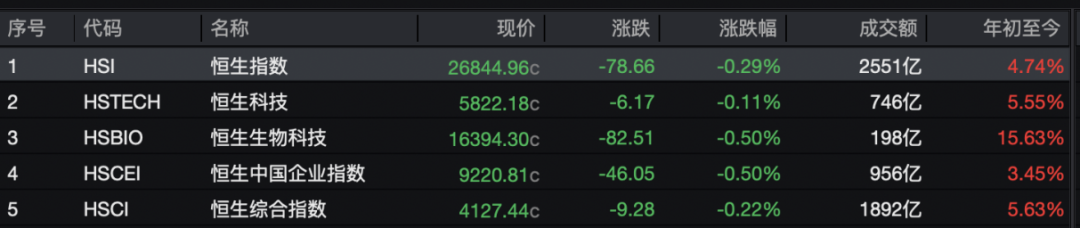
Market Overview - The Hong Kong stock market experienced a collective decline on January 16, with the Hang Seng Index down 0.29% to 26,844.96 points, and a total market turnover of HKD 255.1 billion [1][2]. Semiconductor Sector - The semiconductor sector showed resilience, with Hua Hong Semiconductor rising by 7.39% following the news that the U.S. relaxed export regulations on Nvidia's H200 chips to China [5]. New Consumption Sector - The new consumption sector weakened, exemplified by Pop Mart's decline of 5.60%. A report from Bank of America indicated that the Chinese consumption sector might exhibit a "front low, back high" trend by 2026, with potential improvements expected in the latter half of the year [6]. AI and Technology Developments - Zhizhu's stock reached a new high, increasing over 8% to HKD 263 per share, driven by the launch of the GLM-Image model developed in collaboration with Huawei, which topped the Hugging Face Trending list shortly after its release. Analysts from Dongwu Securities expressed optimism about Zhizhu's capabilities in local deployment and cloud service trends in China's large model industry [8]. Investment Insights - CICC's Liu Gang highlighted four key sectors for investment in the Hong Kong market: AI, dividend stocks, cyclical sectors, and consumer stocks, emphasizing a structural approach to investment [9].
全球大模型第一股,盘中再创新高
中国基金报· 2026-01-16 11:21
Core Viewpoint - The article highlights the performance of various sectors in the Hong Kong stock market, with a focus on the semiconductor sector's strength and the significant rise in the stock price of Zhizhu due to its collaboration with Huawei on an AI model [2][4][9]. Market Performance - On January 16, the Hong Kong stock market indices collectively declined, with the Hang Seng Index at 26,844.96 points, down 0.29%, and a total market turnover of HKD 255.1 billion [2][3]. - The semiconductor sector showed resilience, with Huahong Semiconductor rising by 7.39% following the easing of export regulations for NVIDIA's H200 chips to China [4]. Company-Specific Developments - Zhizhu's stock price reached a new high of HKD 263 per share, reflecting an increase of over 8% during the trading session. The stock closed at HKD 250, with a trading volume of HKD 1.045 billion [9]. - The rise in Zhizhu's stock is attributed to the successful launch of the GLM-Image model, developed in collaboration with Huawei, which quickly gained popularity on the Hugging Face platform [9]. Sector Insights - The new consumption concept stocks, including Pop Mart, experienced a decline, with Pop Mart falling by 5.60%. A report from Bank of America suggests that the Chinese consumption sector may see a "low first, high later" trend by 2026 [6]. - CICC's Liu Gang emphasized the importance of structural opportunities in the Hong Kong market, recommending a focus on four key sectors: AI, dividend stocks, cyclical stocks, and consumer stocks [10].
智谱MiniMax上市一周:学会过苦日子,业绩和股票解禁是真正大考
Sou Hu Cai Jing· 2026-01-16 10:46
Core Viewpoint - The market enthusiasm for the recent IPOs of Zhipu and MiniMax remains high, with significant stock price increases on their debut days, but the sustainability of their high market valuations is questioned due to extremely high price-to-sales ratios and low free float percentages [2][3]. Group 1: Market Valuation and Stock Performance - Zhipu's stock closed up 3.73% with a market capitalization of HKD 110 billion, while MiniMax surged 22.35% to a market cap of HKD 137.3 billion on their debut [2]. - MiniMax has a price-to-sales (P/S) ratio of 250, based on projected 2025 revenue of HKD 5.5 billion, while Zhipu's P/S ratio stands at 244 with projected revenue of HKD 4.5 billion [3]. - Both companies have a very low free float, with MiniMax's true free float at 5.44% and Zhipu's at 2.67%, indicating that over 90% of their shares are locked up [3][4]. Group 2: Lock-up Periods and Future Supply - The first critical date for both companies will be the end of the lock-up period in 6 months, when nearly 50% of MiniMax's shares and 5.83% of Zhipu's shares will become available for trading [7][8]. - The second significant date will be in 12 months, when over 60% of Zhipu's non-controlling shareholders' shares will be unlocked, potentially leading to increased selling pressure [8]. Group 3: Financial Performance and Cost Management - Zhipu's revenue for 2024 is projected at HKD 312 million, with marketing expenses exceeding revenue, raising concerns about its customer acquisition strategy [10]. - MiniMax has shown improvement in managing its sales and marketing expenses, reducing its ratio of sales expenses to revenue significantly from 274% to 73.6% over a year [10]. - Both companies face substantial R&D expenditures, with Zhipu spending HKD 15.94 billion in the first half of 2025 against revenues of HKD 1.91 billion, and MiniMax spending USD 1.8 billion against revenues of USD 1 billion [11].