
云深处

Search documents
美国政策转向引爆机器人赛道,首程控股“资本+场景”布局显先机
Ge Long Hui A P P· 2025-12-04 03:49
面对全球机器人产业化加速趋势,首程控股凭借"资本投资锁定前沿技术,多元场景驱动应用落地"的双 轮模式,不仅有望受益于全球产业加速,为公司带来稳健的财务回报,更是为中国机器人产业的系统性 发展提供了从资本支持、场景落地到产业链协同的新范式。 在此趋势下,早已前瞻布局的首程控股动作引人关注。公司通过旗下基金,已系统性投资宇树科技、银 河通用、云深处等20余家机器人领域核心企业,覆盖从核心零部件到整机开发的产业链关键环节,构筑 了坚实的投资壁垒。 不止于财务投资,首程控股正强力推动技术落地。在ToB端,公司聚焦电力巡检等实际工业场景,进行 二次开发与规模化应用;在ToC端,其线下机器人科技体验店正快速扩张,计划一年内开设至20家,同 时线上直播间也进入密集筹备期,旨在打通商业闭环。 格隆汇12月4日|近日,据多家媒体称,特朗普政府在加速人工智能发展后,正将政策重点转向机器人 技术。美国商务部高层已密集会见行业领袖,并计划于明年发布关于机器人技术的行政命令,同时交通 部也拟成立相关工作组,预示着政策端将全面发力,全球机器人产业竞争进入新阶段。 ...

中国人形机器人调查:采用意愿高,等待产品成熟
2025-12-04 02:22
December 4, 2025 12:51 AM GMT 人形机器人 | Asia Pacific 中国人形机器人调查:采用意 愿高,等待产品成熟 M 我们首次针对中国各行业高管开展AlphaWise调查。在本报告 中,我们将分享关键结果,其中一些颇具意味,甚至令我们 感到意外。 要点 更多调查细节: 目前仅约 10% 的受访企业正在评估或启动试点项目,因此我们认 为采用计划和品牌偏好仍主要是意向性。到 2027 年底 62% 的采用意愿可能性偏 乐观,因为样本企业均为收入超过人民币 10 亿元且已使用其他机器人技术。 即便 如此,这次调查仍反映出强烈的采用意愿。令人意外的是,在整体满意度偏低的 情况下,制造业企业的满意度高于工业及服务业。最希望有改善的方面集中在工 作能力,包括人机协作、物联网集成、自学习功能及灵巧度。价格仍是一大障 碍,92% 的受访者认为单价需低于人民币 20 万元(约 2.8 万美元)才能实现大规 模采用。品牌选择方面,大多数企业仍处于观望状态,显示对不同供应商保持开 放态度。 投资启示:调查结果强化了我们对人形机器人长期积极观点,但目前仍处于早期 阶段,规模化需要时间。我们预计人形 ...
大摩中国机器人调研:人形目前缺成熟产品,复合机器人或率先放量
Hua Er Jie Jian Wen· 2025-12-03 10:36
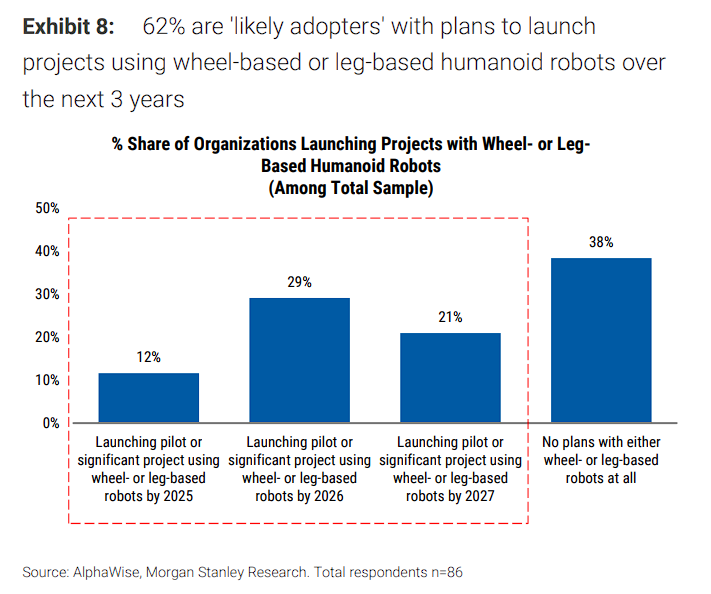
Core Insights - Morgan Stanley's survey reveals a strong interest among Chinese enterprises in deploying humanoid robots, with 62% planning to implement them within three years, indicating significant market potential. However, only 23% of respondents are satisfied with current products, highlighting a critical need for improvements in flexibility, functionality, and pricing [1][4][14]. Deployment Plans - Among 86 surveyed companies, 62% are categorized as "potential adopters," with plans to initiate humanoid robot pilot projects or major deployments within three years. Specifically, 12% plan to invest in 2025, 29% in 2026, and 21% in 2027 [4][3]. - The adoption rate for composite robots (mobile base + robotic arm) is expected to be the fastest, with 21% of companies planning deployment by 2025, increasing to 64% by 2027. In contrast, wheeled humanoid robots will see deployment rates of 8% in 2025, 37% in 2026, and 58% in 2027, while bipedal robots will have rates of 6%, 17%, and 41% respectively [3][7][9]. Product Maturity and Satisfaction - Despite strong market demand, product maturity is a significant constraint on the large-scale application of humanoid robots. Only 23% of respondents express satisfaction with current products, while 53% are neutral and 25% dissatisfied [14][16]. - Satisfaction levels vary by industry, with manufacturing firms showing relatively higher satisfaction compared to industrial and service sectors, which exhibit net dissatisfaction [16]. Performance Expectations - Among potential adopters, only 42%-57% rated various performance indicators as "excellent/good," indicating substantial room for improvement. The most anticipated enhancements include human-robot collaboration (70%), IoT integration (57%), fine manipulation (57%), and self-learning capabilities (49%) [18][24]. - Cost remains a critical barrier, with 92% of respondents believing that the price of humanoid robots must drop below 200,000 RMB (approximately 28,000 USD) for widespread adoption, and 40% identifying the ideal price range as 100,000-200,000 RMB [18]. Market Landscape - Chinese brands dominate the market, with Yushutech being the most engaged integrator, having contact with 60% of potential adopters, followed by Yundongchu (28%), UBTECH (23%), and Midea (17%) [20][22]. - The current brand preferences reflect visibility and media exposure rather than actual performance, as evidenced by Yushutech's high visibility despite lacking manufacturing capabilities [25]. Investment Recommendations - Morgan Stanley maintains a positive long-term outlook for humanoid robots but emphasizes that the market is still in its early stages, with scaling requiring time. The firm suggests prioritizing investments in component suppliers, as these companies are expected to benefit earlier from industry growth [27]. - The anticipated drivers for market interest in 2026 include new product launches by tech giants like Tesla, expanded government subsidies, and IPOs of related companies [27].

转具身最好的机会在昨天,其次是现在...
具身智能之心· 2025-12-01 10:00
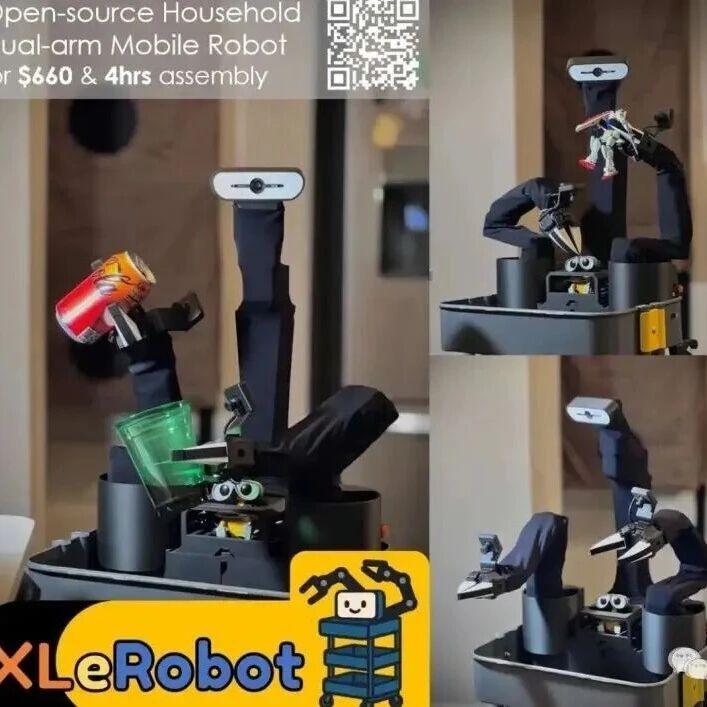
Openarm是一款双臂任务框架,目前有几家公司开始生产相关本体,缺乏移动能力,一些叠衣服、pick and place也都能满足。但从数据采集来看,VR版本更舒服。 XLerobot存在一定的移动能力,但不多,适合一些入门科研&个人开发使用,可以适配移动操作的一些任 务。 最近在为大家收敛具身科研的几个重点模块:行业内容、本体形态、算法、还有部署的一些方案,已经汇 总在我们的社区内部。 目前为大家梳理了行业正在从事具身大脑、本体研发的公司(突然发现本体也卷不太动了......),以及一些 比较活跃的具身实验室。方便大家判断和升学,除此之外,还有很多行业的研报,供大家判断具身的发展 与周期。 本体方面,推荐几款适合科研的产品:SO-100系列、openarm系列、XLerobot系列等; SO100及升级版本,能上一些VA和VLA的算法,常见功能可以实现了; 其它开发平台,成本较高,需要一定的资金投入,可以参考方舟无限、星海图、宇树的几款本体。 算法层面,目前我们收拢了关于vla(训练、无需训练方式、vla+RL、vla+世界模型、vla轻量化、部署 等)、vln(时间语言、目标导航、点导航等)、运控(强化、 ...
杭州,为何成为机器人创新的“梦工厂”?
机器人大讲堂· 2025-12-01 04:00
Core Viewpoint - Hangzhou is transforming from a commercial city into a global hub for robotics innovation, leveraging its robust industrial ecosystem and technological advancements [1][3]. Group 1: Industry Ecosystem - Hangzhou's robotics industry ecosystem features over 200 related enterprises, creating a competitive industrial cluster across various segments such as "brain," "small brain," and "body" [4]. - The city has established a comprehensive ecosystem for embodied intelligence robotics, with key players in upstream components, midstream manufacturing, and downstream system integration [4][6]. - Notable companies include Yushutech, which leads in global humanoid robot shipments, and Yundongchu, which is set to deploy the first industry-level quadruped robot in Singapore's power grid [6][7]. Group 2: Innovation and Application - The robotics ecosystem in Hangzhou emphasizes a closed-loop model of "application - feedback - iteration," supported by strong innovation and talent bases [13]. - The city hosts 39 innovation research institutions related to robotics, including 4 national-level and 26 provincial-level centers, contributing to the development of national standards in the field [13][15]. - Hangzhou is constructing application pilot bases to integrate testing, standardization, and production, enhancing the practical application of robotics across various sectors [15]. Group 3: Policy Support - The Hangzhou government has implemented several supportive policies, including the "Hangzhou Robot Industry Development Action Plan," aiming for a robotics industry scale exceeding 50 billion yuan by 2025 [9][10]. - New regulations, such as the "Hangzhou Regulations on Promoting the Development of Embodied Intelligent Robotics Industry," provide a legal framework for industry growth [9][12]. - Financial incentives and tax benefits are part of the government's strategy to foster innovation and attract talent, creating a conducive environment for robotics development [12][10]. Group 4: Market Potential - The embodied intelligence industry in China is in its early stages, with market size projected to reach 400 billion yuan by 2030 and exceed 1 trillion yuan by 2035 [7]. - Hangzhou's complete industrial ecosystem positions it at the forefront of this growth wave, making it a key player in the global robotics market [7].


转具身最好的机会在昨天,其次是现在...
自动驾驶之心· 2025-12-01 00:04
Core Insights - The article discusses the current state of the embodied intelligence industry, focusing on key modules such as industry content, embodiment forms, algorithms, and deployment solutions [1] - It highlights various companies and laboratories engaged in the development of embodied brains and embodiments, providing insights for assessment and advancement in the field [1] Industry Content - Several companies are recommended for research purposes, including the SO-100 series, Openarm series, and XLerobot series, which are capable of implementing various algorithms [2][4] - Openarm is noted for its dual-arm task framework, suitable for specific tasks like folding clothes and pick-and-place operations, although it lacks mobility [4] - XLerobot has limited mobility but is suitable for entry-level research and personal development [6] - Other development platforms are mentioned as being cost-prohibitive, requiring significant financial investment [8] Algorithm Development - The article outlines various algorithmic directions, including VLA (training and non-training methods, VLA+RL, VLA+world models, VLA lightweight, and deployment), VLN (time language, goal navigation, point navigation), control (reinforcement, MPC, WBC), simulation (general, real), and tactile perception [9] Deployment Solutions - Most deployments are currently focused on cloud-based inference, with edge-side solutions based on Sol's framework gradually being implemented [9] - Companies like Xiaopeng have completed VLM/VLA deployments using self-developed chips, while deployments on platforms with less than 100T computing power are rare [9] Community and Resources - The community has established a platform for sharing technical routes, live discussions, and job opportunities, aiming to cultivate talent in the industry [11][17] - A comprehensive technical stack and routes for beginners have been organized to facilitate entry into the field [13] - Valuable industry systems and project proposals are provided for those already engaged in related research [15] Networking and Job Opportunities - The community has established a job referral mechanism with various embodied companies, allowing members to connect with potential employers [17] - Members can access exclusive learning videos and documents, enhancing the educational experience [21] Research and Development Resources - The community has compiled over 40 open-source projects, 60 datasets related to embodied intelligence, and various technical learning routes to support both newcomers and advanced learners [18] - A summary of domestic and international embodied intelligence companies across various sectors, including education, logistics, and healthcare, is provided [23]
绕过大脑思考,超材料机赋予机器人身体本能! | Science Robotics
机器人大讲堂· 2025-11-30 06:25
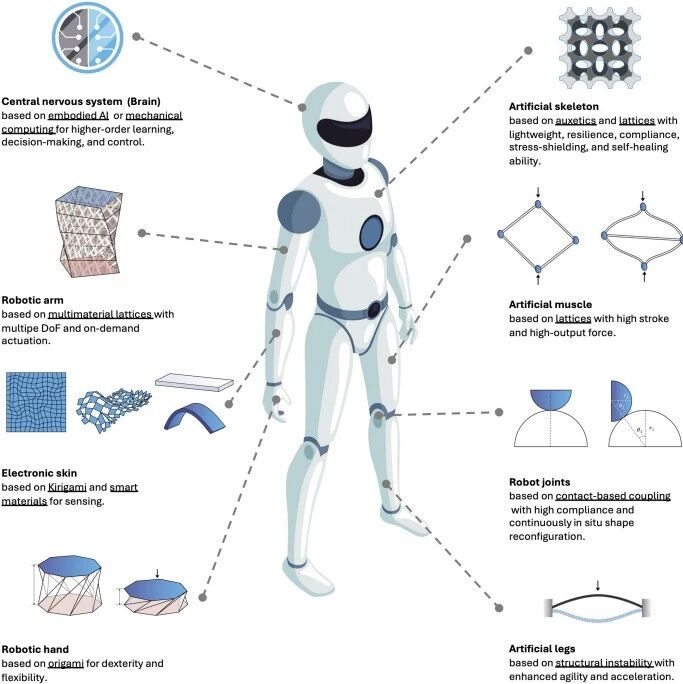
Core Concept - The article discusses a silent revolution in robotics, focusing on the integration of "mechanical metamaterials" to enhance robots' capabilities by allowing them to perceive, react, and adapt autonomously, merging central command with instinctive responses [1][4]. Group 1: Current Challenges in Robotics - Traditional robots operate on a "brain + body" model, where a central processor controls all functions, leading to limitations in flexibility and responsiveness [5][9]. - Current robotic systems are often heavy and rigid, making them unsuitable for delicate tasks that require safe interaction [6][9]. - The reliance on a central brain for every action creates bottlenecks, especially in unpredictable environments where rapid response is crucial [9][10]. Group 2: Mechanical Metamaterials - Mechanical metamaterials are defined as intelligent materials with programmable structures that can directly interpret and execute complex mechanical commands [7][11]. - The design principles of metamaterials include mechanics-inspired architectures, reconfigurable structures, and material-driven functionalities, which collectively enhance robots' physical capabilities [8][11][17]. Group 3: Innovations in Robotic Design - The first principle involves creating lightweight yet strong lattice structures that allow for adaptable flexibility and energy storage for rapid movements [11][12]. - The second principle utilizes origami and kirigami techniques to enable robots to dynamically change their shapes, enhancing their adaptability to various environments [13][15]. - The third principle integrates responsive materials that allow robots to sense and react to their surroundings, effectively merging sensory and motor functions [17][19]. Group 4: AI and Metamaterials - The integration of AI with metamaterials is seen as a key to overcoming current design challenges, allowing for efficient modeling and intelligent control of robotic systems [23][24]. - AI can assist in reverse engineering designs based on desired functionalities, improving the efficiency of creating complex metamaterial structures [24][26]. Group 5: Future Vision - The ultimate vision for metamaterial robots is a deep integration of embodied intelligence, where robots can operate more like biological entities, with distributed sensory and decision-making capabilities [27][28]. - Future robots are expected to function effectively in dynamic environments, with the ability to self-assemble and reconfigure into different forms as needed [28].
快3000人了,这个具身社区有点干货~
具身智能之心· 2025-11-30 03:03
Openarm是一款双臂任务框架,目前有几家公司开始生产相关本体,缺乏移动能力,一些叠衣服、pick and place也都能满足。但从数据采集来看,VR版本更舒服。 XLerobot存在一定的移动能力,但不多,适合一些入门科研&个人开发使用,可以适配移动操作的一些任 务。 最近在为大家收敛具身科研的几个重点模块:行业内容、本体形态、算法、还有部署的一些方案,已经汇 总在我们的社区内部。 目前为大家梳理了行业正在从事具身大脑、本体研发的公司(突然发现本体也卷不太动了......),以及一些 比较活跃的具身实验室。方便大家判断和升学,除此之外,还有很多行业的研报,供大家判断具身的发展 与周期。 本体方面,推荐几款适合科研的产品:SO-100系列、openarm系列、XLerobot系列等; SO100及升级版本,能上一些VA和VLA的算法,常见功能可以实现了; 其它开发平台,成本较高,需要一定的资金投入,可以参考方舟无限、星海图、宇树的几款本体。 算法层面,目前我们收拢了关于vla(训练、无需训练方式、vla+RL、vla+世界模型、vla轻量化、部署 等)、vln(时间语言、目标导航、点导航等)、运控(强化、 ...
智能制造分论坛 - 2026年度策略报告会
2025-11-28 01:42
智能制造分论坛 - 2026 年度策略报告会 20251127 摘要 2025 年人形机器人市场表现分三个阶段:年初至 3 月涨幅显著,4 月 因贸易战及行业因素回调,7 月至 9 月中旬再次上涨后回调,波动与特 斯拉产业链进展高度相关,量产关键卡点在于灵巧手。 国内人形机器人产业链加速上市,语数科技已完成上市辅导,预计 2026 年上市,云深处、乐趣等公司也开始接受券商辅导,明年或有多 家本体、灵巧手及零部件公司进入上市流程。 人形机器人核心零部件包括关节模组、灵巧手、触觉传感器等,评估标 准为高确定性、高价值占比及边际变化。灵巧手是量产关键,各公司加 速推出产品,但需经历市场洗牌。 二级市场投资建议关注特斯拉供应链及国产优质资产,重点关注身体关 节执行器、减速器、电机及灵巧手供应商,以及即将上市的标杆企业如 语数科技及其关键模组供应商。 具身智能发展方向包括替代人类和增强人类,两者可互补发展。算法和 硬件同等重要,但系统集成和二次开发环节薄弱,需加强。数据飞轮对 产业至关重要,高质量数据需求成为行业痛点。 Q&A 目前智能制造产业图谱的总体方向是什么? 国内人形机器人产业链方面,语数科技在春晚亮相及参加名 ...
南都物业:公司持有赛智助龙基金33%股权
Zheng Quan Ri Bao Wang· 2025-11-26 12:41
Group 1 - The company Nandu Property (603506) announced on November 26 that it holds a 33% stake in the Saizhi Zhulong Fund, which indirectly owns 1.0638% of Yundongchu [1] - The investment in Yundongchu is facilitated through the Saizhi Zhulong Fund, indicating a strategic investment approach by the company [1] - This information was shared in response to investor inquiries on the company's interactive platform, highlighting transparency in communication [1]
