
英维克

Search documents
研判2026!中国数据中心基础设施行业政策、发展历程、市场规模、竞争格局及发展趋势:市场规模将保持增长,预制化、智能化、低碳化成为新的发展趋势[图]
Chan Ye Xin Xi Wang· 2026-02-07 01:32
Core Insights - The development of data center infrastructure is driven by the rapid growth of data centers, influenced by national policies promoting intelligent computing centers and AI industry upgrades, as well as the increasing demand for digital transformation across various sectors [1][4] - The market size of China's data center is projected to grow from 87.8 billion yuan in 2019 to 318.2 billion yuan by 2025, while the data center infrastructure market is expected to increase from 16.19 billion yuan to 46.12 billion yuan during the same period [1][4] Group 1: Industry Definition and Structure - Data center infrastructure refers to facilities that provide operational support for electronic information equipment within data centers, including cooling, power distribution, cabinets, wiring, and monitoring systems [2] - The main cooling methods for data center infrastructure are air cooling and liquid cooling, with liquid cooling being a newer technology developed to meet the increasing heat dissipation demands of data centers [2][3] Group 2: Market Growth and Trends - The market for data center infrastructure is expected to grow from 16.19 billion yuan in 2019 to approximately 35.6 billion yuan in 2024, and reach about 46.12 billion yuan by 2025 [4] - The energy consumption of cooling systems is the highest among all data center infrastructure modules, making the improvement of cooling technology a key focus for future development [4] Group 3: Policy Environment - The industry benefits from strong national policy support aimed at promoting green and high-quality development of new infrastructure, including data centers and 5G technology, as part of China's carbon peak and carbon neutrality goals [5] Group 4: Competitive Landscape - The data center infrastructure industry is characterized by intense competition, particularly in air cooling technology, while liquid cooling technology is more capital and research-intensive, with key players including Huawei, Alibaba, Lenovo, Inspur, and Dell China [6] - Shuguang Data Innovation Technology Co., Ltd. specializes in high-efficiency cooling technologies for data centers, focusing on immersion phase change liquid cooling and modular data center products [6][7] Group 5: Future Development Trends - The future of data center infrastructure is expected to focus on prefabrication, intelligence, and low carbon emissions, driven by the rapid growth of new data centers and the need for improved performance metrics such as lower PUE and higher power density [6][10]


英维克:关于股东部分股份质押及解除质押的公告
Zheng Quan Ri Bao· 2026-02-06 13:36
(文章来源:证券日报) 证券日报网讯 2月6日,英维克发布公告称,公司于近日接到控股股东深圳市英维克投资有限公司(简 称"英维克投资")的通知,获悉英维克投资所持有公司的部分股份质押及解除质押,本次质押股数为 700.00万股。 ...

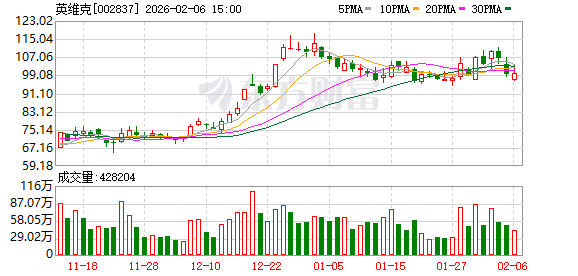
英维克(002837) - 关于股东部分股份质押及解除质押的公告
2026-02-06 10:00
本公司及董事会全体成员保证信息披露的内容真实、准确、完整,没有虚假记载、 误导性陈述或重大遗漏。 深圳市英维克科技股份有限公司(以下简称"公司")于近日接到控股股东深圳市英 维克投资有限公司(以下简称"英维克投资")的通知,获悉英维克投资所持有公司的部 分股份质押及解除质押,具体事项如下: | | 是否为控 股股东或 | 本次质 | 占其所 | 占公司 | 是否为 | 是否 为补 | | | | | | --- | --- | --- | --- | --- | --- | --- | --- | --- | --- | --- | | 股东 名称 | 第一大股 | 押股数 | 持股份 | 总股本 | 限售股 | 充质 | 质押 起始日 | 质押 到期日 | 质权人 | 质押用途 | | | 东及其一 | (万股) | 比例 | 比例 | | 押 | | | | | | | 致行动人 | | | | | | | | | | | 英维 | | | | | | | | 至办理解 | 招商证 券股份 | 偿还债务、向 关联企业提供 | | 克投 | 是 | 700.00 | 2.86% | 0.72% | 否 | ...
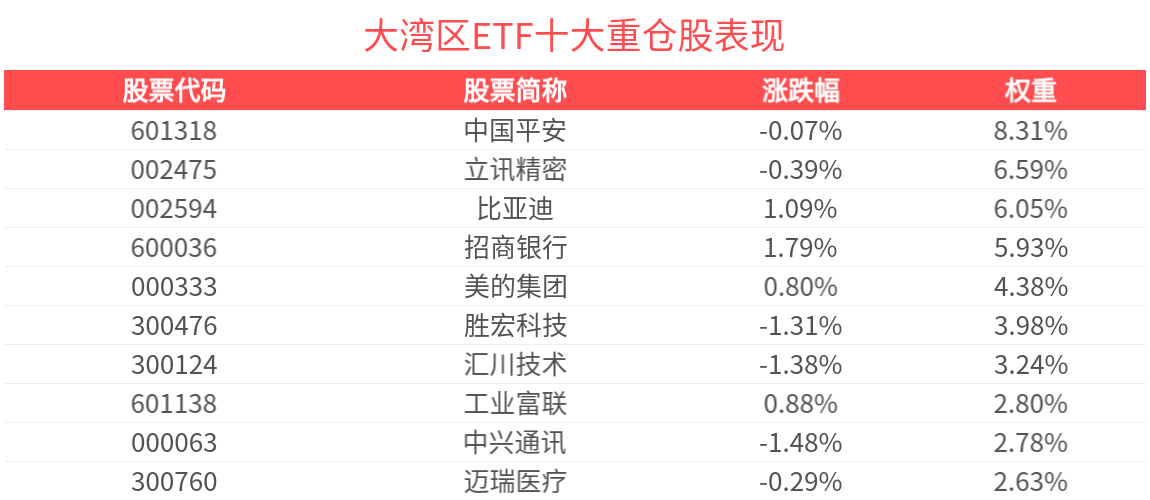
中证粤港澳大湾区发展主题指数下跌0.74%,大湾区ETF(512970)成立以来超越基准年化收益达3.32%
Xin Lang Cai Jing· 2026-02-06 01:40
Core Viewpoint - The performance of the China Securities Guangdong-Hong Kong-Macao Greater Bay Area Development Theme Index and its related ETF reflects the market dynamics and investment opportunities within the Greater Bay Area, with notable fluctuations in constituent stocks and overall index performance [1][2]. Group 1: Index Performance - As of February 5, 2026, the China Securities Guangdong-Hong Kong-Macao Greater Bay Area Development Theme Index (931000) decreased by 0.74% [1]. - The Greater Bay Area ETF (512970) also saw a decline of 0.47%, with the latest price at 1.5 yuan [1]. - Over the past six months, the Greater Bay Area ETF has accumulated a rise of 15.97% [1]. Group 2: Stock Performance - Among the constituent stocks, Huayin Securities led with a gain of 10.02%, while Jiejia Weichuang experienced the largest drop at 12.39% [1]. - The top ten weighted stocks in the index account for 44.55% of the total index weight, with China Ping An, Luxshare Precision, and BYD being the top three [2]. Group 3: Trading and Liquidity - The trading volume for the Greater Bay Area ETF was 57.35 million yuan, with an intraday turnover rate of 0.66% [1]. - The average daily trading volume over the past week was 99.55 million yuan [1]. Group 4: Risk and Return Metrics - The maximum drawdown for the Greater Bay Area ETF this year is 5.52%, with a relative benchmark drawdown of 0.02% [1]. - The ETF's Sharpe ratio over the past year is reported at 1.51 [1]. - The tracking error for the ETF over the last three months is 0.022% [1].
【5日资金路线图】银行板块净流入超82亿元居首 龙虎榜机构抢筹多股
证券时报· 2026-02-05 13:22
2月5日,A股市场整体下跌。 截至收盘,上证指数收报4075.92点,下跌0.64%,深证成指收报13952.71点,下跌1.44%,创业板 指数收报3260.28点,下跌1.55%,北证50指数下跌2.03%。 1. A股市场全天主力资金净流出579.46亿元 今日A股市场主力资金开盘净流出229.06亿元,尾盘净流出56.76亿元,全天净流出579.46亿元。 | | | 沪深两市近五日主力资金流向情况(亿元) | | | | --- | --- | --- | --- | --- | | 日期 | | 净流入金额 开盘净流入 | | 尾盘净流入 超大单净买入 | | 2026-2-5 | -579.46 | -229.06 | -56.76 | -314. 15 | | 2026-2-4 | -591.69 | -303.66 | 2. 50 | -326. 41 | | 2026-2-3 | 16.49 | 50. 22 | 20. 19 | 105. 03 | | 2026-2-2 | -539.77 | -143. 20 | -157. 11 | -384. 36 | | 2026-1-30 | ...

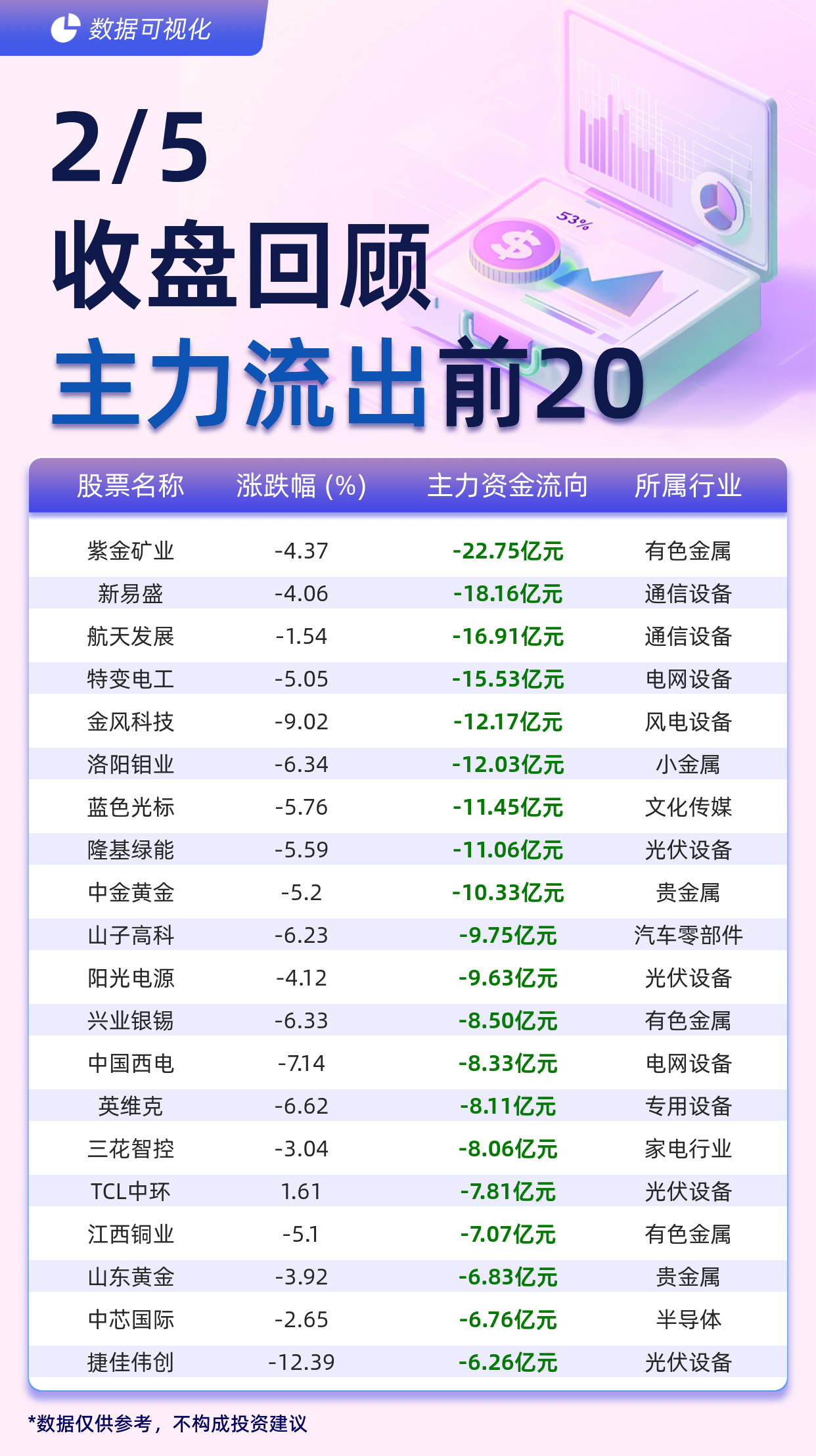
主力个股资金流出前20:紫金矿业流出22.75亿元、新易盛流出18.16亿元
Jin Rong Jie· 2026-02-05 07:43
Core Viewpoint - The data indicates significant outflows of capital from various stocks, with notable losses in both percentage and monetary terms across multiple sectors, particularly in metals, communication equipment, and renewable energy [1][2][3] Group 1: Stock Performance and Capital Outflow - Zijin Mining experienced a capital outflow of 2.275 billion, with a decline of 4.37% [2] - Xinyi Technology saw an outflow of 1.816 billion, with a decrease of 4.06% [2] - Aerospace Development had a capital outflow of 1.691 billion, reflecting a drop of 1.54% [2] - TBEA reported an outflow of 1.553 billion, with a decline of 5.05% [2] - Goldwind Technology faced a capital outflow of 1.217 billion, down by 9.02% [2] - Luoyang Molybdenum experienced an outflow of 1.203 billion, with a decrease of 6.34% [2] - BlueFocus Media saw an outflow of 1.145 billion, down by 5.76% [2] - Longi Green Energy had a capital outflow of 1.106 billion, with a decline of 5.59% [2] - Zhongjin Gold experienced an outflow of 1.033 billion, down by 5.20% [2] - Shanzhi High-Tech saw an outflow of 0.975 billion, with a decrease of 6.23% [2] - Sungrow Power Supply experienced an outflow of 0.963 billion, down by 4.12% [2] Group 2: Additional Stocks and Their Performance - Xinyi Silver experienced a capital outflow of 0.850 billion, with a decline of 6.33% [3] - China Western Power saw an outflow of 0.833 billion, down by 7.14% [3] - Inovance Technology had a capital outflow of 0.811 billion, with a decrease of 6.62% [3] - Sanhua Intelligent Control experienced an outflow of 0.806 billion, down by 3.04% [3] - TCL Zhonghuan saw an outflow of 0.781 billion, with a slight increase of 1.61% [3] - Jiangxi Copper experienced a capital outflow of 0.707 billion, down by 5.10% [3] - Shandong Gold saw an outflow of 0.683 billion, with a decline of 3.92% [3] - SMIC experienced a capital outflow of 0.676 billion, down by 2.65% [3] - Jiejia Weichuang faced an outflow of 0.626 billion, with a significant drop of 12.39% [3]


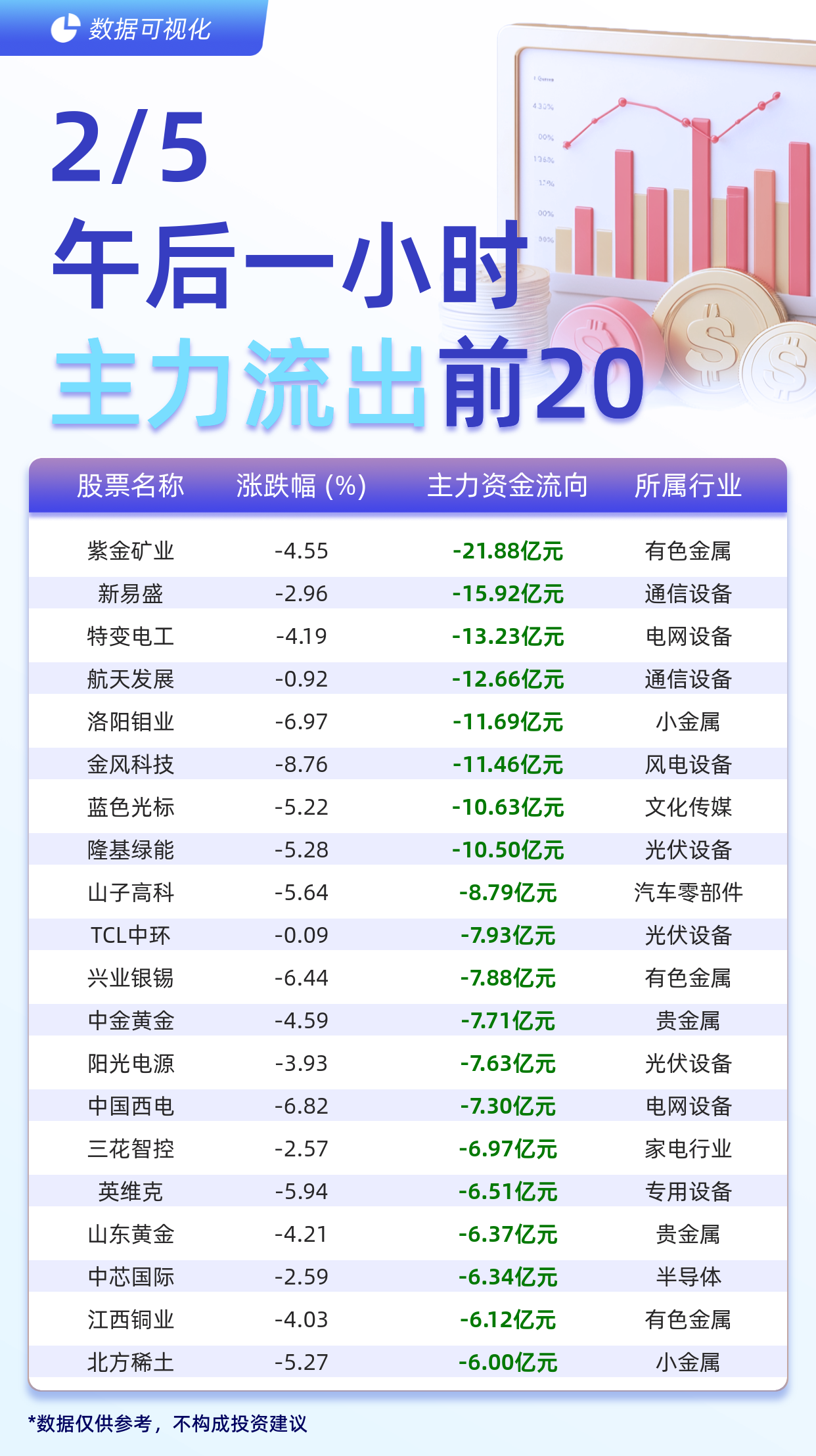
主力个股资金流出前20:紫金矿业流出21.88亿元、新易盛流出15.92亿元



Jin Rong Jie· 2026-02-05 06:40
| 中金黄金 | -4.59 | -7.71亿元 | 贵金属 | | --- | --- | --- | --- | | 阳光电源 | -3.93 | -7.63亿元 | 光伏设备 | | 中国西电 | -6.82 | -7.30亿元 | 电网设备 | | 三花智控 | -2.57 | -6.97亿元 | 家电行业 | | 英维克 | -5.94 | -6.51亿元 | 专用设{ | | 山东黄金 | -4.21 | -6.37亿元 | 贵金属 | | 中芯国际 | -2.59 | -6.34亿元 | 未营体 | | 江西铜业 | -4.03 | -6.12亿元 | 有色金属 | | 北方稀土 | -5.27 | -6.00亿元 | 小金属 | *数据仅供参考,不构成投资建议 据交易所数据显示,截至2月5日午后一小时,主力资金流出前20的股票分别为: 紫金矿业(-21.88亿元)、 新易盛(-15.92亿元)、 特变电工(-13.23亿 元)、 航天发展(-12.66亿元)、 洛阳钼业(-11.69亿元)、 金风科技(-11.46亿元)、 蓝色光标(-10.63亿元)、 隆基绿能(-10.50亿元)、 山子高 ...
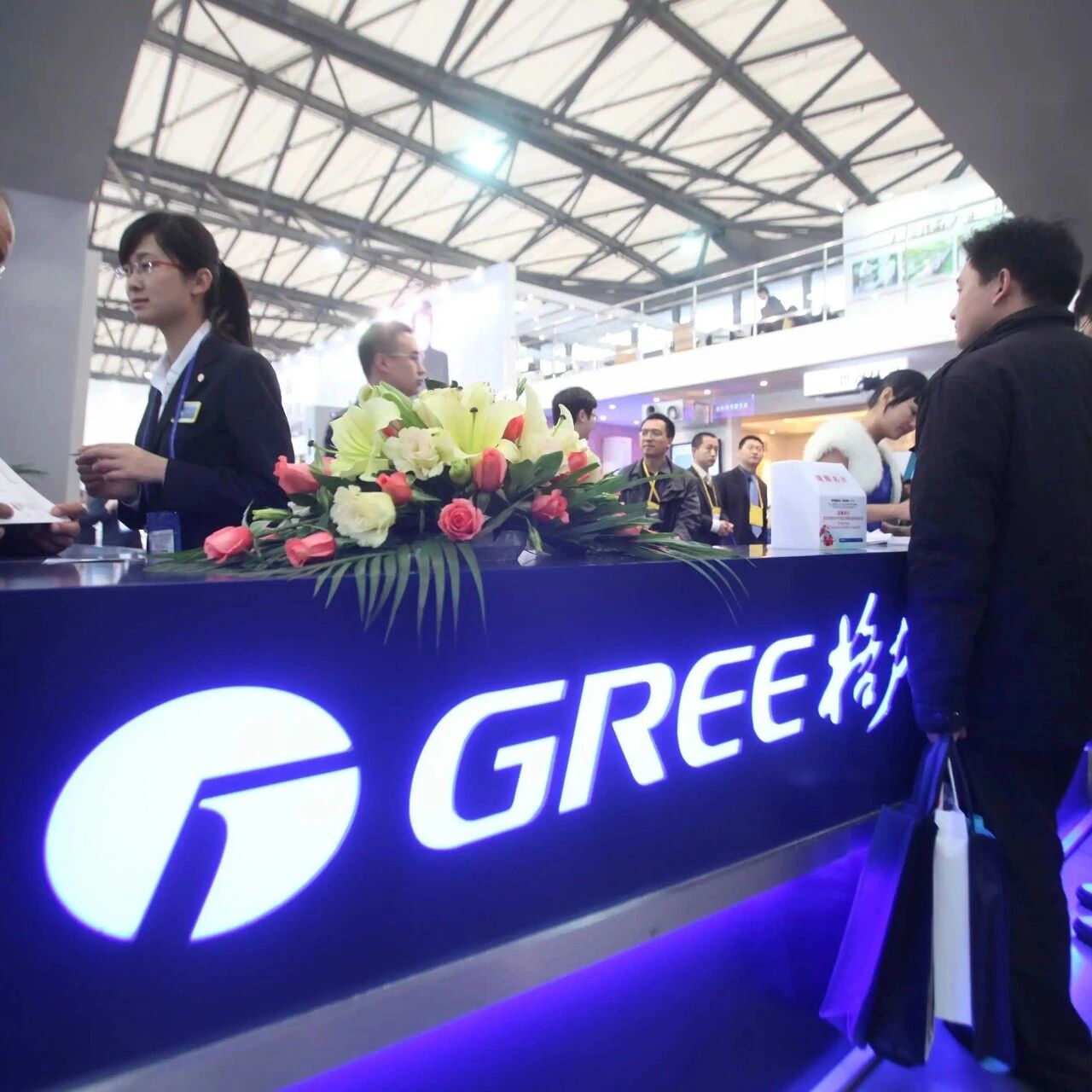
传统空调需求承压,格力、美的切入AI数据中心制冷领域
第一财经· 2026-02-04 09:46
Core Viewpoint - The central air conditioning industry is undergoing an adjustment period due to declining traditional engineering demand, prompting companies like Gree Electric and Midea Group to invest more resources in AI data center cooling and high-performance infrastructure to seek structural growth opportunities [5][6]. Group 1: Market Dynamics - Air conditioning still accounts for about 70% of Gree Electric's revenue, with central air conditioning being a core segment. However, the industry faces pressure from a downturn in real estate, weak traditional engineering demand, and intensified price competition [7]. - In 2025, the sales scale of China's central air conditioning industry is projected to be 138.68 billion yuan, with a 7.4% year-on-year decline in the domestic market, while the export market is expected to grow by 12.7%. The growth in exports is significantly driven by ongoing investments in overseas data centers and computing infrastructure [7]. Group 2: Technological Trends - As AI computing power increases, the power density of server cabinets is rising rapidly, revealing limitations in traditional air cooling solutions in terms of efficiency and heat dissipation. Liquid cooling is gradually becoming an important technology route for high-performance data centers [8]. - Liquid cooling is not merely an equipment upgrade but involves comprehensive changes in system architecture, core components, and operational modes. It is seen as a supplementary solution in high-performance scenarios, often coexisting with air cooling solutions, requiring higher system integration and project experience [8]. Group 3: Competitive Landscape - The data center cooling market is primarily dominated by two types of companies: specialized manufacturers with extensive experience in data center temperature control, such as Vertiv, Ingersoll Rand, and others, and foreign brands like Johnson Controls and Carrier, alongside domestic central air conditioning manufacturers like Gree and Midea [10]. - Domestic central air conditioning companies face significant challenges in the data center market, including the maturity of technology in high-performance scenarios, the ability to deliver complex projects, and the long verification cycles required by leading clients [10]. Group 4: Future Outlook - Overall, AI data center cooling presents a rare structural growth opportunity for the central air conditioning industry, but its scale, pace, and profit model differ significantly from traditional engineering markets. In the short term, data center business serves more as a buffer against the decline of traditional business rather than a decisive replacement [11]. - The ability of companies like Gree and Midea to establish stable engineering capabilities and long-term customer relationships in high-barrier technology paths like liquid cooling will be crucial in determining their position in the computing infrastructure cycle [11].


传统空调需求承压,格力、美的切入AI数据中心制冷领域
Di Yi Cai Jing· 2026-02-04 08:50
Core Insights - The data center cooling business is a significant growth point for the central air conditioning industry during its consolidation phase, but competition is intensifying, presenting both opportunities and challenges [1] Industry Overview - The central air conditioning industry is currently in an adjustment period due to weakening traditional engineering demand. Companies like Gree Electric Appliances (000651.SZ) and Midea Group (000333.SZ) are reallocating resources towards AI data center cooling and high-computing infrastructure to seek structural growth [3] - The data center temperature control market has high requirements for system design capabilities, project experience, and long-term operation and maintenance, posing challenges for traditional HVAC companies [3] Market Dynamics - Air conditioning still accounts for approximately 70% of Gree's revenue, with central air conditioning being a core segment. However, the industry faces pressure from a downturn in real estate, weak traditional engineering demand, and intensified price competition [4] - The Chinese central air conditioning market is projected to reach a sales scale of 138.68 billion yuan by 2025, with a year-on-year decline of 7.4% in the domestic market, while the export market is expected to grow by 12.7% [4] - Data centers are viewed as one of the few remaining sources of certain demand in the central air conditioning industry, although their contribution to Gree and Midea's central air conditioning revenue remains limited [4] Technological Trends - As AI computing power increases, the power density of server cabinets is rising rapidly, revealing limitations in traditional air-cooled solutions regarding efficiency and heat dissipation. Liquid cooling is becoming an important technology route for high-computing data centers [4] - Liquid cooling is not merely an equipment upgrade but involves comprehensive changes in system architecture, core components, and operational modes, requiring higher system integration and project experience [4] Competitive Landscape - The data center cooling market is primarily dominated by two types of companies: specialized temperature control manufacturers and foreign brands. Specialized firms have accumulated substantial project experience and customer loyalty, while central air conditioning manufacturers like Gree and Midea have advantages in manufacturing and global service networks but face competition in specialized cooling solutions [6] - Domestic central air conditioning companies see opportunities in the data center market due to incremental space and localization trends, but they also face challenges such as technology maturity and complex project delivery capabilities [6] Strategic Outlook - Overall, AI data center cooling presents a rare structural growth opportunity for the central air conditioning industry, but its scale, pace, and profit model differ significantly from traditional engineering markets. In the short term, data center business acts more as a buffer against the decline of traditional business rather than a decisive replacement [7] - The ability of Gree and Midea to establish stable engineering capabilities and long-term customer relationships in high-barrier technologies like liquid cooling will be crucial for their positioning in the computing infrastructure cycle [7]
英维克股价跌5%,兴业基金旗下1只基金重仓,持有1600股浮亏损失8784元
Xin Lang Cai Jing· 2026-02-04 06:26
Company Overview - Invech Technology Co., Ltd. is located in Longhua District, Shenzhen, Guangdong Province, and was established on August 15, 2005. The company went public on December 29, 2016 [1] - The main business involves the research, production, and sales of precision temperature control energy-saving equipment, as well as air conditioning and maintenance services for rail transit trains and traditional buses [1] Revenue Composition - The revenue composition of Invech is as follows: - 52.50% from data center temperature control energy-saving products - 36.00% from cabinet temperature control energy-saving products - 9.82% from other sources - 0.93% from rail transit train air conditioning and services - 0.75% from bus air conditioning [1] Stock Performance - On February 4, Invech's stock price fell by 5%, closing at 104.28 CNY per share, with a trading volume of 4.827 billion CNY and a turnover rate of 5.30%. The total market capitalization is 101.835 billion CNY [1] Fund Holdings - According to data, one fund under Industrial Bank holds a significant position in Invech. The Industrial Bank CSI 500 ETF (510570) held 1,600 shares in the fourth quarter, accounting for 0.71% of the fund's net value, making it the second-largest holding [2] - The fund has a total size of 24.0657 million CNY and has achieved a return of 10.36% year-to-date, ranking 789 out of 5,562 in its category. Over the past year, it has returned 48.01%, ranking 1,368 out of 4,285 [2] Fund Manager Information - The fund managers of the Industrial Bank CSI 500 ETF are Xu Chengcheng and Zhang Shiyue. Xu has a tenure of 9 years and 4 days, with a total fund size of 1.492 billion CNY and a best return of 769.46% during his tenure. Zhang has a tenure of 5 years and 33 days, managing a fund size of 827 million CNY with a best return of 63.64% [3]