
Antofagasta

Search documents
铜_ 需求依然强劲,但全球库存上升;伦敦金属交易所价格年内上涨 13%-Copper Dashboard_ Demand remains strong, but global inventories rising; LME price up 13% YTD
2025-09-11 12:11
Summary of J.P. Morgan Copper Dashboard Industry Overview - **Industry**: Copper Mining - **Current Trends**: Strong demand persists despite rising global inventories; LME copper price has increased by 13% year-to-date (YTD) to $4.46/lb [1][1][1] Key Takeaways 1. **Global Copper Production**: - Increased by 7.4% YTD as of May, with notable strength in the Democratic Republic of Congo (DRC) and Chile, while Peru showed weakness [1][1][1] - Global copper inventories rose approximately 160,000 tons from around 440,000 tons in late June to about 600,000 tons currently, nearing 2023/24 levels [1][1][1] 2. **China's Copper Market**: - Refined copper production in China rose by 11% YTD through July, matching a 12% increase in demand, although July demand saw a 4% decline year-over-year (YoY) [1][1][1] - Downstream purchases in China are reportedly weak, with onshore premiums declining from earlier in the year [2][2][2] 3. **Market Dynamics**: - High-frequency data presents mixed signals: - Positive indicators include falling TC/RCs (treatment and refining charges), rising cathode premiums, and increasing smelter operating rates in China [1][1][1] - Negative indicators include a decline in LME net speculative positioning returning to five-year average levels [1][1][1] 4. **Price and Inventory Trends**: - Despite rising inventories, the LME copper price has increased, with forward curves in contango, the highest in the past year [1][1][1] - The current LME copper price is $4.46/lb, reflecting a strong market position [1][1][1] 5. **Equity Preferences**: - J.P. Morgan continues to favor Capstone Copper (CSC) in Australia and Antofagasta in EMEA, both rated as Overweight [1][1][1] Additional Insights - **Future Outlook**: - The copper supply-demand balance is expected to remain in marginal surplus for 2025/26, but a positive long-term outlook is maintained [2][2][2] - **Analyst Ratings**: - Various companies in the copper sector have been rated, with BHP, Rio Tinto, and Glencore receiving Overweight ratings, while Southern Copper is rated Neutral [4][4][4] Conclusion - The copper industry is experiencing strong production and demand, particularly in China, despite rising inventories. The market remains optimistic about long-term prospects, with specific equities highlighted for investment.
Reeves to impose ‘significant tax rises’ at Budget, says Goldman Sachs
Yahoo Finance· 2025-09-09 17:49
Group 1: UK Economic Outlook - The UK is facing a challenging fiscal position characterized by sluggish growth, persistent inflation, and rising borrowing costs [3][53][69] - Rachel Reeves, the Chancellor, is expected to implement significant tax increases in the upcoming autumn Budget on November 26, which may not effectively improve the fiscal situation based on historical data [5][6][66] - The Confederation of British Industry has urged the Chancellor to focus on long-term strategic tax reforms rather than adhering strictly to previous manifesto promises [1] Group 2: US Job Market and Economic Indicators - The US economy has shown signs of weakening, with a significant downward revision of job growth figures, indicating that only about 70,000 jobs were added monthly instead of the previously estimated 147,000 [8][29] - Jamie Dimon, CEO of JP Morgan, expressed concerns about the US economy's health, suggesting it may be on the brink of recession [2] - The Federal Reserve is anticipated to cut interest rates in response to the softening job market, with traders betting on a potential rate cut at the next meeting [12][23] Group 3: Global Market Reactions - Global stock markets have reacted to the disappointing US job figures, with the MSCI World index and S&P 500 showing slight declines [20][22] - The FTSE 100 index in the UK saw a modest increase, driven by gains in mining companies following a merger announcement [60] - Gold prices reached a new record high, driven by expectations of interest rate cuts, highlighting a shift in investor sentiment towards safe-haven assets [47][51]

全球矿业公司_从上半年业绩中吸取的经验:关注中国、关税问题。讨论铜矿项目-Big Global Miners_ Learnings from H1 earnings. Eyes on China, tariffs. Talking copper projects.
2025-08-31 16:21
Summary of Key Points from the Conference Call Industry Overview - The focus is on tariffs and China, with a mention of a potential "new" EU market [1] - Key themes post H1 results include the impact of tariffs on global growth and efficiency, particularly in the copper sector [2] Core Themes and Arguments - **Tariffs**: Ongoing changes are seen as detrimental to the US and global growth, with copper tariffs negatively affecting valuations [2] - **Dollar**: Speculation on whether the dollar has peaked or if further declines are expected, with the market pricing in potential rate cuts [2] - **China**: Mixed signals with credit data appearing stable, but property market issues persist; grid investment in China is projected to increase by 8% this year [2] - **Energy Transition**: Rapid developments outside the US, with battery storage becoming a new driver for metal demand and solar energy being the lowest cost option [2] Company-Specific Insights - **BHP**: Focus on smoothing copper production and managing costs despite project overruns [6] - **Rio Tinto**: New CEO, emphasis on copper growth and potential lithium price stabilization [6] - **Glencore**: Coal market recovery, but challenges in copper production expected in H2 [6] - **Anglo American**: Restructuring efforts and key commodities performing well [6] - **Vale**: Volume growth and cost improvements in base metals driving profits [6] - **Teck**: Issues with QB ramp-up affecting guidance despite copper growth [6] - **South32**: Copper and aluminum are key growth drivers, with challenges in nickel [6] - **Fortescue**: Profit impacted by iron price fluctuations, with a focus on decarbonization capital expenditures [6] - **Freeport**: Positioned as a leading copper company in the US, with growth driven by leaching processes [6] - **Antofagasta**: Notable 30% low-risk volume growth with strong copper leverage [6] - **ArcelorMittal**: Consolidation efforts in the EU market are generating investor optimism [6] Commodities Market Insights - **Copper**: Supply issues due to incidents in DRC and Chile, with treatment and refining charges remaining negative [4] - **Iron Ore**: Marginal cost support highlighted, with the market able to absorb new supply from Simandou [4] - **Lithium**: Prices recovering from lows due to supply cuts in China [4] - **Gold**: Current windfall cash flows in the sector, while bulk commodities show subdued free cash flow [4] Market Sentiment - The end of downgrades in many commodities is seen as a positive sign for the sector [5] - The overall equity story for the sector is improving, with many companies showing resilience despite market challenges [5] Additional Insights - The revenue breakdown indicates that copper and iron ore are key revenue drivers, accounting for over 60% of aggregate revenues for major companies [13][15] - The report includes detailed financial metrics and projections for various companies, indicating a cautious but optimistic outlook for the mining sector [12]


冶炼产能强劲释放 需求转入淡季 未来铜价走势难言明朗
Zhong Guo Chan Ye Jing Ji Xin Xi Wang· 2025-08-19 22:23
Group 1: Tariff Impact and Market Reaction - The U.S. President Trump announced a 50% tariff on imported copper semi-finished products and high-copper derivatives starting August 1, leading to a significant drop in COMEX copper prices and closing the arbitrage space between U.S. and London copper prices [1] - The sentiment around domestic "anti-involution" policies has cooled, resulting in a general decline in commodity prices, with the characteristics of the off-season in the non-ferrous metal sector becoming more pronounced [1] Group 2: Supply and Production Dynamics - Global copper supply remains tight, with several major copper mining companies lowering their annual production guidance due to underperformance [2] - The International Copper Study Group (ICSG) reported a year-on-year increase of approximately 300,000 tons in global concentrate production for the first five months, but refined copper production is expected to increase by only 450,000 tons due to profit pressures in the smelting segment [2] - The market anticipates a tight balance or slight shortage in the global copper market from 2025 to 2028, with expected growth in global copper mine production potentially below 1% by 2025 [2] Group 3: Processing Fees and Smelting Profitability - Antofagasta reached a copper concentrate processing fee (TC/RC) of $0.0 per thousand tons and $0.0 per pound with Chinese smelting companies for mid-2025, indicating a continued tight supply of copper concentrates [3] - Despite some smelting plants operating at a loss, the overall smelting profit has improved when accounting for by-product sulfuric acid revenue [3] Group 4: Demand Trends and Seasonal Effects - The recent U.S. tariff policy does not restrict copper raw material imports, leading to a rapid disappearance of the COMEX copper premium, with U.S. copper imports exceeding last year's levels [4] - Downstream processing enterprises are cautious about high copper prices, primarily purchasing to meet immediate needs, resulting in weak market demand [5] - The operating rate of wire and cable enterprises has dropped to around 70%, with signs of slowing progress in major power grid projects [5] Group 5: Overall Market Outlook - The supply side is becoming marginally looser due to high domestic refined copper production and steady import levels, while traditional copper-consuming industries show clear signs of off-season characteristics [6] - The pricing logic for copper is shifting from macro-driven sentiment to fundamentals, with expectations of weak copper prices in the short term due to seasonal demand fatigue and pressure from the spot market [6]
Encounter Resources (E6H) 2025 Conference Transcript
2025-08-06 06:55
Summary of Encounter Resources Conference Call Company Overview - Encounter Resources is positioned as a high-impact Australian explorer focused on niobium, rare earths, and copper, with a defined maiden high-grade niobium resource in the West Arundra region, Australia's newest critical minerals province [1][2] Key Points Industry and Market Context - The niobium market is significant, valued at over $5 billion annually, with only three major mines globally, two located in Brazil [15][16] - Encounter Resources aims to become a major player in this emerging mineral province, which is expected to be a globally important source of niobium [3][6] Exploration and Discoveries - Encounter has been exploring Central Australia for over 15 years, focusing on greenfields exploration strategies [3] - The company has a large exploration landholding in the Northern Territory and is actively drilling multiple projects, including Sandover and Jessica [5][6] - High-grade niobium deposits have been discovered rapidly in the West Arundra region, with significant potential for rare earths and orogenic gold [7][8] Resource Development - A resource of 19.2 million tonnes at 1.74% niobium was announced, indicating a high-grade potential compared to existing mines [15][16] - The company is advancing resource development through project studies, metallurgy, and marketing, supported by a strong institutional shareholder base [4][19] Future Plans and Drilling Activities - Encounter plans to drill over 40,000 meters this year, targeting multiple new sites based on recent geophysical surveys [24][23] - Upcoming drilling includes the Joyce deposit, which has shown promising initial results [17] - The company is also focused on copper exploration across Western Australia and Northern Territory, with partnerships that have provided over $30 million in funding [19][20] Geophysical and Academic Collaborations - Significant investments in geophysics and collaborations with academic institutions are aiding in the exploration and characterization of mineral resources [14][27] - The company has utilized pre-competitive data from the Geological Survey of Western Australia to identify promising drilling sites [25][26] Strategic Partnerships - Encounter has partnered with major mining companies, including BHP and Newcrest Mining, to minimize dilution and secure funding for exploration projects [19][20] Additional Insights - The exploration success in the West Arundra region is attributed to deep mantle tapping structures that bring valuable minerals to the surface [9][10] - The company emphasizes the importance of government support and geological surveys in facilitating exploration efforts in new regions [25][26]
全球金属与矿业_2025 年或将再度出现铜供应短缺-Global Metals & Mining_ 2025 is set to be another year of copper supply failure
2025-08-05 03:20
29 July 2025 Global Metals & Mining Global Metals & Mining: 2025 is set to be another year of copper supply failure Bob Brackett, Ph.D. +1 917 344 8422 bob.brackett@bernsteinsg.com Andrianto Guntoro +44 207 676 6825 andrianto.guntoro@bernsteinsg.com Copper demand almost always rises (almost 3% CAGR over the next ten years, or ~1 mln tonnes/year). Copper production almost always misses, for a variety of reasons discussed below. We show that the risk of those reasons is rising. And 2025 is set to be a prime e ...
中国 “反内卷” 政策的欧洲受益企业-JPM _ European Beneficiaries from China‘s Anti Involution Policy
2025-07-28 01:42
Summary of Key Points from the Conference Call Industry and Company Involvement - The discussion primarily revolves around the **chemical**, **metals**, **mining**, **steel**, and **cement** industries, particularly in the context of **China's anti-involution policy** and its implications for **European cyclical sectors** [1][2][6]. Core Insights and Arguments - **Chemical Industry Impact**: China's significant increase in petrochemical capacity, with **28 million tons of ethylene capacity** added in the last five years against a global demand of **19.5 million tons**, has led to a severe slump in the chemical industry, the worst in **40 years**. An additional **30 million tons of ethylene** capacity is expected to come online in the next five years, potentially extending the slump into the **2030s** [2][6]. - **Capacity Closures**: China's actions have forced closures of approximately **4.5 million tons** (about **20%** in Europe) of capacity elsewhere, but limited closures have occurred within China despite poor sector economics. Significant closures of older, non-economic plants in China could positively impact European petrochemical companies [2][6]. - **Coal and Chemical Production**: The potential for capacity rationalization in the coal industry could increase coal prices in China, raising production costs for chemicals and making European production more competitive. However, there is currently no evidence of mandated production cuts in the chemical value chains by the Chinese government [2][6]. - **Metals and Mining Sector**: Companies with exposure to iron ore, copper, and coal are expected to benefit from potential price increases. Key European companies like **Rio Tinto**, **Glencore**, and **Antofagasta** are highlighted as having significant exposure. The European metals and mining sector has underperformed the MSCI Europe index by approximately **60%** since January 2023, indicating potential for significant outperformance in **2025/26** [2][6]. - **Cement Industry Developments**: The China Cement Association has mandated production cuts for enterprises exceeding recorded capacity to combat low-price competition, which is expected to positively impact the sector. Companies like **Holcim** and **Heidelberg Cement** are noted for their higher exposure due to local joint ventures [2][6]. Additional Important Insights - **Seasonal Slowdown**: China's steel production is showing signs of a controlled slowdown, with expectations of a seasonal decline in the second half of **2025** [2][6]. - **Naphtha Import Quota**: China has approved a naphtha import quota for **2025** that is nearly double that of **2024**, indicating planned expansions in capacity with five new crackers set to start in the second half of **2025** [2][6]. - **Diverse Chemical Products**: The chemical industry comprises thousands of different products, complicating regulatory efforts compared to more singular product sectors like solar polysilicon, steel, or coal [2][6]. This summary encapsulates the critical insights and implications discussed in the conference call, focusing on the potential impacts of China's policies on various sectors and the opportunities for European companies.
全球大宗商品一周回顾Global Commodities_ The Week in Commodities
2025-07-24 05:04
Summary of Key Points from the Conference Call Industry Overview - The conference call primarily discusses the **global commodities market**, with a focus on **oil**, **natural gas**, **copper**, and **cocoa** markets. Core Insights and Arguments Oil Market - President Trump has issued a 50-day ultimatum to Russia regarding oil exports, threatening 100% secondary tariffs if no deal is reached, which could significantly impact economic growth and oil demand [6] - Oil consumption is on the rise due to improved travel demand and trade activities, with global liquid stocks increasing by 191 million barrels year-to-date through July 11 [7] - The US oil rig count has decreased by two units, primarily in Delaware, Texas, leading to a modest downward revision of US supply forecasts for 2025 and 2026 [13] Natural Gas - Natural gas remains strategically important to Russia, which is exploring alternative markets due to the EU's plan to phase out Russian gas [9] - The Power of Siberia 2 pipeline is under discussion as a potential route for Russian gas to China, but concerns over pricing and supply concentration remain [9] Copper Market - A proposed 50% tariff on copper imports could lead to a 4% reduction in refined copper demand growth in the US next year, although this represents only a 0.2% impact on global demand [9] - The US exports 540-580 thousand metric tons of copper contained in scrap annually, which could help reduce import dependence on copper cathode [9] - The US has significant copper project potential, but new supply responses are not expected until the next decade due to long lead times [9] Cocoa Market - The cocoa market has experienced a sharp decline in prices, attributed to demand-side destruction, but prices are expected to remain structurally higher due to multi-season availability constraints [3][11] - The medium-term price forecast for cocoa is set at $6,000 per tonne as the market seeks balance, likely by 2025/26 [11] Additional Important Insights - The global commodity market open interest has rebounded by 2.2% week-over-week, with energy leading the charge, although base metals have seen outflows [12] - The overall economic outlook for the second half of 2025 is expected to be stagflationary, with sluggish growth anticipated [12] - The cocoa market's long-term structural price increase is supported by ongoing supply constraints despite short-term demand destruction [3][11] This summary encapsulates the key points discussed in the conference call, highlighting the dynamics within the global commodities market and the implications for various sectors.
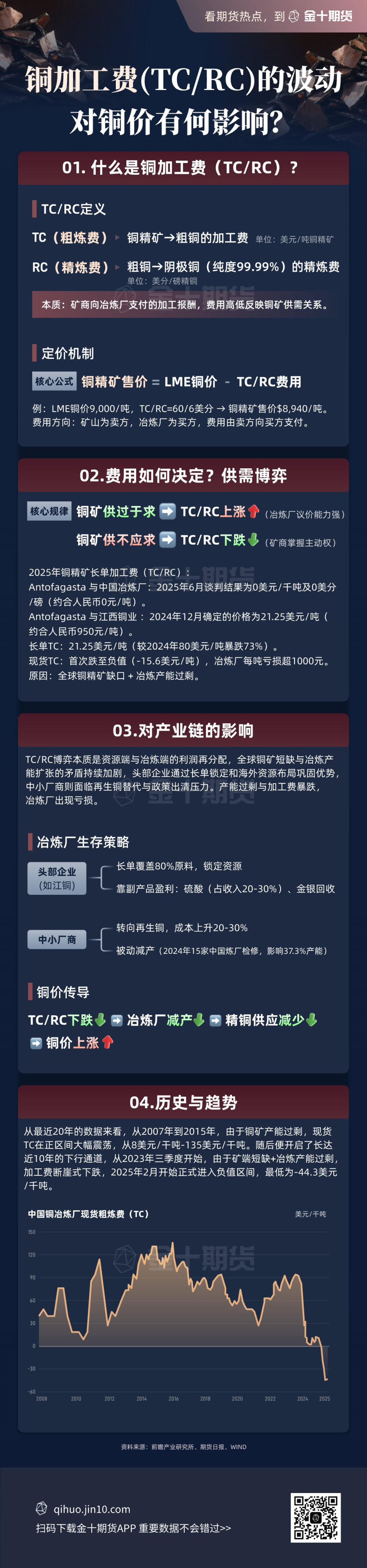
【金十期货热图】铜加工费跌至近20年低位,冶炼减产传导至精铜供给,铜价支撑逻辑全梳理!一图看懂TC/RC对铜价的影响。
news flash· 2025-07-23 12:11
会十期货执图 铜加工费跌至近20年低位,冶炼减产传导至精铜供给,铜价支撑逻辑全梳理!一图看懂TC/RC对铜价的影响。 看期货热点,到 2 金十期货 铜加工费(TC/RC)的波动 对铜价有何影响? 01. 什么是铜加工费(TC/RC) ? TC/RC定义 TC (粗炼费) > 铜精矿→粗铜的加工费 单位:美元/吨铜精矿 RC (精炼费) · 粗铜→阴极铜(纯度99.99%) 的精炼费 单位:美分/磅精铜 本质:矿商向冶炼厂支付的加工报酬,费用高低反映铜矿供需关系。 定价机制 核心公式 铜精矿售价 = LME铜价 - TC/RC费用 例:LME铜价9.000/吨,TC/RC=60/6美分 → 铜精矿售价$8,940/吨。 费用方向:矿山为卖方,治炼厂为买方,费用由卖方向买方支付。 02.费用如何决定? 供需博弈 辑 4 铜矿供不应求 → TC/RC下跌 (矿商掌握主动权) 2025年铜精矿长单加工费(TC/RC) : = = Antofagasta 与中国冶炼厂: 2025年6月谈判结果为0美元/千吨及0美分 /磅(约合人民币0元/吨)。 Antofagasta 与江西铜业: 2024年12月确定的价格为21.2 ...


铜日报:铜显性库存累增施压,弱势震荡延续-20250715
Tong Hui Qi Huo· 2025-07-15 08:28
Group 1: Report Summary - The copper market is expected to remain weak in the next 1 - 2 weeks, with prices likely to fluctuate in the range of RMB 76,000 - 79,000 per ton, mainly due to weak demand, ample supply, and macro - level factors such as US tariff policies and potential delays in Fed rate cuts. [34] Group 2: Market Data Changes Sub - group 1: Main Contracts and Basis - On July 14, the SHFE copper price dropped to RMB 78,330 per ton, a decrease of RMB 140 from July 11. The LME price also declined, and the LME (0 - 3) basis widened, indicating short - term supply surplus. The premium of premium copper remained at RMB 0, and the discount of flat - copper remained at RMB - 50, suggesting weak spot demand. The discount of wet - copper narrowed, possibly indicating improved supply. [2][33] Sub - group 2: Position and Trading Volume - On July 14, the LME copper inventory soared to 34,379 tons, a significant increase of 11,000 tons from July 11, with a growth rate of 47.5%. The SHFE inventory also increased, but at a slower rate of 0.83%. The accumulation of inventory is bearish for copper prices. [3][33] Group 3: Industry Chain Supply, Demand, and Inventory Sub - group 1: Supply - China's copper concentrate imports in June decreased by 1.9% month - on - month but increased by 6.4% year - to - date, indicating overall growth in imports. The CSPT meeting decided not to set a reference processing fee for Q3, which may reflect tightness at the mine end and pressure on smelting profits, potentially leading to smelter production cuts. The 50% tariff on imported copper in the US may disrupt the supply chain, especially affecting Chile's exports. The suspension of production by Canada's Hudbay Minerals due to wildfires may temporarily reduce supply, but the impact is minor. [4][34] Sub - group 2: Demand - Domestic downstream restocked when copper prices rebounded but then reduced purchases, indicating unstable demand. Spot market transactions in Shandong and North China were light, with downstream being cautious before the contract change, mainly driven by rigid demand. This may suggest insufficient terminal demand, especially in the power and construction sectors. [5][34] Sub - group 3: Inventory - The continuous accumulation of LME and SHFE inventories, especially the significant increase in LME inventory, along with the rising COMEX inventory, indicates an increase in global visible inventory, strengthening the expectation of a supply - abundant market, which is unfavorable for prices. [6][34]