OPPO

Search documents
从“产品出海”到“文化出海” 双轮驱动“广货”全球启新程
2 1 Shi Ji Jing Ji Bao Dao· 2026-02-10 23:11
Core Viewpoint - The "Guanghuo" initiative represents Guangdong's commitment to high-quality development and industrial upgrading, facilitating a comprehensive global outreach that transcends traditional foreign trade practices [1][2]. Group 1: Overview of "Guanghuo" Initiative - The "Guanghuo" initiative has evolved into a significant platform for Guangdong's global trade, linking local industrial clusters with over 200 countries and regions [1]. - Guangdong has maintained its position as China's largest foreign trade province for over 30 years, accounting for approximately one-quarter of the national total [2]. Group 2: Industrial Foundation - The industrial advantages of "Guanghuo" are particularly evident in the consumer electronics and home appliance sectors, with Shenzhen being a global innovation hub [4]. - Major companies like Midea and Galanz are expanding their global presence, with Midea's high-end appliances ranking among the world's best and Galanz products being exported to over 190 countries [4]. Group 3: Challenges and Opportunities - Despite its achievements, "Guanghuo" faces challenges such as a lack of core technology and global brand recognition, with many SMEs relying on OEM models [4][5]. - The transition from low-end manufacturing to high-end creation is crucial for "Guanghuo" to enhance its global competitiveness [6]. Group 4: Policy and Support - Guangdong's government is implementing supportive policies, including export tax rebates and R&D subsidies, to alleviate financial and logistical pressures on enterprises [5][10]. - The Canton Fair serves as a national-level platform, facilitating connections with global buyers and enhancing the outreach of "Guanghuo" products [5]. Group 5: Cultural Empowerment - Cultural elements are being integrated into the "Guanghuo" initiative, enhancing the global appeal of products through cultural storytelling and branding [7][8]. - Companies are leveraging local cultural heritage to create unique brand identities, such as the promotion of Guangdong lychee as the "Eastern Love Fruit" [8]. Group 6: Strategic Collaboration - The dual-driven strategy of industrial foundation and cultural empowerment is essential for overcoming the "big but not strong" dilemma faced by "Guanghuo" [9][10]. - Successful examples from companies like Xiaopeng and DJI illustrate the effectiveness of this collaborative approach in enhancing brand and cultural outreach [9]. Group 7: Future Outlook - The 2026 "Guanghuo" Spring Action marks a new beginning for transforming "Guanghuo" into a global brand, emphasizing the importance of quality and innovation [11]. - By adhering to the dual-driven strategy and focusing on cultural confidence, "Guanghuo" aims to create more world-class national brands and contribute to the high-quality development of Chinese manufacturing [11].


手机大厂都来抢大疆的生意了
3 6 Ke· 2026-02-10 13:28
大疆Pocket,近几年火爆全网的一款手持云台相机。 相比手机,它自带机械防抖,走路、运动拍视频也不晃;收音更干净,可外接麦克风,能过滤环境杂音;长时间拍视频不发热、不卡顿。 对比普通相机,它极致便携,巴掌大能装进口袋;自带防抖,不用额外花钱买稳定器;操作简单零门槛,新手一键就能开拍。 如今,很多网红博主外出拍视频,都用一台大疆Pocket 3搞定。 Pocket 3非常优秀,但对普通人来说,三千左右的价格,有那么一点压力。加上官方配件,售价都快赶上一台旗舰手机。 面对这种情况,OPPO、vivo和荣耀出手了。 各种消息显示,几家手机大厂,都在布局类似Pocket的手持云台相机项目,预计今年就能看到相关产品发布。 一位业内人士对科技每日推送表示,手机厂商在供应链整合、成本控制、影像算法、和手机的生态联动,以及消费级渠道等方面,都有一些优势;但要让 市场认可,则有一定的难度。 可以肯定的是,它们入局后,未来手持云台相机市场,价格会更加实惠。 OPPO这边同样很重视"Pocket项目",由首席产品官刘作虎亲自带队,组建了高规格的研发团队。 试图将手机影像领域积累的算力芯片、光感芯片等技术优势,迁移到该项目中。 手 ...

正经媒体报道“山寨货”,反而说明智能戒指要完
3 6 Ke· 2026-02-10 13:04
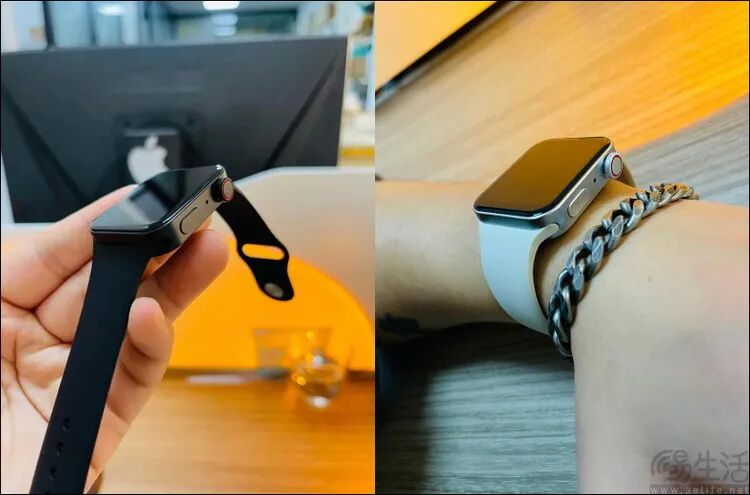
在消费类电子产品行业,"造假"或者说"山寨"从来都不是很罕见的现象。 从行业的角度来说,这是因为山寨厂商也有成熟且强大的产业链,甚至有一些"芯片大厂"为了出货量在他 们背后撑腰。 最近,我们三易生活在多个媒体都看到了一款名为"Rogbid Fusion"的设备。 从市场的角度来说,山寨产品之所以一直存在,也是因为生产者和消费者实际上是"双向奔赴"。生产山寨 产品的人看中的是低成本和"蹭热度"可能带来的暴利。而买山寨的消费者则往往有一种侥幸心理,觉得兴 许能捡个便宜,或者如果别人看不出自己用的是山寨产品,多少还能"挣个面子"。 但正是因为大多数情况下这些山寨产品假得"直白又离谱",所以大家也会注意到,主流的"正规媒体"绝大 多数情况下都绝不会去主动报道相关产品。因为如果报道了,就无异于是"助纣为虐"了。 这其实是一款"二合一智能戒指"。说它"二合一",是因为与普遍的智能戒指不同,它在结构和外观上实际 上不像智能戒指,而更像是"迷你智能手表"。它有一个非常小的触摸屏,并可以通过更换不同的"表带", 切换智能戒指和智能手环两种不同的"佩戴方式"。 但如果有那么一类山寨产品,正经的媒体普遍对其"毫不避讳",甚至都不是 ...
成本12美元收费119美元?iPhone17电池利润惊人
Guan Cha Zhe Wang· 2026-02-10 08:39
Group 1 - The core point of the article highlights the significant profit margin Apple achieves from its battery replacement service for the iPhone 17 Pro Max, with a net profit of $100 per battery replacement, resulting in a profit margin of 89% [3] - The cost of the battery for Apple is approximately $12, while the replacement price for consumers is $119 in the US and 969 yuan in China, indicating a substantial markup [3] - Apple's service revenue for the fiscal year 2025 exceeded $108.6 billion, with a gross margin of 75%, and the first quarter of fiscal year 2026 saw service revenue surpassing $30 billion, growing 14% year-over-year with a gross margin of 76.5% [3] Group 2 - The article compares Apple's battery replacement costs with those of competitors, noting that OPPO Find X9 Pro's battery replacement costs 249 yuan, while Xiaomi 17 Pro and Vivo X300 series are priced at 199 yuan, highlighting the disparity in revenue potential [7]


雷军在线过小年、OPPO二月大升级、荣耀给惊喜,vivo呢?
Sou Hu Cai Jing· 2026-02-10 05:36
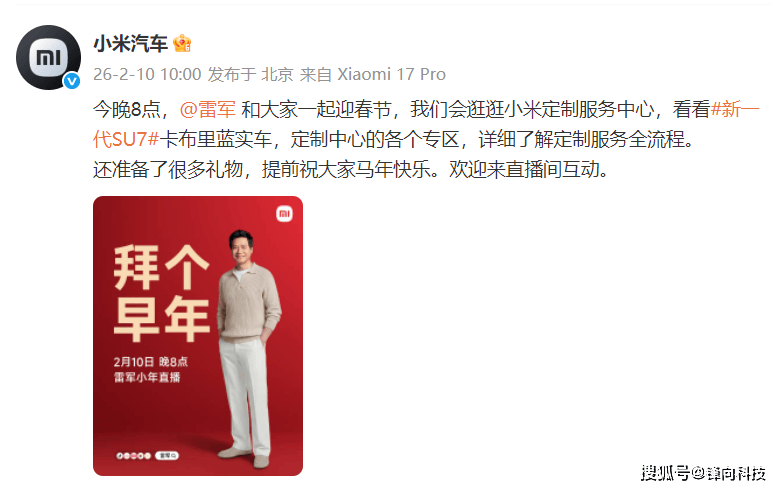
Group 1 - Xiaomi's Lei Jun will host a live stream at the Xiaomi Custom Service Center, showcasing the new SU7 car and discussing recent developments in Xiaomi's automotive sector, including legal updates for users [4] - Vivo is leveraging the return of brand ambassador Zheng Qinwen to promote the Vivo X300 series, which has sold approximately 1.4 million units, ranking third among domestic flagship brands [7] - OPPO has announced a significant update for its ColorOS, introducing features like AI writing for New Year greetings and enhancements for various applications, while also preparing for the launch of the Find N6 foldable phone [8] Group 2 - Honor is offering a limited-time discount of 300 yuan on two models, the Honor Magic8 Pro mini and Honor Magic V Flip2, with a total discount of 800 yuan, bringing the starting price of the Magic8 Pro mini to 4199 yuan [10]

苹果加入「互传联盟」?安卓将兼容AirDrop,无需装App即可「隔空投送」
3 6 Ke· 2026-02-10 04:53
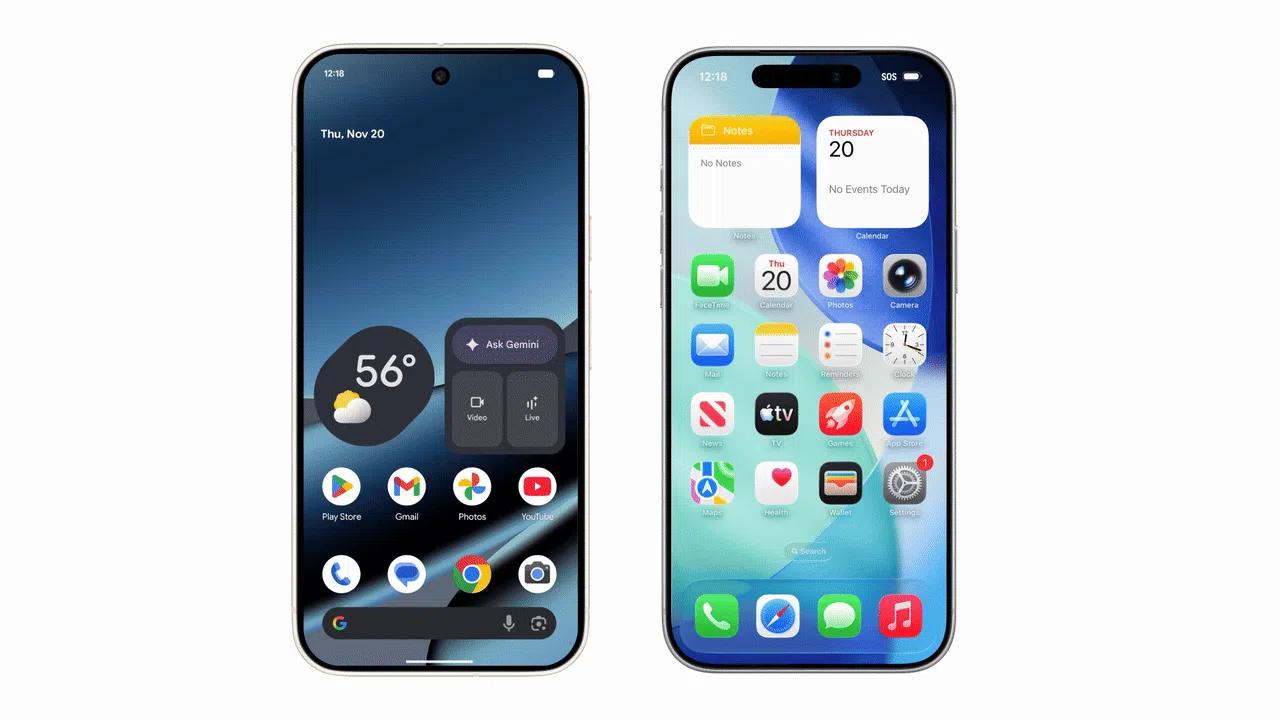
Core Insights - Google has enabled Pixel phones to appear in the AirDrop list of Apple devices, allowing seamless file transfer without the need for third-party apps [1] - The compatibility with AirDrop will be expanded to the entire Android ecosystem by 2026, enhancing cross-platform file sharing capabilities [2] - This development signifies a shift in the competitive landscape, as it provides Android devices with a native entry point for cross-ecosystem communication, challenging Apple's previously exclusive ecosystem [4][11] Group 1: Compatibility and User Experience - Google's approach differs from other manufacturers by directly integrating with the AirDrop protocol, allowing Android devices to be recognized as native Apple devices during file sharing [6][10] - The user experience is significantly improved, as there are no additional steps or learning curves required for file sharing between Android and Apple devices [8][20] - This change reduces the friction in cross-ecosystem file transfers, making it more natural for users to share files between different platforms [14][21] Group 2: Impact on Competitors - The expansion of AirDrop compatibility will challenge Android manufacturers that have previously emphasized their own cross-compatibility solutions with Apple devices [15][17] - Companies like Xiaomi, OPPO, and Huawei, which have built their ecosystems around proprietary solutions, may need to reassess their strategies as Google's integration becomes a standard feature across Android devices [16] - The shift towards a unified local transfer standard could reshape relationships within the Android ecosystem, promoting better interoperability among different brands [17] Group 3: Benefits to Users - Users will benefit from a more flexible device ecosystem, as they can easily switch between Android and Apple devices without worrying about file transfer limitations [20] - The ability to share files seamlessly across platforms enhances the overall user experience, making device selection less constrained by compatibility issues [21] - This development highlights the importance of connectivity between devices, which may become a key factor in user satisfaction and device choice in the future [21]

中国银河证券:空调行业提价坚决 扫地机在犹豫中减少自补
智通财经网· 2026-02-10 01:51
智通财经APP获悉,中国银河证券发布研报称,家电面临成本驱动的提价,以及部分结构性升级。本轮 成本上涨周期与2020Q3-2022Q2连续8个季度的成本大幅上涨差异。空调提价坚决,该行预计2025年Q4 是空调市场竞争、成本压力最大的时期。2026年以来的提价将明显缓解行业成本压力。扫地机试图结束 自补,但情况较为复杂。彩电结构升级、运动相机竞争激烈。 1)扫地机国补受益于部分地方政府选品。2025年下半年,扫地机国补基本停止,科沃斯、石头等品牌自 补(对消费者宣称国补)导致企业盈利承压。2)扫地机企业试图结束自补,但由于2026年初以来部分省份 恢复对扫地机的补贴,JD、TMALL也倾向于给与补贴,目前已经全面恢复"国补"(补贴来自国家、平 台、企业)。3)AVC监测的扫地机线上零售均价,2025年10、11、12月零售均价3645、3387、3291,同 比分别-2.9%、-6.2%、-5.1%,环比也呈现下降。到2026年第四周、第五周均价回升到3535、3403元, 有所回升。但扫地机市场没有摆脱 "国补"名义的影响(补贴来自国家、平台、企业)。 彩电结构升级、运动相机竞争激烈 本轮成本上涨周期与20 ...

板块一年暴涨80%,AI 吞噬式需求引爆存储超级周期
3 6 Ke· 2026-02-10 01:15
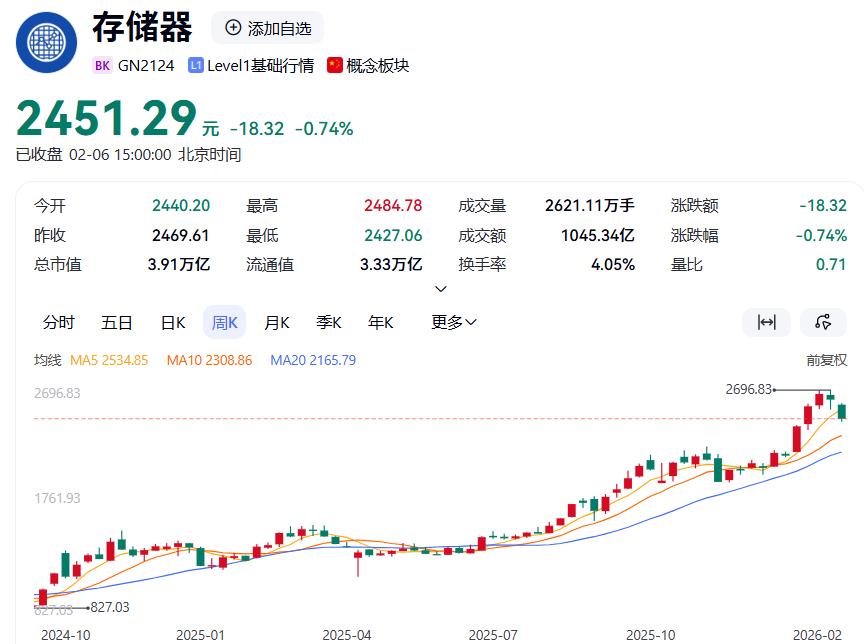
Core Viewpoint - The Chinese storage industry is experiencing a "value reassessment" with a significant surge in stock prices and a 50% increase in the storage sector within a month, marking the onset of a "super bull market" driven by AI demand and domestic production capabilities [1][3][5]. Group 1: Market Dynamics - Over ten trading days, more than 20 stocks hit the daily limit, with companies like Zhaoyi Innovation seeing an 80% increase in ten days and Changjiang Storage achieving a 180% rise this year [3][5]. - The price of 256GB DDR5 server memory has exceeded 50,000 yuan, while the price of 16GB DDR4 memory has surged from 180 yuan to 420 yuan, indicating extreme market volatility [5][7]. - The current demand for AI servers is 8-10 times higher than traditional servers, consuming 53% of global memory production capacity, while supply is constrained due to major manufacturers reallocating 80% of advanced capacity to higher-margin products [7][9]. Group 2: Technological Advancements - The establishment of the domestic storage ecosystem alliance and a 5 billion yuan special fund aims to focus on core technologies such as DRAM and NAND Flash, with significant improvements in efficiency and cost reductions [3][9]. - The HBM3e high-bandwidth memory has achieved mass production, and Changjiang Storage's 232-layer 3D NAND has reduced unit storage costs by 70% [3][9]. - The transition from imported reliance to domestic alternatives in storage chips signifies a major shift in the industry, with the storage cycle moving from "moderate growth" to a "super bull market" [3][9]. Group 3: Financial Performance - SK Hynix's net profit is expected to surge by 119% in Q3 2025, while Samsung's semiconductor business profits are projected to grow by 31.81% [11][12]. - Domestic module manufacturers like Jiangbolong are experiencing a V-shaped recovery, with net profits increasing by 1994% year-on-year [11][12]. - The overall market for storage chips in China is projected to reach nearly 500 billion yuan by 2026, with domestic manufacturers rapidly filling the gap in mature process fields [12][13]. Group 4: Industry Structure and Future Outlook - The storage chip industry is evolving from a traditional cyclical market to a core component of AI infrastructure, necessitating a comprehensive restructuring of the industry chain [13][25]. - The domestic storage industry is poised for a significant rebound in 2026, supported by government initiatives and market demand, with a focus on high-end breakthroughs [25][26]. - Companies that can integrate data, storage, and computing solutions will establish barriers in AI inference, edge computing, and smart terminals, positioning themselves as key players in the storage era [23][25].
从“产品出海”到“文化出海”:双轮驱动“广货”全球启新程
2 1 Shi Ji Jing Ji Bao Dao· 2026-02-10 00:25
Core Viewpoint - The "Guangdong Goods Going Global" initiative represents a significant step in Guangdong's strategy to enhance its global trade presence, focusing on high-quality development and industrial upgrades, while leveraging local cultural elements to strengthen brand identity and market reach [2][3][9]. Group 1: Industrial Foundation - Guangdong has maintained its position as China's largest foreign trade province for over 30 years, accounting for about one-quarter of the national total, establishing itself as a core hub for international market engagement [3]. - The province has developed a comprehensive industrial ecosystem, particularly in consumer electronics, new energy vehicles, and home appliances, with thousands of specialized enterprises and leading companies [3][4]. - Shenzhen is highlighted as a global innovation center for consumer electronics, with major companies like Huawei and OPPO driving rapid responses to global demand through efficient industrial clusters [4][5]. Group 2: Challenges and Opportunities - Despite impressive export volumes, Guangdong's "Guangdong Goods" face challenges such as a lack of core technologies and global brand recognition, with many small enterprises relying on OEM models [4][5]. - The need for deeper cultural communication and adaptation to international standards is emphasized, as well as the importance of overcoming barriers related to green trade and geopolitical tensions [4][9]. Group 3: Policy and Platform Support - The Guangdong government has implemented supportive policies, including export tax rebates and R&D subsidies, to alleviate financial and logistical pressures on enterprises [5][10]. - The Canton Fair serves as a national-level platform facilitating global connections, attracting numerous international buyers and enhancing trade opportunities [5][10]. Group 4: Cultural Empowerment - Cultural elements are integrated into the branding and marketing strategies of "Guangdong Goods," enhancing their appeal in international markets [7][8]. - The initiative promotes a dual approach of "product + culture," allowing for a richer narrative that resonates with global consumers, as seen in the marketing of local agricultural products and traditional crafts [7][8]. Group 5: Strategic Collaboration - The dual-wheel drive strategy, combining industrial strength and cultural communication, is essential for overcoming the "big but not strong" dilemma faced by Guangdong's exports [9][10]. - Successful examples from companies like Xiaopeng and DJI illustrate the effectiveness of this collaborative approach in enhancing brand recognition and market penetration [9][10]. Group 6: Future Outlook - The "Guangdong Goods Going Global" initiative marks a new starting point for transforming Guangdong into a global brand leader, emphasizing the importance of maintaining quality and innovation while fostering cultural confidence [11].
对话MossCode:估值1亿美金的AI运动手表,想给用户构建一套「个人运动能力Context」
Founder Park· 2026-02-09 12:45
Core Insights - The AI wearable market is experiencing significant growth, with various forms of products like necklaces, headphones, rings, and watches emerging [2] - The smartwatch segment is undergoing structural changes, with Apple Watch experiencing a decline in shipments by 10%-19% annually, while competitors like Garmin are seeing substantial growth, with 10 million units shipped and $4 billion in revenue, reflecting a 30% year-over-year increase [3] - There is a clear consumer trend towards more specialized and segmented health monitoring devices, leading to increased competition and innovation in the market [3] Company Overview - MossCode, an AI smart wearable brand, recently completed a multi-million RMB angel round financing led by XVC and Qingliu Capital, achieving a valuation of $100 million [4] - The founding team comprises members from leading companies and institutions, including EcoFlow, OPPO, Stanford, Apple, Huawei, and Suunto, with a focus on creating a product that breaks away from traditional narratives in the sports industry [4][5] - The company's philosophy emphasizes understanding individual differences through AI, aiming to help users find their own rhythm rather than competing against others [4][5] Market Positioning - MossCode's product strategy is based on three principles: long-term relevance, differentiation through personal experience, and aligning users with consumers [10] - The choice of smartwatches as the primary product form is due to their unobtrusive nature and ability to serve as a central data hub, making them ideal for continuous user engagement [11] - The company aims to differentiate itself by integrating AI deeply into its products, addressing the hidden barriers that traditional smartwatches present to users [17][18] User-Centric Approach - MossCode seeks to redefine the relationship between users and sports products by focusing on holistic health management rather than just athletic performance [19][20] - The brand aims to help users return to self-awareness, emphasizing that the goal of exercise is personal improvement rather than competition [20][21] - The product design incorporates user feedback and subjective experiences, aiming to create a supportive environment for personal growth [41][42] Technological Innovation - The integration of AI allows for personalized fitness guidance, making professional advice more accessible and tailored to individual needs [24][25] - The system is designed to continuously learn from user data, providing insights that evolve over time, thus enhancing the user experience [28][36] - The focus on subjective user experiences and feelings is seen as a critical variable in understanding individual adaptability and performance [41][42] Competitive Landscape - MossCode recognizes the reliability and established trust of competitors like Garmin, aiming to build a strong foundation of quality and user trust through rigorous testing and product development [45] - The company plans to target international markets, particularly Europe, where the sports market is more mature and competitive, allowing for advanced product refinement [46] - MossCode believes that even with similar AI technologies, its unique approach to user engagement and product development will set it apart from larger brands [50][51]