
中国移动

Search documents
1月8日港股通净卖出49.01亿港元





Zheng Quan Shi Bao Wang· 2026-01-08 15:16
Market Overview - On January 8, the Hang Seng Index fell by 1.17%, closing at 26,149.31 points, with a total net sell of HKD 4.901 billion through the southbound trading channel [1][3] - The total trading volume for the southbound trading was HKD 117.906 billion, with a net sell of HKD 4.901 billion [1] Trading Activity - In the Shanghai-Hong Kong Stock Connect, the trading volume was HKD 70.891 billion, with a net sell of HKD 3.968 billion; in the Shenzhen-Hong Kong Stock Connect, the trading volume was HKD 47.015 billion, with a net sell of HKD 0.933 billion [1] - The most actively traded stock in the Shanghai-Hong Kong Stock Connect was Alibaba-W, with a trading volume of HKD 57.22 billion, followed by the Tracker Fund of Hong Kong and SMIC, with trading volumes of HKD 48.64 billion and HKD 33.52 billion, respectively [1] Net Buy/Sell Analysis - Tencent Holdings had the highest net buy amount of HKD 0.585 billion, despite a closing price drop of 1.36% [1] - The Tracker Fund of Hong Kong recorded the highest net sell amount of HKD 4.631 billion, closing down by 1.28% [1] - In the Shenzhen-Hong Kong Stock Connect, Alibaba-W also led in trading volume with HKD 37.64 billion, while Xiaomi Group-W had the highest net buy of HKD 0.494 billion, closing down by 0.37% [2]
港股通1月8日成交活跃股名单
Zheng Quan Shi Bao Wang· 2026-01-08 15:07
Market Overview - On January 8, the Hang Seng Index fell by 1.17%, with southbound capital totaling HKD 117.906 billion, comprising HKD 56.503 billion in buying and HKD 61.403 billion in selling, resulting in a net sell of HKD 4.901 billion [1] Southbound Trading Activity - The southbound trading through Stock Connect (Shenzhen) had a total turnover of HKD 47.015 billion, with buying at HKD 23.041 billion and selling at HKD 23.974 billion, leading to a net sell of HKD 0.933 billion [1] - The southbound trading through Stock Connect (Shanghai) recorded a total turnover of HKD 70.891 billion, with buying at HKD 33.461 billion and selling at HKD 37.429 billion, resulting in a net sell of HKD 3.968 billion [1] Active Stocks - Alibaba-W had the highest trading volume among southbound stocks, with a total turnover of HKD 94.86 billion, followed by the Tracker Fund of Hong Kong and SMIC, with turnovers of HKD 65.30 billion and HKD 55.70 billion respectively [1] - The top net buying stocks included Xiaomi Group-W with a net buy of HKD 10.72 billion, Tencent Holdings with HKD 8.64 billion, and SMIC with HKD 5.63 billion [1] - The stock with the highest net sell was the Tracker Fund of Hong Kong, with a net sell of HKD 62.84 billion, followed by Hang Seng China Enterprises and Southern Hang Seng Technology with net sells of HKD 28.78 billion and HKD 12.88 billion respectively [1] Continuous Net Buying and Selling - Xiaomi Group-W, Tencent Holdings, and SMIC were among the eight stocks that appeared on both the Shenzhen and Shanghai Stock Connect active lists, with Xiaomi Group-W having a total turnover of HKD 41.07 billion and a net buy of HKD 10.72 billion, while Tencent Holdings had a turnover of HKD 45.90 billion and a net buy of HKD 8.64 billion [2] - Over a continuous period, Xiaomi Group-W, Alibaba-W, and Goldwind Technology saw net buying for more than three days, with Xiaomi Group-W leading with a total net buy of HKD 46.84 billion [2] - Conversely, China Mobile and Hua Hong Semiconductor experienced continuous net selling, with net sells of HKD 31.39 billion and HKD 6.88 billion respectively [2]
为创收要求工作人员“上门断网”?上海移动:与事实严重不符,已报案
Cai Jing Wang· 2026-01-08 14:15
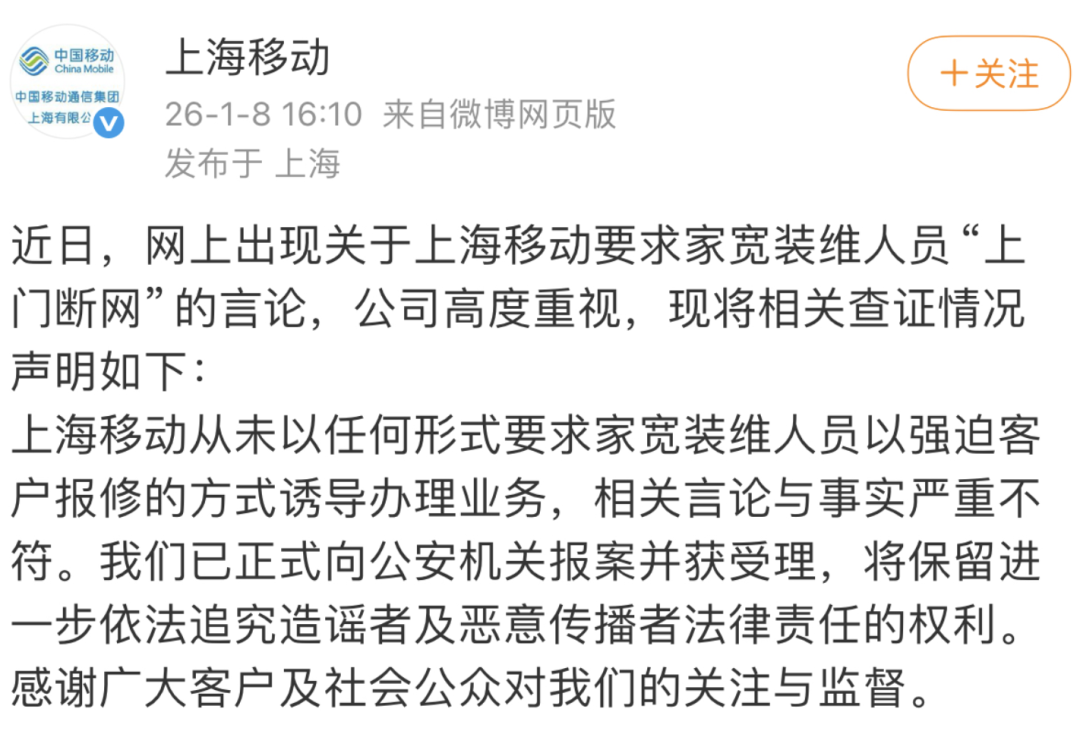
Core Viewpoint - Shanghai Mobile has been accused of pressuring employees to disconnect customers' internet services, which the company strongly denies, stating that such claims are false and have been reported to the police for further investigation [1] Group 1 - On January 7, 2026, a video surfaced alleging that Shanghai Mobile employees were coerced into disconnecting customers' internet services [1] - Shanghai Mobile officially responded on January 8, stating that it has never required its broadband installation and maintenance personnel to force customers into service cancellations [1] - The company has filed a report with law enforcement regarding the allegations and intends to pursue legal action against those spreading false information [1]


轻量化“内卷”与eSIM加持下,智能眼镜迎来新纪元?
Guo Ji Jin Rong Bao· 2026-01-08 13:24
Core Insights - The smart glasses industry is expected to transition from a niche market to a mainstream one by 2025, with significant growth in market size and product penetration [1] - Global smart glasses sales are projected to surge by 350.82% year-on-year to 13.448 million units in 2025, with the Chinese market seeing a 159.76% increase to 3.286 million units [2] - The introduction of eSIM technology is anticipated to enhance the functionality of smart glasses, allowing them to operate independently from smartphones [7][8] Market Trends - The CES 2026 showcased smart glasses as a focal point, with 38 exhibition booths dedicated to this category, highlighting the growing interest and competition in the market [4] - Lightweight design has become a core competitive factor, with several companies unveiling ultra-light models, such as Rokid's 38.5g AI glasses and MoJie's 25g AR glasses [5][6] - The integration of eSIM technology is seen as a pivotal development, enabling smart glasses to function as independent communication devices, similar to smartwatches [8] Industry Challenges - The smart glasses industry faces challenges in achieving product differentiation, maintaining lightweight designs, and effectively utilizing AI technology to establish themselves as independent smart devices [3][10] - The competition is expected to shift from a chaotic phase to a more structured one, focusing on quality, technology, and ecosystem capabilities [9] - Key challenges include balancing power consumption, size, and functionality, as well as establishing a robust application ecosystem that creates indispensable use cases for smart glasses [10]


超聚变要上市 走势之外的关键在这里
Sou Hu Cai Jing· 2026-01-08 13:10
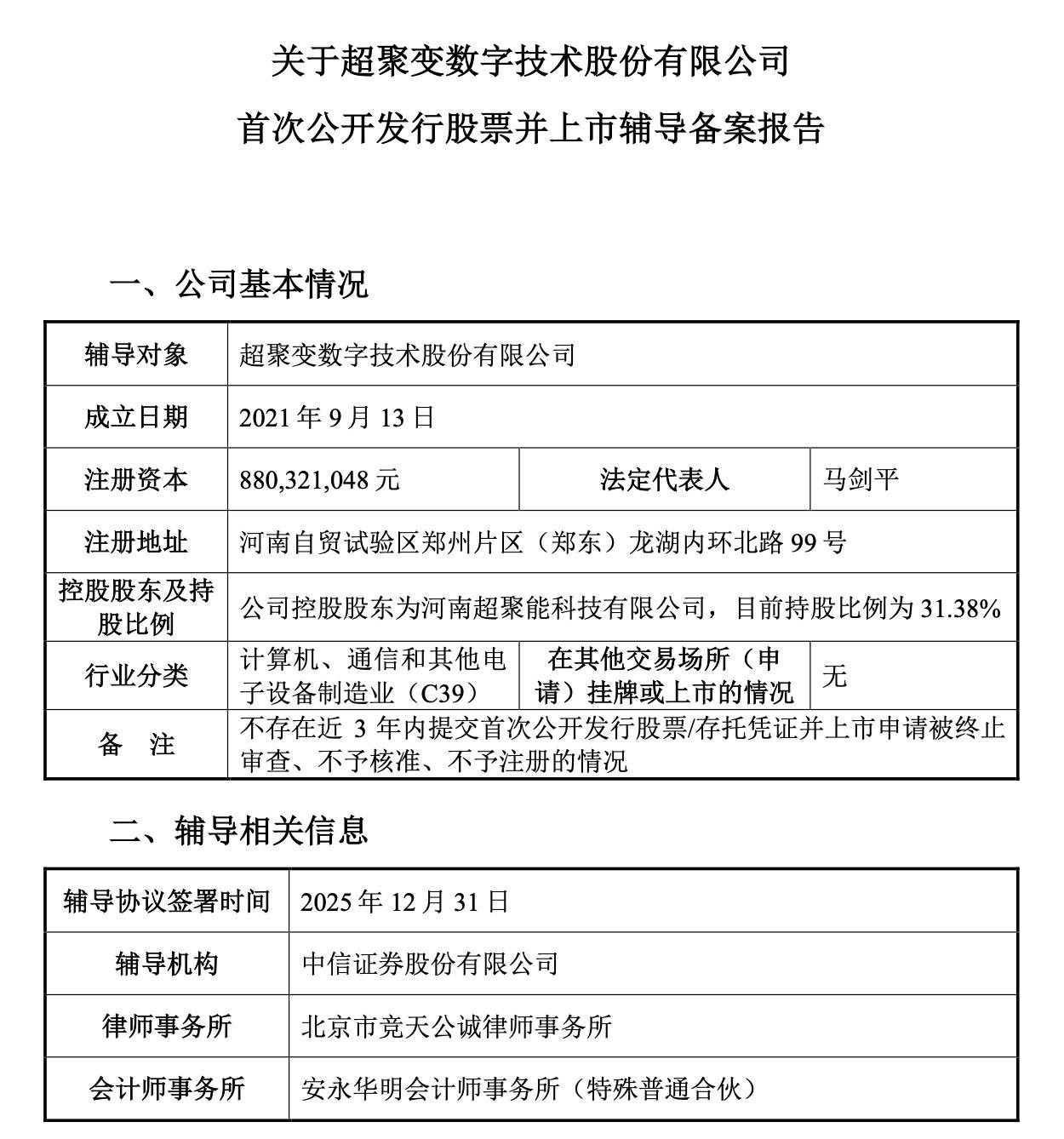
Group 1 - The core point of the article highlights the rapid growth of Chaojuyuan Digital Technology Co., Ltd., which has seen its revenue increase from 10 billion in 2022 to 40 billion in 2024, and is preparing for an IPO with support from major state-owned investors [1][2] - Chaojuyuan was established in September 2021 and is based in Zhengzhou, Henan, with a registered capital of approximately 880 million yuan [2] - The company is backed by significant state-owned entities, including China Mobile's investment arm and China Telecom, indicating strong institutional support [1][2] Group 2 - The article emphasizes that stock price movements are primarily influenced by institutional trading behaviors rather than company fundamentals or shareholder backgrounds [1][6] - It discusses the importance of monitoring institutional inventory data to understand market trends, as institutional funds have a more substantial impact on stock prices than retail investors [6][9] - The author shares experiences illustrating how misleading stock price movements can be, stressing that true market dynamics are driven by institutional actions rather than superficial trends [4][11] Group 3 - The article concludes that for investors, especially retail ones, it is crucial to focus on institutional trading behaviors rather than just stock price movements or news [13][14] - It suggests that even if a company has strong fundamentals, the stock price will ultimately depend on the interest and activity of institutional investors [13][14] - The use of quantitative data to assess institutional activity is recommended as a more reliable method for making investment decisions [14]
中国移动通信集团四川有限公司因违规被暂停军采购资格
Qi Lu Wan Bao· 2026-01-08 12:38
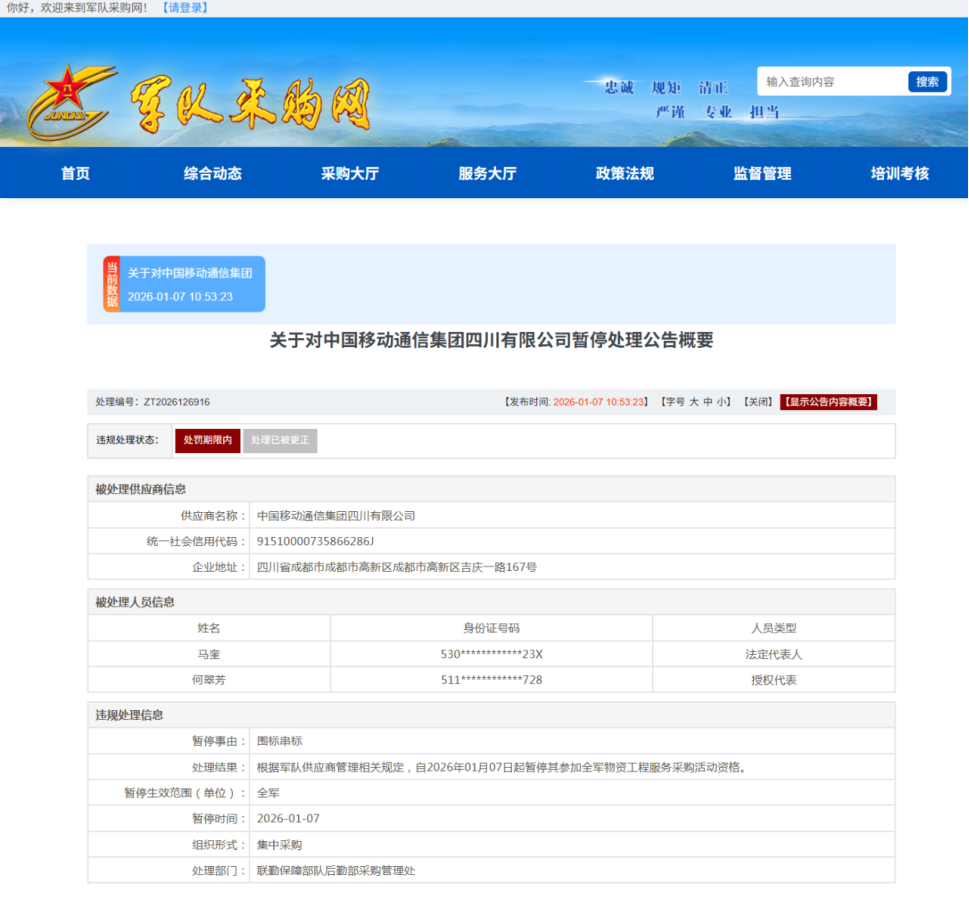
Group 1 - The core point of the article is that China Mobile Communication Group Sichuan Co., Ltd. has been suspended from participating in military procurement activities due to "collusion in bidding" behavior, effective from January 7, 2026 [1][4]. - The suspension applies to all military procurement activities and is organized in a centralized manner by the Logistics Support Force's Procurement Management Office [4]. - The legal representative of the company, Ma Kui, and the authorized representative, He Cuifang, are also prohibited from participating in military procurement activities during the suspension period [4]. Group 2 - China Mobile Communication Group Sichuan Co., Ltd. was established on February 4, 2002, with a registered and paid-in capital of 748,362.56 million RMB [5]. - The company operates in the mobile telecommunications service industry [5].
战新产业与未来产业领航,央企开辟增长“第二曲线”
Hua Xia Shi Bao· 2026-01-08 12:16
Core Insights - The article emphasizes the importance of the "14th Five-Year Plan" implementation period starting in 2026, focusing on enhancing core functions and competitiveness of state-owned enterprises (SOEs) to achieve world-class status [2] - The central government aims to accelerate industrial upgrades and foster new growth drivers through strategic investments in emerging industries such as artificial intelligence, biomedicine, and digital economy [2][3] Group 1: Industrial Upgrades and Strategic Focus - The State-owned Assets Supervision and Administration Commission (SASAC) is promoting a dual-track development model for SOEs, focusing on both traditional industry enhancement and the cultivation of new growth drivers [3] - Central enterprises are expected to invest in strategic emerging industries, with an annual investment growth rate exceeding 20% over the past five years, reaching 3.3 trillion yuan in fixed asset investments (excluding real estate) from January to November 2025 [3] Group 2: Technological Advancements and R&D Investment - Central enterprises have significantly increased R&D investment, amounting to 890.16 billion yuan from January to November 2025, with an R&D intensity of 2.62% [5] - Breakthroughs in key technologies have been achieved, such as the development of a world-first megawatt-level CO₂ thermal energy storage system and a 700-megawatt ultra-supercritical circulating fluidized bed boiler [5][6] Group 3: Collaborative Ecosystem and Mechanism Reforms - SOEs are moving away from isolated operations by forming innovation alliances and promoting collaborative development across the industrial chain, with 24 innovation alliances involving over 800 enterprises and institutions [7] - The SASAC plans to advance strategic and specialized mergers and acquisitions in 2026, focusing on sectors like new energy, integrated circuits, and biotechnology to enhance competitive advantages [8]


图解丨南下资金逆势净买入小米、腾讯和中芯国际
Ge Long Hui· 2026-01-08 11:56
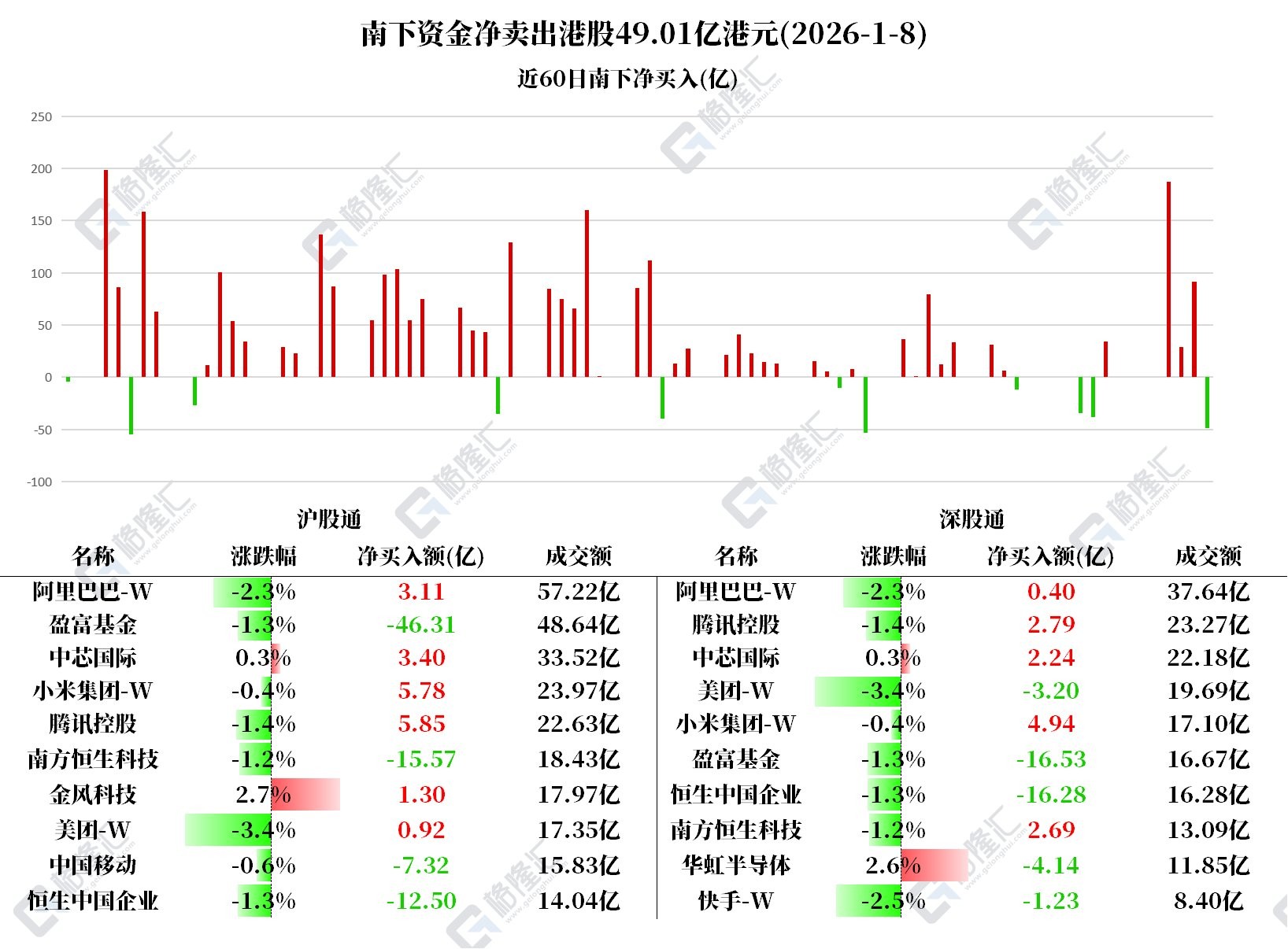
Group 1 - The net outflow of southbound funds from Hong Kong stocks today amounted to HKD 4.9 billion, with notable net purchases in Xiaomi Group (HKD 1.072 billion), Tencent Holdings (HKD 0.863 billion), SMIC (HKD 0.563 billion), Alibaba (HKD 0.35 billion), and Goldwind Technology (HKD 0.13 billion) [1] - The net sales included significant amounts in the Tracker Fund of Hong Kong (HKD 6.284 billion), Hang Seng China Enterprises (HKD 2.878 billion), Southern Hang Seng Technology (HKD 1.288 billion), China Mobile (HKD 0.732 billion), Hua Hong Semiconductor (HKD 0.413 billion), Meituan (HKD 0.227 billion), and Kuaishou (HKD 0.122 billion) [1] - Southbound funds have recorded six consecutive days of net purchases in Xiaomi, totaling HKD 4.6844 billion, and five consecutive days of net purchases in Alibaba, totaling HKD 2.46627 billion; conversely, there have been four consecutive days of net sales in China Mobile, totaling HKD 3.13893 billion [1] Group 2 - In the Shanghai Stock Connect, Alibaba saw a decline of 2.3% with a net purchase of HKD 0.311 billion, while Tencent experienced a drop of 1.3% with a net outflow of HKD 4.631 billion [4] - SMIC had a slight increase of 0.3% with a net purchase of HKD 0.34 billion, and Xiaomi Group saw a decrease of 0.4% with a net purchase of HKD 0.578 billion [4] - Goldwind Technology increased by 2.7% with a net purchase of HKD 0.13 billion, while China Mobile decreased by 0.6% with a net outflow of HKD 0.732 billion [4]

如何挑选合适的随身WiFi品牌?2026 年随身WiFi品牌推荐与选购指南
Xin Lang Cai Jing· 2026-01-08 11:48
一、随身 WiFi 选购核心要素1.1 北京地区网络环境特点 北京作为超大型城市,不同区域的网络环境存在显著差异。选择随身 WiFi 前,需要了解你经常活动的 区域有哪些网络特点: 市中心区域(国贸、CBD、朝阳大悦城等) 中国联通:在市区表现最为出色,朝阳大悦城实测 5G 平均网速可达 368Mbps,视频加载速度比普通套 餐快 38% 中国电信:在商务区信号稳定,特别适合高楼林立的 CBD 区域 痛点:晚高峰时段,西二旗、望京等互联网公司聚集地网络拥堵严重 郊区及偏远地区(昌平、门头沟等) 中国移动:在郊区的覆盖表现突出,昌平区已实现 5G 连续覆盖,山区自然村也建设了超过百个 5G 基 站 中国广电:作为新晋运营商,共享移动基站,并拥有 700MHz 黄金频段,信号穿透力强 特殊场景(地铁、地下车库、电梯) 中国广电:凭借 700MHz 频段,在一些地下车库或电梯内,信号表现甚至优于其他运营商 中国移动:基站数量最多,在密闭空间通常有较好的信号表现 实测数据:北京地铁 10 号线使用移动卡刷视频基本无缓冲 1.2 四大运营商信号质量对比 中国移动:信号覆盖的王者 优势:郊区覆盖最强,夜间网络稳定,基站数 ...
图解丨北水加仓小米超10亿港元,连续4日卖出中国移动
Ge Long Hui· 2026-01-08 11:47
Group 1: Investment Trends - Net purchases included Xiaomi Group at 1.072 billion, Tencent Holdings at 863 million, SMIC at 563 million, Alibaba at 350 million, and Goldwind Technology at 130 million [1] - Net sales included the Tracker Fund at 6.284 billion, Hang Seng China Enterprises at 2.878 billion, Southern Hang Seng Technology at 1.288 billion, China Mobile at 732 million, and Hua Hong Semiconductor at 413 million [1] - Southbound funds have recorded six consecutive days of net purchases for Xiaomi, totaling 4.6844 billion HKD, and five consecutive days for Alibaba, totaling 2.46627 billion HKD [1] Group 2: Stock Performance - Alibaba-W saw a decline of 2.3% with a net purchase of 311 million and a transaction volume of 5.722 billion [4] - Tencent Holdings experienced a drop of 1.4% with a net purchase of 585 million and a transaction volume of 2.263 billion [4] - Goldwind Technology increased by 2.7% with a net purchase of 130 million and a transaction volume of 1.797 billion [4] Group 3: Company Insights - Tencent Holdings is viewed positively for its monetization capabilities among moderate to heavy users, despite short-term competition concerns in the music sector [5] - SMIC's acquisition of 49% of the shares in SMIC North is expected to positively impact both short-term and long-term shareholder value, with a projected increase in net profit of over 120 million USD by 2026 [5] - Alibaba's recent communication indicates significant progress in its Taobao Flash Sale initiative, with a clear strategy for market share growth and increased investment [5] Group 4: Analyst Ratings - Daiwa has upgraded Goldwind Technology's rating to "Outperform" with a target price raised to 17 HKD [6]
