
成都银行

Search documents
银行股一季度机构持仓情况:中央汇金借道ETF增持,险资举牌活跃
Huan Qiu Wang· 2025-05-09 06:08
Group 1 - Central Huijin has heavily invested in 8 bank stocks, including major state-owned banks like ICBC, ABC, BOC, and CCB, as well as several joint-stock banks and a city commercial bank [3] - Social Security Fund has increased its holdings in 5 bank stocks, with a notable increase in shares of Changshu Bank, totaling an increase of 288.18 thousand shares since the beginning of the year [3] - Insurance funds have shown strong interest in bank stocks, with multiple insurance companies acquiring stakes in 5 listed banks during the first quarter of this year [3] Group 2 - Australia and New Zealand Banking Group signed a share transfer agreement with New China Life Insurance, transferring approximately 330 million shares of Hangzhou Bank, representing 5.45% of the total issued shares [4]






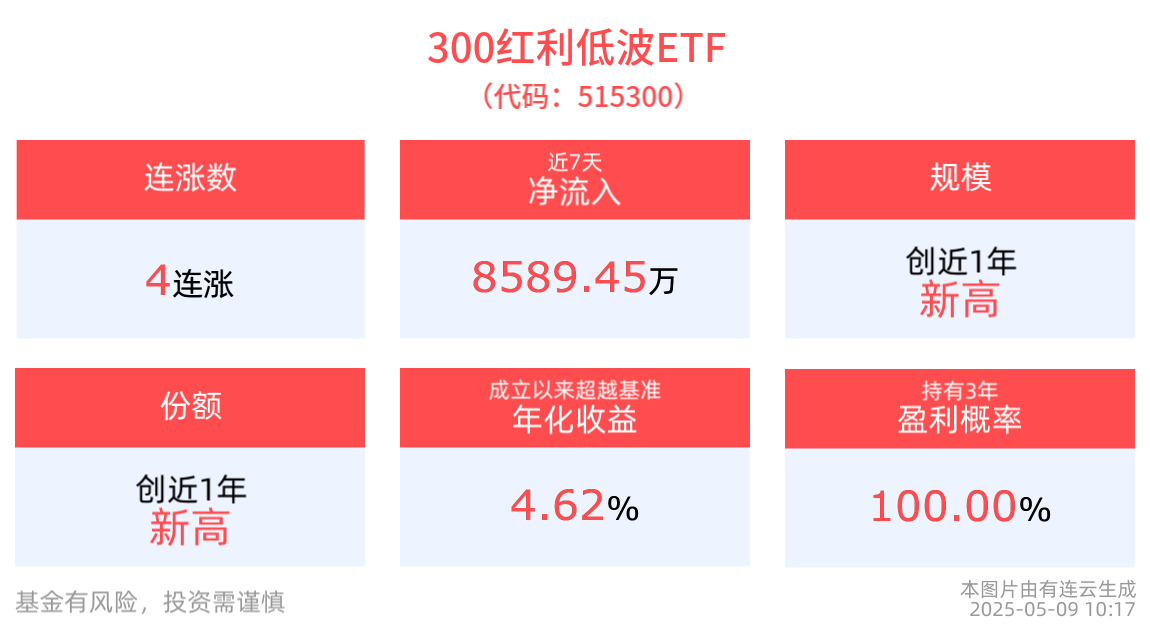
单日获资金净流入超5200万元,300红利低波ETF(515300)冲击4连涨
Xin Lang Cai Jing· 2025-05-09 02:45
Group 1 - The core viewpoint of the news highlights the strong performance and increasing popularity of the 300 Dividend Low Volatility ETF, with significant trading volume and net inflows indicating investor confidence [1] - As of May 8, the average daily trading volume of the 300 Dividend Low Volatility ETF over the past week reached 115 million yuan, with a total trading volume of 17.2858 million yuan on a single day [1] - The latest scale of the 300 Dividend Low Volatility ETF has reached 5.497 billion yuan, marking a one-year high, with the latest share count at 4.015 billion shares, also a one-year high [1] Group 2 - The net inflow of funds into the 300 Dividend Low Volatility ETF was 52.0532 million yuan, with six out of the last seven trading days showing net inflows totaling 85.8945 million yuan [1] - The top ten weighted stocks in the CSI 300 Dividend Low Volatility Index as of April 30, 2025, include major companies such as China Shenhua, Gree Electric, and Sinopec, accounting for a total of 37.43% of the index [1] - A report from Huatai Securities indicates that recent financial policies aimed at stabilizing the market and improving expectations, along with positive developments in Sino-US trade relations, are likely to support the risk appetite of market participants [1] Group 3 - The report suggests that mid-term investments should focus on large-cap stocks, particularly in sectors like technology and consumer goods, which are expected to benefit from policy support [1] - For investors without stock accounts, there is an opportunity to invest in the corresponding CSI 300 Dividend Low Volatility ETF linked fund (007606) [2]
成都银行:“万亿行”再进阶,铸造区域金融“新引擎”
Si Chuan Ri Bao· 2025-05-08 22:49
Core Viewpoint - Chengdu Bank's 2024 annual report highlights significant growth, with total assets exceeding 1.25 trillion yuan and a net profit increase of 10.17%, marking it as a key player in the financial sector of the Chengdu-Chongqing economic circle [1][8]. Group 1: Regional Economic Collaboration - Chengdu Bank is positioned as a "new engine" for regional finance, leading in new deposit and loan scales among financial institutions in Sichuan, and supporting major infrastructure and livelihood projects [2][3]. - The bank has actively engaged in financing significant projects, including a tailored asset-backed commercial paper for Huaxi Group, unlocking nearly 1 billion yuan in receivables [3]. - The bank's services extend to major infrastructure projects, ensuring comprehensive financial support for key industries and achieving 100% coverage of financial services for regional industrial chains [3][4]. Group 2: Retail Transformation - Chengdu Bank has shifted focus to retail banking, with personal deposits surpassing 400 billion yuan and leading in personal loan growth within the region [5]. - The bank's retail strategy emphasizes customer-centric services, including tailored offerings for elderly clients, resulting in a significant increase in service accessibility [5][6]. - The bank has developed a chain service system for corporate clients, enhancing financial management solutions and expanding its wealth management services [6]. Group 3: Financial Technology Development - Chengdu Bank is enhancing its digital capabilities through significant investments in technology, including upgrades to its bill business system and internet loan services [7]. - The bank's technology-driven approach has led to a high coverage rate of financial services for specialized small and medium enterprises, supporting their growth [7]. - The introduction of AI models for risk management has improved the bank's asset quality, with a decrease in non-performing loan rates and a high provision coverage ratio [7]. Group 4: Strategic Goals and Future Outlook - Chengdu Bank aims to build a partnership-based relationship with clients, focusing on long-term growth and alignment with regional development [8]. - The bank plans to deepen its engagement in the Chengdu-Chongqing economic circle, contributing to the prosperity of the regional financial ecosystem [8].
成都银行发布2024年报:资产规模千亿级增长,扎根区域经济凸显发展韧性
2 1 Shi Ji Jing Ji Bao Dao· 2025-05-08 19:12
Core Insights - Chengdu Bank reported a total asset of over 1.2 trillion yuan, with a year-on-year growth of 14.56%, and achieved net profit of 12 billion yuan, marking a 10.17% increase [1][2][3] Financial Performance - Total assets reached 1,250.116 billion yuan, an increase of 158.873 billion yuan from the previous year, with a growth rate of 14.56% [1][2] - Total deposits amounted to 885.859 billion yuan, up by 105.438 billion yuan, reflecting a growth of 13.51% [1][2] - Total loans increased to 742.568 billion yuan, with a growth of 116.826 billion yuan, representing an 18.67% increase [1][2] - The bank's non-performing loan ratio decreased to 0.66%, marking a nine-year decline [1][2] Strategic Focus - Chengdu Bank emphasizes a strategy of "stabilizing deposits and efficient assets," which has led to significant market advantages [2] - The bank has successfully integrated into major regional economic strategies, enhancing its financial service capabilities [4][5] Risk Management - The bank maintains a high-quality risk control framework, with a non-performing loan coverage ratio of 479%, indicating strong risk resistance [2][3] Growth in Specific Areas - Chengdu Bank ranked second in the province for new deposits and first for new loans in 2024, showcasing its competitive position [2] - The bank's personal deposit growth has reached 5.6 times the level when it first proposed a "large retail" transformation in 2018 [2] Future Outlook - The bank aims to continue enhancing its development quality and efficiency, contributing to China's modernization efforts [6]
政策“组合拳”发力 银行股持续活跃
Shang Hai Zheng Quan Bao· 2025-05-08 18:45
Core Viewpoint - The recent surge in A-share bank stocks is attributed to a series of supportive financial policies, including interest rate cuts and reserve requirement ratio reductions, which enhance the stability and profitability of banks [1][2]. Group 1: Financial Policies Impact - On May 7, the People's Bank of China announced a package of financial measures, including a 0.1 percentage point reduction in policy interest rates and a 0.5 percentage point decrease in the reserve requirement ratio [2]. - The introduction of 500 billion yuan for consumer and pension re-loans is expected to further stimulate bank lending and improve asset quality [2]. - Analysts believe that these policies will lead to a stable credit supply and manageable asset quality pressures for banks [2]. Group 2: Market Performance - On May 8, bank stocks continued to perform strongly, with Shanghai Pudong Development Bank reaching a new high of 11.69 yuan per share, and Jiangsu Bank closing up 2.46% at 10.41 yuan per share, pushing its market capitalization above 191 billion yuan [1]. - Other banks, such as Qingnong Commercial Bank and Qingdao Bank, also saw significant gains, with increases exceeding 3% [1]. - Bank-related ETFs also performed well, with several ETFs showing gains of over 1% [1]. Group 3: Institutional Investment - Insurance funds have shown a strong preference for bank stocks, holding 27.82 billion shares valued at 265.78 billion yuan as of the end of the first quarter, making banks the top holdings [3]. - The trend of institutional investment in bank stocks is expected to accelerate, enhancing the dividend value of the banking sector [3]. - Analysts suggest that the high dividend yield characteristic of bank stocks makes them attractive for long-term investors, reinforcing their strategic value in both short and long-term portfolios [3].




一季度银行板块资金动向浮出水面 多路中长期资金涌入
Zheng Quan Ri Bao· 2025-05-08 16:10
Core Viewpoint - The report highlights the significant inflow of medium to long-term funds into the banking sector in China during the first quarter of 2024, driven by increased investments from Central Huijin, social security funds, and insurance companies, leading to a positive performance in bank stocks [1][4]. Group 1: Central Huijin's Investment Activities - Central Huijin increased its holdings in multiple ETFs, which brought additional passive funds into the banking sector, particularly benefiting high-dividend bank stocks [1][2]. - As of the end of Q1 2024, Central Huijin held significant positions in eight bank stocks, including major state-owned banks and several national joint-stock banks, with notable increases in ETF holdings [2]. Group 2: Social Security Fund's Holdings - By the end of Q1 2024, the social security fund had significant holdings in five bank stocks, with an overall increase in the number of shares held compared to the beginning of the year, particularly in Changshu Bank [3]. Group 3: Insurance Companies' Activities - Insurance companies have shown strong interest in bank stocks, with several firms collectively acquiring stakes in five listed banks, including Agricultural Bank of China and China Merchants Bank, indicating a robust inflow of funds into the banking sector [4]. Group 4: Market Outlook - The valuation recovery of bank stocks is influenced by macroeconomic policies and asset quality improvements, with expectations for continued interest in high-dividend strategies in the short term [5].
银行业:降息降准落地,息差影响中性偏积极,银行股价值凸显
China Post Securities· 2025-05-08 12:23
Industry Investment Rating - The industry investment rating is maintained at "Outperform the Market" [2][24] Core Viewpoints - The recent interest rate cuts and reserve requirement ratio reductions are expected to have a neutral to positive impact on banks' net interest margins, with a projected decrease in the Loan Prime Rate (LPR) by approximately 0.1 percentage points [4][13] - The policy signals are significant and are expected to improve the fundamentals of the banking sector, stimulating credit and asset investments, with an estimated increase of about 1.8 trillion yuan in credit funds due to various refinancing measures [6][16] - The asset quality of banks is anticipated to improve, particularly in the real estate sector, as new financing regulations are expected to stabilize the market [19] Summary by Sections 1. Impact of Interest Rate Cuts and Reserve Requirement Ratio Reductions - The People's Bank of China announced a reduction in the 7-day reverse repo rate by 0.1 percentage points to 1.4%, which is expected to lead to a similar decrease in the LPR [13] - The reserve requirement ratio was lowered by 0.5 percentage points, providing approximately 1 trillion yuan in long-term liquidity to the market [13] 2. Policy Signals and Their Implications 2.1 Stimulating Credit and Asset Investments - The central bank has increased the quota for refinancing aimed at technological innovation and transformation by 300 billion yuan, and established a 500 billion yuan refinancing facility for consumer services and elderly care [6][16] - Additional refinancing quotas for agricultural and small business loans are expected to further enhance lending capabilities [16] 2.2 Improvement in Asset Quality - New financing regulations are being introduced to support the real estate sector, which is expected to lead to marginal improvements in the quality of housing-related loans [19] 3. Investment Recommendations - Following the interest rate cuts, there is an opening for lower risk-free interest rates, highlighting the value of state-owned banks. Recommended banks include Industrial and Commercial Bank of China, Agricultural Bank of China, Bank of China, China Construction Bank, and Bank of Communications [7][21] - The emphasis on expanding domestic demand through fiscal policies suggests that regional banks may exceed expectations in credit deployment, with recommendations for Chongqing Bank, Bank of Chongqing, Chengdu Bank, and Qilu Bank [21]
降息降准落地,息差影响中性偏积极,银行股价值凸显
China Post Securities· 2025-05-08 12:03
Industry Investment Rating - The industry investment rating is maintained at "Outperform the Market" [2] Core Viewpoints - The recent interest rate cuts and reserve requirement ratio reductions are expected to have a neutral to positive impact on banks' net interest margins [4][13] - The policy signals are significant and are likely to improve the fundamentals of the banking sector, stimulating credit and asset investments [6][19] - The overall outlook for bank asset quality is expected to improve due to new financing regulations and support for the real estate sector [19] Summary by Sections 1. Impact of Interest Rate Cuts and Reserve Requirement Ratio Reductions - The People's Bank of China announced a 0.1 percentage point cut in the 7-day reverse repo rate to 1.4%, which is expected to lead to a similar decrease in the Loan Prime Rate (LPR) [13] - The reserve requirement ratio was lowered by 0.5 percentage points, providing approximately 1 trillion yuan in long-term liquidity to the market [13][16] 2. Policy Signals and Their Implications 2.1 Stimulating Credit and Asset Investments - The central bank has increased the quota for re-lending to support technological innovation and small enterprises, potentially unlocking about 1.8 trillion yuan in new credit [6][16] - Additional re-lending quotas have been established for consumer services and agriculture, indicating a broadening of credit support [6][16] 2.2 Improvement in Bank Asset Quality - New financing regulations are expected to stabilize the real estate market, leading to a marginal improvement in the quality of housing-related loans [19] - The policies reflect the central government's focus on stabilizing employment, enterprises, and market expectations, which may enhance the overall asset quality of banks [19] 3. Investment Recommendations - Following the interest rate cuts, there is an opening for lower risk-free interest rates, highlighting the value of state-owned banks [21] - Recommended banks include Industrial and Commercial Bank of China, Agricultural Bank of China, Bank of China, China Construction Bank, and Bank of Communications [21] - Regional banks such as Chongqing Bank, Yunnan Rural Commercial Bank, Chengdu Bank, and Qilu Bank are also recommended due to expected credit support from fiscal policies [21]
股市特别报道·财经聚焦|银行股息率最高超8%,买入银行股便可“躺赚”
Shen Zhen Shang Bao· 2025-05-08 11:55
面对上市银行大手笔的"红包雨"以及高股息,股民们是否可靠银行股"躺赚"? 深圳商报·读创客户端首席记者 谢惠茜 与此同时,也有9家银行股息率低于4%,3家银行股息率低于2%。其中,浦发银行股息率为2.76%;宁 波银行股息率为2.40%,西安银行(600928)股息率仅为1.55%。 对此,苏商银行特约研究员武泽伟在接受记者采访时表示,高股息率表明更好的分红水平以及更低的估 值水平,投资者可以以股息率对银行股标的进行初步筛选。 不过,需要注意的是,如果投资银行股是以长期持有为目的,就要注意规避低估值陷阱,有的企业经营 状况一般,因此市场给予其较低的估值水平,企业的股息率水平就较高。但是,投资者既然准备长期持 有,就一定希望企业运营良好,从而产生源源不断的现金流来回馈股东。所以,投资者在关注股息率的 同时,要注意分辨企业的高股息率究竟来源于何方。毕竟投资要取得良好的业绩,并不是买的越便宜越 好,而是要以合适的价格买入优秀的企业。 他指出,整体而言,对于普通投资者来说,"买入并持有"银行股,是比较好的策略。拉长时间来看,银 行股长期上涨,如果算上分红,则收益水平更加丰厚。对于普通投资者来说,最重要的是要能抵住诱 ...
上市城商行2024不良率榜:哈尔滨银行2.84%蝉联第一
Zhong Guo Jing Ji Wang· 2025-05-08 07:47
Core Insights - The report highlights the performance of 30 A-share and H-share listed city commercial banks in terms of non-performing loan (NPL) ratios for the year 2024, with Harbin Bank having the highest NPL ratio at 2.84% [1][2] - Chengdu Bank recorded the lowest NPL ratio at 0.66%, showing a slight decrease from the previous year [1][2] - Overall, 20 city commercial banks saw a decrease in their NPL ratios, while 5 banks experienced an increase, and 5 banks maintained the same ratio compared to the previous year [1] NPL Ratio Summary - Harbin Bank: NPL ratio of 2.84%, down from 2.87% in 2023 [2] - Chengdu Bank: NPL ratio of 0.66%, down by 0.02 percentage points from 0.68% in 2023 [2] - Other banks with NPL ratios below 1% include Xiamen Bank, Ningbo Bank, Hangzhou Bank, Nanjing Bank, Suzhou Bank, Jiangsu Bank, and Huishang Bank [1][2] - Notable increases in NPL ratios were observed in Jiujiang Bank (up 0.10 percentage points) and West Xi'an Bank (up 0.37 percentage points) [2] - The majority of banks, 20 out of 30, reported a decrease in NPL ratios, indicating an overall improvement in asset quality within the sector [1]