
华泰柏瑞

Search documents
单只中证A500ETF最大规模突破500亿元
Zheng Quan Shi Bao Wang· 2026-01-07 10:01
Core Insights - The maximum scale of a single CSI A500 ETF has surpassed 50 billion yuan, specifically for the Huatai-PB CSI A500 ETF [1] - Other funds, including those from Southern Fund and Huaxia Fund, have also seen their CSI A500 ETFs exceed 40 billion yuan in scale [1] - Currently, there are a total of 8 CSI A500 ETFs with scales over 10 billion yuan, including products from Guotai Fund and E Fund [1] - From December 1, 2025, to the present, the CSI A500 ETF group has received over 90 billion yuan in net inflows, with both Huatai-PB and Southern CSI A500 ETFs seeing net inflows exceeding 20 billion yuan [1]
还给基民500亿
3 6 Ke· 2026-01-07 09:35
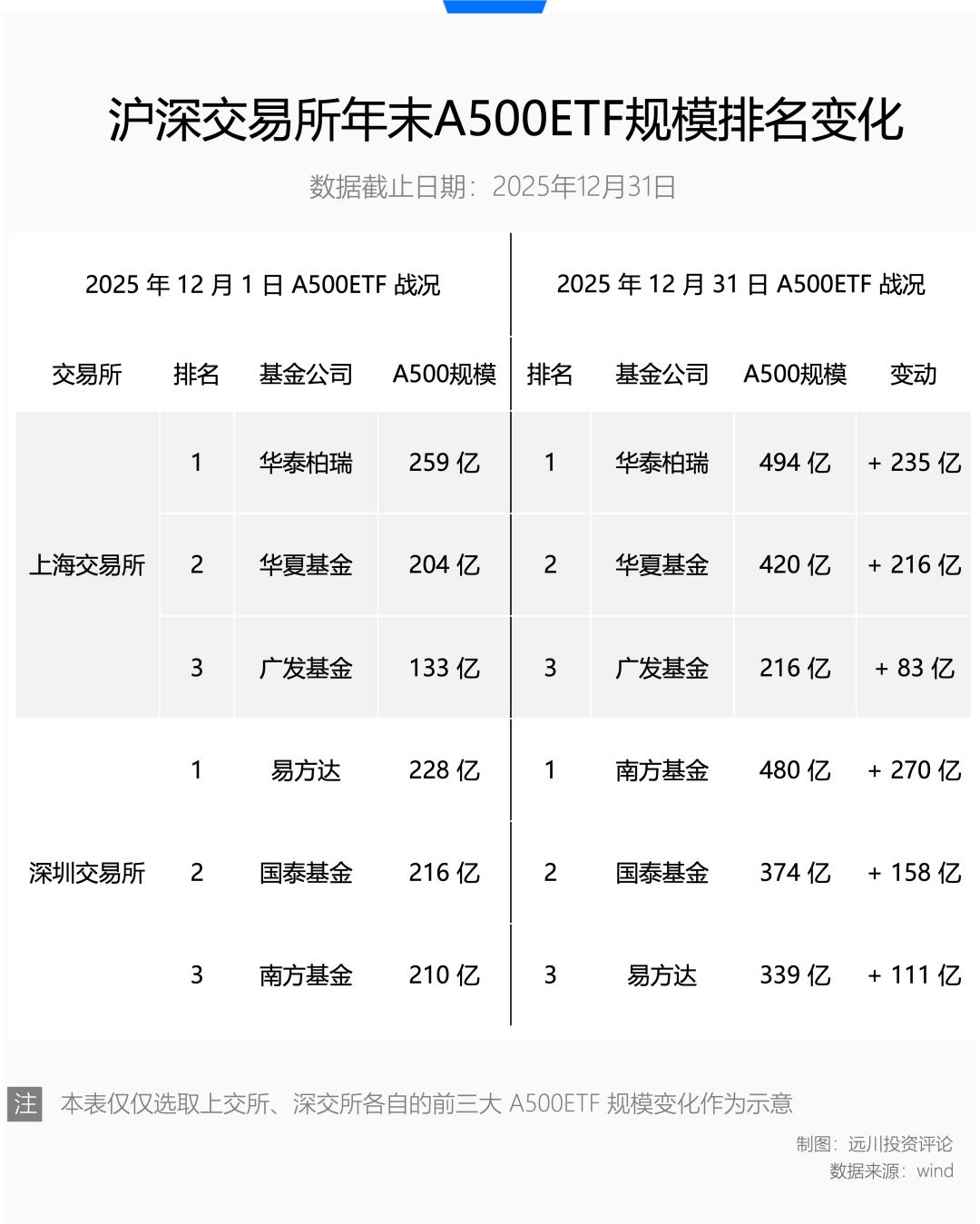
Core Insights - The A500 ETF market has seen significant growth, with total assets increasing by over 100 billion yuan in December 2025, despite a lack of retail investor activity [1] - The competition among fund companies for A500 ETF dominance is intensifying, with the focus shifting from annual performance to securing long-term market positions [3] - The upcoming introduction of options for A500 ETFs is expected to further consolidate the market, with only a few funds likely to survive the competition [4][20] Fund Company Performance - As of December 31, 2025, the A500 ETF rankings show significant changes, with Huatai-PB leading with 494 billion yuan, followed by Changxia Fund and GF Fund [2] - The A500 ETF battle reflects a broader transition in the public fund industry from an active to a passive investment approach [4][19] Fee Reform Impact - The public fund industry is undergoing a fee reform that aims to reduce management and transaction fees, resulting in an estimated annual savings of over 500 billion yuan for investors [5][11] - The first phase of the reform has already reduced management fees for active equity funds from 1.5% to 1.2%, leading to a projected annual benefit of 140 million yuan for investors [6] - The new transaction fee regulations are expected to further lower costs, allowing for an additional 70 million yuan in savings for investors [8] Sales Fee Regulations - The final phase of the fee reform targets sales fees, which have been a complex area with significant costs, and is expected to save investors around 300 million yuan annually [9][10] - The implementation of new sales fee regulations aims to encourage longer holding periods and reduce frequent trading, impacting the overall revenue structure of fund companies [10] Industry Outlook - The fee reform is seen as a double-edged sword, benefiting investors while simultaneously squeezing the profit margins of active equity funds, leading to a potential decline in their viability [13][14] - The shift towards passive investment strategies, particularly ETFs, is becoming more pronounced as the industry adapts to lower fee structures and changing investor expectations [19][22] - The future of public funds may become less dynamic and more standardized, as the focus shifts from individual performance to overall market returns and cost efficiency [23][26]

ETF主力榜 | A500ETF华泰柏瑞(563360)主力资金净流出4.21亿元,居股票型ETF基金前3-20260107
Xin Lang Cai Jing· 2026-01-07 08:59
与此同时,该基金最新成交量为112.47亿份,最新成交额跌破150.00亿元,当日主力资金净流出成交额 占比达2.86%。 A500ETF华泰柏瑞(563360.SH),场外联接(A类:022438;C类:022439;I类:022742;Y类: 022947)。 2026年1月7日,A500ETF华泰柏瑞(563360.SH)收跌0.38%,主力资金(单笔成交额100万元以上)净 流出4.21亿元,居股票型ETF基金前3。(数据来源:Wind) ...
还给基民500亿,机构的好日子结束了
Xin Lang Cai Jing· 2026-01-07 07:58
Core Insights - The public fund industry in China is transitioning from an "active era" to a "passive era," highlighted by the fierce competition surrounding the A500 ETF, which saw a significant increase in total scale by over 100 billion in December 2025 [5][31][28] - The A500 ETF's growth is accompanied by a comprehensive fee reform that will lead to a reduction of over 500 billion in revenue across the fund industry, impacting all stakeholders [31][40] - The upcoming introduction of options for A500 ETFs is expected to further intensify competition, with only a few funds likely to survive in the long term [30][47] Fund Performance and Competition - As of December 31, 2025, the A500 ETF rankings showed significant growth for major fund companies, with Huatai-PB leading at 494 billion, followed by Huaxia and Southern Fund [29][3] - The focus for fund companies has shifted from achieving high annual returns to securing a long-term position in the A500 ETF market [3][29] Fee Reform Impact - The fee reform initiated by the China Securities Regulatory Commission aims to reduce management fees, custody fees, transaction costs, and sales fees, with the first phase targeting management fees and custody fees [32][33] - The management fee cap for active equity funds has been reduced from 1.5% to 1.2%, resulting in an annual benefit of approximately 140 billion for investors [33][36] - The second phase of the reform addresses transaction costs, with new regulations limiting commission rates for passive equity funds, leading to an estimated annual benefit of 70 billion for investors [35][36] Sales Fee Regulations - The sales fee reform, effective from January 1, 2026, aims to reduce sales fees and regulate commission distribution, potentially benefiting investors by around 300 billion annually [38][40] - The sales fees have been a complex area with significant growth despite overall fee reductions, indicating a need for stricter regulations [37][40] Industry Outlook - The shift towards passive investment strategies, particularly ETFs, is seen as a necessary adaptation to the changing market dynamics, with the potential for a more stable business model despite lower fees [46][45] - The competitive landscape is expected to narrow, with only a few fund companies likely to thrive as the industry moves towards a more standardized and less personalized approach [47][48] - The future of public funds may become less exciting as the focus shifts to efficiency and cost control, potentially diminishing the role of individual talent in the industry [48][49]

还给基民 500 亿
远川投资评论· 2026-01-07 07:47
Core Viewpoint - The public fund industry is undergoing a significant transformation, moving from an "active era" to a "passive era," with the A500 ETF battle symbolizing this shift. The competition among fund companies is intensifying as they vie for a long-term foothold in the market, especially with the upcoming introduction of options related to the A500 ETF [5][7][20]. Group 1: A500 ETF Competition - The A500 ETF saw a dramatic increase in total scale, rising by over 100 billion yuan in December 2025, despite a lack of significant retail investor activity [3]. - By the end of December 2025, the leading A500 ETF products included Huatai-PB with 494 billion yuan, followed by Nanfang Fund with 480 billion yuan, indicating a fierce competition among fund companies [4]. - The battle for A500 ETF dominance is critical for fund companies, as the winner will secure a long-term revenue stream, especially with the anticipated launch of related options in early 2026 [5][6]. Group 2: Fee Reform Impact - The fee reform initiated by the China Securities Regulatory Commission (CSRC) aims to reduce management and custody fees, resulting in an annual benefit of approximately 140 billion yuan to investors [8][10]. - The average comprehensive fee rate for public funds decreased from 1.41% in 2022 to 1.29% by the end of 2023, with further reductions expected in 2024 [10]. - The sales fee reform, effective from January 1, 2026, is projected to provide an additional annual benefit of around 300 billion yuan to investors, further tightening the profit margins for fund companies [11][13]. Group 3: Industry Challenges - The fee reductions have significantly compressed the profit margins for actively managed equity funds, leading to a decline in their attractiveness and a shift towards passive investment strategies like ETFs [14][18]. - The public fund industry is experiencing a shift in incentive structures, where fund managers are increasingly pressured to deliver excess returns, leading to a potential exodus of talent from active management roles [15][20]. - The competitive landscape is becoming increasingly polarized, with only a few fund companies likely to survive in the A500 ETF space, mirroring the market dynamics seen in the U.S. with the S&P 500 [18][19].

国投白银LOF今日停牌1小时
Zhong Zheng Wang· 2026-01-07 01:04
Group 1 - The recent announcement from Guotou Silver LOF indicates significant fluctuations in the secondary market trading price of its Class A shares, leading to a temporary suspension of trading from January 7 until 10:30 AM to protect investor interests [1] - On January 6, six ETFs in the market experienced a rise of over 7%, with five of them being satellite-themed ETFs. The Penghua Satellite ETF (563790) saw a rapid increase in the afternoon, reaching a peak rise of 9.83% before closing with an increase of 8.31% [1] - On the same day, three ETFs, including the Huaxia Shanghai Stock Exchange Science and Technology Innovation Board 50 ETF, the Huatai-PB CSI 300 ETF, and the Southern CSI 500 ETF, reported net inflows exceeding 1 billion yuan [1]
港股通红利低波ETF(520890)涨0.64%,成交额3524.55万元
Xin Lang Cai Jing· 2026-01-06 11:02
Core Viewpoint - The Hong Kong Dividend Low Volatility ETF (520890) has shown significant growth in both share count and total assets since its inception, indicating strong investor interest and performance under the management of Li Qian, who has achieved a return of 42.27% since taking over the fund [1][2]. Group 1: Fund Performance - As of January 5, 2025, the fund's share count increased by 15.79% to 1.10 million shares, while total assets rose by 15.96% to 157 million yuan [1]. - The fund's management fee is set at 0.50% annually, with a custody fee of 0.10% annually [1]. Group 2: Trading Activity - The cumulative trading amount over the last 20 trading days reached 614 million yuan, with an average daily trading amount of approximately 30.72 million yuan [1]. - In the first two trading days of the year, the cumulative trading amount was 67.42 million yuan, averaging about 33.71 million yuan per day [1]. Group 3: Holdings and Composition - The fund's top holdings include Shougang Resources (3.76%), Yanzhou Coal Mining (2.94%), and VTECH Holdings (2.76%), among others, with a diversified portfolio across various sectors [2]. - The total market value of the top holdings reflects a strategic focus on high dividend yield and low volatility stocks [2].
两市ETF两融余额增加2.58亿元丨ETF融资融券日报
2 1 Shi Ji Jing Ji Bao Dao· 2026-01-06 04:12
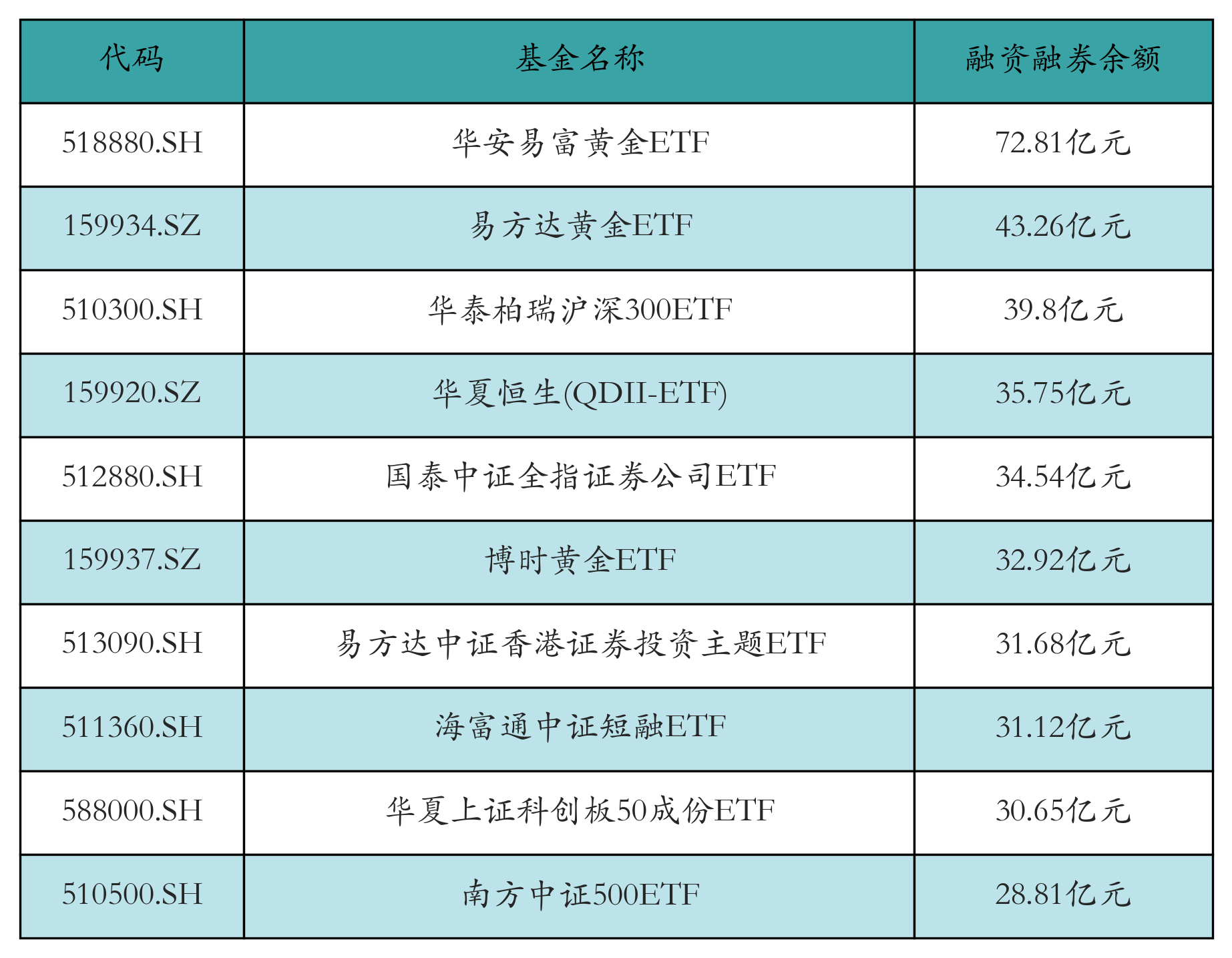
Market Overview - As of January 5, the total ETF margin balance in the two markets reached 117.108 billion yuan, an increase of 0.258 billion yuan from the previous trading day. The financing balance was 109.584 billion yuan, up by 10.1788 million yuan, while the securities lending balance was 7.525 billion yuan, increasing by 0.248 billion yuan [1] - In the Shanghai market, the ETF margin balance was 82.818 billion yuan, an increase of 0.194 billion yuan. The financing balance decreased by 2.39695 million yuan to 76.232 billion yuan, while the securities lending balance increased by 0.218 billion yuan to 6.587 billion yuan [1] - In the Shenzhen market, the ETF margin balance was 34.29 billion yuan, an increase of 0.0646316 billion yuan. The financing balance increased by 3.41483 million yuan to 33.352 billion yuan, and the securities lending balance rose by 0.0304833 billion yuan to 0.938 billion yuan [1] ETF Margin Balances - The top three ETFs by margin balance on January 5 were: 1. Huaan Yifu Gold ETF (7.281 billion yuan) 2. E Fund Gold ETF (4.326 billion yuan) 3. Huatai-PB CSI 300 ETF (3.98 billion yuan) [2] ETF Financing Amounts - The top three ETFs by financing amount on January 5 were: 1. E Fund CSI Hong Kong Securities Investment Theme ETF (1.448 billion yuan) 2. Hai Fu Tong CSI Short-term Bond ETF (1.395 billion yuan) 3. Huaxia Hang Seng Technology (QDII-ETF) (0.967 billion yuan) [3] ETF Net Financing Amounts - The top three ETFs by net financing amount on January 5 were: 1. Huatai-PB CSI 300 ETF (0.319 billion yuan) 2. E Fund CSI Hong Kong Securities Investment Theme ETF (0.152 billion yuan) 3. Southern CSI 500 ETF (0.12 billion yuan) [5] ETF Securities Lending Amounts - The top three ETFs by securities lending amount on January 5 were: 1. Huatai-PB CSI 300 ETF (63.8662 million yuan) 2. Huaxia SSE 50 ETF (34.5471 million yuan) 3. Southern CSI 500 ETF (23.8536 million yuan) [7]
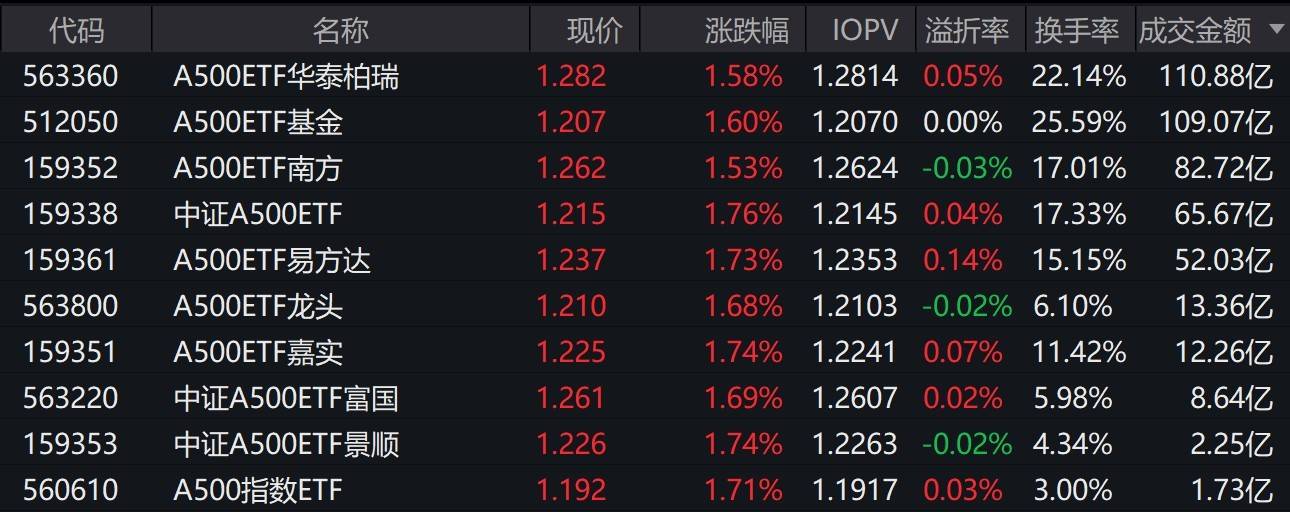
市场早盘高开高走,中证A500指数上涨1.81%,2只中证A500相关ETF成交额超109亿元
Sou Hu Cai Jing· 2026-01-05 04:10
Market Performance - The market opened strong with the Shanghai Composite Index returning to 4000 points, and the CSI A500 Index rising by 1.81% [1] - The A500 ETFs saw significant trading volumes, with 10 ETFs related to the CSI A500 exceeding 100 million yuan in trading volume, and 2 surpassing 10.9 billion yuan [1] Sector Analysis - The brain-computer interface concept experienced a surge, while the commercial aerospace sector remained active, and the insurance sector showed strength [1] - Conversely, tourism-related stocks faced a downward adjustment [1] Investment Insights - Recent strengthening of the RMB has enhanced the attractiveness of RMB-denominated assets, likely aiding in capital inflow [1] - Analysts expect the Shanghai Composite Index to consolidate around the 4000-point level, advising investors to closely monitor macroeconomic data, overseas liquidity changes, and policy developments [1]
ETF规模年内激增两万亿!聪明钱正在流向这三条核心赛道
Sou Hu Cai Jing· 2026-01-03 23:14
Core Viewpoint - The ETF market in China is experiencing significant inflows despite market volatility, with a total scale reaching 5.78 trillion yuan by December 15, 2025, an increase of over 2 trillion yuan since the beginning of the year. This trend indicates that institutional investors are using ETFs to capitalize on market dips, with nearly 35.8 billion yuan flowing into ETFs on a single day of market decline [1][2]. Group 1: ETF Market Dynamics - The total scale of the ETF market has surged to 5.78 trillion yuan, reflecting a substantial increase of over 2 trillion yuan since the start of the year [1]. - On November 21, a significant market drop saw nearly 35.8 billion yuan in funds entering ETFs, highlighting the trend of "smart money" seeking opportunities during downturns [1]. - The preference for ETFs is attributed to their transparency, liquidity, and risk diversification, making them a favored choice for institutional investors like insurance companies and pension funds [3]. Group 2: Fund Flows into ETFs - Broad-based ETFs are the primary beneficiaries of recent fund inflows, with notable growth in the Huatai-PB CSI 300 ETF and Huaxia CSI 300 ETF, which increased by 63.04 billion yuan and 62.36 billion yuan respectively [4]. - The Southern CSI 500 ETF saw a weekly net inflow of nearly 5.8 billion yuan, while the E Fund ChiNext ETF experienced over 4 billion yuan in weekly inflows, indicating a strong preference for core assets during stable economic growth expectations [4]. - Despite some sectors experiencing pullbacks, funds continue to flow into technology-related ETFs, with the Jia Shi SSE Sci-Tech Innovation Board Chip ETF and Huaxia CSI Robot ETF each seeing net subscriptions exceeding 4.4 billion yuan [5]. Group 3: Defensive Investment Strategies - In a volatile market, defensive ETFs focusing on low volatility and free cash flow have become popular, with the Huatai-PB Low Volatility Dividend ETF attracting over 4.5 billion yuan in net subscriptions [6]. - High-rated credit bond ETFs, such as the AAA Sci-Tech Bond ETF, have also performed well, with a growth of nearly 200 billion yuan this year, appealing to investors seeking stable returns in a low-interest environment [6]. Group 4: Investment Principles for Retail Investors - Retail investors are advised to prioritize leading products in the ETF market, focusing on those managed by top companies like Huaxia and E Fund, which offer better liquidity and reliability [7]. - Caution is recommended against blindly chasing high-flying sectors; instead, a dollar-cost averaging strategy is suggested to mitigate risks associated with short-term volatility [7]. - A diversified investment approach is encouraged, combining broad-based ETFs with sector-specific and defensive ETFs to balance risk and return [7]. Group 5: Conclusion on ETF Trends - The flow of funds into ETFs reflects the market's collective judgment, with investments spanning broad-based, high-growth sectors, and defensive options, indicating a strategic approach to navigating market complexities [8].
