平安银行

Search documents
最长春节假期|线上专区+线下市集+境外返现,金融机构“多箭齐发”促消费
券商中国· 2026-02-12 14:43
随着2026年"史上最长春节假期"临近,一场由政策引领、金融全线参与的消费促进行动已全面铺开。 券商中国记者发现,近期,银行、支付机构等金融机构积极响应政策号召,纷纷推出形式多样、力度空前的促 消费活动。 从线上专属活动专区到线下特色市集,从境内消费满减到境外消费返现,一系列精准、普惠的金融举措正密集 落地。 政策定调,打造春节消费盛宴 2月11日,国务院新闻办公室举行新闻发布会,商务部副部长盛秋平详细介绍了2026"乐购新春"春节特别活 动。此次活动时间聚焦于2月15日至23日(农历腊月二十八至正月初六)的9天春节假期,旨在打造一场全域联 动、全民乐享的春节消费盛宴。 据悉,各地已统筹安排高达20.5亿元资金,计划在假期内通过发放消费券、补贴、红包等多种形式,直接惠及 广大消费者。这一顶层设计为金融机构参与促消费指明了方向,提供了政策与资金协同的有力支撑。 1月23日,《2026"乐购新春"春节特别活动方案》(以下简称"方案")正式发布。方案围绕2026年春节9天假 期,以繁荣节日市场、丰富群众文化生活、激发假期消费活力为目标,致力于打造一场全域联动、全民乐享的 消费盛宴。 近段时间以来,建设银行策划开展" ...


丈量地方性银行(3):川渝132家区域性银行全梳理-20260212
GF SECURITIES· 2026-02-12 14:21
Investment Rating - The industry investment rating is "Buy" [2] Core Insights - The report analyzes 132 regional banks in the Sichuan-Chongqing area, highlighting the growth and structural changes in the banking sector [6][27] - The asset growth rates of major city commercial banks in the region are higher than those of listed city commercial banks, indicating a robust expansion [38] - Profitability metrics show that city commercial banks in the region have lower ROE compared to listed banks, while rural commercial banks outperform them [6][27] - Asset quality is slightly weaker in regional banks compared to listed banks, with higher non-performing loan ratios [6][27] Summary by Sections Economic Structure Analysis - Sichuan province is positioned as a key driver for western development, with a focus on enhancing the Chengdu-Chongqing economic circle [13][14] - In 2025, Chengdu's GDP is projected to account for 38.7% of the province's total, with significant growth in various sectors [15] Banking Sector Overview - The Sichuan-Chongqing region has 132 commercial banks, including 14 city commercial banks, 65 rural banks, and 51 rural commercial banks [27] - The asset growth rates for major city commercial banks in the region are 15.6% and 18.2%, surpassing the 14.2% growth of listed city commercial banks [38] Asset and Liability Structure - The proportion of loans to total assets has been increasing since 2016, with city commercial banks in Sichuan projected to have a loan ratio of 56.1% by 2024 [38][40] - The financial investment ratio for city commercial banks is on a downward trend, with a slight recovery noted in the first half of 2025 [40][46] Profitability and Asset Quality - The average ROE for city commercial banks in the region is 10.97%, lower than the 11.99% average for listed city commercial banks [6][27] - Non-performing loan ratios for city commercial banks in the region are higher than those of listed banks, indicating potential asset quality concerns [6][27] Capital Adequacy - Capital adequacy ratios for regional banks are comparable to those of listed banks, providing a safety margin for operations [6][27]




【12日资金路线图】两市主力资金净流出近12亿元,电子等行业实现净流入
证券时报· 2026-02-12 12:55
Market Overview - The A-share market experienced a narrow range of consolidation on February 12, with the Shanghai Composite Index rising by 0.05%, the Shenzhen Component Index increasing by 0.86%, and the ChiNext Index up by 1.32%. The total trading volume for the day was 2.16 trillion yuan, compared to 2 trillion yuan the previous day [1]. Capital Flow - The main funds in the Shanghai and Shenzhen markets saw a net outflow of approximately 12 billion yuan, with an opening net outflow of 31.42 billion yuan and a closing net outflow of 8 billion yuan, resulting in a total net outflow of 11.81 billion yuan for the day [2]. - Over the last five trading days, the main funds have shown a consistent trend of outflow, particularly in the ChiNext, which saw a net outflow of 39.79 billion yuan on February 12, while the CSI 300 index recorded a net inflow of 10.85 billion yuan [3][4]. Sector Performance - The electronics sector achieved a net inflow of 167.93 billion yuan, with a growth of 1.36%. Other sectors with positive net inflows included electric power equipment (143.16 billion yuan, up 1.10%) and computers (81.72 billion yuan, up 0.89%) [5]. - Conversely, the banking sector experienced a significant net outflow of 76.90 billion yuan, declining by 1.51%. Other sectors with notable outflows included non-bank financials (-64.83 billion yuan), pharmaceuticals (-57.24 billion yuan), and retail (-40.91 billion yuan) [5]. Institutional Activity - The top stocks with net buying from institutions included Yingweike (32.02 million yuan, up 10.00%), Zhichuan Co. (22.56 million yuan, down 4.92%), and Jingchen Co. (18.68 million yuan, up 15.75%) [7]. - The stocks with the highest net selling included Jihua Group (-12.02 million yuan, down 14.19%) and Jianxin Culture (-10.16 million yuan, down 14.19%) [9]. Institutional Focus - Recent institutional ratings highlighted stocks such as Guangdong Hongtu (target price 13.00 yuan, current price 12.25 yuan, potential upside 6.12%) and China Duty Free Group (target price 116.00 yuan, current price 94.17 yuan, potential upside 23.18%) [10].

金价高位波动能否持仓过节?业内提醒→
第一财经· 2026-02-12 11:34
Core Viewpoint - The article discusses the tightening of gold-related business by banks in response to recent volatility in gold prices and the upcoming Chinese New Year holiday, highlighting the need for investors to manage risks effectively during this period [3][4][6]. Group 1: Market Conditions - As of February 12, gold prices are experiencing high volatility, with London gold at $5063 per ounce and Shanghai gold at 1123 yuan per gram, while retail prices in major cities reach up to 1556 yuan per gram [3][4]. - The gold market has seen significant fluctuations, with prices peaking above $5600 per ounce at the end of January and then dropping below $4500, indicating a volatility of over 20% within three trading days [6]. Group 2: Bank Responses - Major banks, including China Construction Bank, Industrial Bank, and Bank of Communications, have raised margin requirements and implemented dynamic trading limits on gold transactions to mitigate risks associated with market volatility [4][5][6]. - The minimum investment amounts for gold accumulation products have been increased by several banks, with China Bank raising the threshold from 950 yuan to 1200 yuan, and Construction Bank increasing it to 1500 yuan [5][6]. Group 3: Investor Guidance - Analysts suggest that investors should be cautious about holding positions over the holiday, as the Shanghai Gold Exchange will be closed while international markets remain open, creating a "time difference risk" [6][9]. - For those considering gold as a long-term investment, a strategy of gradual buying and holding is recommended, with a suggested allocation of 5% to 10% of the investment portfolio to gold as a risk hedge [10].



2025年NPL市场回顾与展望:市场持续扩容,未来回收表现有待持续关注
Lian He Zi Xin· 2026-02-12 11:16
Market Overview - The NPL product market continued to expand in 2025, with a total issuance scale of 820.57 billion yuan, representing a year-on-year growth of 61.32%[4] - The cumulative issuance scale of NPL products from 2016 to 2025 reached 3285.88 billion yuan, indicating a sustained growth trend over six consecutive years[4] Asset Securitization - In 2025, commercial banks disposed of a total of 519.11 billion yuan of non-performing loans (NPLs) through asset securitization, with principal accounting for 90.53% of this amount, marking a 62.80% increase from 2024[5] - As of September 2025, the balance of non-performing loans in commercial banks was 3522.48 billion yuan, with 349.45 billion yuan disposed of through securitization, accounting for 10.28% of the median balance of non-performing loans[7] Issuance Characteristics - Large state-owned commercial banks remained the main issuers in the NPL market, with the top three institutions (Industrial and Commercial Bank of China, China Construction Bank, and Bank of China) accounting for 39.92% of the total issuance in 2025[9] - The types of NPL products issued have diversified, including personal housing mortgage NPLs and small micro-enterprise NPLs, reflecting a trend towards greater variety in product offerings[9] Recovery Rates and Valuation - The expected recovery rate for credit card NPL products ranged from 4.09% to 16.15%, with a weighted average recovery rate of 9.68%[22] - Personal housing mortgage NPL products had a higher expected recovery rate of 31.44% to 50.02%, with a weighted average recovery rate of 42.30%, although this represents a decline from 50.08% in 2024[31] Small Micro-Enterprise Loans - In 2025, 44 small micro-enterprise NPL products were issued, with a total issuance scale of 224.01 billion yuan, accounting for 27.03% of the total issuance[36] - The expected recovery rate for small micro-enterprise NPLs varied significantly, ranging from 11.58% to 57.20%, depending on the type of collateral involved[37]

平安银行重庆分行被罚30万元:质价不符
Xin Lang Cai Jing· 2026-02-12 11:08
以下为罚单详细信息: 来源:金融一线 2月12日金融一线消息,据重庆金融监管局行政处罚信息公开表显示,平安银行股份有限公司重庆分行 因质价不符,被罚款30万元。同时,唐赟因质价不符,被罚款5万元。 ...

买了300万信托亏超136万,法院:代销银行违反适当性义务,赔偿20%损失
Xin Lang Cai Jing· 2026-02-12 10:37
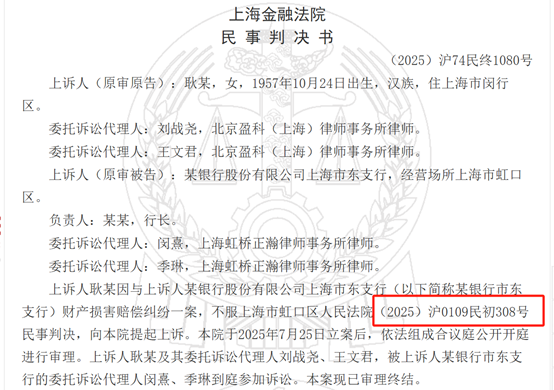
智通财经2月12日讯(编辑 杨斌)信托产品暴雷,代销银行究竟该承担多少赔偿责任?近日,光大银行 违规代销信托产品的一个案例宣判。案例中,投资者斥资300万元认购该行推介的煤炭产业信托,本金 亏损超136万元,法院判决银行承担20%的损失,赔偿27万余元。随着信托刚性兑付被打破及监管持续 趋严,代销机构的责任边界正通过一系列司法判决得以清晰勾勒。 300万信托本金亏损136万,法院判决银行赔偿20%的损失 上海金融法院民事判决书【(2025)沪74民终1080号】显示,耿某在某银行市东支行处经工作人员推 荐,认购《某信托·煤炭资源产业投资基金3号集合资金信托计划》,签署认购风险申明书。同日,耿某 向某国际信托公司汇款300万元,附言:"耿某认购长安楼俊项目"。 某国际信托公司合计向耿某分配信托收益28.5万元,分配信托本金163.74万元,耿某投入的煤炭产业信 托的本金亏损超过136万元。耿某一审向法院提出诉讼请求:判令某银行市东支行赔偿耿某投资本金损 失140余万元,以及投资收益、诉讼费等费用。 一审法院酌情认定某银行市东支行应承担耿某投资本金损失20%的赔偿责任,某银行市东支行应于判决 生效之日起十日内向耿 ...

逼近6.90关口!提个醒:春节期间请务必关注汇率波动!
Sou Hu Cai Jing· 2026-02-12 07:01
连涨6个月! 中资机构观点: 值得注意的是,各家银行的结售汇价格在中国银行间外汇市场开市期间,基本以中国外汇交易中心的美元兑人民币实时牌价为基准,结合自身情况制定。而 在中国银行间外汇市场闭市期间,中国外汇交易中心的美元兑人民币牌价不再更新,各家银行会采用不同的定价方式。 春节假期临近,人民币汇率持续升值。截至1月末,人民币兑美元汇率已经连涨了六个月。 春节期间,中国银行间外汇市场闭市。在此期间,部分机构的美元兑人民币结售汇价格,以中国外汇交易中心2月13日的美元兑人民币收盘价为参照而定 价,因此其春节假期期间的价格基本不变,目前较多银行采用此种较为通行的做法;部分机构的美元兑人民币结售汇价格,以离岸美元兑人民币价格为参 照,因此其春节假期期间的价格会适当调整(采用此种做法的银行,大部分在境外设立了分支机构)。 自2025年初以来,人民币已上涨5%,成为自9月以来表现第三好的亚洲货币。 分析认为,本轮人民币升值不同于历史上的任何一轮。 中国企业海外赚钱能力不断提高后的结汇需求、全球资金对美元的不信任及对实物资产背后支撑货币的需求、中国政策对外"征税"补贴内需的顶层设计是本 轮人民币升值的底层逻辑,而美元走势、 ...

银行推出多重购车福利
Jin Rong Shi Bao· 2026-02-12 02:03
Core Viewpoint - Banks are intensifying their promotional efforts in the auto finance market by offering low-interest loans and various subsidies to attract consumers during the year-end shopping season, particularly with the upcoming Spring Festival [1][2]. Group 1: Low-Interest Loan Promotions - Multiple banks are launching low-interest car purchase subsidies, with some offering up to 3,000 yuan in consumer loan subsidies to ease monthly payment burdens [2]. - Ping An Bank has introduced a special car loan subsidy for new car buyers, allowing for annual interest rates as low as 0% and loan amounts up to 5 million yuan [2]. - SPDB has also launched promotional activities, offering annual interest rates as low as 0.49% for specific Tesla models, with monthly payments starting at 1,788 yuan [2]. Group 2: Extended Loan Terms - Many banks are extending the loan terms for low-interest car loans from a maximum of 5 years to 7 years, aiming to reduce monthly payment amounts for consumers [4]. - Huishang Bank has introduced a loan product with a maximum amount of 1 million yuan and an interest rate as low as 3.0%, with a repayment period of up to 7 years [4]. - The extension of loan terms is seen as a strategy to stimulate demand for mid-to-high-end vehicles, particularly those priced above 200,000 yuan [6]. Group 3: Credit Card Incentives - Banks are leveraging credit card programs to boost auto consumption, with activities such as offering points for test drives and financing options [3]. - Shanghai Bank is providing discounts for new credit card holders who apply for auto financing, enhancing the overall consumer experience [3]. Group 4: Risks and Challenges - The combination of low-interest rates and extended loan terms presents challenges such as complex risk pricing and potential asset depreciation over long repayment periods [7]. - Consumers are advised to be cautious of the hidden risks associated with low monthly payments, including the potential for negative equity in vehicles due to rapid technological advancements [7]. - Industry experts suggest that banks should shift from price competition to value-driven strategies, focusing on product innovation and risk management [8].
基本面120ETF嘉实(159910)开盘涨0.08%
Xin Lang Cai Jing· 2026-02-12 01:44
Group 1 - The core point of the article highlights the performance of the Basic Fundamental 120 ETF managed by Harvest Fund Management, which opened at 2.504 yuan with a slight increase of 0.08% [1] - The ETF's performance benchmark is the Shenzhen Basic Fundamental 120 Index, and it has achieved a return of 150.22% since its inception on August 1, 2011, with a recent one-month return of 1.30% [1] Group 2 - Major holdings in the ETF include companies such as CATL, which increased by 0.54%, and Midea Group, which decreased by 0.29% [1] - Other notable stock performances include Gree Electric Appliances down by 0.21%, BOE Technology Group unchanged, Ping An Bank unchanged, Luxshare Precision up by 0.22%, Vanke A up by 0.82%, TCL Technology down by 0.21%, Wuliangye down by 0.13%, and Weichai Power up by 1.62% [1]