
爱美客

Search documents
肉毒毒素产品获批 爱美客鏖战红海
Zhong Guo Jing Ying Bao· 2026-01-16 20:27
Core Viewpoint - Aimeike has recently received approval for the exclusive distribution of Huons Bio Pharma's A-type botulinum toxin product in China, marking a significant milestone in its long-term partnership with Huons [2][3][4] Group 1: Product Approval and Market Context - Aimeike's A-type botulinum toxin product received its drug registration certificate from the National Medical Products Administration, becoming the seventh approved botulinum toxin product in China [3][4] - The approval comes after a lengthy process that began with a distribution agreement signed in September 2018, highlighting the long-term commitment to this product line [4][5] - The Chinese botulinum toxin market is still underpenetrated compared to mature markets, presenting significant growth opportunities for Aimeike [2][7] Group 2: Strategic Plans and Market Positioning - Aimeike plans to leverage its established professional channels and brand advantages to efficiently promote the product's market entry [2][8] - The company aims to focus on the mid-to-high-end market segment, utilizing its extensive distribution network and customer trust to offer comprehensive and customized treatment solutions [8] - The sales strategy will be determined based on various factors, including import inspection timelines and market conditions [2][6] Group 3: Competitive Landscape - The number of approved botulinum toxin products in China has increased from two to seven during the time Aimeike has been working on its product, indicating a competitive market environment [7][8] - The market for A-type botulinum toxin in China was approximately 8.1 billion yuan in 2023, with a compound annual growth rate of nearly 30% over the past five years [7] - Aimeike's product will compete with established brands like Botox and domestic products such as Hengli and Letibot, which have already captured significant market shares [7][8] Group 4: Financial Performance and Investment - Aimeike's revenue for the first three quarters of 2025 was approximately 1.865 billion yuan, a year-on-year decrease of 21.49%, with net profit declining by 31.05% [8] - The company views the botulinum toxin project as a new growth point, having invested 120 million yuan in the project as part of its IPO fundraising efforts [2][5]


爱美客(300896.SZ):暂未有AI方面的技术与业务计划
Ge Long Hui· 2026-01-16 13:17
Group 1 - The company, Aimeike (300896.SZ), has stated on its interactive platform that it currently does not have any technology or business plans related to AI [1]
医疗美容板块1月16日跌1.79%,华熙生物领跌,主力资金净流出1.12亿元
Zheng Xing Xing Ye Ri Bao· 2026-01-16 09:03
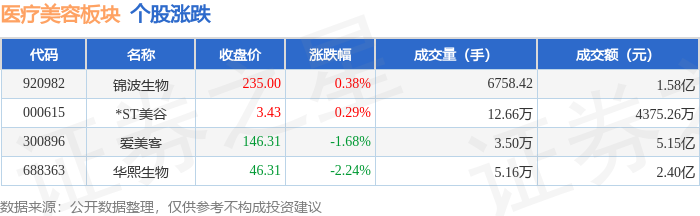
Market Overview - The medical beauty sector experienced a decline of 1.79% on January 16, with Huaxi Biological leading the drop [1] - The Shanghai Composite Index closed at 4101.91, down 0.26%, while the Shenzhen Component Index closed at 14281.08, down 0.18% [1] Individual Stock Performance - Jinbo Biological (920982) closed at 235.00, with a slight increase of 0.38% and a trading volume of 6758.42 lots [1] - ST Meigu (000615) closed at 3.43, up 0.29% with a trading volume of 12.66 million [1] - Aimeike (300896) closed at 146.31, down 1.68% with a trading volume of 35,000 [1] - Huaxi Biological (688363) closed at 46.31, down 2.24% with a trading volume of 51,600 [1] Capital Flow Analysis - The medical beauty sector saw a net outflow of 112 million yuan from main funds, while retail investors contributed a net inflow of 73.41 million yuan [1] - The detailed capital flow for individual stocks shows: - ST Meigu had a main fund net outflow of 446,500 yuan and a retail net inflow of 198,200 yuan [2] - Jinbo Biological experienced a main fund net outflow of 7.88 million yuan and a retail net outflow of 223,700 yuan [2] - Huaxi Biological had a significant main fund net outflow of 46.59 million yuan, with retail investors contributing a net inflow of 27.27 million yuan [2] - Aimeike faced a main fund net outflow of 64.99 million yuan, while retail investors had a net inflow of 45.95 million yuan [2]

第一创业晨会纪要-20260116
First Capital Securities· 2026-01-16 04:03
Macro Economic Group - In December, M2 growth was 8.5%, exceeding Wind's expectation of 7.9% and up from 8.0% in November. M1 growth was 3.8%, matching expectations but down from 4.9% in November, indicating a slowdown in money velocity [4] - The total social financing (TSF) in December grew by 8.3%, slightly above the expected 8.2% but down from 8.5% in November. The TSF increment was 2.21 trillion yuan, surpassing the expected 1.82 trillion yuan but down from 2.49 trillion yuan year-on-year [4] - Bank credit in December increased by 910 billion yuan, exceeding the expected 679.4 billion yuan and up from 390 billion yuan in the previous month. However, it was down 800 billion yuan year-on-year [5] Industry Comprehensive Group - Siyi Electric (002028.SZ) reported a revenue of 21.2 billion yuan for 2025, a 37.2% year-on-year increase, with Q4 revenue reaching 7.38 billion yuan, up 46.1%. The net profit attributable to shareholders was 3.16 billion yuan, a 54.4% increase, exceeding market expectations [12] - Guanghe Technology (001389.SZ) forecasted a net profit of 980 million to 1.02 billion yuan for 2025, a growth of 45% to 50.8%. The Q4 net profit was estimated at 280 million yuan, a 50.4% increase, driven by strong demand for server PCB boards [13] Advanced Manufacturing Group - The UK AR7 offshore wind auction resulted in 8.4GW of capacity, exceeding expectations and marking a historical high. This sets the stage for significant supply chain orders in the coming years, with a peak delivery expected between 2028 and 2030 [15] - The State Grid has confirmed a total investment of 4 trillion yuan for the 14th Five-Year Plan, a 40% increase from the previous plan, focusing on accelerating ultra-high voltage construction and enhancing supply chain capabilities [16] Consumer Group - The Financial Regulatory Bureau emphasized the need for financial support to boost consumption and investment, particularly in sectors like real estate, healthcare, and small businesses. This is expected to benefit consumer sectors such as automobiles and home appliances [18] - Juzhi Bio's second collagen medical device has been approved, enhancing the focus on the collagen market, which is gaining traction in aesthetic and skin repair applications [19] - Liufeng Group reported a same-store sales growth of 15% for Q4 2025, driven by increased customer flow and product pricing strategies, indicating strong growth momentum [19]

全链”上市!美妆企业争做“第一股
Shen Zhen Shang Bao· 2026-01-16 00:33
Core Viewpoint - The beauty industry is experiencing a surge in IPO activities, with over 41 companies aiming for public listings in 2025, while simultaneously facing challenges with 10 companies exiting the capital market [1][4]. Group 1: IPO Activities - In December, Lin Qingxuan successfully listed on the Hong Kong Stock Exchange, marking it as the first high-end domestic skincare stock in Hong Kong [1]. - Major domestic beauty brands like Naturals, Proya, and Marubi are also pursuing listings, with Proya and Marubi aiming for dual listings in both A-shares and H-shares [1]. - The IPO wave includes a diverse range of companies across the beauty supply chain, including raw material suppliers and packaging companies, with 8 companies like Vicky Technology and Jiakai Biotechnology also in the IPO race [2]. Group 2: Market Challenges - Despite the IPO enthusiasm, 10 beauty-related companies have exited the A-share or New Third Board markets, indicating a stringent selection process by capital markets [4]. - Many companies, including Naturals and Vicky Technology, have faced delays in their IPO processes, often remaining in the application or advisory stages [4]. - The third-quarter report for 2025 shows that only a few beauty companies have maintained revenue growth, with many facing significant operational pressures [5]. Group 3: Industry Dynamics - The beauty industry is characterized by a dual trend of IPO excitement and market exits, highlighting the need for companies to address issues such as heavy reliance on marketing over research and development [6]. - Companies like Naturals have reported high marketing costs, with sales and marketing expenses reaching 57% of revenue, while R&D investment has decreased significantly [6]. - The reliance on flagship products, such as Lin Qingxuan's dependence on its essence oil, poses additional challenges for sustainable growth [7].

“全链”上市!美妆企业争做“第一股”
Shen Zhen Shang Bao· 2026-01-15 17:51
Core Viewpoint - The beauty industry is experiencing a surge in IPO activities, with over 41 beauty-related companies aiming for IPOs in 2025, indicating a robust interest in capital markets within this sector [2][3]. Group 1: IPO Activities - In December 2024, Lin Qingxuan successfully listed on the Hong Kong Stock Exchange, marking it as the first high-end domestic skincare stock in Hong Kong [2]. - Major domestic beauty brands such as Naturals, Proya, and Marubi have initiated their IPO processes, with Proya and Marubi already listed on A-shares, aiming for a dual listing in Hong Kong [2][3]. - The IPO wave includes a diverse range of companies from the beauty supply chain, including raw material suppliers, packaging companies, and brand operators [2][3]. Group 2: Market Dynamics - Since the end of 2024, there has been a notable trend of companies exiting the capital market, with 10 beauty-related companies having withdrawn from A-shares or the New Third Board [5]. - Many companies are facing delays in their IPO processes, with some, like Naturals and Weiqi Technology, still in the application or advisory stages despite having significant revenue [5][6]. - The A-share beauty companies reported a total revenue of 27.707 billion yuan and a net profit of 3.753 billion yuan in the first three quarters of 2025, with Proya leading at 7.098 billion yuan, showing only a slight growth of 1.89% year-on-year [6]. Group 3: Challenges in the Industry - The beauty industry is grappling with challenges such as an overemphasis on marketing at the expense of research and development, as evidenced by Naturals' marketing costs significantly outweighing its R&D investments [7][8]. - Companies like Lin Qingxuan are heavily reliant on a single product category for revenue, which poses risks to their long-term growth and stability [8]. - The current market environment is increasingly selective, favoring companies with solid market foundations, clear brand positioning, and strong technological barriers [5][7].

“全链”上市!美妆企业争做“第一股” 去年40多家相关企业冲刺IPO,也有10家告别资本市场
Shen Zhen Shang Bao· 2026-01-15 17:43
Core Insights - The beauty industry is experiencing a surge in IPO activity, with over 41 beauty-related companies aiming for IPOs since 2025, covering various segments of the supply chain [1][2] - The trend of companies seeking to become the "first stock" in their respective niches is prominent, with several brands targeting specific categories such as whitening and anti-hair loss [3] - Despite the IPO enthusiasm, there are challenges as 10 beauty-related companies have exited the capital market, indicating a stricter selection process by investors [4] IPO Activity - Numerous companies are preparing for IPOs, with notable brands like Gu Yu, Lin Qingxuan, and Plant Doctor submitting applications in 2025 [2][3] - The IPO wave includes not only brand companies but also raw material suppliers and packaging companies, indicating a comprehensive industry interest [2] - Specific milestones include Lin Qingxuan becoming the first high-end domestic skincare stock in Hong Kong and other brands aiming for dual listings [1][2] Financial Performance - In the first three quarters of 2025, eight listed beauty companies reported a total revenue of 27.707 billion yuan and a net profit of 3.753 billion yuan [5] - The leading company, Proya, achieved a revenue of 7.098 billion yuan, showing only a slight year-on-year increase of 1.89%, while Shanghai Jahwa reported a 10.83% growth [5] Industry Challenges - The beauty industry faces significant challenges, including a heavy reliance on marketing over research and development, which could hinder long-term growth [6][7] - Companies like Natural Hall and Lin Qingxuan have shown a concerning trend of low R&D investment compared to their marketing expenditures, with R&D costs declining as a percentage of revenue [6][7] - The industry's dependency on flagship products poses risks, as seen with Lin Qingxuan's reliance on its essence oil for revenue [7]
爱美客:公司主营业务为Ⅲ类医疗器械,是Ⅲ类医疗器械的提供商
Mei Ri Jing Ji Xin Wen· 2026-01-15 10:52
Core Viewpoint - The company, Aimeike (300896.SZ), primarily operates in the field of Class III medical devices and engages with qualified medical beauty institutions and distributors as its downstream clients [1]. Group 1: Company Overview - Aimeike's main business involves providing Class III medical devices [1]. - The company's downstream clients are qualified medical beauty institutions and distributors [1]. Group 2: Industry Context - Downstream clients independently conduct medical services based on legal regulations and their qualifications [1].
医疗美容板块1月15日跌1.03%,爱美客领跌,主力资金净流出1305.43万元
Sou Hu Cai Jing· 2026-01-15 09:07
Group 1 - The medical beauty sector experienced a decline of 1.03% on January 15, with Aimeike leading the drop [1] - The Shanghai Composite Index closed at 4112.6, down 0.33%, while the Shenzhen Component Index closed at 14306.73, up 0.41% [1] - The net outflow of main funds in the medical beauty sector was 13.05 million yuan, while retail funds saw a net outflow of 0.95 million yuan [1] Group 2 - The sector saw a net inflow of 14.01 million yuan from speculative funds on the same day [1] - Detailed fund flow data for individual stocks in the medical beauty sector is available in the accompanying table [1]

爱美客跌2.02%,成交额3.83亿元,主力资金净流出1833.83万元
Xin Lang Cai Jing· 2026-01-15 03:50
Core Viewpoint - The stock price of Aimeike has shown fluctuations, with a recent decline of 2.02% and a total market capitalization of 44.998 billion yuan as of January 15. The company has experienced a net outflow of funds, indicating potential investor concerns [1]. Group 1: Stock Performance - Aimeike's stock has increased by 4.93% year-to-date, with a 1.86% rise over the last five trading days and a 5.80% increase over the last 20 days. However, it has seen a decline of 11.38% over the past 60 days [2]. - As of January 9, the number of Aimeike's shareholders has increased to 61,500, up by 2.32%, while the average circulating shares per person decreased by 2.27% to 3,393 shares [2]. Group 2: Financial Performance - For the period from January to September 2025, Aimeike reported a revenue of 1.865 billion yuan, representing a year-on-year decrease of 21.49%. The net profit attributable to the parent company was 1.093 billion yuan, down 31.05% year-on-year [2]. - Aimeike has distributed a total of 3.887 billion yuan in dividends since its A-share listing, with 3.012 billion yuan distributed over the last three years [3]. Group 3: Shareholder Composition - As of September 30, 2025, the sixth-largest circulating shareholder is Hong Kong Central Clearing Limited, holding 6.8295 million shares, a decrease of 151,300 shares from the previous period. Other notable shareholders include Hua Bao Zhong Zheng Medical ETF and Yi Fang Da Growth Enterprise Board ETF, both of which have also seen reductions in their holdings [3].