欣旺达

Search documents
山东城市观察 | 枣庄的“锂”想:资源枯竭型城市何以突围?
Xin Lang Cai Jing· 2025-10-22 04:51
Core Points - The 2025 New Energy Battery Industry Development Conference was held in Zaozhuang, focusing on solid-state batteries, ultra-fast charging technology, and energy storage applications [1][14] - Zaozhuang is transitioning from a coal-dependent economy to becoming a "Chinese New Energy Battery City," with 278 new energy enterprises established by the end of 2024 [3][6] - The local government has implemented strategic initiatives to support the lithium battery industry, including the establishment of a comprehensive industrial chain and attracting major projects [5][12] Industry Overview - Zaozhuang's economy was historically reliant on coal, with coal-related industries accounting for over 80% of its economic output [3] - The city has developed a full industrial chain for lithium batteries, including raw material extraction, production of cathodes and anodes, electrolytes, separators, and battery cells [6][10] - By 2021, Zaozhuang adopted a strategy to focus on lithium batteries as a key industry for urban transformation, aiming to become a model city for green and safe new energy [5][12] Investment Opportunities - Major projects, such as the joint venture between Li Auto and Xinnengda, and the agreement with Zhongchuangxin to establish a base in Zaozhuang, are expected to bring significant investment and enhance the local supply chain [12][13] - The establishment of the first lithium battery industry union and various innovation platforms indicates a supportive environment for industry growth [9][10] - The hosting of the conference has amplified Zaozhuang's brand influence in the new energy sector, facilitating future project attraction and technological collaboration [14][16]



中国对高端锂电池及技术实施出口管制 首次在新能源领域筑起“技术护栏”
Zhong Guo Neng Yuan Wang· 2025-10-22 04:30
Core Insights - The Ministry of Commerce and the General Administration of Customs of China announced export controls on lithium batteries and related technologies, effective from November 8, 2025, marking the first "technical-level" export review in the new energy equipment manufacturing sector [1][2] - The export controls aim to protect core technologies, enhance national security, and ensure compliance with international non-proliferation obligations while maintaining the competitiveness of Chinese lithium battery companies in the global market [1][4] Industry Overview - China's lithium battery industry is a core advantage in the new energy sector, with over 250 overseas orders totaling 188 GWh secured by domestic energy storage companies in the first eight months of 2025, and a significant increase in demand from international markets [2][4] - The export controls are seen as a "signpost" that may reshape the development landscape for Chinese lithium battery companies, encouraging more firms to invest abroad [2][3] Export Control Details - The export controls specifically target rechargeable lithium-ion batteries with an energy density of 300 Wh/kg or higher, high-pressure lithium iron phosphate materials, artificial graphite anode materials, and related equipment and technologies [1][5] - The measures also include controls on artificial diamond micro-powder and single crystal products, which are critical for semiconductor and precision manufacturing applications [6] Technological Implications - The export controls are designed to provide a "technical barrier" for the lithium battery industry, ensuring that high-end products and technologies are managed with precision rather than imposing blanket export bans [3][4] - The focus on dual-use technologies reflects a global trend in maintaining national security while fostering innovation in high-tech sectors [4][5] Market Dynamics - The export controls may lead to short-term price premiums for high-end products due to their scarcity, while compliance for overseas capacity expansion and core equipment export may become stricter [5][7] - Long-term, these measures are expected to protect the leading technological advantages of Chinese companies and stabilize their pricing power within the global supply chain [5][7] Future Outlook - The lithium battery industry is transitioning from a focus on quantity to quality, with an emphasis on technological innovation and core competitiveness [6][7] - The anticipated growth of solid-state battery markets, projected to exceed an 80% compound annual growth rate from 2024 to 2030, highlights the importance of rapid industrialization and scaling production capabilities [6][7]


市占率创新低?日赚1.8亿的宁德时代,被谁挖了墙脚|能见派
Xin Lang Cai Jing· 2025-10-22 01:41
Core Insights - CATL reported a third-quarter revenue of 104.186 billion yuan, a year-on-year increase of 12.9%, and a net profit of 18.549 billion yuan, up 41.21% year-on-year [1] - Despite strong financial performance, CATL's market share in the power battery sector has declined to 41.7%, the lowest in nearly six years, indicating a potential shift in its dominant position [1][2] - The rapid development of the lithium iron phosphate battery sector has contributed to CATL's declining market share, as competitors gain ground in specific niches [1][2] Market Dynamics - The power battery industry is transitioning from a "one strong leader" model to a more fragmented competitive landscape, with second-tier manufacturers finding their strengths in specialized areas [2] - Automakers are diversifying their battery supply chains to mitigate risks, opting to collaborate with multiple battery suppliers rather than relying solely on one [2][3] - The competitive landscape among battery manufacturers remains stable in the short term, with both first and second-tier companies maintaining their positions [3] Strategic Collaborations - Automakers are increasingly interested in collaborating with battery manufacturers for research and development, seeking to enhance their understanding of battery technology [3] - A recent partnership between Li Auto and battery manufacturer Sunwoda aims to establish a joint venture for the production and sale of lithium-ion batteries, indicating a trend towards customized battery solutions [3] - The shift in focus from traditional partnerships to joint ventures reflects a desire for more tailored and stable supply chains among automakers [3] Industry Evolution - The changing dynamics in the battery market reflect the maturation of the entire electric vehicle industry, moving from rapid growth to more refined operations [2][3] - Analysts suggest that while second-tier companies are gradually increasing their market share, the competition will remain fierce, and some may still fall behind [3]
5000亿政策性金融工具投放过半
2 1 Shi Ji Jing Ji Bao Dao· 2025-10-22 01:28
Core Insights - The new policy financial tools amounting to 500 billion yuan have been officially announced and are aimed at supporting project capital requirements, with nearly 300 billion yuan already allocated as of October 17 [1][2] Investment Allocation - As of October 17, the China Development Bank has allocated 1,893.5 billion yuan and the Agricultural Development Bank has allocated 1,001.11 billion yuan, with a total of nearly 3,000 billion yuan expected to stimulate total project investments of 28 trillion yuan and 12.6 trillion yuan respectively [1] - The Export-Import Bank has indicated that 83% of its allocations are directed towards major economic provinces, with 40% of the funding supporting private capital participation and focusing on digital economy and artificial intelligence projects [1][2] Sector Focus - The new financial tools are designed to support eight key areas: digital economy, artificial intelligence, low-altitude economy, infrastructure for consumption, green and low-carbon transition, agriculture and rural development, transportation and logistics, and municipal and industrial parks [5][9] - The Agricultural Development Bank has invested 671.36 billion yuan in 407 projects across 12 major economic provinces, emphasizing support for emerging industries [2][5] Economic Impact - Analysts predict that the current round of policy financial tools could leverage an additional 2 to 2.5 trillion yuan in new credit growth, potentially boosting economic performance in the fourth quarter and the first quarter of the following year [2][9] - The tools are expected to address both short-term economic stability and long-term structural adjustments, enhancing investment confidence in key sectors [9][10] Market Dynamics - The introduction of these financial tools is seen as a response to the "asset shortage" phenomenon in the financial market, as they expand investment opportunities into more market-oriented sectors [10] - The mechanism of these tools aims to alleviate capital shortages for major projects, thereby activating the overall credit cycle and directing funds towards effective demand areas [10]

5000亿政策性金融工具投放过半
21世纪经济报道· 2025-10-22 01:19
Core Viewpoint - The new policy financial tools, totaling 500 billion yuan, are aimed at supporting project capital and stimulating investment in key sectors, particularly in economic provinces and emerging industries [1][4]. Investment Deployment - As of October 17, the National Development Bank and Agricultural Development Bank have deployed nearly 300 billion yuan of the new policy financial tools, with expected project investments of 2.8 trillion yuan and 1.26 trillion yuan respectively [1][2]. - The National Development Bank has invested 77.4% of its funds into 12 economic provinces, while 28.8% has gone to private investments, and 37.5% to digital economy and AI projects [2]. - The Agricultural Development Bank has also focused on digital economy and AI, investing 671.36 million yuan in 407 projects across economic provinces [2]. Support for Key Sectors - The new financial tools are designed to support long-term goals of expanding domestic demand and technological innovation, focusing on eight key areas including digital economy, AI, and green transformation [4][6]. - Companies like ChipLink Integrated and Xinwanda have already shown interest in utilizing these financial tools for their projects, indicating a positive response from private enterprises [5][6]. Economic Impact - The tools are expected to have a multiplier effect, potentially generating 2 to 2.5 trillion yuan in new credit growth, which could boost economic performance in the fourth quarter and the first quarter of the following year [2][4]. - The rapid deployment of these tools is seen as a means to enhance investment confidence and stimulate economic growth [6][8]. Addressing Asset Scarcity - The introduction of these financial tools is aimed at alleviating the "asset scarcity" phenomenon in the financial market by expanding investment opportunities in emerging sectors [9][10]. - The tools are expected to provide higher returns on investments, thus attracting more social capital into the market [10].

市占率创新低? 日赚1.8亿的宁德时代,被谁挖了墙脚 | 能见派
Xin Lang Cai Jing· 2025-10-22 00:41
Core Viewpoint - CATL reported a significant increase in revenue and net profit for Q3, but its market share in the power battery sector has declined to its lowest level in nearly six years, indicating potential challenges ahead [1][2]. Financial Performance - In Q3, CATL achieved a revenue of 104.186 billion yuan, a year-on-year increase of 12.9%, and a net profit attributable to shareholders of 18.549 billion yuan, up 41.21% [1]. - For the first three quarters, CATL's total revenue reached 283.072 billion yuan, a 9.28% increase year-on-year, with a net profit of 49.034 billion yuan, reflecting a 36.2% growth [1]. Market Share Dynamics - CATL's market share in the power battery sector has decreased to 41.7%, marking a decline from previous years, with competitors like BYD and other second-tier manufacturers gaining ground [1][2]. - From 2020 to 2025, CATL's market share is projected to fluctuate, with a notable drop from 50.0% in 2020 to 41.7% in 2023 [2][4]. Competitive Landscape - The power battery market is shifting from a "one strong leader" model to a more diversified competition, with second-tier manufacturers finding success in niche markets [2][5]. - Second-tier manufacturers are adopting differentiated strategies, focusing on specific technologies such as lithium iron phosphate and cylindrical batteries, which enhances market health [2][5]. Supply Chain Strategies - Automakers are diversifying their battery suppliers to mitigate supply chain risks, opting to work with multiple battery manufacturers rather than relying solely on one [5][6]. - This trend has led to a more stable competitive landscape among first and second-tier battery companies, as automakers seek to balance cost and supply chain security [5][6]. Collaboration and Innovation - Companies like Li Auto are forming joint ventures with battery manufacturers to develop customized battery solutions, indicating a shift towards collaborative innovation in the industry [6][7]. - The establishment of joint ventures allows automakers to gain tailored components while reducing investment risks for suppliers, contrasting with CATL's preference for traditional sales models [6][7]. Industry Evolution - The evolving battery market reflects the maturation of the entire electric vehicle industry, with increased competition leading to more diverse product offerings and improved supply chain efficiencies [7][8]. - Analysts suggest that while competition will intensify, CATL's advantages may still provide it with a competitive edge in the long run [8].
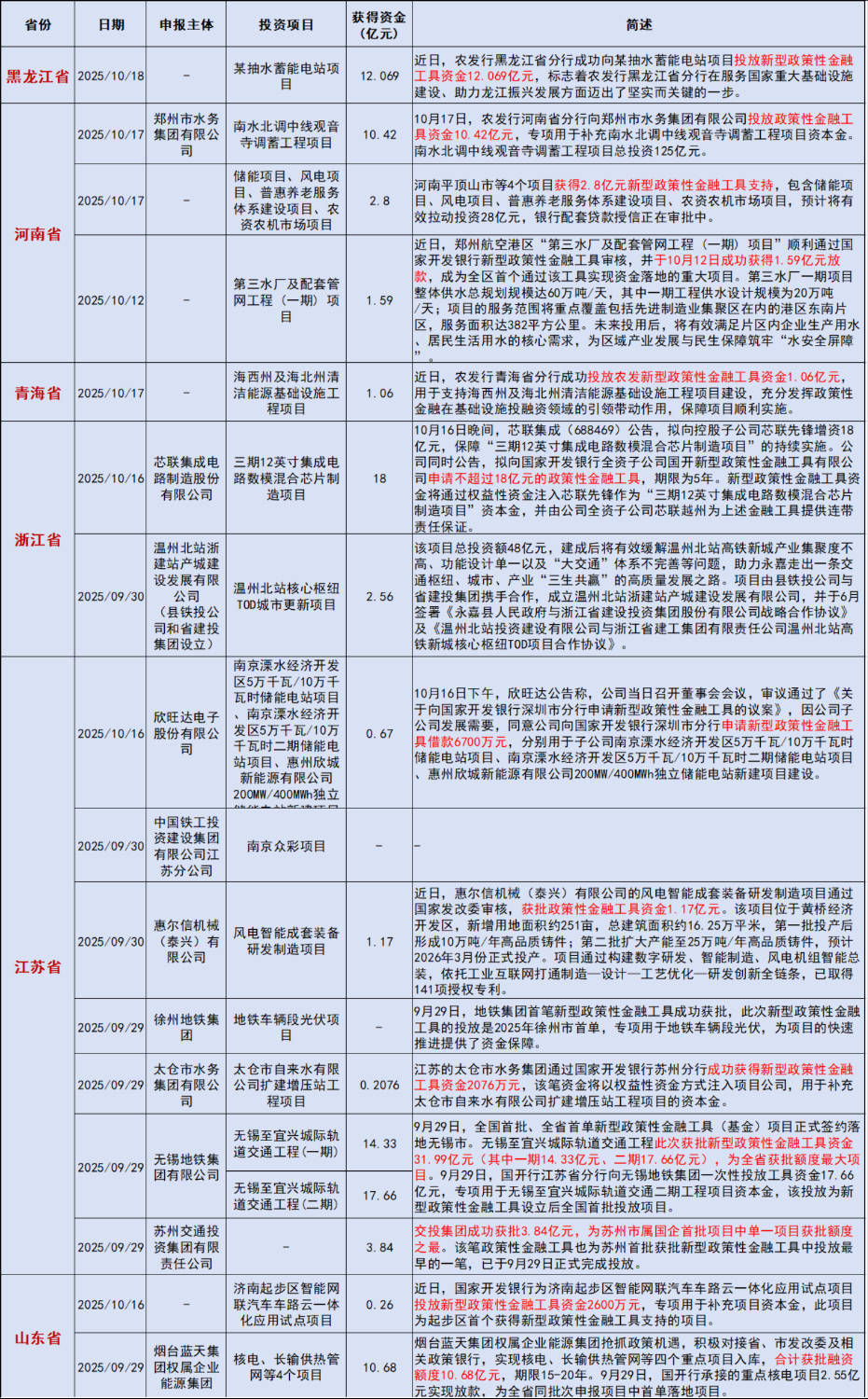
近3000亿元政策性金融工具加速投放,有望撬动数万亿投资动能
Sou Hu Cai Jing· 2025-10-21 23:39
Core Insights - The new policy financial tools are being implemented at an unprecedented speed, with a total of 1,893.5 billion yuan allocated by the National Development Bank and 1,001.11 billion yuan by the Agricultural Development Bank, expected to drive total project investments of 28 trillion yuan and 12.6 trillion yuan respectively [1][2][9] Group 1: Financial Tool Implementation - As of October 17, the National Development Bank has allocated 1,893.5 billion yuan, while the Agricultural Development Bank has allocated 1,001.11 billion yuan, showcasing the efficiency of financial support for the real economy [1][2] - The new policy financial tools, with an initial total scale of 500 billion yuan, are designed to supplement project capital, demonstrating a rapid deployment within 20 days [1][2] Group 2: Investment Focus and Impact - The funds are directed towards key economic sectors, with 77.4% of the National Development Bank's allocations going to 12 major provinces and 28.8% supporting private investment projects [2] - The focus is on new productive forces, particularly in digital economy, artificial intelligence, and consumption sectors, with significant allocations made in these areas [2][9] Group 3: Expected Economic Effects - The leverage effect of the new financial tools is anticipated to mobilize investments of approximately 50 trillion yuan, with the National Development Bank's allocations expected to generate a multiplier effect exceeding 14 times [9][10] - The tools are expected to facilitate a recovery in infrastructure investment, with projections indicating a potential increase in annual growth rates for narrow and broad infrastructure investments to 3.0% and 6.0% respectively [9][10] Group 4: Structural Adjustments - The new financial tools are seen as a mechanism to address capital shortages for major projects, thus enabling smoother project financing and execution [6][7] - The approach represents a shift from traditional stimulus measures to structural repair, aiming to restore investment cycles without significantly increasing government debt or monetary supply [7][9]
强化顶层设计 多元赛道布局 山东枣庄:新能源电池产业构筑“多能互补”新图景
Jing Ji Ri Bao· 2025-10-21 21:58
Core Viewpoint - The transformation of Zaozhuang from a coal-based economy to a green energy hub, focusing on the development of the new energy battery industry as a key driver for future growth [2][13]. Industry Transformation - Zaozhuang is transitioning from a "black engine" reliant on coal to a "green energy" model, driven by the need for sustainable development and innovation in the face of resource depletion and environmental pressures [2]. - The city has positioned itself as a pioneer in the new energy battery sector since 2003, alongside cities like Tianjin and Shenzhen, although it initially struggled to develop a complete industrial chain [2][3]. Strategic Development - In 2021, Zaozhuang launched a strategic initiative to prioritize the lithium battery industry, aiming to become a model city for green energy and a "Northern Lithium City" [3][4]. - The establishment of significant projects, such as the partnership with Shandong Xinnengda New Energy Co., has led to the formation of a lithium battery industrial cluster [3][5]. Technological Advancements - Companies like Shandong Xinnengda are implementing intelligent manufacturing processes, significantly increasing production capacity and efficiency [4][8]. - Innovations in lithium battery materials, such as high-density lithium iron phosphate, are enhancing performance, enabling faster charging and longer ranges for electric vehicles [4][11]. Policy Support - A series of high-standard policies and regulations, including the "Zaozhuang New Energy Battery Industry Development Plan (2024-2030)," are guiding the growth of the industry [5][9]. - The establishment of a comprehensive industrial ecosystem is supported by initiatives that promote collaboration among various stakeholders [7][9]. Collaborative Ecosystem - Zaozhuang is fostering a collaborative environment where upstream and downstream companies work closely together, enhancing supply chain efficiency [7][9]. - The presence of leading companies is attracting numerous supporting enterprises, creating a multi-point support system for the industry [7][9]. Innovation and Talent Development - The city is actively attracting high-level talent and fostering innovation through various initiatives, including the establishment of over 180 innovation platforms and the creation of a lithium battery industry innovation community [9][10]. - The collaboration between educational institutions and the industry is strengthening the talent pipeline for the new energy sector [10][11]. Future Prospects - Zaozhuang is expanding its focus beyond lithium batteries to include other renewable energy technologies such as perovskite solar cells, sodium-ion batteries, and hydrogen energy [11][12]. - The city is also developing energy storage projects and wind power initiatives, positioning itself as a leader in the clean energy transition [12][13].
5000亿政策性金融工具投放过半 “稳增长”与“调结构”并进
2 1 Shi Ji Jing Ji Bao Dao· 2025-10-21 14:44
Core Insights - The new policy financial tools amounting to 500 billion yuan have been officially announced and are aimed at supporting project capital requirements, with nearly 300 billion yuan already allocated as of October 17 [1][2][3] Investment Allocation - As of October 17, the China Development Bank has allocated 1,893.5 billion yuan and the Agricultural Development Bank has allocated 1,001.11 billion yuan, with a total of nearly 3,000 billion yuan expected to stimulate total project investments of approximately 4.06 trillion yuan [1][2] - The China Export-Import Bank has emphasized that 83% of its allocations are directed towards major economic provinces, with 40% of the funding aimed at private sector participation and projects in digital economy and artificial intelligence [1][2] Focus Areas - The new financial tools are designed to support eight key areas: digital economy, artificial intelligence, low-altitude economy, infrastructure for consumption, green and low-carbon transition, agriculture and rural development, transportation and logistics, and municipal and industrial parks [3][6] - A minimum of 20% of the funding is mandated to be directed towards private enterprises, indicating a strong push for private sector involvement [3][6] Economic Impact - Analysts predict that the current round of policy financial tools could leverage an additional 2 to 2.5 trillion yuan in new credit growth, significantly boosting economic performance in the fourth quarter and the first quarter of the following year [2][6] - The tools are expected to provide both short-term support for economic growth and long-term structural adjustments, enhancing investment confidence in key sectors [5][6] Addressing Asset Scarcity - The introduction of these financial tools is seen as a solution to the "asset scarcity" phenomenon in the financial market, as they expand investment opportunities into emerging sectors like digital economy and artificial intelligence [7][8] - By addressing capital shortages for major projects, these tools are anticipated to activate overall credit cycles and direct funds towards effective demand areas, thereby alleviating structural issues in the market [7][8]
二线电池厂,出海求生
远川研究所· 2025-10-21 13:14
Core Viewpoint - The article discusses the competitive landscape of the battery industry, particularly focusing on the dominance of CATL and BYD in the domestic market, while highlighting the challenges and opportunities for second-tier battery manufacturers in both domestic and overseas markets [5][9][10]. Group 1: Domestic Market Dynamics - The domestic battery market is primarily dominated by CATL and BYD, which together hold approximately 70% market share, leaving only 30% for other manufacturers [9][10]. - Since 2019, the installed capacity of domestic power batteries has increased more than eightfold, with CATL's market share rising from 10% in 2015 to 41% by 2018, surpassing BYD [9][10]. - The shift in subsidy policies from "supporting the weak" to "strengthening the strong" has favored manufacturers with higher energy density batteries, allowing CATL to secure significant partnerships with major automakers [9][10][13]. Group 2: International Expansion - Second-tier battery manufacturers are increasingly looking to international markets for growth due to the saturated domestic market [9][14]. - The article highlights that overseas markets, particularly in Europe, offer higher profit margins and lower market concentration compared to the domestic market, making them attractive for expansion [16][23]. - The average price of lithium battery packs in Europe is significantly higher than in China, with a reported average of $139/kWh in Europe compared to $94/kWh in China, indicating greater profit potential for manufacturers operating in Europe [19][23]. Group 3: Challenges for Second-Tier Manufacturers - Second-tier manufacturers face intense competition from CATL, which has established a strong brand presence and customer loyalty, making it difficult for others to gain market share [14][33]. - The article notes that the number of domestic battery manufacturers has increased to 49, leading to oversupply and fierce competition, while the European market remains less saturated [26][30]. - The high costs associated with establishing production facilities overseas, including labor and operational expenses, pose significant challenges for second-tier manufacturers aiming to compete with established players like CATL [33][34].