宁波银行

Search documents
个别银行“抢跑”年末揽储负债成本管控更趋精细化
Zheng Quan Shi Bao· 2025-10-26 17:38
Core Viewpoint - In the context of sustained pressure on net interest margins, many small and medium-sized banks are initiating a new round of interest rate cuts, actively lowering the upper limit of deposit rates to create space for profit growth [1][5]. Group 1: Deposit Rate Adjustments - Some banks have begun to quietly ramp up deposit acquisition efforts as the year-end approaches, combining this with refined and tiered customer management to stabilize general deposits while effectively controlling liability costs [1][3]. - Recent adjustments in deposit rates have seen most market deposit products enter the "1" range, with major state-owned banks' two-year, three-year, and five-year fixed deposit rates set at 1.05%, 1.25%, and 1.3% respectively [3][4]. - Some banks have implemented actual execution rates above the listed rates, with examples including Postal Savings Bank offering a one-year fixed deposit rate of 1.15% and large certificates of deposit at 1.25% [4]. Group 2: Marketing Strategies - Banks are employing various marketing strategies to attract deposits, such as cash rewards for customers who meet certain asset thresholds, as seen in activities launched by China Merchants Bank [2][3]. - The year-end "closing battle" and the beginning of the new year "opening red" strategy are emphasized by many banks, particularly in rural commercial banks in regions like Shanxi, Jiangsu, and Jiangxi [3][5]. Group 3: Liability Cost Management - The continuous narrowing of net interest margins has become a common challenge for the banking industry, leading to a focus on managing liability costs more effectively [4][6]. - The People's Bank of China has called for further reductions in overall bank liability costs to alleviate pressure on net interest margins, which has led to recent adjustments in deposit rates [5][6]. Group 4: Targeted Deposit Strategies - Banks are increasingly adopting differentiated deposit strategies for specific customer segments, particularly for older clients, offering higher interest rates and lower minimum deposit thresholds [7]. - This approach not only optimizes the liability structure but also helps in acquiring stable long-term funds while reducing liquidity management pressure [7].
上市银行三季报陆续披露 资产质量均有好转 息差有望企稳
Shang Hai Zheng Quan Bao· 2025-10-26 17:24
Core Viewpoint - The A-share listed banks are expected to show overall revenue and net profit growth or a narrowing decline in their Q3 2025 reports, with improved asset quality across the board [1][2]. Group 1: Financial Performance - Four A-share listed banks, including Chongqing Bank and Wuxi Bank, reported revenue and net profit growth exceeding 10% and 3% respectively in the first three quarters of the year [2]. - Ping An Bank's net profit for the first three quarters was 38.339 billion yuan, a year-on-year decline of 3.5%, but the decline was narrower compared to the first half of the year [2]. - Huaxia Bank reported a net profit of 17.982 billion yuan for the first three quarters, down 2.86% year-on-year, with a decline of 5.09 percentage points compared to the first half [2]. Group 2: Asset Quality - Asset quality has improved for most banks, with Chongqing Bank's non-performing loan (NPL) ratio at 1.14%, down 0.11 percentage points from the end of the previous year [3]. - Huaxia Bank's NPL ratio was 1.58%, a decrease of 0.02 percentage points, while Ping An Bank's NPL ratio stood at 1.05%, down 0.01 percentage points [3]. Group 3: Interest Margin and Revenue - Analysts predict that the net interest margin (NIM) decline will narrow, supporting positive growth in bank performance [4]. - The overall revenue and net profit for A-share listed banks are expected to grow by 0.4% and 1.1% year-on-year respectively for the first three quarters of 2025 [4]. - The improvement in net interest income and non-interest income, particularly from fees and commissions, is anticipated to continue [4][5]. Group 4: Market Outlook - The banking sector is viewed positively by multiple institutions, with expectations of steady performance and growth potential in the context of a recovering economy [5]. - As of October 24, 2023, 37 bank stocks have shown positive growth since the beginning of the year, with some exceeding 30% [5].



信用卡债权腾挪背后
Bei Jing Shang Bao· 2025-10-26 15:50
Core Insights - The article discusses the ongoing trend of credit card debt transfer among banks in response to rising non-performing loans and capital pressure, indicating a strategic shift towards optimizing credit structures and managing risks [1][4]. Group 1: Credit Card Debt Transfer Activities - Multiple banks, including Ping An Bank, SPDB, Ningbo Bank, and Huaxia Bank, have been actively transferring credit card debts to local asset management companies (AMCs) to accelerate the clearing of non-performing loans [2][3]. - Ping An Bank has announced several batches of credit card debt transfers in October, emphasizing the legal obligation of debtors to repay the new creditors post-transfer [2][3]. - The trend is not isolated, as other banks like SPDB and Ningbo Bank have also engaged in similar debt transfer agreements with AMCs, highlighting a collective industry response to rising credit card defaults [3][4]. Group 2: Industry Trends and Data - The credit card non-performing loan transfer has become a common practice in the industry, driven by stricter regulations and increasing default rates [5][6]. - As of October 23, Everbright Bank listed seven personal non-performing loan transfer projects, involving a total of 20,516 borrowers with an outstanding principal and interest of 653 million yuan [5]. - Data from the first quarter indicates that the scale of personal non-performing loan transfers reached 37.04 billion yuan, a year-on-year increase of 7.6 times, with credit card overdrafts accounting for 5.19 billion yuan, or 14% of the total [6][7]. Group 3: Implications for Banks - Analysts suggest that the batch transfer of non-performing loans is a key strategy for banks to quickly reduce their non-performing asset scale and release occupied capital, thus meeting regulatory requirements [4][7]. - The transfer process improves asset quality metrics, directly lowering the non-performing loan ratio and enhancing capital adequacy ratios for banks [7][8]. - The shift towards batch transfers is seen as a more efficient and compliant method compared to traditional collection methods, which are often slow and costly [7][8]. Group 4: Challenges and Strategic Recommendations - The article highlights the dual challenge faced by banks, with both non-performing loan balances and rates increasing, necessitating a more nuanced approach to risk management [8][9]. - Large banks are encouraged to explore asset-backed securities (ABS) for non-performing asset management, while smaller banks should focus on batch transfers or revenue rights transfers to clear bad debts [9][10]. - Recommendations for improving risk management include enhancing credit models, leveraging technology for better risk assessment, and educating customers on responsible credit use [10].




银行“甩包袱”、资产管理公司接盘,信用卡债权“腾挪”背后
Bei Jing Shang Bao· 2025-10-26 14:26
Core Viewpoint - The ongoing trend of credit card debt transfer among banks is a response to rising non-performing loans and capital pressure, aiming for both short-term risk clearance and long-term credit structure optimization [1][5]. Group 1: Credit Card Debt Transfer Activities - Multiple banks, including Ping An Bank, SPDB, Ningbo Bank, and Huaxia Bank, have announced batch transfers of credit card debts to local asset management companies (AMCs) [3][4]. - Ping An Bank has issued four announcements in October alone regarding the transfer of credit card debts, emphasizing the obligation of debtors to repay the new creditors [3][4]. - The trend is not isolated, as SPDB and Ningbo Bank have also engaged in similar debt transfer agreements with AMCs, highlighting a collective industry movement [4][5]. Group 2: Industry Context and Trends - The transfer of credit card non-performing loans has become a norm in the industry, driven by stricter regulations and rising non-performing loan rates [7][9]. - Data from the first quarter of 2025 indicates that the scale of personal non-performing loan transfers reached 37.04 billion, a year-on-year increase of 7.6 times, with credit card overdrafts accounting for 5.19 billion [8]. - The efficiency of batch transfers compared to traditional collection methods is noted, as it allows banks to quickly offload non-performing assets and reduce capital occupation [9][10]. Group 3: Financial Health and Risk Management - As of mid-2025, the total non-performing credit card loans across 11 banks reached 162.69 billion, with a year-to-date increase of 5.885 billion [10][11]. - The rise in non-performing loans is attributed to aggressive card issuance practices and economic pressures affecting borrowers' repayment capabilities [10][11]. - Differentiated strategies for managing non-performing assets are recommended, with larger banks advised to explore asset securitization while smaller banks focus on batch transfers [11][12]. Group 4: Recommendations for Future Management - To achieve long-term non-performing asset clearance, banks must enhance their risk management frameworks, focusing on credit assessment and customer education [12]. - The implementation of technology in risk management, such as AI for predictive modeling and monitoring, is suggested to improve efficiency in identifying potential defaults [12].


\十五五\规划背景下,银行如何进行战略升级?:银行业周报(20251020-20251026)-20251026
Huachuang Securities· 2025-10-26 11:16
Investment Rating - The report maintains a "Recommendation" rating for the banking sector, expecting the industry index to outperform the benchmark index by over 5% in the next 3-6 months [24]. Core Insights - The banking sector is transitioning from a "deposit-loan intermediary" to a key executor of national strategies and resource allocation hubs, focusing on five major areas: technology finance, green finance, inclusive finance, pension finance, and digital finance [2]. - The "14th Five-Year Plan" emphasizes the importance of financial system security, urging banks to balance profit-making with risk management while enhancing operational efficiency and service quality [3]. - The report highlights the need for banks to adapt to a more complex international competitive environment while prioritizing financial security and risk management in cross-border capital flows [3]. - The overall market performance shows a 1.40% weekly increase in the banking index, lagging behind the Shanghai Composite Index by 1.84 percentage points [7]. Summary by Sections Industry Overview - The banking sector's total market capitalization is approximately 1.15 trillion yuan, with a circulating market value of about 790 billion yuan [4]. - The report notes a 3.24% increase in the Shanghai Composite Index and a 2.88% increase in the Shanghai A-share market during the week [7]. Performance Metrics - The banking sector's absolute performance over the last month is 5.0%, with a relative performance of 2.8% compared to the benchmark [5]. - The report indicates a significant increase in the banking index over the past 12 months, with a relative performance of 24.4% [5]. Investment Recommendations - The report suggests a diversified investment strategy focusing on state-owned banks and stable joint-stock banks, highlighting the ongoing dividend plans and valuation improvement initiatives [8]. - Specific banks recommended for investment include China Merchants Bank, CITIC Bank, and Jiangsu Bank, among others, due to their solid fundamentals and growth potential [8][9].



平安基金高勇标旗下平安瑞兴A三季报最新持仓,重仓宁波银行
Sou Hu Cai Jing· 2025-10-25 15:25
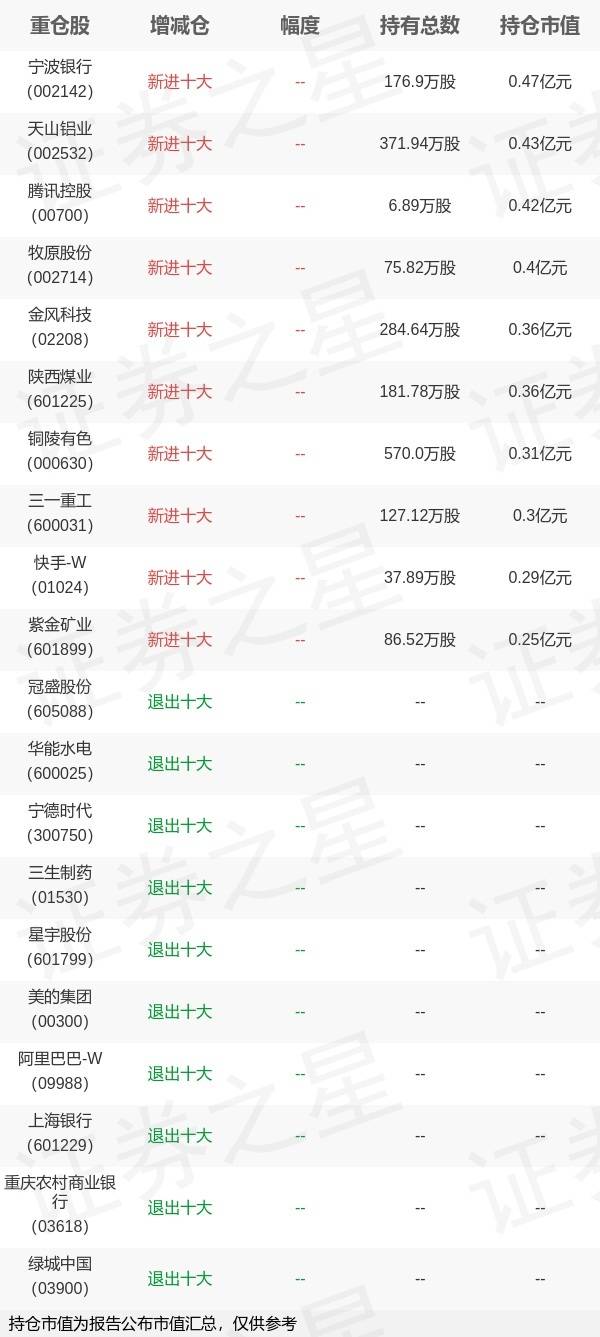
Group 1 - The core point of the article is the performance and changes in the top holdings of the Ping An Ruixing 1-Year Holding Mixed Fund, which reported a net value growth rate of 6.38% over the past year [1] - The fund's top ten holdings saw the addition of several new stocks, including Ningbo Bank, Tianshan Aluminum, Tencent Holdings, Muyuan Foods, and others, indicating a diversification strategy [1] - Ningbo Bank emerged as the largest holding with a 0.69% allocation, while several previous top holdings such as Guansheng Co., Huaneng Hydropower, and Alibaba were removed from the list [1] Group 2 - The new top ten holdings include stocks with significant share quantities and market values, such as Tianshan Aluminum with 3.72 million shares valued at 0.43 billion and Tencent Holdings with 68,900 shares valued at 0.42 billion [1] - The fund's adjustments reflect a strategic shift in investment focus, moving away from previously held stocks to new opportunities in the market [1] - The overall market sentiment and performance of the fund suggest a cautious yet optimistic approach to investment in the current economic climate [1]
宁波银行(002142) - 宁波银行股份有限公司关于赎回优先股的第三次提示性公告
2025-10-24 12:16
证券代码:002142 证券简称:宁波银行 公告编号:2025-035 优先股代码:140001、140007 优先股简称:宁行优01、宁行优02 宁波银行股份有限公司 关于赎回优先股的第三次提示性公告 本公司及董事会全体成员保证信息披露内容的真实、准确和完整, 没有虚假记载、误导性陈述或者重大遗漏。 四、赎回时间 "宁行优02"固定股息发放日,即2025年11月7日。 宁波银行股份有限公司(以下简称"公司")于2018年11月7 日非公开发行优先股1亿股(以下简称"宁行优02"),优先股代码: 140007。2025年8月27日,公司第八届董事会第十一次会议审议通 过了《关于行使第二期优先股赎回权的议案》。经宁波金融监管局 审核同意,公司拟于2025年11月7日全部赎回"宁行优02",现将 有关赎回事宜提示如下: 一、赎回条件 根据"宁行优02"募集说明书约定,经相关监管部门批准,公 司有权自发行结束日期满5年之日起,于每年的优先股股息支付日 全部或部分赎回本次发行的优先股。 二、赎回规模 "宁行优02"共计1亿股,每股面值100元人民币,总规模100 亿元人民币。公司本次拟全额赎回"宁行优02"。 三、赎 ...
城商行板块10月24日跌0.76%,厦门银行领跌,主力资金净流出1.42亿元
Zheng Xing Xing Ye Ri Bao· 2025-10-24 08:27
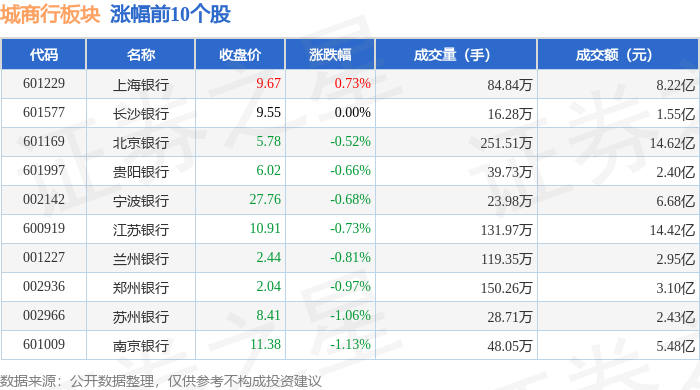
Core Insights - The city commercial bank sector experienced a decline of 0.77% on October 24, with Xiamen Bank leading the drop [1] - The Shanghai Composite Index closed at 3950.31, up 0.71%, while the Shenzhen Component Index closed at 13289.18, up 2.02% [1] Stock Performance - Shanghai Bank closed at 9.67, up 0.73% with a trading volume of 848,400 shares and a transaction value of 822 million [1] - Xiamen Bank closed at 6.68, down 1.76% with a trading volume of 153,100 shares and a transaction value of 103 million [2] - The majority of city commercial bank stocks showed negative performance, with notable declines in Beijing Bank (-0.52%) and Guizhou Bank (-0.66%) [1][2] Capital Flow - The city commercial bank sector saw a net outflow of 142 million from institutional investors, while retail investors contributed a net inflow of 55.9 million [2] - Jiangsu Bank had a net inflow of 70.84 million from institutional investors, while Shanghai Bank experienced a net outflow of 78.96 million from retail investors [3] Individual Stock Analysis - Chengdu Bank had a slight negative net flow from institutional investors of 19.75 million, but a positive inflow from retail investors of 596.99 million [3] - Lanzhou Bank saw a net inflow of 13.36 million from institutional investors, while it faced a net outflow of 1.48 million from retail investors [3]

二级资本债赎回分化加剧 中小银行资本补充难题待解?
Mei Ri Jing Ji Xin Wen· 2025-10-23 18:17
Core Viewpoint - The secondary capital bond market for commercial banks is experiencing a rare divergence, with large banks actively redeeming old bonds while some small and medium-sized banks are opting not to redeem, highlighting the varying capital adequacy levels and operational conditions across the banking sector [1][3][6]. Group 1: Market Dynamics - Large banks such as Bank of China and China Construction Bank have fully redeemed billions in secondary capital bonds, indicating a strategic move to optimize their capital structure [3][4]. - In contrast, smaller banks like Fuxin Bank and Nanchang Rural Commercial Bank have chosen not to exercise their redemption rights, raising concerns about their capital adequacy and operational health [1][4][5]. Group 2: Regulatory Environment - Regulatory bodies are responding to the trend of non-redemption by proposing that banks must report any decision not to redeem bonds within 24 hours, signaling a focus on maintaining market stability and transparency [6][8]. - The introduction of a rapid reporting mechanism aims to mitigate potential risks associated with non-redemption, which could lead to increased scrutiny of the banks' financial health [6][8]. Group 3: Capital Adequacy Challenges - Many small and medium-sized banks are facing pressure on their capital adequacy ratios, with some nearing regulatory limits, which complicates their ability to redeem old bonds without risking their capital positions [5][7]. - The declining effectiveness of existing bonds as capital supplements over time adds to the urgency for these banks to find alternative capital-raising strategies [5][7]. Group 4: Strategic Responses - Small and medium-sized banks are encouraged to diversify their capital sources, including the issuance of perpetual bonds and engaging in equity financing to strengthen their capital bases [7][8]. - A focus on regional or sector-specific strategies may help these banks avoid the pitfalls of homogeneous competition and enhance their capital efficiency [8].
靠降薪2亿维持体面增长,苏州银行之忧何解
Sou Hu Cai Jing· 2025-10-23 13:42
Core Viewpoint - The performance of Suzhou Bank has significantly declined, with its growth relying on cost-cutting measures rather than genuine business expansion, raising concerns about its long-term sustainability and profitability [3][4][7]. Financial Performance - In the first half of 2025, Suzhou Bank reported operating income of approximately 65.04 billion yuan, a year-on-year increase of only 1.81%, and a net profit attributable to shareholders of 31.34 billion yuan, up 6.15% year-on-year, marking the lowest growth rate in five years [5][6]. - The bank's net profit growth is largely superficial, achieved through salary reductions, as employee costs decreased by 2.11 billion yuan despite an increase in employee numbers [8][9][10]. Business Segments - Suzhou Bank's business is primarily divided into corporate, personal, and funding segments, with corporate business contributing over 50% of revenue. However, both corporate and personal business segments are currently underperforming [12]. - The bank's corporate business profit share rose to 72.12%, while personal and funding business profits declined significantly [12][16]. Loan and Asset Management - As of June 30, 2025, Suzhou Bank's total assets reached 754.97 billion yuan, an increase of 8.83% from the previous year, but still significantly smaller compared to its peers [12][19]. - The bank's personal loan principal has been consistently declining, with a notable drop of 2.52% in the first half of 2025 [13][14]. Challenges and Goals - Suzhou Bank aims to reach a total asset scale of 1 trillion yuan by 2026, but achieving this goal poses significant challenges given the current growth trajectory and market competition [17][19][21]. - The bank faces intense competition from larger state-owned banks and regional financial institutions, complicating its expansion efforts [21]. - Internal control issues have also been highlighted, with regulatory warnings issued due to various compliance failures [22].