宁波银行

Search documents
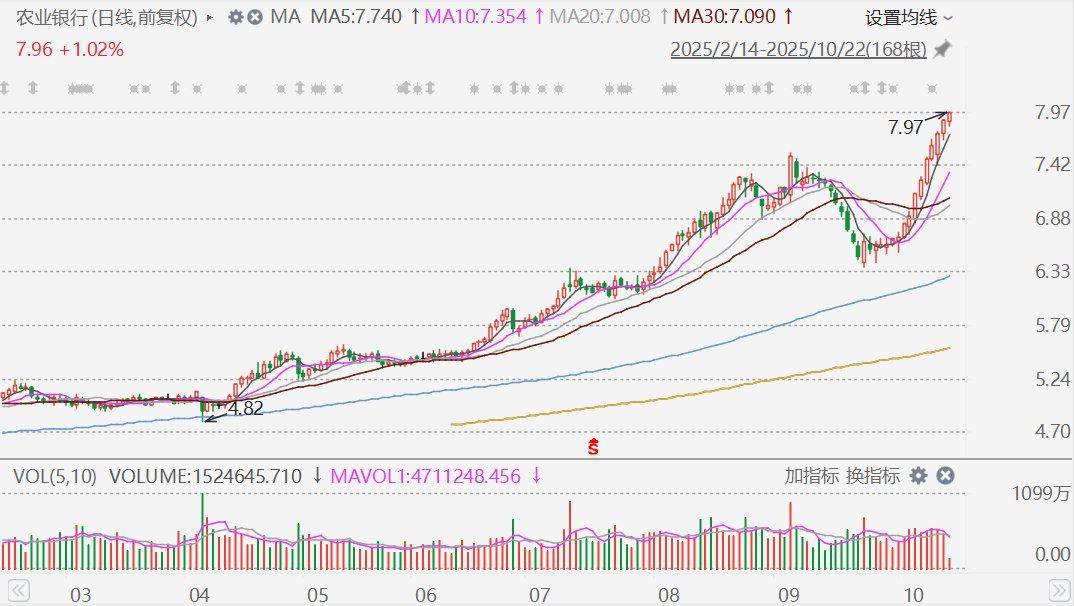
农业银行14连阳,再创历史新高,年内累涨近56%
Ge Long Hui A P P· 2025-10-22 02:29
Core Insights - The A-share market has seen a rise in bank stocks, with notable increases in shares of several banks, including Agricultural Bank of China, which has achieved a 14-day consecutive rise and a year-to-date increase of nearly 56% [1][3] Group 1: Bank Stock Performance - Zhejiang Commercial Bank, Wuxi Bank, CITIC Bank, Xi'an Bank, Jiangyin Bank, Sunong Bank, Agricultural Bank of China, Ningbo Bank, and Nanjing Bank all experienced gains exceeding 1% [1][3] - Agricultural Bank of China has reached a historical high with a year-to-date increase of 55.96%, marking a significant performance in the banking sector [1][3] Group 2: Market Data - Zhejiang Commercial Bank: 1.32% increase, total market value of 84.6 billion [3] - Wuxi Bank: 1.30% increase, total market value of 13.7 billion [3] - CITIC Bank: 1.29% increase, total market value of 436.8 billion [3] - Agricultural Bank of China: 1.14% increase, total market value of 27,894 billion [3]


A股银行股逆势上涨,农业银行14连阳再创历史新高,年内累涨近56%!浙商银行、无锡银行、中信银行涨超1%
Ge Long Hui· 2025-10-22 02:16
Core Viewpoint - The A-share market is witnessing a counter-trend rise in bank stocks, with several banks showing significant gains, particularly Agricultural Bank of China, which has reached a historical high with a substantial year-to-date increase [1] Group 1: Bank Performance - Zhejiang Commercial Bank, Wuxi Bank, CITIC Bank, Xi'an Bank, Jiangyin Bank, Suning Bank, Agricultural Bank of China, Ningbo Bank, and Nanjing Bank have all risen over 1% [1] - Agricultural Bank of China has achieved a remarkable 14 consecutive days of gains, marking a new historical high and an approximate year-to-date increase of 56% [1]



平均回报率28%!权益类保险资管产品表现亮眼
Zhong Guo Zheng Quan Bao· 2025-10-21 23:24
Core Insights - The insurance asset management products have shown strong performance in 2023, with 92.7% of the 1,583 products achieving positive returns this year [1][2] - Equity insurance asset management products have been particularly outstanding, with an average return rate of 28% year-to-date [1] - There is a notable increase in insurance institutions' research efforts on listed companies, especially in the technology innovation sector [3] Group 1: Product Performance - As of October 21, 2023, among the 1,583 disclosed insurance asset management products, 156 products have an annualized return rate exceeding 30%, highlighting the strong performance of equity products [2] - In the fixed income category, 1,008 products were reported, with 945 achieving positive returns this year; in the equity category, 263 products were reported, with 259 achieving positive returns [2] - The top 10 products in terms of return rate over the past six months are all equity products, indicating a strong preference for equities among insurance asset managers [2] Group 2: Focus on Technology Innovation - Insurance and asset management companies have significantly increased their research on listed companies, with a focus on technology innovation firms [3] - A total of 206 insurance and asset management companies participated in over 14,000 research activities this year, with the highest number of research activities conducted by Taikang Asset Management at 875 times [3] - Key sectors of interest include electronic components, industrial machinery, integrated circuits, and healthcare equipment, with specific companies like Shenzhen South Circuit and Lixun Precision receiving considerable attention [3] Group 3: Future Outlook - Industry experts suggest that in addition to traditional fixed income and equity assets, diversifying sources of returns through alternative investments is becoming a crucial strategy for insurance asset allocation [4]
乘股市回暖东风 逾九成保险资管产品年内实现正收益
Zhong Guo Zheng Quan Bao· 2025-10-21 21:41
Core Insights - The insurance asset management products have shown strong performance, with 92.7% of the 1,583 products reporting positive returns this year, particularly equity products averaging a return of 28% [1][2] - There is a significant increase in insurance institutions' research on listed companies, especially in the technology sector, focusing on high dividend and high growth opportunities [3][4] - The shift towards equity investments is driven by a recovering market and rising risk appetite among insurance companies, leading to improved performance and profit growth [4][5] Group 1: Performance of Insurance Asset Management Products - A total of 1,583 insurance asset management products have disclosed their latest net values since October, with 1,468 products achieving positive returns this year [1] - Among these, 263 equity products have only 4 reporting losses, while 190 out of 200 mixed products have positive returns [2] - The top 10 products in the last six months by return rate are all equity products, indicating strong performance in this category [2] Group 2: Research and Investment Focus - Insurance and asset management companies have conducted over 14,000 research sessions on listed companies this year, with a focus on technology and high-growth sectors [3] - Key sectors of interest include electronic components, industrial machinery, integrated circuits, and healthcare equipment, with specific companies like Deep South Circuit and Junzheng Technology receiving significant attention [3] - Traditional banking stocks remain a core focus for high dividend strategies, with regional banks being frequently researched [3] Group 3: Strategic Shifts in Asset Allocation - The market environment has changed significantly since September last year, with a notable recovery in confidence reflected in rising stock prices and bond yields [4] - Insurance companies are increasing their equity investment allocations, leading to better-than-expected earnings reports from major insurers like China Life and New China Life [4] - There is a growing trend towards diversifying income sources through alternative investments to enhance long-term returns and stabilize net value fluctuations [5]


乘股市回暖东风逾九成保险资管产品年内实现正收益
Zhong Guo Zheng Quan Bao· 2025-10-21 20:18
Core Insights - The insurance asset management products have shown strong performance in 2023, with 92.7% of the 1,583 products reporting positive returns this year [1] - Equity insurance asset management products have an impressive average return rate of 28% year-to-date, with 156 products achieving an annualized return rate exceeding 30% [1][2] - Insurance institutions are increasingly focusing on long-term investments and diversifying their asset allocation, particularly through alternative investments to enhance yield and stabilize net value fluctuations [1][4] Performance of Equity Products - In the last six months, equity products have outperformed, with all top 10 products in terms of return being equity-based [2] - The low interest rate environment has made equity investments a viable option for insurance funds to enhance long-term returns [2] Focus on High Dividend and High Growth - Insurance and asset management companies have intensified their research on listed companies, particularly in the technology sector, with over 14,000 total research engagements this year [2] - Key sectors of interest include electronic components, industrial machinery, integrated circuits, and healthcare equipment, with specific companies like Deep South Circuit and Lixun Precision receiving significant attention [2][3] Increased Allocation to Equity Assets - The market environment has shifted since September last year, leading to increased risk appetite among insurance institutions [3] - Major insurance companies like China Life and New China Life have reported significant earnings growth due to increased equity investment returns, with stock positions rising [3] Diversification of Investment Sources - Insurance institutions are exploring diverse investment sources beyond traditional fixed income and equity assets, focusing on alternative investments to enhance yield and manage risk [4]
国际大行继续“超配中国”,部分个股一度被外资“买爆”
Di Yi Cai Jing Zi Xun· 2025-10-21 16:01
2025.10.21 本文字数:3357,阅读时长大约6分钟 作者 |第一财经 周楠 A股三大指数21日集体收涨,上证指数再次收复3900点。多家外资近日表态,继续看好中国市场,有国 际大行喊出"超配中国"。 瑞银日前公开表示,在新兴市场中继续给予中国超配评级,理由是,与另一新兴市场印度相比,中国 (企业)营收增长更快,每股收益增长同样较快,"即使忽略中国的AI及互联网股票,MSCI中国指数中 其余股票的资本回报率(ROIC)也在改善"。 瑞银证券中国股票策略分析师孟磊21日对第一财经记者表示,10月以来,A股经历了从"科技成 长"向"价值红利"的风格切换,影响因素包括中美贸易再次出现摩擦、投资者对组合进行再平衡,科技 板块前期涨幅较大、部分投资者获利了结等。但他认为,A股中期表现依然向好,"成长"风格可能跑 赢"价值"风格。 第一财经同时了解到,外资高度关注中国"十五五"规划,特别是"反内卷"、促消费、高质量增长和发展 新质生产力等方面的情况。 第一财经记者梳理上市公司三季报时还发现,部分外资三季度确实在行动,"瞄准"A股龙头股跑步入 场,部分个股的外资持股比例维持较高水平。比如,思源电气(002028.S ...

基金公司和代销机构风险重估潮来袭:基金风险等级大量上调
2 1 Shi Ji Jing Ji Bao Dao· 2025-10-21 13:34
Core Viewpoint - A significant wave of risk level reassessment has swept through the public fund industry, with nearly 20 fund companies adjusting the risk levels of hundreds of products since September, primarily increasing risk ratings for previously considered "stable" bond funds and "fixed income+" products [1][4][10] Summary by Sections Risk Level Adjustments - Since September, nearly 20 fund companies have issued over 20 adjustment announcements, a sharp increase compared to previous months [4] - Major fund companies like Huazhang Fund and Fuguo Fund have announced risk level adjustments for multiple products, with many bond funds moving from R2 (medium-low risk) to R3 (medium risk) and several equity funds moving from R3 to R4 (medium-high risk) [3][4] Sales Channels Involvement - Adjustments are not limited to fund companies; banks and third-party sales channels have also participated in the risk level reassessment [5][6] - For instance, CITIC Bank has made multiple adjustments to the risk ratings of its sold asset management products, with a significant number of products seeing their risk ratings increased [5] Regulatory and Market Drivers - The core drivers behind the risk level adjustments are regulatory requirements and market changes, particularly the implementation of the new regulations by the National Financial Regulatory Administration [8][9] - The new regulations emphasize the need for sales institutions to ensure that product risks align with customer risk tolerance, leading to a more rigorous assessment process [8] Dynamic Risk Assessment - The adjustments reflect a broader trend towards dynamic risk assessment, where fund managers and sales institutions regularly evaluate and adjust risk ratings based on market conditions and product performance [9][10] - This dynamic approach requires investors to stay informed about changes in risk levels, especially when products are deemed to have increased risk [12][13] Impact on Investors - The adjustments have direct implications for investors, who will receive notifications about changes in risk levels and may need to reassess their investment strategies accordingly [11][12] - New subscription and investment plans may be restricted if the adjusted risk levels exceed the investor's risk tolerance, serving as a protective measure [12]

国际大行继续“超配中国” A股行业龙头最受青睐
Di Yi Cai Jing· 2025-10-21 13:32
Core Viewpoint - The A-share market is experiencing a collective rise, with foreign investors expressing optimism about China's market, particularly highlighting the potential for growth in the A-share index compared to other emerging markets like India [1][3]. Group 1: Market Performance and Investor Sentiment - The A-share indices collectively rose on the 21st, with the Shanghai Composite Index reclaiming the 3900-point mark [1]. - UBS has maintained an "overweight" rating on China within emerging markets, citing faster revenue and earnings growth compared to India, and improvements in capital return rates for the MSCI China Index [1][3]. - Since October, A-shares have shifted from a "technology growth" style to a "value dividend" style, influenced by factors such as renewed US-China trade tensions and profit-taking by investors [1][3]. Group 2: Foreign Investment Trends - Foreign investors have been actively targeting leading A-share stocks, with significant holdings in companies like Siyuan Electric, Huaming Equipment, and Hongfa Technology, each having over 24% foreign ownership [2][6]. - As of the end of September, major foreign-favored stocks included Kweichow Moutai, Ping An Insurance, and Wuliangye, with foreign institutional holdings reaching 85, 83, and 81 respectively [6]. - The banking sector remains a strong focus for foreign investors, with seven of the top ten A-share companies by foreign holdings being banks [6][7]. Group 3: Market Outlook and Strategic Focus - UBS believes that the A-share market will continue to perform well in the medium term, with growth styles likely to outperform value styles [9]. - Investors are encouraged to focus on companies with strong fundamentals and pricing power to navigate uncertainties in the trade environment [10]. - The upcoming "14th Five-Year Plan" is expected to provide investment opportunities, particularly in areas like "anti-involution" and service consumption, which may drive cyclical improvements in various industries [10][11].






国际大行继续“超配中国”,A股行业龙头最受青睐
Di Yi Cai Jing· 2025-10-21 13:15
Group 1 - UBS maintains an overweight rating for China in emerging markets, citing faster revenue and earnings growth compared to India, and improving capital return rates in the MSCI China index [1][3] - A-share indices collectively rose, with the Shanghai Composite Index recovering above 3900 points, indicating positive sentiment from foreign investors towards the Chinese market [1][3] - Foreign investors are focusing on China's 14th Five-Year Plan, particularly on themes like "anti-involution," consumption promotion, high-quality growth, and the development of new productivity [1][10] Group 2 - Foreign capital has been actively entering the A-share market, particularly targeting leading stocks, with significant foreign ownership in companies like Siyuan Electric and Huaming Equipment, where foreign holdings exceed 24% [2][6] - The A-share market has shown structural differentiation since October, with foreign investors not overly concerned about the impacts of recent tariff changes, suggesting that A-shares still hold high allocation value [3][4] - UBS and other institutions believe that the current market fluctuations present opportunities for long-term investors, especially in sectors with stable earnings growth [9][10] Group 3 - Leading stocks remain the favorite among foreign investors, with significant foreign institutional holdings in companies like Kweichow Moutai and Ping An Insurance, indicating strong interest in industry leaders [6][7] - As of the end of September, foreign holdings in A-shares exceeded 100 billion yuan for 42 stocks, with CATL leading at 265.66 billion yuan, highlighting the preference for high-value companies [7][8] - The focus on growth stocks is expected to continue, with UBS suggesting that growth styles may outperform value styles in the medium term, providing a favorable risk-return profile for investors [9][10] Group 4 - The upcoming 14th Five-Year Plan is anticipated to emphasize supply-side measures and demand stimulation, with a focus on enhancing consumer income and improving the social security system [11] - The "anti-involution" theme is expected to drive cyclical improvements across various industries, potentially impacting the overall earnings targets for the CSI 300 index by 2025 [10][11]
厦门金龙汽车集团股份有限公司关于2025年7-9月份委托理财情况的公告
Zhong Guo Zheng Quan Bao - Zhong Zheng Wang· 2025-10-21 10:42
Core Viewpoint - The company aims to enhance the efficiency of fund utilization and reduce financial costs through entrusted wealth management while ensuring the safety of funds [5][4]. Group 1: Overview of Entrusted Wealth Management - The total amount for entrusted wealth management is 498,900 million yuan [3]. - The entrusted wealth management products include various structured deposits linked to gold and exchange rates from multiple banks [3]. - The duration for entrusted wealth management is within one year [4]. Group 2: Purpose and Source of Funds - The purpose of the entrusted wealth management is to ensure fund safety while improving fund utilization efficiency and obtaining certain investment returns [5]. - The source of funds for the entrusted wealth management is the temporarily idle self-owned funds of the company and its subsidiaries [6]. Group 3: Risk Control and Management - The company will conduct strict evaluations and selections of wealth management products, focusing on high safety, good liquidity, and low-risk principal-protected products [7]. - The company aims to avoid investment risks associated with policy changes by selecting short-term bank wealth management products [8]. Group 4: Impact on the Company - The wealth management activities are designed to improve the efficiency of idle funds without affecting the company's main business operations, thus benefiting the overall returns for the company and its shareholders [12]. - The accounting treatment for the wealth management products will be reported under "trading financial assets" according to the new financial instrument standards issued by the Ministry of Finance [12]. Group 5: Decision-Making Process - The decision to conduct wealth management was approved by the company's board of directors and the annual general meeting, emphasizing the importance of fund safety and efficiency [14]. - Independent directors believe that using temporarily idle self-owned funds for low-risk financial institution products aligns with the interests of the company and all shareholders [14].