格力电器

Search documents
家电2026策略:周期筑底与智能新机遇
2025-11-14 03:48
Summary of Key Points from the Conference Call Industry Overview - The conference call focuses on the home appliance industry in China, particularly the trends and strategies leading up to 2026 [1][3][5]. Core Insights and Arguments - **Market Demand Trends**: The domestic demand for home appliances is expected to bottom out in 2026, with traditional white goods companies showing low valuations and stable growth, indicating defensive value [1][3]. - **Innovation and Smart Upgrades**: Companies that focus on product innovation and smart upgrades are favored, particularly in emerging fields like robotics and AI computing [1][3][4]. - **Globalization Strategy**: Chinese home appliance companies are expanding globally through acquisitions and local manufacturing to mitigate tariff impacts, transitioning from a focus on volume to structural upgrades and globalization [1][5][6]. - **Smart Home Ecosystem**: The industry is evolving from single product offerings to a multi-scenario integration of smart home ecosystems, driven by AI computing, energy management, and robotics [1][7][8]. - **Investment Strategy for 2026**: Key investment focuses include core assets (e.g., Midea, Haier, Gree), innovative smart home companies (e.g., Ugreen, Anker Innovations, Ecovacs), and emerging business opportunities in sectors like environmental technology and LED supply chains [1][10]. Additional Important Insights - **Performance Disparities**: The home appliance sector is experiencing internal disparities, with traditional companies facing challenges due to subsidy reductions and competition, while smart home companies are rapidly growing [2][3]. - **Long-term Transformations**: The industry is undergoing significant changes, including a shift from quantity to quality and from export-driven growth to global restructuring [6][11]. - **Short-term Market Dynamics**: The market is expected to show cyclical recovery, with domestic sales gradually improving despite fluctuations in demand due to policy changes and competition [11][12]. - **Global Export Challenges**: The global home appliance export market is facing challenges due to high tariffs and weakening demand in North America and Europe, although long-term growth is anticipated as companies adapt [17][19]. - **Technological Differentiation**: Traditional companies are focusing on building comprehensive smart ecosystems, while emerging companies leverage technological innovations for rapid market entry [21][23]. Conclusion - The home appliance industry in China is poised for a transformative period leading up to 2026, characterized by a focus on smart technology, globalization, and structural upgrades, with varying performance across different segments and companies. The strategic emphasis on innovation and adaptation to market conditions will be crucial for future growth and investment opportunities [1][10][25].
银行股集体上涨,中证A500红利低波ETF(561680)红盘向上
Xin Lang Cai Jing· 2025-11-14 03:07
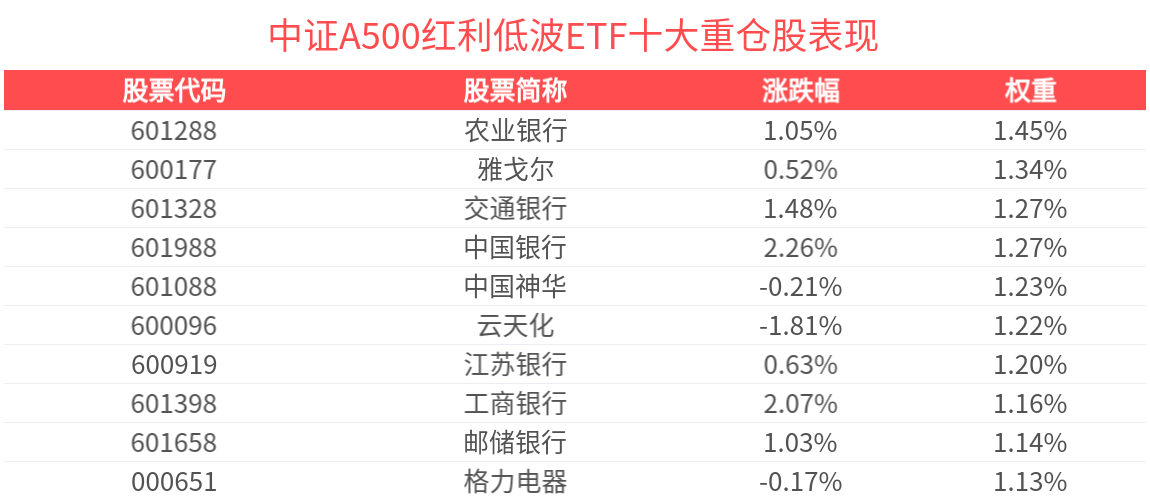
Core Insights - The China A500 Dividend Low Volatility Index (932422) has shown a slight increase of 0.14% as of November 14, 2025, with notable gains in major banks such as Bank of China (601988) up by 2.26% and Industrial and Commercial Bank of China (601398) up by 2.07% [1] Investment Environment - The National Bureau of Statistics emphasizes the need to focus on high-quality development, optimize investment structure, and enhance the investment environment to stimulate private investment and promote healthy investment growth [1] - According to Zhongtai Securities, the investment logic for bank stocks is shifting from "pro-cyclical" to "weak-cyclical," making high-dividend bank stocks more attractive during economic stagnation [1] - With the M1 growth rate declining, major financial data has entered a downward cycle, attributed to weaker fiscal expansion and the fading of low base effects [1] ETF Performance - The China A500 Dividend Low Volatility ETF (561680) has a turnover rate of 1.8% and a transaction volume of 3.36 million yuan as of November 14, 2025 [2] - Since its inception, the ETF has recorded a maximum monthly return of 3.37% and an average monthly return rate of 3.37%, with a monthly profit probability of 78.57% [2] - The maximum drawdown since inception is 3.42%, with a recovery period of 30 days [2] Index Composition - As of October 31, 2025, the top ten weighted stocks in the China A500 Dividend Low Volatility Index account for 31.82% of the index, including Agricultural Bank of China (601288) and China Shenhua Energy (601088) [3] - The top ten stocks include major banks and companies, indicating a strong representation of the financial sector within the index [3][5]







市场低开企稳,不含金融地产的自由现金流ETF基金(159233)备受关注
Sou Hu Cai Jing· 2025-11-14 02:28
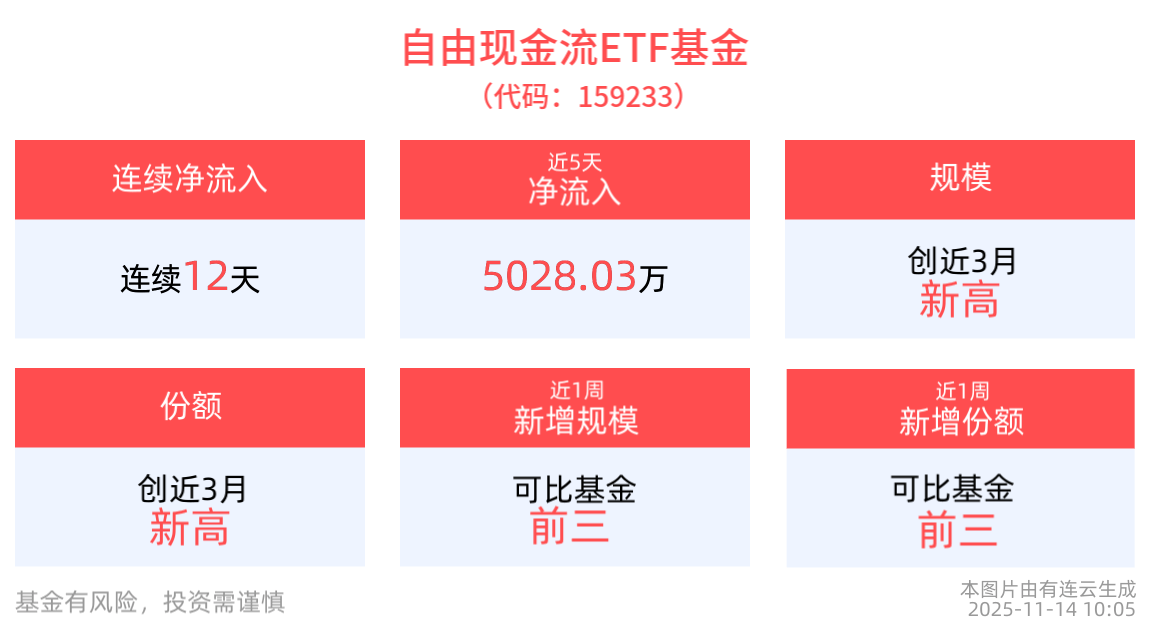
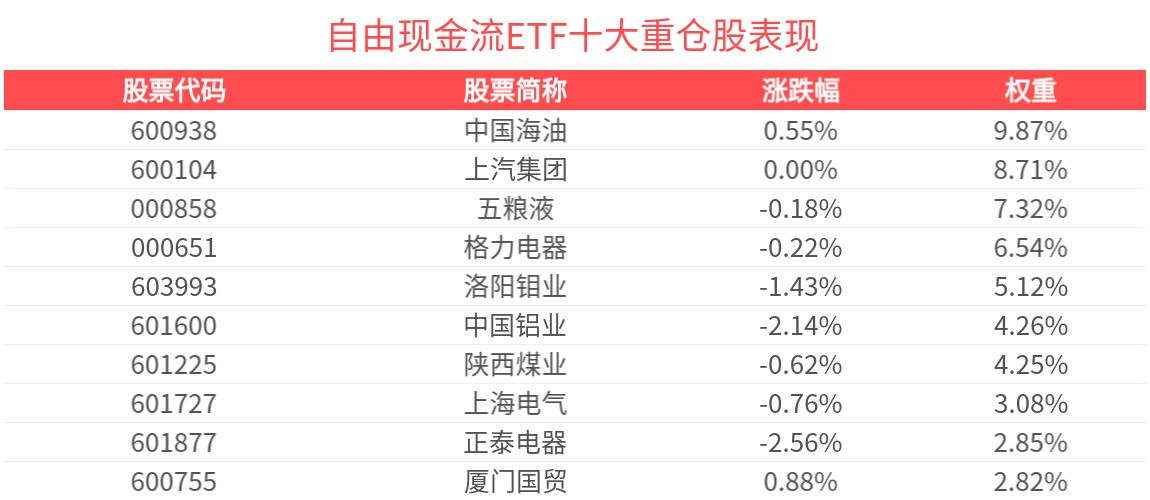
Core Viewpoint - The Zhongzheng All Index Free Cash Flow Index (932365) experienced a decline of 0.40% as of November 14, 2025, with mixed performance among constituent stocks [3][4]. Group 1: Index Performance - The top-performing stocks included Furui Co., Ltd. (002083) with a rise of 9.99%, Chuan Yi Co., Ltd. (603100) up by 7.50%, and CIMC Vehicles (301039) increasing by 7.14% [3]. - Conversely, the worst performers were Yiyi Co., Ltd. (001206) down by 3.01%, Shenhuo Co., Ltd. (000933) down by 2.85%, and Yun Aluminum Co., Ltd. (000807) down by 2.40% [3]. Group 2: Fund Inflows and Returns - The Free Cash Flow ETF Fund (159233) saw a decrease of 0.48%, with the latest price at 1.23 yuan [3]. - Over the past 12 days, the Free Cash Flow ETF Fund experienced continuous net inflows, peaking at a single-day net inflow of 22.2454 million yuan, totaling 103 million yuan with an average daily net inflow of 8.6165 million yuan [3]. Group 3: Fund Performance Metrics - Since its inception, the Free Cash Flow ETF Fund recorded a maximum monthly return of 7.80%, with the longest streak of consecutive monthly gains being 5 months and a total gain of 17.66% [3][4]. - The fund has a historical monthly profit percentage of 100.00%, with a monthly profit probability of 91.84% and a 100.00% probability of profit over a 3-month holding period [3]. Group 4: Drawdown and Fees - The maximum drawdown for the Free Cash Flow ETF Fund since inception was 3.76%, with a relative benchmark drawdown of 0.56% and a recovery period of 35 days [4]. - The management fee for the Free Cash Flow ETF Fund is 0.50%, and the custody fee is 0.10% [4]. Group 5: Index Composition - As of October 31, 2025, the top ten weighted stocks in the Zhongzheng All Index Free Cash Flow Index accounted for 56.53% of the index, including China National Offshore Oil Corporation (600938), Midea Group (000333), and Gree Electric Appliances (000651) [4].
内外双卷不确定下找到百亿品牌的持续结构增长逻辑?
Jing Ji Guan Cha Bao· 2025-11-14 02:23
Core Insights - The article discusses the challenges and strategies for companies transitioning from a billion-level revenue to a hundred-billion-level brand, emphasizing the need for a deep understanding of core advantages and strategic optimization in a competitive market [1][38]. Group 1: Current Challenges in Revenue Growth - Companies face significant challenges in revenue growth due to market saturation and intensified competition, with traditional linear growth models becoming ineffective [3]. - The loss of clear causal relationships complicates growth strategies, making it difficult for companies to predict and drive growth as they scale [3]. - Increased market uncertainty from macroeconomic changes, technological advancements, and competitor strategies further complicates long-term planning [3]. Group 2: Differences in Growth Logic - Companies at the billion-level focus on product line breakthroughs, optimizing existing products and expanding variations to meet diverse consumer needs [5][6]. - In contrast, hundred-billion-level brands shift focus to brand expansion, enhancing brand influence and market positioning through diversified product portfolios [6][7]. - Successful large enterprises recognize the limitations of relying on a single product line and adopt multi-faceted strategies for sustained revenue growth [6][7]. Group 3: Strategic Approaches for Growth - The transition from billion to hundred-billion revenue requires a shift from a map strategy, which relies on clear market positioning and plans, to a puzzle strategy that emphasizes flexibility and adaptability in a dynamic market [8][9]. - Companies must integrate various business units and market opportunities to create a complex growth network, allowing for rapid adaptation to market changes [9]. Group 4: Building a Hundred-Billion Brand - Companies should focus on core advantage development and reasonable structural extensions to diversify and expand their market presence [11]. - The growth process should transition from category expansion to business expansion, ultimately enhancing brand value and market leadership [13][14]. - Successful examples include Huawei, which leveraged its core technology in telecommunications to expand into smartphones and smart home products [12]. Group 5: Multi-Category and Multi-Business Strategies - Companies should start with a strong single product and then expand into related categories based on market validation [15][16]. - The example of Bosideng illustrates how a focus on a core product can lead to successful category expansion, achieving significant revenue growth [17]. Group 6: Multi-Brand Strategy - Companies can consider a multi-brand strategy when market maturity limits growth potential, leveraging established brand reputation to enter new markets [22]. - Anta's multi-brand strategy demonstrates how a company can cover various market segments, enhancing competitiveness and brand influence [24]. Group 7: Internal and Structural Growth - Companies must recognize external challenges and effectively integrate internal resources to achieve structural growth [36][37]. - The experiences of Haier, Midea, and Gree highlight the importance of understanding core brand genes—service, channel, and product—as pathways to growth [34][35]. Group 8: Future Growth Pathways - The article outlines a framework for companies to transition from billion to hundred-billion brands, emphasizing the importance of strategic planning and resource optimization [39][42]. - The future growth stages include transitioning to a thousand-billion platform and a ten-thousand-billion ecosystem, requiring a comprehensive understanding of market dynamics and consumer needs [41][44].
资金抢筹!自由现金流ETF(159201)最新规模达64.64亿元,创成立以来新高
Sou Hu Cai Jing· 2025-11-14 02:12
Core Insights - The Guozheng Free Cash Flow Index has decreased by 0.42% as of November 14, 2025, with mixed performance among constituent stocks [1] - The Free Cash Flow ETF (159201) has seen a decline of 0.49%, currently priced at 1.23 yuan [1] - Over the past week, the Free Cash Flow ETF has averaged daily trading volume of 4.84 billion yuan [1] Fund Performance - The Free Cash Flow ETF has experienced a net asset value increase of 25.14% over the past six months [2] - Since inception, the ETF's highest monthly return was 7%, with a maximum consecutive monthly gain of 22.69% [2] - The ETF has a historical six-month profit probability of 100% [2] Fee Structure - The management fee for the Free Cash Flow ETF is 0.15%, and the custody fee is 0.05%, both at the lowest tier [3] Top Holdings - As of October 31, 2025, the top ten weighted stocks in the Guozheng Free Cash Flow Index account for 54.79% of the index, including China National Offshore Oil Corporation, SAIC Motor, and Wuliangye [3]
南特科技:北交所IPO打新冻资8675.82亿元,获配比例0.033%
Sou Hu Cai Jing· 2025-11-14 02:09
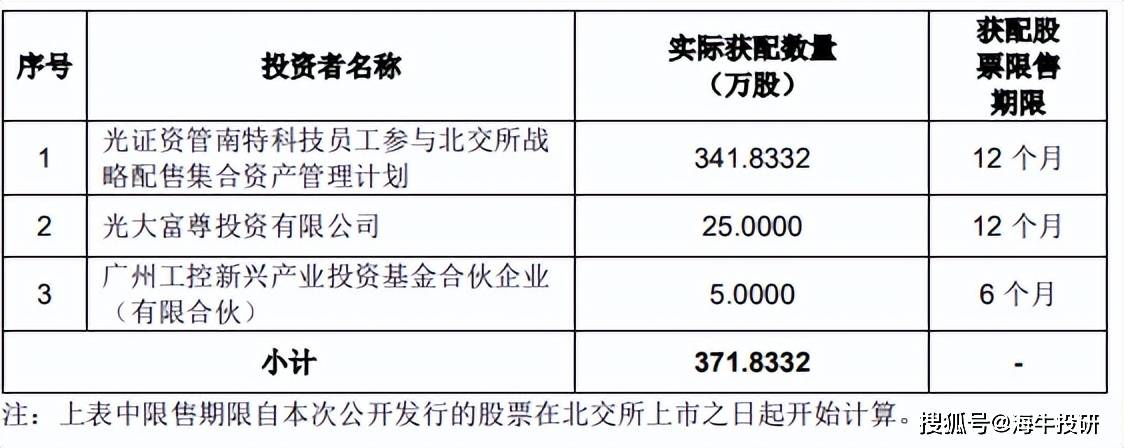
Core Viewpoint - Nantong Technology (920124) successfully completed its IPO on the Beijing Stock Exchange, attracting significant investor interest with a subscription multiple of 2993.66 times and a total subscription amount of 100.183 billion shares, leading to approximately 867.582 billion yuan in frozen funds [1] Group 1: IPO Details - A total of 637,000 investors participated in the IPO, with an effective subscription amount of 1001.83 billion shares and a subscription ratio of 0.033% [1] - The strategic placement segment involved three investors, including Guangzheng Asset Management, Guangda Fuzun Investment Co., and Guangzhou Industrial Control Emerging Industry Investment Fund, with a total allocation of 371.83 million shares, representing 10% of the total issuance [2][3] Group 2: Company Overview - Nantong Technology specializes in the R&D, production, and sales of precision mechanical components, focusing on high-performance products applicable in air conditioning and automotive sectors [3] - The company has established stable partnerships with four of the top five air conditioning compressor manufacturers, including Midea Group, Gree Electric Appliances, Haili Co., and Panasonic, earning various supplier awards [4] Group 3: Financial Performance - Projected revenues for Nantong Technology from 2022 to 2024 are 834 million yuan, 938 million yuan, and 1.031 billion yuan, respectively, with net profits of 46.64 million yuan, 84.18 million yuan, and 98.22 million yuan [4]
消费大利好,汇金重仓的6家消费龙头,全是低估值+高净利
Sou Hu Cai Jing· 2025-11-13 22:52
Core Insights - Central Huijin's significant investments in high-profit consumer stocks indicate a strategic focus on undervalued, high-net-margin companies in the consumer sector [3][5][10] Group 1: Central Huijin's Investment Strategy - Central Huijin holds over 3 trillion yuan in assets and has invested in 152 stocks, with a total market value of 3.02 trillion yuan as of Q1 2025 [3] - The investment strategy emphasizes large-cap stocks and industry leaders, particularly those with strong profitability and dividend levels [3][10] - The consumer sector is highlighted as a key area of focus, with a notable recovery in the CPI and core CPI, signaling a potential resurgence in consumer spending [3][5] Group 2: Performance of Key Consumer Stocks - Leading companies in the liquor industry, such as Kweichow Moutai, have exceptionally high profit margins, with a gross margin of 91.9% and a net margin of 52.2% [5] - Other prominent liquor brands like Wuliangye and Luzhou Laojiao also exhibit strong profitability, with net margins of 38% and 47% respectively [5] - In the home appliance sector, Midea Group shows a net margin of 10.64% and a price-to-earnings ratio of 12.1, indicating solid financial health [5] Group 3: Retail and Consumer Electronics - Retail companies like Dashang Group and Chongqing Department Store have net margins of 10.24% and 8.62%, respectively, showcasing their profitability [7] - The consumer electronics sector is experiencing a rebound, driven by new product categories such as AI smartphones and smart wearables, supported by recent subsidy policies [8] - The resilience of leading consumer companies is evident, with the CSI Consumer 50 Index constituents showing a 19.82% year-on-year increase in net profit for the first three quarters of 2025 [10] Group 4: Market Valuation and Future Outlook - The CSI Consumer 50 Index is currently at a historical low valuation, with a price-to-earnings ratio of 17.39, indicating potential for growth [10] - The average dividend yield of the index's constituents is 3.84%, surpassing the yield of ten-year government bonds, making it an attractive investment [10] - Continued government support for consumer spending, including subsidies for appliances and vehicles, is expected to drive growth in the retail sector [8][10]



11月13日深证龙头(399653)指数涨1.73%,成份股瑞达期货(002961)领涨
Sou Hu Cai Jing· 2025-11-13 10:06
Core Insights - The Shenzhen Leading Index (399653) closed at 3104.35 points, up 1.73%, with a trading volume of 105.65 billion yuan and a turnover rate of 0.96% [1] - Among the index constituents, 36 stocks rose while 12 fell, with Ruida Futures leading the gainers at an increase of 8.07%, and Binjiang Group leading the decliners with a drop of 3.33% [1] Index Constituents Summary - The top ten constituents of the Shenzhen Leading Index include: - Ningde Times (20.44% weight) at 415.60 yuan, up 7.56%, with a market cap of 1896.42 billion yuan [1] - Zhongji Xuchuang (8.35% weight) at 481.00 yuan, down 2.19%, with a market cap of 534.45 billion yuan [1] - Midea Group (7.67% weight) at 79.60 yuan, up 0.14%, with a market cap of 611.73 billion yuan [1] - Luxshare Precision (6.06% weight) at 57.38 yuan, down 0.68%, with a market cap of 417.85 billion yuan [1] - Sungrow Power (5.67% weight) at 190.51 yuan, up 1.53%, with a market cap of 394.97 billion yuan [1] - BYD (5.25% weight) at 99.83 yuan, up 2.11%, with a market cap of 910.17 billion yuan [1] - Wugong Liquor (4.41% weight) at 121.20 yuan, up 0.68%, with a market cap of 470.45 billion yuan [1] - Gree Electric (3.53% weight) at 41.00 yuan, down 0.36%, with a market cap of 229.66 billion yuan [1] - ZTE Corporation (2.83% weight) at 40.35 yuan, up 1.56%, with a market cap of 193.02 billion yuan [1] - Yuanlefang A (2.75% weight) at 4.04 yuan, unchanged, with a market cap of 151.15 billion yuan [1] Capital Flow Analysis - The net inflow of main funds into the Shenzhen Leading Index constituents totaled 3.862 billion yuan, while retail investors experienced a net outflow of 684 million yuan [1] - Notable capital flows include: - Ningde Times saw a net inflow of 2.655 billion yuan from main funds, while retail investors had a net outflow of 448 million yuan [2] - BYD had a net inflow of 607 million yuan from main funds, with retail investors experiencing a net outflow of 208 million yuan [2] - Zhongji Xuchuang had a net inflow of 409 million yuan from main funds, while retail investors had a negligible outflow [2]




8.76亿元资金今日流出家用电器股
Zheng Quan Shi Bao Wang· 2025-11-13 09:04
家用电器行业今日上涨0.27%,全天主力资金净流出8.76亿元,该行业所属的个股共94只,今日上涨的 有60只,涨停的有2只;下跌的有28只。以资金流向数据进行统计,该行业资金净流入的个股有29只, 其中,净流入资金超千万元的有6只,净流入资金居首的是九阳股份,今日净流入资金1.01亿元,紧随 其后的是立达信、康盛股份,净流入资金分别为2839.36万元、2721.73万元。家用电器行业资金净流出 个股中,资金净流出超3000万元的有12只,净流出资金居前的有开能健康、格力电器、汉宇集团,净流 出资金分别为1.93亿元、1.65亿元、7626.41万元。(数据宝) 家用电器行业资金流向排名 | 代码 | 简称 | 今日涨跌幅(%) | 今日换手率(%) | 主力资金流量(万元) | | --- | --- | --- | --- | --- | | 300272 | 开能健康 | 2.59 | 33.95 | -19314.92 | | 000651 | 格力电器 | -0.36 | 0.80 | -16460.22 | | 300403 | 汉宇集团 | -0.91 | 11.48 | -7626.41 | ...
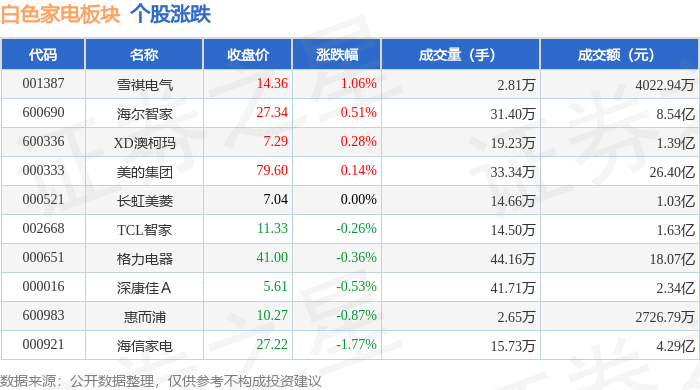
白色家电板块11月13日涨0.02%,雪祺电气领涨,主力资金净流出3.29亿元
Zheng Xing Xing Ye Ri Bao· 2025-11-13 08:44
Core Insights - The white goods sector experienced a slight increase of 0.02% on November 13, with Xueqi Electric leading the gains [1] - The Shanghai Composite Index closed at 4029.5, up 0.73%, while the Shenzhen Component Index closed at 13476.52, up 1.78% [1] Stock Performance - Xueqi Electric (001387) closed at 14.36, with a gain of 1.06% and a trading volume of 28,100 shares, amounting to a transaction value of approximately 40.23 million yuan [1] - Haier Smart Home (600690) closed at 27.34, up 0.51%, with a trading volume of 314,000 shares and a transaction value of about 854 million yuan [1] - Midea Group (000333) closed at 79.60, with a slight increase of 0.14%, trading 333,400 shares for a total of approximately 2.64 billion yuan [1] - Gree Electric (000651) closed at 41.00, down 0.36%, with a trading volume of 441,600 shares and a transaction value of around 1.81 billion yuan [1] Capital Flow - The white goods sector saw a net outflow of 329 million yuan from institutional investors, while retail investors contributed a net inflow of approximately 67.13 million yuan [1] - Xueqi Electric had a net inflow of 1.76 million yuan from institutional investors, while it faced a net outflow of 1.18 million yuan from speculative funds [2] - Midea Group experienced a net outflow of 41.77 million yuan from institutional investors, but saw a net inflow of 64.27 million yuan from speculative funds [2]