山西汾酒

Search documents
山西汾酒跌2.00%,成交额3.96亿元,主力资金净流出6143.00万元
Xin Lang Cai Jing· 2026-02-12 02:56
Core Viewpoint - Shanxi Fenjiu's stock price has experienced a decline, with a 3.17% drop year-to-date and a 15.57% drop over the past 60 days, indicating potential challenges in the market [1]. Financial Performance - For the period from January to September 2025, Shanxi Fenjiu reported a revenue of 32.924 billion yuan, representing a year-on-year growth of 5.00% [2]. - The net profit attributable to shareholders for the same period was 11.405 billion yuan, showing a modest increase of 0.48% year-on-year [2]. Shareholder Information - As of September 30, 2025, the number of shareholders for Shanxi Fenjiu was 80,000, a decrease of 23.37% from the previous period [2]. - The average number of circulating shares per shareholder increased by 30.50% to 15,252 shares [2]. Dividend Distribution - Since its A-share listing, Shanxi Fenjiu has distributed a total of 24.325 billion yuan in dividends, with 16.775 billion yuan distributed over the past three years [3]. Institutional Holdings - As of September 30, 2025, the top circulating shareholder was the China Securities Index White Wine Index A, holding 38.6514 million shares, an increase of 4.5109 million shares from the previous period [3]. - Hong Kong Central Clearing Limited, the fourth-largest shareholder, reduced its holdings by 21.8352 million shares to 27.1639 million shares [3].

ETF盘中资讯|茅台批价继续上涨!吃喝板块震荡回调,估值至历史低位!机构:板块有望走出底部
Sou Hu Cai Jing· 2026-02-12 02:46
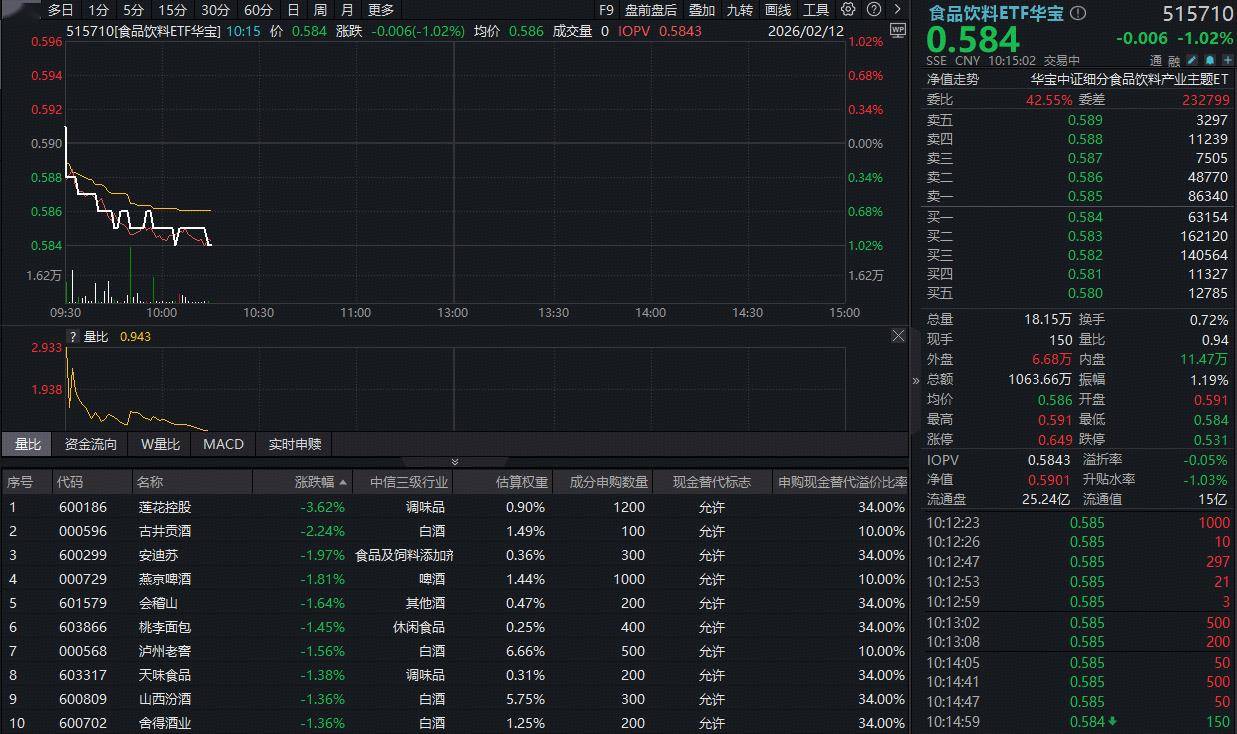
Group 1 - The core viewpoint of the news highlights the poor performance of liquor and consumer goods stocks, with significant declines in companies like Lianhua Holdings and Gujing Gongjiu, impacting the overall sector [1] - The wholesale price of Moutai liquor has increased, with the 2026 original box price rising by 25 yuan to 1715 yuan per bottle, while the 2025 original box price also saw a similar increase [2][3] - The food and beverage sector is currently at a historical low in terms of valuation, suggesting a potential good entry point for investments, with the food and beverage ETF's price-to-earnings ratio at 20.58 times, which is in the 9.2% percentile of the last decade [3] Group 2 - Analysts expect improvements in supply and demand relationships across various sub-sectors in 2026, with a clearer recovery in the Consumer Price Index (CPI), indicating a potential bottoming out for traditional consumption sectors [3] - The food and beverage sector is seen as a crucial part of domestic demand, with government policies aimed at boosting consumption and expanding domestic demand expected to positively impact the sector [3] - The food and beverage ETF is heavily weighted towards leading high-end and mid-range liquor stocks, with approximately 60% of its portfolio allocated to these companies, including major brands like Moutai and Wuliangye [3]



茅台批价继续上涨!吃喝板块震荡回调,估值至历史低位!机构:板块有望走出底部
Xin Lang Ji Jin· 2026-02-12 02:25
展望后市,银河证券指出,2026年多个子板块的供需关系有望改善,CPI修复的确定性愈发清晰,新消 费仍具持续性但内部将会轮动,而受益于CPI复苏弹性较大的传统消费有望迎来底部改善,建议关注大 众品板块及白酒板块等相关公司。 还有机构表示,官媒多次发文报道提振消费、扩大内需是2026年经济增长的重要抓手,食品饮料板块作 为内需重要环节,伴随着政策预期转暖,相关板块也有望走出底部。 一键配置吃喝板块核心资产,重点关注食品饮料ETF华宝(515710)。根据中证指数公司统计,食品饮 料ETF华宝(515710)跟踪中证细分食品饮料产业主题指数,约6成仓位布局高端、次高端白酒龙头 股,近4成仓位兼顾饮料乳品、调味、啤酒等细分板块龙头股,前十权重股包括"茅五泸汾洋"、伊利股 份、海天味业等。场外投资者亦可通过食品饮料ETF华宝联接基金(A类012548/C类012549)对吃喝板 块核心资产进行布局。 吃喝板块今日(2月12日)继续回调。反映吃喝板块整体走势的食品饮料ETF华宝(515710)开盘后震 荡下行,截至发稿,场内价格跌1.02%。 成份股方面,白酒、大众品均表现不佳。截至发稿,莲花控股大跌超3%,古井贡酒跌 ...
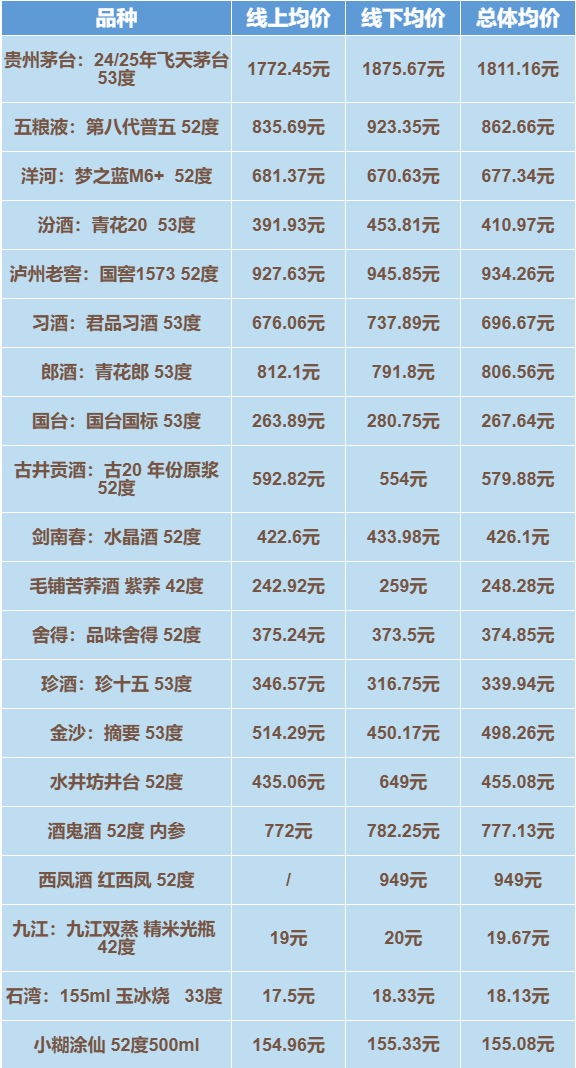
酒价内参2月12日价格发布 单品表现分化总价小幅抬升
Xin Lang Cai Jing· 2026-02-12 01:24
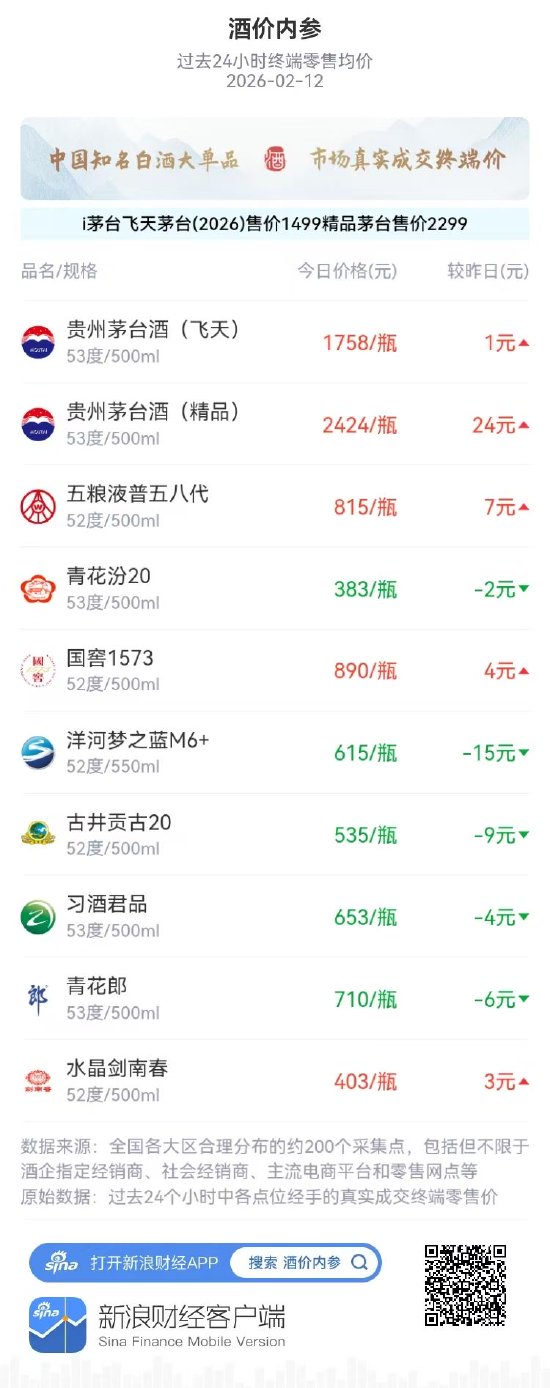
Core Viewpoint - The Chinese liquor market is experiencing a structural differentiation in retail prices, with the average price of the top ten products showing a slight increase, indicating varied performance across different price segments [1][6]. Price Trends - The total retail price for a package of the top ten liquor products is 9,186 yuan, up by 3 yuan from the previous day [1][6]. - The market shows a mixed trend with five products increasing in price and five decreasing [7]. - Notable price increases include: - Guizhou Moutai's premium liquor, up 24 yuan per bottle, reaching a 30-day high due to pre-Spring Festival demand [7]. - Wuliangye's 58th generation, up 7 yuan per bottle, marking a one-month high [7]. - Other increases include 4 yuan for Guojiao 1573 and 3 yuan for Shuijingjiu [7]. - Decreases in price include: - Yanghe Dream Blue M6+, down 15 yuan per bottle [7]. - Guqingong 20, down 9 yuan per bottle [7]. - Other declines include 6 yuan for Qinghualang and 4 yuan for Xijiu Junpin [7]. Market Data Collection - The data for liquor prices is sourced from approximately 200 collection points across various regions, including designated distributors, social distributors, e-commerce platforms, and retail outlets [2][8]. - The pricing data aims to provide an objective and traceable overview of the market [2][8]. Market Analysis - JPMorgan recently reaffirmed a positive outlook on the Chinese stock market, suggesting that the appreciation of the RMB against the USD typically boosts stock returns [2][8]. - The report highlights high-end liquor, particularly Guizhou Moutai and Wuliangye, as key investment areas, alongside other sectors like gold, tourism, and education [2][8].

春潮启市白酒春节旺季价格带“分化而行”
Bei Jing Shang Bao· 2026-02-11 12:21
Core Viewpoint - The Chinese liquor market is experiencing a shift in consumer preferences, with a notable increase in demand for products priced around 300 yuan, contrasting with previous years where high-end products priced at 1,000 yuan were more popular. This indicates a transition from scale expansion to competition within existing market shares as the industry adapts to changing consumer behavior [1][2][7]. Market Trends - Consumers are increasingly opting for mid-range liquor products, with many shifting from high-end options to those around 300 yuan due to better cost-performance ratios [2][3]. - The sales of products priced at 300 yuan have become the main focus in retail markets, while products priced above 800 yuan have also seen slight growth during the festive season [2][3]. - The overall market is witnessing a bifurcation, with both low-end (under 100 yuan) and high-end (over 800 yuan) segments gaining market share, while mid-range products face pressure [3][7]. Marketing Strategies - Major liquor companies are implementing various promotional activities to stimulate market activity, including gift card promotions and cash rewards for consumers [4][5]. - The focus has shifted from merely increasing cash flow to enhancing actual sales and reducing inventory through innovative marketing strategies [5][6]. Consumer Behavior - The upcoming Spring Festival is anticipated to boost liquor sales, with expectations of increased consumer gatherings and spending due to an extended holiday period [6][7]. - There is a notable trend of consumers prioritizing value for money, leading to a preference for products that meet both family and business gathering needs [2][6]. Industry Outlook - The liquor industry is undergoing a transformation, moving towards a dual competition model involving both channel-owned and manufacturer-owned products, which is expected to diversify the competitive landscape [7][8]. - The integration of new technologies and innovative retail channels is becoming crucial for liquor companies to adapt to evolving consumer demands and enhance sales effectiveness [8].


京潮年货地图丨春潮启市白酒春节旺季价格带“分化而行”
Bei Jing Shang Bao· 2026-02-11 12:20
Core Insights - The white liquor market is experiencing a shift from high-end products to more affordable options, particularly in the 300 yuan price range, as consumers prioritize value for money ahead of the 2026 Spring Festival [1][2][3] - The industry is transitioning from a phase of scale expansion to a new normal characterized by competition for existing market share, with a notable increase in the popularity of self-owned liquor brands among distributors [7][8] Market Trends - Consumers are increasingly opting for 300 yuan liquor products over traditional high-end options, reflecting a change in purchasing behavior driven by value considerations [2][3] - Sales of products priced above 800 yuan have seen slight growth, indicating that while high-end purchases are down, there remains a niche market for premium products during the festive season [2][3] Marketing Strategies - Major liquor companies are implementing various promotional activities to stimulate market demand, including gift card promotions and QR code scanning rewards [4][5] - The focus has shifted from merely increasing cash flow to enhancing actual sales and reducing inventory pressure through innovative marketing strategies [5][6] Industry Outlook - The 2026 Spring Festival is anticipated to be a critical period for the liquor industry, with expectations of improved sales performance compared to previous years due to an extended holiday period [6][7] - The market is expected to see a rise in the share of self-owned liquor products, potentially exceeding 20%, as distributors diversify their offerings to include both self-owned and factory-produced brands [7][8] Technological Integration - The industry is witnessing a dual-directional restructuring of the value chain, with channels moving upstream for product integration and technology enhancing consumer engagement through innovative marketing [8]
白酒“春节档” 茅台领涨!
Nan Fang Du Shi Bao· 2026-02-11 10:27
Core Insights - The white liquor market is entering a traditional peak season ahead of the Lunar New Year in 2026, with significant marketing efforts from major liquor companies and notable price fluctuations observed in various products [1][5]. Group 1: Market Trends - The sales of white liquor are showing a clear recovery signal, driven by demand for gifting and social gatherings, which is alleviating some inventory pressure in distribution channels [14]. - The price dynamics are notably diverse, with Moutai leading a price rebound, while other high-end and mid-range brands experience frequent price fluctuations due to competitive pressures [14]. - The overall market sentiment indicates a trend of "the strong getting stronger," with Moutai's performance serving as a bellwether for the entire price range [14]. Group 2: Price Movements - In Guangzhou, the average price of the "Inner Reference" product from Jiu Gui Jiu has seen the largest decline, dropping approximately 32 yuan to around 777 yuan, while Moutai's price increased from 1718 yuan to 1811 yuan, marking a rise of about 93 yuan [4][3]. - In Shenzhen, Moutai's retail price surged to an average of 1835.28 yuan, reflecting an increase of approximately 101 yuan compared to the previous period, influenced by high demand [9]. - Other products such as "Dream Blue M6+" and "Ancient Well Tribute Wine" also experienced price increases, while some mid-range products like "Green Flower Fen Wine" saw slight declines [10][11]. Group 3: Consumer Behavior - The upcoming extended holiday period is expected to stimulate social drinking demand, providing a boost to the market [5]. - The price stability and occasional increases in certain products indicate a healthy interaction between brand strength and market dynamics, with promotional activities on online platforms affecting price variations across different sales channels [14].
白酒春节前渠道跟踪系列报告二:行业动销符合预期,茅台景气领先
CMS· 2026-02-11 09:31
Investment Rating - The report maintains a strong buy recommendation for key companies in the industry, specifically Guizhou Moutai, Wuliangye, Shanxi Fenjiu, Luzhou Laojiao, and Gujing Gongjiu, while suggesting an increase in holdings for Yingjia Gongjiu [8][28]. Core Insights - The overall sales decline in the industry before the Spring Festival aligns with expectations, with Moutai showing leading performance. The industry is experiencing a double-digit sales decline, but demand is gradually recovering as the Spring Festival approaches. The pressure on channels is easing, and confidence in the industry is expected to improve [1][12]. - Moutai's sales volume and price have exceeded expectations, with a significant increase in demand from traditional channels. The report anticipates a net increase of over 2,000 tons in January [1][12]. - The report highlights a clear differentiation among brands, with Moutai, Wuliangye, and Fenjiu outperforming the industry, while other brands are experiencing varying degrees of decline. The next high-end price segment is under significant pressure [1][12]. Summary by Sections 1. Regional Sales Feedback - The report summarizes feedback from various regions, indicating that the overall sales decline is in line with expectations. Moutai's performance is notably strong, with double-digit growth in sales volume. Other brands, such as Wuliangye, show regional sales differentiation, particularly in areas like Sichuan, where sales have accelerated due to previous inventory control measures [1][12][15]. 2. Core Company Tracking - Guizhou Moutai's sales are expected to continue growing, with a current average delivery progress exceeding 30%. The report notes that Moutai's inventory is low, and the market remains in a supply-demand imbalance, supporting price stability [24][28]. - Wuliangye's sales are stable, with delivery progress around 35-40%. The report indicates that the brand's performance is slightly better than last year, particularly in regions like Sichuan and Anhui [24][28]. - Luzhou Laojiao is experiencing slower sales, with delivery progress below 20%. The brand's high-end products are facing a decline in demand, while lower-end products still show some demand [25][28]. - Shanxi Fenjiu's sales are performing better than the industry average, with a stable inventory situation and continued growth in certain products [25][28]. - Yingjia Gongjiu is expected to see a slight decline in sales, but certain products are performing relatively well [26][28]. 3. Industry Holdings Analysis - The report notes that institutional holdings in the liquor sector are at historical lows, with a significant decrease in the proportion of active fund holdings in the liquor sector. This trend indicates a potential for recovery as the market stabilizes [2][8].
ETF盘中资讯|白酒春节动销超预期!吃喝板块震荡盘整,估值仍处历史低位!能否上车?
Sou Hu Cai Jing· 2026-02-11 06:20
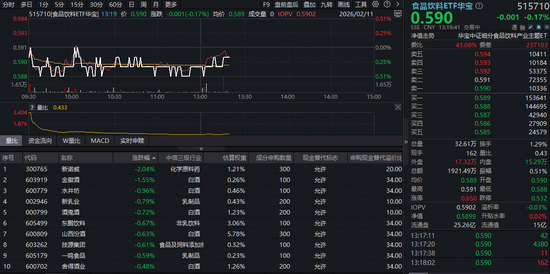
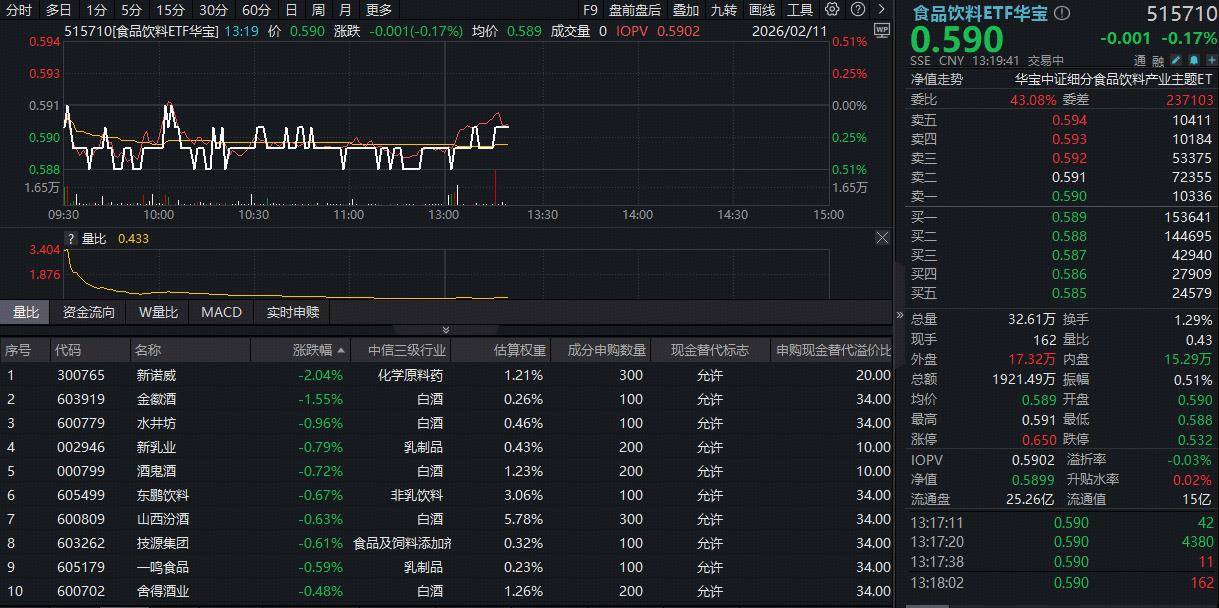
Core Viewpoint - The food and beverage sector is experiencing a pullback, with the Huabao Food and Beverage ETF (515710) showing a slight decline of 0.17% as of the latest update, influenced by significant drops in key stocks like XinNuoWei and JinHuiJiu [1][3]. Group 1: Market Performance - The Huabao Food and Beverage ETF (515710) is currently trading at 0.590, reflecting a decrease of 0.001, or -0.17% [2]. - Major stocks within the sector, such as XinNuoWei, JinHuiJiu, and ShuiJingFang, have seen declines exceeding 2% and 1%, respectively, contributing to the overall negative performance of the sector [1][2]. Group 2: Industry Insights - A recent survey indicates that the demand for liquor has increased in the month leading up to the Spring Festival, with overall sales performance of major liquor distributors exceeding expectations, despite a reported decline in shipment volumes of 10%-20% [1]. - The food and beverage sector's valuation is at a historical low, with the price-to-earnings ratio of the underlying index for the Huabao ETF at 20.59, placing it in the 9.2% percentile over the past decade, suggesting a favorable long-term investment opportunity [3]. Group 3: Future Outlook - Looking ahead, improvements in supply and demand dynamics across various sub-sectors are anticipated by 2026, with a clearer recovery in the Consumer Price Index (CPI) expected, which may benefit traditional consumption sectors [3]. - The Huabao Food and Beverage ETF is positioned to track key high-end and mid-range liquor stocks, with approximately 60% of its portfolio allocated to leading liquor brands and nearly 40% to other beverage and dairy segments [3].
白酒春节动销超预期!吃喝板块震荡盘整,估值仍处历史低位!能否上车?
Xin Lang Cai Jing· 2026-02-11 05:36
Group 1 - The food and beverage sector experienced a pullback on February 11, with the Huabao Food and Beverage ETF (515710) showing a slight decline of 0.17% [1][6] - Major stocks within the sector, such as Xin Nuo Wei and Jin Hui Jiu, saw significant drops of over 2% and 1% respectively, contributing to the overall negative performance of the sector [1][6] - A survey indicated that demand for liquor increased in the month leading up to the Spring Festival, with some distributors reporting stable or even growing sales compared to the previous year, suggesting a potential recovery in the market [1][6] Group 2 - The valuation of the food and beverage sector is currently at a historical low, with the price-to-earnings ratio of the underlying index for the Huabao Food and Beverage ETF at 20.59, which is in the 9.2% percentile of the last decade, indicating a favorable long-term investment opportunity [3][8] - Looking ahead, there is an expectation for improved supply-demand dynamics across various sub-sectors by 2026, with a clearer recovery in the Consumer Price Index (CPI) and a rotation in new consumption trends [4][9] - The Huabao Food and Beverage ETF is primarily invested in leading high-end and mid-range liquor stocks, with approximately 60% of its portfolio allocated to these sectors, while also including beverage, dairy, seasoning, and beer stocks [4][10]