易方达基金

Search documents
单日涨超4.8%,这只ETF逆袭
Zhong Guo Ji Jin Bao· 2026-02-11 11:54
(原标题:单日涨超4.8%,这只ETF逆袭) 来源:ETF洞察 【导读】今日跨境ETF表现亮眼,稀有金属ETF"霸榜" 中国基金报记者 曹雯璟 大家好,这里是ETF洞察。 2月11日,A股三大指数走势分化,小金属、油气开采走强,影视院线板块回调;有色金属、化学纤维、磷化工、钢铁等概念涨幅居前。 稀有金属板块全面爆发 稀有金属ETF最高上涨3.86% 今日,稀有金属板块全面爆发,嘉实稀有金属ETF上涨3.86%,紧随其后的是工银瑞信、广发、华富旗下稀有金属ETF,分别上涨3.79%、3.78%、 3.53%,占据涨幅榜靠前席位。 其中,嘉实稀有金属ETF规模最大,超65亿元。紧随其后的是广发稀有金属ETF,规模超51亿元;工银瑞信、华富旗下稀有金属ETF规模分别超13 亿元、2亿元。全市场4只稀有金属ETF产品中,仅工银瑞信基金旗下产品管理费和托管费为0.45%和0.07%,其余3只的管理费和托管费均为 0.5%、0.1%。 ETF方面,当日全市场共有640只股票ETF(含跨境)上涨,其中,华夏日经ETF涨4.85%,多只稀有金属ETF涨幅居前。 同时,有713只股票ETF下跌,多只影视ETF、传媒ETF领跌。 ...

“一姐”告别、“明星”空降!天弘基金万亿固收团队完成新老交替
Xin Lang Cai Jing· 2026-02-11 10:50
长期稳健的业绩、数百亿管理规模,曾是姜晓丽旗下债券基金最耀眼的光环。然而与此形成反差的是, 其管理规模在过去几年内大幅收缩,其中天弘永利债券规模由高峰期的近400亿元缩水至185亿元,其个 人管理总规模也由2022年高峰期的781.94亿元回落过半,离职前管理规模为350亿元左右。 来源 | 独角金融 作者 | 刘银平编辑 | 付影 在即将到来的春节前夕,2月9日,天弘基金发布一纸卸任公告,为固收"顶梁柱"姜晓丽长达16年的坚守 画下句号。姜晓丽在清仓式卸任全部10只基金后,正式离场。 作为公司任职时间最长的基金经理,姜晓丽自2009年毕业后便扎根天弘基金,从研究员到曾掌管超700 亿资金的明星舵手,其职业生涯几乎与公司固收业务的崛起同步。 在她转身之前,天弘固收的"新局"早已布下。2025年5月,招商基金原明星基金经理、管理规模曾一度 逼近900亿元的马龙空降天弘基金,出任总经理助理兼固收部总经理,成为公司固收业务的新领军人 物。 正当市场期待这一对固收名将组成黄金搭档时,姜晓丽却称自己需要"休个长假",至此,天弘基金固收 团队正在翻开新的一页。 1 350亿固收名将告别,16年风雨同行 陪伴是最长情的告白 ...

红利板块低开高走,恒生红利低波ETF易方达(159545)、红利ETF易方达(515180)等产品受资金关注
Sou Hu Cai Jing· 2026-02-11 10:43
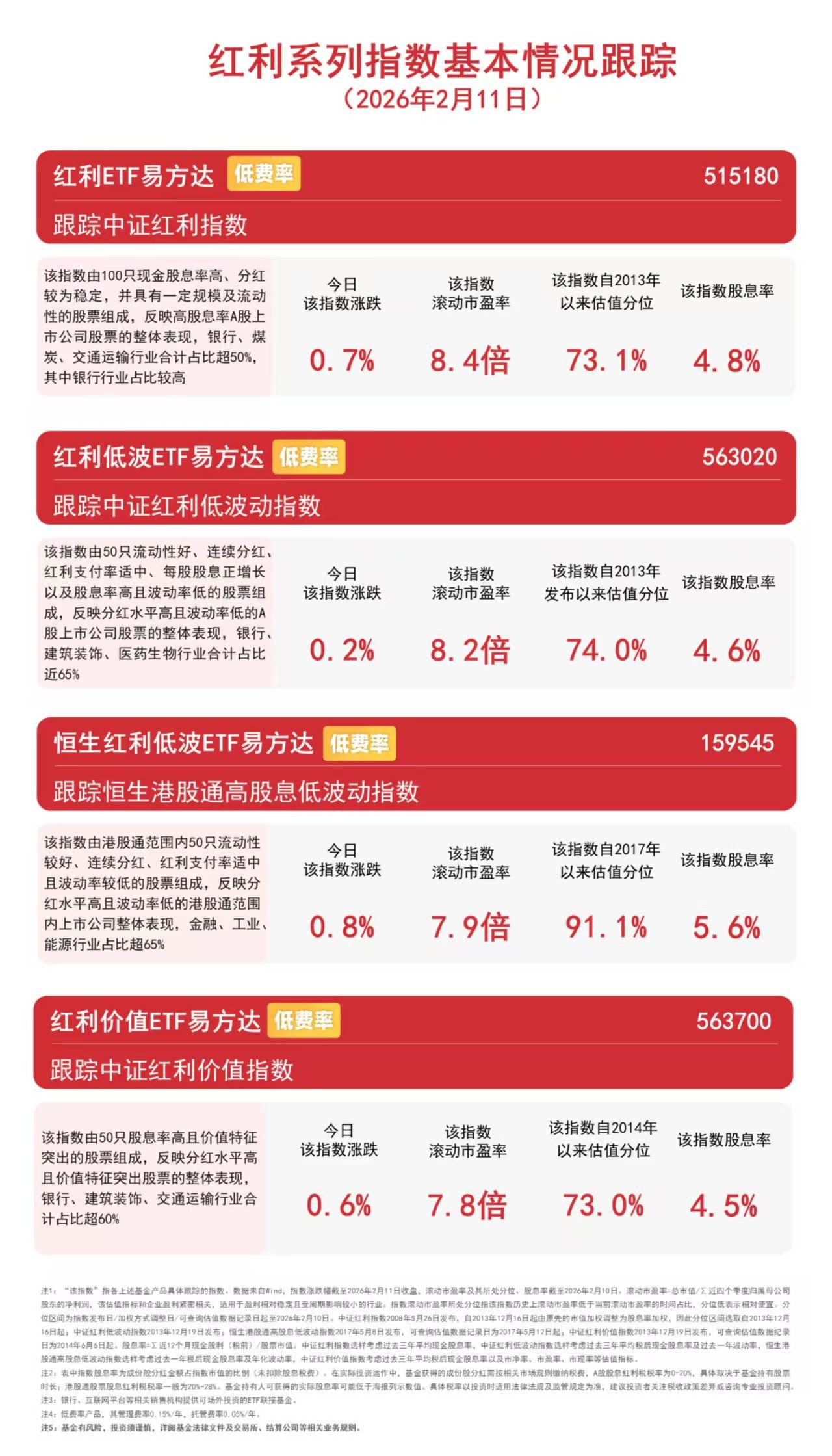
Core Viewpoint - The article highlights the performance of various dividend-focused ETFs managed by E Fund, emphasizing their low fee structure and recent capital inflows, indicating strong investor interest in high dividend yield assets. Group 1: ETF Performance - The Hang Seng High Dividend Low Volatility Index increased by 0.8%, the CSI Dividend Index rose by 0.7%, the CSI Dividend Value Index went up by 0.6%, and the CSI Dividend Low Volatility Index saw a 0.2% increase [1] - E Fund's Hang Seng Dividend Low Volatility ETF (159545) and Dividend ETF (515180) experienced net inflows of 210 million yuan and 420 million yuan respectively over the past week [1] Group 2: E Fund's Low Fee Structure - E Fund is currently the only fund company offering all dividend ETFs at a low management fee rate of 0.15% per year, which helps investors to cost-effectively allocate to high dividend assets [1] - The management fee for E Fund's various dividend ETFs, including the Hang Seng Dividend Low Volatility ETF, Dividend ETF, and others, is consistently set at 0.15% per year [1][5] Group 3: Index Composition - The CSI Dividend Index consists of 100 stocks with high cash dividend yields and stable performance, with banking, coal, and transportation sectors accounting for over 50% of the index [3] - The CSI Dividend Low Volatility Index is composed of 50 stocks that exhibit good liquidity, continuous dividends, moderate dividend payout ratios, and low volatility, with banking, construction, and pharmaceutical sectors making up 65% of the index [3] - The Hang Seng High Dividend Low Volatility Index includes 50 stocks from the Hong Kong Stock Connect that have good liquidity, continuous dividends, moderate dividend payout ratios, and low volatility, reflecting the overall performance of high dividend and low volatility stocks in the Hong Kong market [3]
指数与创新产品研究系列之十七:2025海外ETF:高拥挤格局下的发展启示
Shenwan Hongyuan Securities· 2026-02-11 10:42
1. Report's Industry Investment Rating No information regarding the industry investment rating is provided in the report. 2. Core Viewpoints of the Report - The US ETF market has witnessed continuous and rapid growth in scale, with an increasing proportion of alternative products. Newly issued products show characteristics such as a focus on single - stock products, a higher number of active products than passive ones, and a significant increase in strategy complexity and comprehensiveness. - The US ETF market presents trend - like features, including intense competition among core broad - based products, significant differences in fees based on strategy complexity and scarcity, large differences in institutional ownership among different product types, and managers' forward - looking layout of potential market concerns. - For the domestic ETF business, it is necessary to focus on management details for highly crowded broad - based products, make forward - looking layouts for industry - themed products, and strengthen the "timely promotion" of different products [2]. 3. Summary According to the Directory 3.1 US ETF Scale Continues to Break Through Rapidly, and the Proportion of Alternative Products Increases - In 2025, the total scale of US ETFs reached $13.45 trillion, with a scale increase of 30%. The number of newly issued ETFs reached 1,078, and the total number of all US ETFs reached 4,814, a net increase of 950 compared to the end of 2024. The proportion of alternative products in the newly issued products increased significantly, driving the proportion of alternative products in the entire market to reach 30%. Newly issued bond and money - market funds also had good scales [2][8][10]. - **Single - stock products become the focus of issuance**: Single - stock products were first issued in 2022, and the number of newly issued products in 2025 was the highest. Leveraged products had the largest scale and number, followed by option products. These products are more and more widely distributed, covering different sectors, and the market capitalization of the underlying stocks is also decreasing. The issuance is related to market attention. The single - stock Covered Call products are mainly for high - volatility stocks, aiming to achieve more certain returns through stable high - option premium dividends [18][19]. - **The number of active products exceeds that of passive products**: As of the end of 2025, the number of active ETF products in the US reached 2,682, exceeding the 2,132 passive products, with a total scale of $1.5 trillion. Alternative products are the category with the highest proportion in terms of both quantity and scale. The scale of option - strategy products exceeds $200 billion, making it the most important type of active ETF. The scale of active ETFs has grown rapidly in the past two years, with a compound annual growth rate of 57% from 2019 to 2025 [24][29]. - **The complexity and comprehensiveness of strategies are significantly improved**: As of the end of 2025, there were 697 option - strategy products in the US, with a scale of $224.727 billion, and 221 new products were issued in 2025. Option strategies are increasingly used as an "add - on" to traditional strategies to increase returns. Other types of products also have more complex strategies, and the standardization of ETF strategies is decreasing [34][38][40]. 3.2 Trendy Features of US ETFs - **Intense competition among core broad - based products, and returns have a certain impact on scale**: In 2025, the scale ranking of S&P 500 ETFs changed significantly. The long - time leader, SPY, was continuously surpassed by VOO and IVV, and the gap widened rapidly. Over the past 10 years, VOO has been the best - performing product in 7 years. In 2025, the total inflow of US ETFs was $1.4753 trillion, with significant inflows into broad - based stock and bond ETFs, and the inflow proportion of alternative products mainly based on option strategies significantly exceeded their scale proportion [43][49]. - **Fees vary greatly based on strategy complexity and scarcity**: As of 2025, the scale - weighted average fee of US ETFs was about 0.17%, with the lowest fee as low as 0.01% and the highest exceeding 5%. Most types of active products have an average fee more than 20 basis points higher than passive products, and alternative products have the same average fee. Different asset types also have different fee levels, with broad - based stock and bond products having the lowest fees, and more focused industry - themed products and alternative option - strategy products having higher fees [53]. - **Large differences in institutional ownership among different product types**: Active products generally have a higher institutional ownership than passive products. Different types of products target different customer groups. For example, leveraged products in alternative products are mainly for individual customers with high - risk preferences, while more complex option - strategy products are mainly for institutional customers [56][59]. - **Managers' forward - looking layout of potential market concerns**: US managers continue to actively layout, and the layout direction is often closely related to market concerns and future possible events. For example, in response to the possible concentration risk of the S&P 500, some managers have launched improved S&P 500 ETFs, which have received recognition from institutional customers [60][61]. 3.3 Thoughts on the Domestic ETF Business - **Focus on management details for highly crowded broad - based products**: As of December 2025, domestic non - monetary ETFs had a total scale of 5.8 trillion yuan and 1,369 products. Broad - based products account for 44% of the total scale, but the homogenization competition is fierce. In the competition of domestic broad - based products, after the fee reduction, the competition has entered a stage of "competing on tracking error" and "competing on excess returns". Lower tracking error and higher excess returns are more likely to attract capital inflows [64][71][72]. - **Continue to make forward - looking layouts for industry - themed products**: Although the number of products tracking the same target is relatively small compared to broad - based products, domestic industry - themed products are numerous, widely distributed, and highly segmented, with fierce competition. Some products that were initially unpopular may attract large - scale capital inflows when the market conditions arrive. Therefore, it is still valuable to make early layouts in long - term promising niche segments, but in - depth fundamental research is required before layout [75][80]. - **Strengthen the "timely promotion" of different products**: In addition to early layout, it is also crucial to promote products reasonably at appropriate times. Overseas institutions' Model Portfolio marketing model has had an important impact on ETFs. Domestic managers are also beginning to try ETF portfolio strategies and investment research services to improve investors' investment experience, and this area still has great development potential [81][82][84].
超百亿“跑了”!这些宽基ETF成为“失血”大户
Zhong Guo Jing Ji Wang· 2026-02-11 07:26
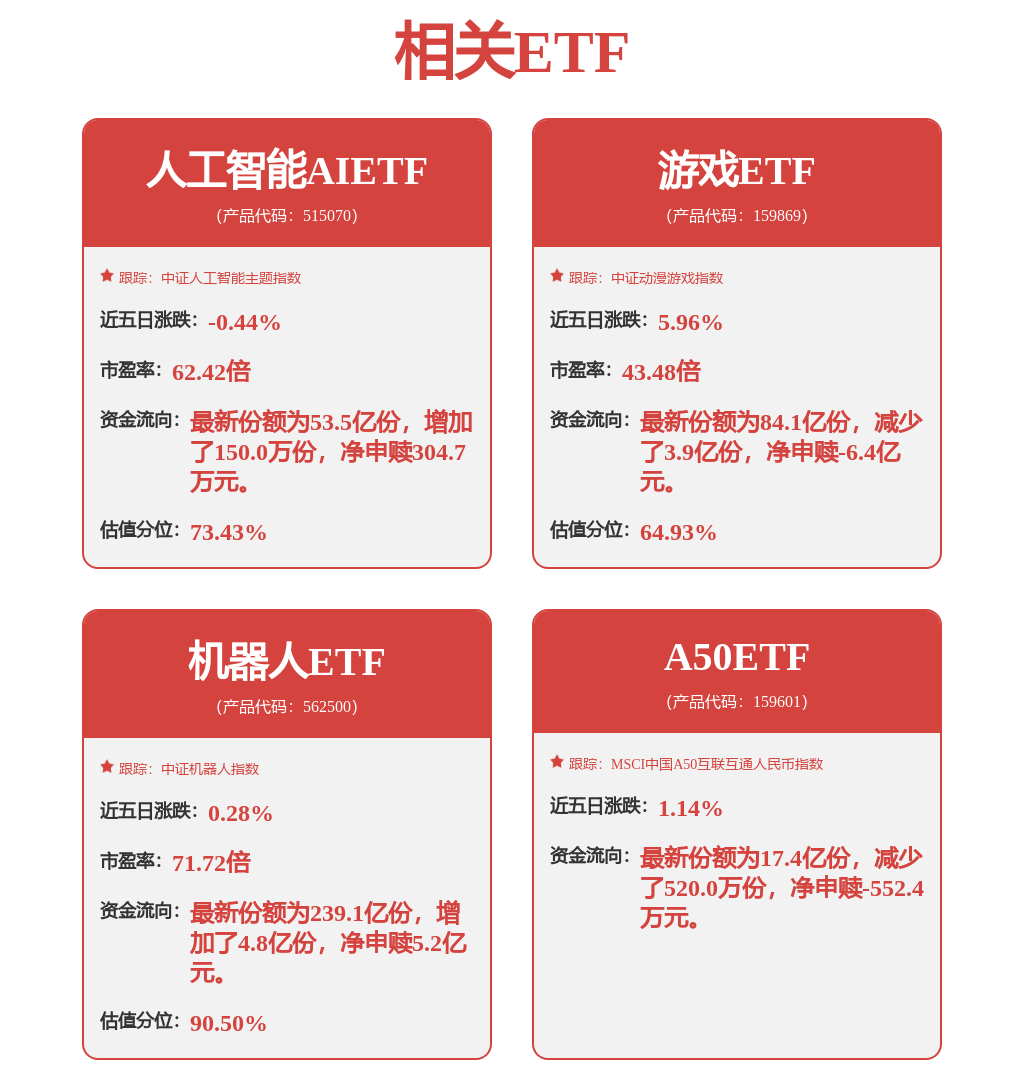
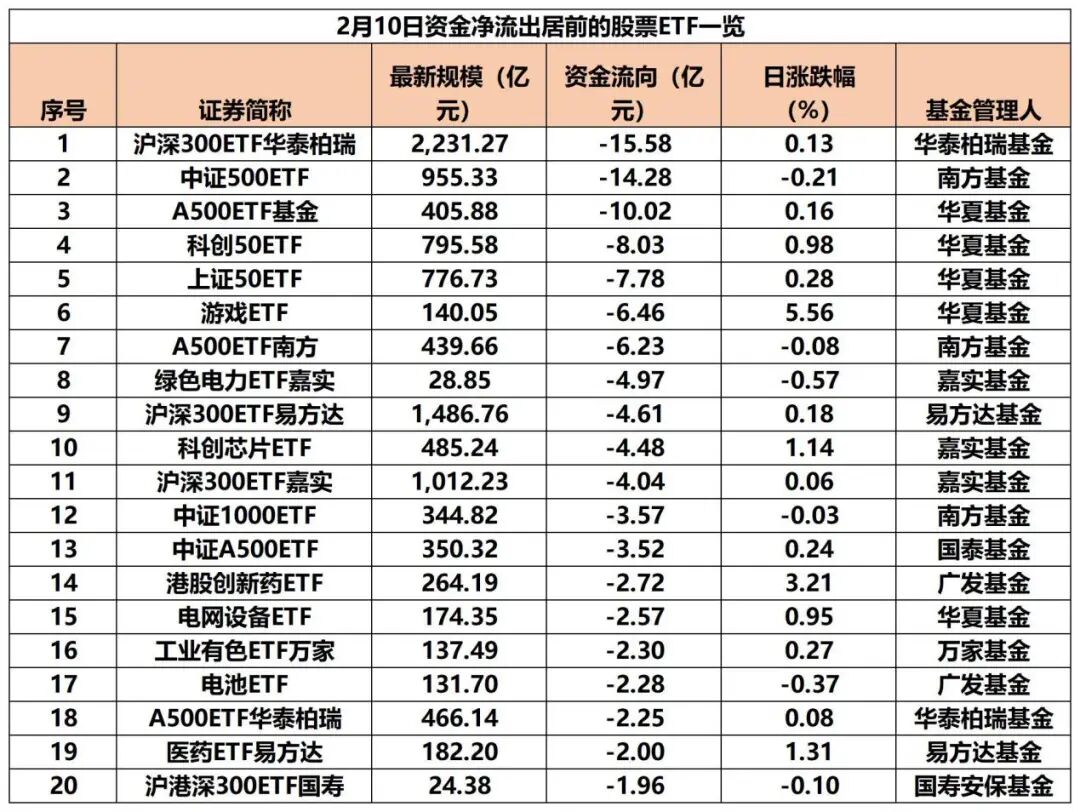
Core Viewpoint - The stock market experienced narrow fluctuations on February 10, with active performance in media and humanoid robot sectors, while stock ETFs saw a net outflow exceeding 10.26 billion yuan [1][2]. ETF Fund Flows - On February 10, the total net outflow from stock ETFs (including cross-border ETFs) reached 10.259 billion yuan, with the CSI 300 index-related ETFs experiencing a net outflow of 2.904 billion yuan, while the CSI Film Index-related ETFs saw a net inflow of 1.339 billion yuan [2][4]. - Over the past five days, the Hang Seng Technology Index-related ETFs attracted over 8.5 billion yuan, and the SGE Gold 9999 Index-related ETFs received over 6.2 billion yuan [2]. Fund Company Performance - E Fund's ETF scale reached 661.58 billion yuan, with a net inflow of 1.05 billion yuan. The China concept internet ETF saw a net inflow of 158 million yuan, while the Hang Seng Technology ETF had a net inflow of 144 million yuan [2]. - Huaxia Fund's robot ETF and sci-tech semiconductor ETF had significant net inflows of 527 million yuan and 117 million yuan, respectively, with their latest scales at 25.818 billion yuan and 8.196 billion yuan [3]. - GF Fund's media ETF received the highest net inflow of 460 million yuan, with a year-to-date increase of over 26%, making it one of the top three ETFs in the market [3]. Market Trends and Insights - The market is expected to shift focus from January's credit and liquidity performance to subsequent macroeconomic and industrial clues, as indicated by E Fund's index investment department [5]. - The manager from GF Fund highlighted the importance of vertical multi-modal AI application opportunities by 2026, emphasizing the deep penetration of AI technology in the production processes of games and films, which could enhance content innovation efficiency [5].
天智航股价连续3天下跌累计跌幅8.17%,易方达基金旗下1只基金持1078.03万股,浮亏损失2382.45万元
Xin Lang Cai Jing· 2026-02-11 07:18
Group 1 - Tianzhihang's stock price fell by 2.36% to 24.84 yuan per share, with a total market capitalization of 11.327 billion yuan, and a cumulative decline of 8.17% over three consecutive days [1] - The company, Beijing Tianzhihang Medical Technology Co., Ltd., focuses on the research, production, sales, and service of orthopedic surgical navigation robots, with main business revenue composition: 58.31% from navigation robots, 23.86% from supporting equipment and consumables, 16.49% from technical services, and 1.31% from other sources [1] Group 2 - E Fund's ETF, E Fund National Robot Industry ETF (159530), entered Tianzhihang's top ten circulating shareholders, holding 10.7803 million shares, accounting for 2.38% of circulating shares, with a floating loss of approximately 6.4682 million yuan today [2] - The E Fund National Robot Industry ETF has a total scale of 15.267 billion yuan, with a year-to-date return of 0.81% and a one-year return of 20.43% [2] - Fund managers Li Shujian and Li Xu have managed the fund for 2 years and 3 years respectively, with the best returns during their tenure being 118.55% and 166.96% [2]

丰倍生物股价连续3天下跌累计跌幅6.73%,易方达基金旗下1只基金持88股,浮亏损失351.12元
Xin Lang Cai Jing· 2026-02-11 07:13
Group 1 - The core point of the news is that Fengbei Biotechnology's stock has experienced a decline of 2.54%, with a total market value of 7.937 billion yuan and a cumulative drop of 6.73% over three consecutive days [1] - Fengbei Biotechnology, established on July 25, 2014, focuses on the comprehensive utilization of waste oil resources, with 91.18% of its revenue coming from this segment, including 79.60% from bio-based materials and 11.58% from biofuels [1] - The company's stock price is currently at 55.31 yuan per share, with a trading volume of 189 million yuan and a turnover rate of 10.80% [1] Group 2 - E Fund's fund holds a small position in Fengbei Biotechnology, with 88 shares representing 0.0002% of the circulating shares, ranking as the fourth largest holding [2] - The fund has incurred a floating loss of approximately 126.72 yuan today and a total floating loss of 351.12 yuan during the three-day decline [2] - E Fund's fund has a total asset size of 5.93 billion yuan, with a year-to-date return of 15.3% and a cumulative return of 20.92% since inception [2]
股票ETF资金净流出超百亿元
Zhong Guo Ji Jin Bao· 2026-02-11 06:26
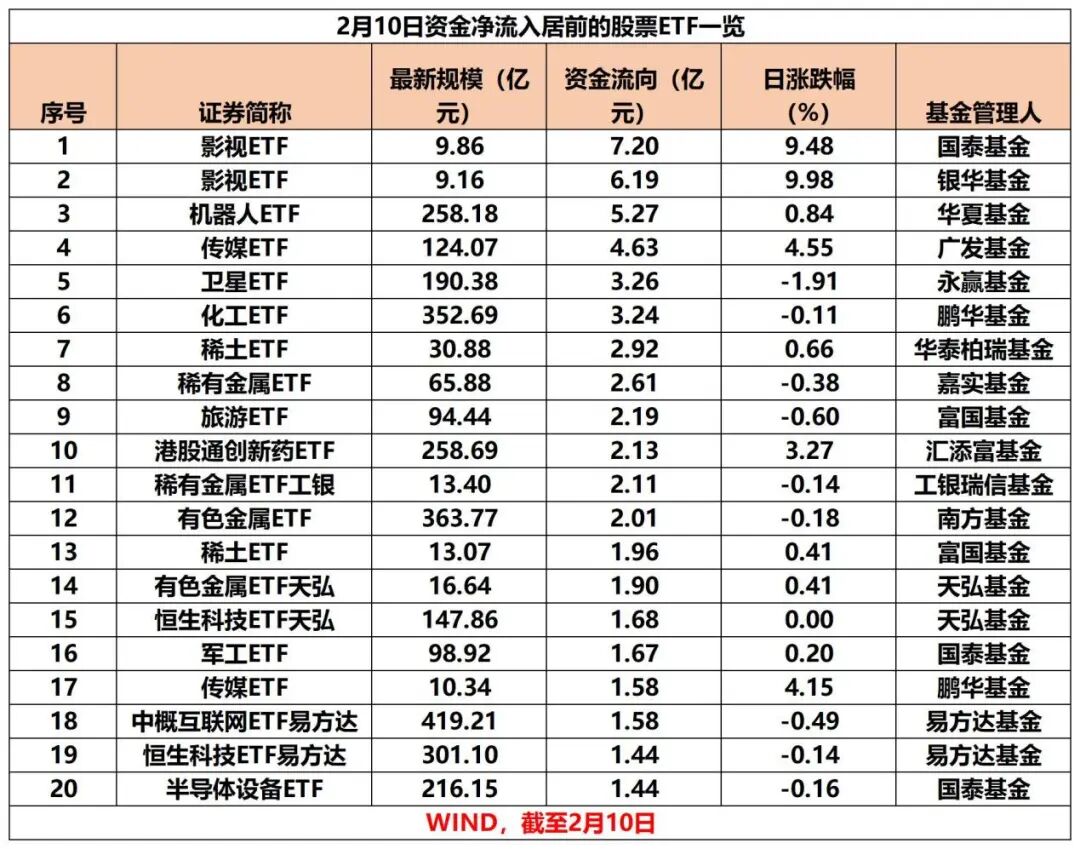
Core Viewpoint - The A-share market experienced a narrow fluctuation on February 10, with significant capital outflows from stock ETFs exceeding 10.26 billion yuan, while sectors like media and humanoid robots showed active performance [1][2]. Group 1: Market Performance - On February 10, the three major A-share indices showed mixed results: the Shanghai Composite Index rose by 0.13%, the Shenzhen Component Index increased by 0.02%, while the ChiNext Index fell by 0.37% [2]. - The overall market saw a net outflow of 102.59 billion yuan from stock ETFs, including cross-border ETFs [2]. Group 2: ETF Capital Flows - The net inflow for the media-related ETFs was significant, with the film and television index-related ETFs seeing a net inflow of 13.39 billion yuan, while the CSI 300 index-related ETFs experienced a net outflow of 29.04 billion yuan [2]. - Over the past five days, the Hang Seng Technology Index-related ETFs attracted over 8.5 billion yuan, and the SGE Gold 9999 Index-related ETFs saw inflows exceeding 6.2 billion yuan [2]. Group 3: Fund Company Insights - E Fund's ETF had a latest scale of 661.58 billion yuan, with a net inflow of 1.05 billion yuan. The China concept internet ETF saw a net inflow of 158 million yuan, while the Hang Seng Technology ETF had a net inflow of 144 million yuan [2]. - Huaxia Fund's robot ETF and sci-tech semiconductor ETF had notable net inflows of 527 million yuan and 117 million yuan, respectively, with their latest scales reaching 25.818 billion yuan and 8.196 billion yuan [3]. Group 4: Notable ETFs - The top ETFs by net inflow on February 10 included the film and television ETF with a net inflow of 720 million yuan, and the robot ETF with a net inflow of 527 million yuan [4]. - Conversely, the top ETFs by net outflow included the CSI 300 ETF with a net outflow of 1.558 billion yuan and the CSI 500 ETF with a net outflow of 1.428 billion yuan [5]. Group 5: Future Market Outlook - The investment focus may shift from January's credit and liquidity performance to macroeconomic and industrial clues as the market enters a relatively data-vacuum period post-Spring Festival [6]. - The media sector is expected to benefit from AI applications, particularly in gaming and film production, which could enhance content creation efficiency and reduce costs [6].
超百亿,“跑了”!
Zhong Guo Ji Jin Bao· 2026-02-11 06:17
Core Viewpoint - The stock ETF market experienced a net outflow of over 10.26 billion yuan on February 10, with significant movements in various thematic ETFs and broad-based ETFs [2][4][5]. Group 1: Market Overview - On February 10, the three major A-share indices showed mixed results, with the Shanghai Composite Index rising by 0.13%, the Shenzhen Component Index increasing by 0.02%, and the ChiNext Index declining by 0.37% [2]. - The overall market saw a net outflow of 10.26 billion yuan in stock ETFs, including cross-border ETFs [2]. Group 2: ETF Performance - The net inflow for the China Film Index-related ETFs was the highest, reaching 1.339 billion yuan, while the net outflow for the CSI 300 Index-related ETFs was the largest at 2.904 billion yuan [2]. - Over the past five days, the Hang Seng Technology Index-related ETFs saw inflows exceeding 8.5 billion yuan, and the SGE Gold 9999 Index-related ETFs attracted over 6.2 billion yuan [2]. Group 3: Fund Company Insights - E Fund's ETF had a latest scale of 661.58 billion yuan, with an increase of 1.05 billion yuan. The China Internet ETF from E Fund had a scale of 41.921 billion yuan, with a net inflow of 158 million yuan [2]. - Huaxia Fund's Robot ETF and Sci-Tech Semiconductor ETF had significant net inflows of 527 million yuan and 117 million yuan, respectively, with latest scales of 25.818 billion yuan and 8.196 billion yuan [3]. Group 4: Thematic ETF Trends - Popular thematic ETFs such as the Film ETF, Robot ETF, and Satellite ETF saw the highest net inflows, while broad-based ETFs like the CSI 300 ETF and CSI 500 ETF were the biggest losers in terms of net outflows [4][5]. - The Media ETF from GF Fund received the most net inflow, amounting to 460 million yuan, and has seen a year-to-date increase of over 26%, making it one of the top performers in the market [3]. Group 5: Future Market Outlook - The investment focus may shift from January's credit and liquidity performance to macroeconomic and industrial cues as the market enters a relatively quiet period for macro data [6]. - The core assets in the market are currently at historical median valuation levels, suggesting potential for valuation recovery, supported by stable profit expectations and a warming trend in foreign capital inflows [6].
化工行业迎来“戴维斯双击”?如何借道ETF一键布局
Sou Hu Cai Jing· 2026-02-11 05:16
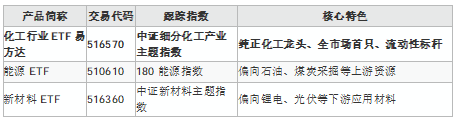
作者:樱桃 第二部分:产品地图——市场上有哪些化工/石化ETF? 目前场内聚焦能源与材料的ETF种类繁多,但针对化工中游制造的纯度各不相同。化工行业ETF易方达 (516570)作为全市场首只、规模领先的化工主题ETF,其专业性备受市场认可。 | 产品饲药 交易代码 | 跟踪指数 | 核心特色 | | --- | --- | --- | | 化工行业 ETF 易 516570 中证细分化工产业 方达 | 主题指数 | 苑正化工龙头、全市场首只、流动性标杆 | | 能源 ETF | 510610 180 能源指数 | 偏向石油、煤炭采掘等上游资源 | | 新材料 ETF 516360 | 职题出获得到我们中 数 | 偏向锂电、光伏等下游应用材料 | 注: 在当前"反内卷"的投资共识下,化工行业ETF易方达(516570)通过优选各细分赛道具备绝对竞争 优势的龙头,剔除尾部产能,其投资理念与挖掘优质龙头、拒绝盲目扩张的逻辑高度契合。 第三部分:深度解析——为什么聚焦化工行业ETF易方达(516570)? 在对比众多同类产品后,化工行业ETF易方达(516570)展现出五个核心维度的碾压优势: 1.纯度最高:化工行 ...