
联发科

Search documents
昨夜今晨:美团入局线上卖车 迅雷起诉前CEO陈磊索赔2亿元
Sou Hu Cai Jing· 2026-01-16 02:52
Group 1 - ZhiMi Technology plans to enter the online travel market by establishing a ticket and hotel division, aiming to compete with Ctrip and reduce its market dominance [2] - The move aligns with national calls for market competition, following an investigation into Ctrip's alleged abuse of market dominance by the State Administration for Market Regulation [2] - ZhiMi has previously focused on smart cleaning devices but has been diversifying into various consumer electronics and service sectors in recent years [2] Group 2 - Shenzhen Xunlei Network Technology Co., Ltd. has filed a civil lawsuit against former CEO Chen Lei, seeking to recover 200 million RMB for damages to the company [3] - The lawsuit centers on allegations that Chen Lei controlled a company that transferred assets from Xunlei without board approval through related-party transactions [3] - A previous criminal investigation into the same matter was terminated in late 2022 due to insufficient evidence [3] Group 3 - Meituan has signed a strategic cooperation agreement with Shanghai Xiche Future Intelligent Technology Co., Ltd. to enter the car sales market [4] - The partnership aims to integrate local life service platform resources with automotive industry capabilities, creating a one-stop solution for car purchasing and services [4] - Initial focus will be on online display, test drive appointments, and transaction closure, leveraging Meituan's existing traffic system to enhance user engagement [4] Group 4 - MediaTek has launched two new system-on-chip (SoC) products for the smartphone market: Dimensity 9500s and Dimensity 8500 [5] - The Dimensity 9500s is manufactured using TSMC's 3nm process, featuring a full big-core CPU architecture and Immortalis-G925 GPU, with a benchmark score exceeding 3.61 million on AnTuTu [5] - The Dimensity 8500 is based on a 4nm process and also utilizes a full big-core design with an octa-core Mali-G720 GPU [5] Group 5 - Apple has expanded the cross-border payment capabilities of Apple Pay for Visa cardholders in mainland China, allowing them to make contactless payments abroad [6] - Initial participating banks include Industrial and Commercial Bank of China and Bank of China, with plans to add more issuers and Mastercard support in the future [6] - This update enhances the usability of digital wallets for individuals traveling abroad or studying overseas [6]





270亿收购,Marvell豪赌光芯片
半导体行业观察· 2026-01-16 01:48
Core Insights - The economic benefits of AI infrastructure have reached a turning point, with copper cabling becoming a bottleneck due to power consumption and bandwidth limitations for modern AI workloads [1] - Marvell Technology's recent acquisition of Celestial AI for approximately $3.25 billion and XConn Technologies for $540 million aims to address these challenges and strengthen its position in the emerging optical interconnect semiconductor market [1] Group 1: Business Case for Optical Networks - Traditional AI systems limit processors to a single rack, restricting scalability and requiring expensive hardware redundancy [3] - Next-generation architectures will distribute hundreds of AI accelerators across multiple racks, enabling direct memory access between processors, thus improving resource utilization [3] - Copper interconnects have significant power and transmission distance limitations, making them economically and thermally unfeasible as AI accelerators approach kilowatt-level power [3] Group 2: Marvell's Three-Pronged Connection Strategy - Marvell's acquisition strategy combines three complementary technologies: CXL for memory decoupling, optical interconnect for extended connections, and UALink for high-performance communication between accelerators [5] - CXL technology allows data centers to share memory across multiple systems without dedicated high-bandwidth memory in each server, addressing critical economic challenges posed by AI demand [5] - This approach enables the reuse of existing DDR4 memory into a shared memory pool, extending the life of depreciated assets and reducing reliance on limited HBM and DDR5 memory supplies [5] Group 3: Competitive Landscape - Marvell's acquisitions have altered the competitive landscape in the AI infrastructure chip sector, positioning it favorably against Broadcom, which currently leads in custom chip solutions but lacks the necessary optical interconnect technology [9] - MediaTek, traditionally focused on consumer electronics, is expanding into data center infrastructure but lacks the strong partnerships and comprehensive product offerings that Marvell possesses [9] - The acquisitions of XConn and Celestial AI further widen the technological gap, particularly in co-packaged optical devices, giving Marvell a competitive edge in providing complete connection solutions [9] Group 4: Financial Forecasts and Market Opportunities - Marvell anticipates that XConn will generate approximately $100 million in revenue by fiscal year 2028, with initial contributions starting in the second half of fiscal year 2027 [12] - Celestial AI is expected to represent a larger growth opportunity, with projected annualized revenue of $500 million by the fourth quarter of fiscal year 2028, doubling to $1 billion by the fourth quarter of fiscal year 2029 [12] - The revenue potential reflects a new market opportunity for semiconductor suppliers, as traditional optical interconnect technologies are now being integrated into processor packages, creating significant new chip development opportunities [12] Group 5: Analyst Perspectives - Marvell's recent acquisitions signal a fundamental shift in data center architecture from copper to optical interconnects, driven by physical and economic factors [15] - The key question for technology buyers is not whether this transition will occur, but which suppliers will successfully implement it and when optical storage extension technologies will meet enterprise workload demands [15] - The responses from Broadcom and MediaTek will determine whether Marvell's first-mover advantage in co-packaged optical interconnects can be sustained or if it will trigger a reshaping of the custom chip landscape through mergers and acquisitions [16]


美国在为最后的时刻做准备
Sou Hu Cai Jing· 2026-01-16 00:48
Group 1 - The United States and Taiwan have reached a broad consensus on tariffs, with the U.S. planning to reduce tariffs on Taiwanese imports to 15% and Taiwan committing to invest $300 billion in the U.S., including the construction of five additional semiconductor fabs in Arizona, which could increase TSMC's total fabs in the U.S. to at least six, potentially up to eleven [1] - TSMC's competitive edge lies in its advanced process chip foundry capabilities, with six main fabs currently in Taiwan producing advanced chips, including 7nm, 5nm, and 3nm technologies [1][2] - Establishing more than six advanced process chip foundries in the U.S. could lead to an oversupply of advanced chips globally, as TSMC's production costs in the U.S. are expected to rise significantly, with current gross margins around 60% in Taiwan compared to only 8% in the U.S. [2] Group 2 - The construction of advanced process chip manufacturing capabilities in mainland China is expected to create a bipolar world in the advanced chip sector, with the U.S. and China as the two main competitors, making it difficult for other regions to compete [3] - Over the next five years, significant changes in the global semiconductor industry are anticipated, where cost will become the primary competitive factor rather than technology [3] - The rapid pace of change in the industry suggests that companies must adapt to remain competitive and vibrant, as the next five years are expected to bring profound and shocking transformations in the global landscape [3]


联发科发布两颗天玑芯片
Zhong Guo Jing Ying Bao· 2026-01-15 15:10
Core Insights - MediaTek has officially launched two mobile chips, the Dimensity 9500s and Dimensity 8500, targeting the flagship and light flagship markets respectively, enhancing the competitive landscape with advanced features and energy efficiency [1][3] Group 1: Product Specifications - The Dimensity 9500s is built on TSMC's 3nm process, featuring a "1+3+4" full-core CPU architecture and Immortalis-G925 GPU, supporting PC-level ray tracing and 165Hz ultra-high frame gaming [3] - The Dimensity 8500, aimed at the light flagship segment, utilizes a 4nm process with eight Cortex-A725 cores clocked at 3.4GHz, offering a 25% performance increase and 20% power reduction compared to its predecessor [3] Group 2: Market Positioning - The Dimensity 9500s aims to democratize flagship experiences, while the Dimensity 8500 focuses on the gaming needs of younger consumers [3] - Both chips enhance network and connectivity capabilities, supporting 5G Release-17 and advanced Wi-Fi and Bluetooth technologies, further solidifying MediaTek's product matrix across various price segments [3] Group 3: Strategic Partnerships - The REDMI Turbo 5 series will be among the first devices to feature the Dimensity 9500s, with the REDMI Turbo 5 Max expected to launch within the month [1][3] - The collaboration with REDMI and other flagship market terminals is anticipated to strengthen MediaTek's leading position in the global mobile chip market [3]
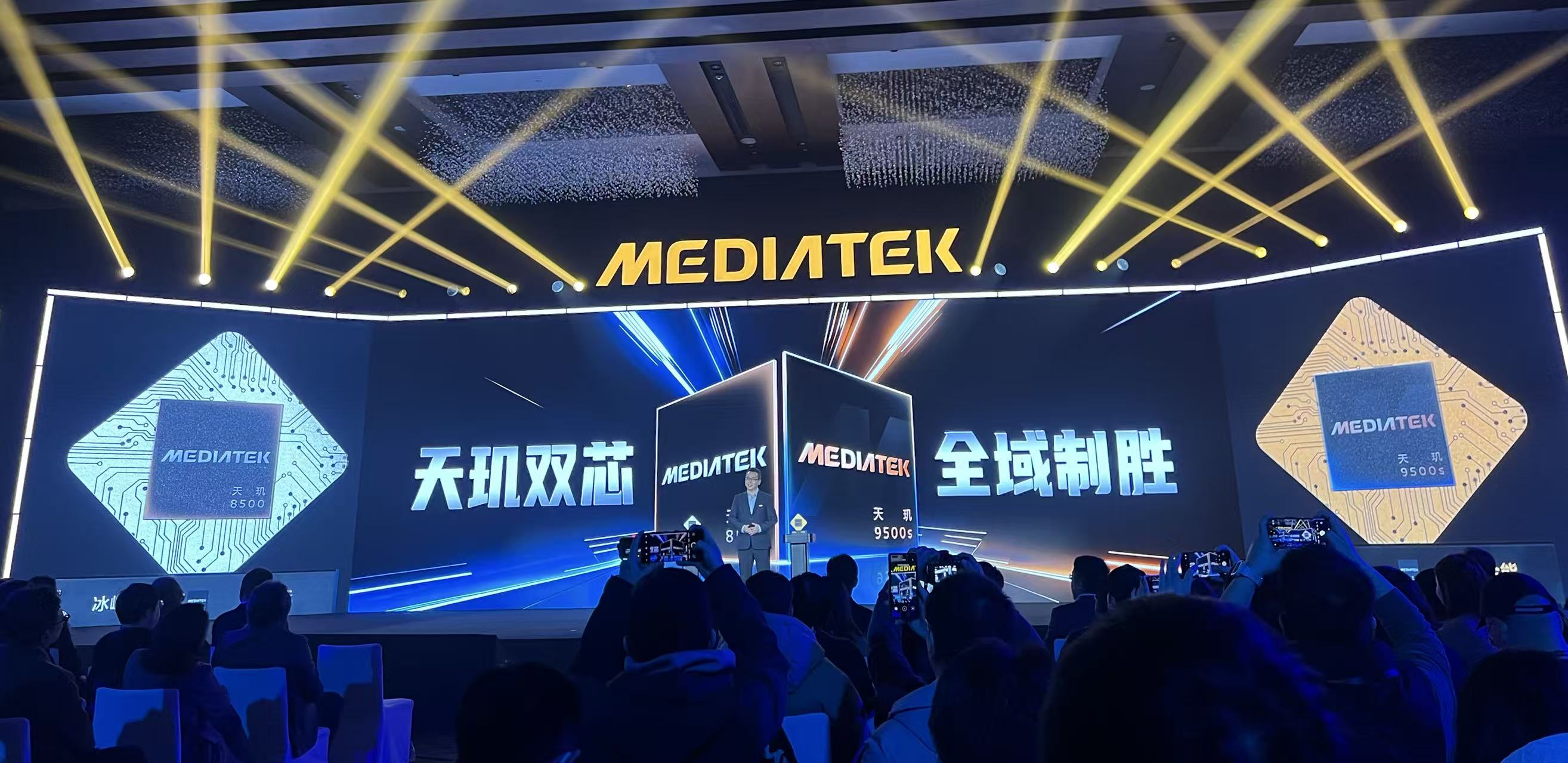
联发科发布天玑9500s和天玑8500两款移动芯片
Zheng Quan Shi Bao Wang· 2026-01-15 09:05
Core Insights - MediaTek launched two flagship mobile chips, the Dimensity 9500s and Dimensity 8500, on January 15 [1] Group 1: Dimensity 9500s - The Dimensity 9500s utilizes a flagship 3nm process and features a full big-core architecture [1] - It supports advanced AI functionalities such as real-time photo beautification, AI photo editing (including upscaling, background removal, and deletion), and AI content summarization for calls, meetings, and documents [1] - The chip also supports ray tracing technology and ultra-high frame rate gaming at 165 FPS [1] Group 2: Dimensity 8500 - The Dimensity 8500 is built on a high-efficiency 4nm process and is equipped with an octa-core Mali-G720 GPU [1] - Peak performance of the Dimensity 8500 is improved by 25% compared to its predecessor [1] - Power consumption for peak performance has decreased by 20% compared to the previous generation [1]
联发科发布天玑9500s:3nm工艺,支持硬件级光线追踪技术
Feng Huang Wang· 2026-01-15 08:33
Group 1 - MediaTek officially launched the Dimensity 9500s mobile platform on January 15, featuring a 3nm process and a full big-core CPU architecture with a main frequency of 3.73GHz for the Cortex-X925 super core, 3 Cortex-X4 super cores, and 4 Cortex-A720 big cores [1] - The Dimensity 9500s integrates the Immortalis-G925 GPU, supporting hardware-level ray tracing technology, and enhances gaming efficiency and battery life through MAGT 3.0 and MFRC 3.0 technologies, achieving up to 165 frames per second in mainstream gaming [1] - The platform's NPU is optimized for generative AI and multimodal models, supporting features like AI photo enhancement and content summarization, while the image processor supports 8K Dolby Vision HDR video recording at 30 frames per second [1] - The platform includes a modem that supports 5G Release-17 standards, achieving a downlink speed of 7Gbps through four-carrier aggregation technology, and enhances Wi-Fi connectivity and Bluetooth direct connection over a range of 5 kilometers [1] Group 2 - MediaTek also announced the Dimensity 8500 mobile platform, which utilizes a 4nm process and features an 8-core full big-core architecture with a maximum frequency of 3.4GHz, supporting LPDDR5X memory at 9600Mbps [2] - The Dimensity 8500 is equipped with the Mali-G720 GPU, offering a 25% performance increase over the previous generation while reducing power consumption by 20% at the same performance level [2] - The platform supports mobile ray tracing technology and optimizes game frame rates and efficiency through scheduling and dual-engine technology [2] - The integrated NPU 880 supports mainstream large language models and image generation models, featuring AI ultra-clear long-focus algorithms, video semantic segmentation, and AI reflection removal capabilities [2]
【招商电子】CES 2026跟踪报告:AI赋能依旧是主旋律,聚焦穿戴/IoT、智能车、机器人等新品创新
招商电子· 2026-01-12 12:03
Core Viewpoint - CES 2026 showcased significant advancements in AI-driven consumer electronics, with a focus on wearable devices, automotive technology, robotics, and IoT innovations, highlighting the integration of AI across various sectors [2][5][6]. Group 1: Wearable/IOT - AI glasses and camera headphones remain focal points in wearable technology, with over 50 companies participating, primarily from mainland China, emphasizing design improvements and multi-modal interactions [2][10]. - Headphone innovations shifted from audio performance to a combination of sound quality, AI integration, and multi-modal capabilities, with products featuring cameras and environmental awareness [2][13]. - New IoT categories, including smart imaging devices and AI home products, are gaining traction, with many startups entering the market [2][16]. Group 2: Automotive - AI is driving a comprehensive upgrade in automotive technology, with high-level autonomous driving expected to scale commercially [3][19]. - NVIDIA introduced the Alpamayo series of open-source AI models, enhancing the development of autonomous driving capabilities [3][19]. - Major automotive companies like Geely and Great Wall showcased their AI systems, while international brands are partnering with AI giants to enhance their offerings [3][24][26]. Group 3: Robotics - The robotics sector is evolving from household and service robots to humanoid collaboration, with significant participation from electronic companies [4][34]. - Innovations in household robots include advanced cleaning capabilities and a broader range of applications, while humanoid robots are becoming more sophisticated in interaction and movement [4][34]. - Chinese electronic companies are increasingly showcasing key components and technologies in robotics at CES 2026 [4][34]. Group 4: PC/Smartphone - Lenovo launched its first personal super intelligent system, Lenovo Qira, and announced a partnership with NVIDIA for AI infrastructure [4][36]. - Chip manufacturers like Intel, Qualcomm, and AMD are upgrading their products to enhance AI performance and user experience in PCs [4][39]. - The focus on AI integration in smartphones and PCs is expected to drive innovation and market growth in the coming years [4][39].







半导体行业月报:长鑫IPO获受理,关注国内存储器产业链-20260112
Zhongyuan Securities· 2026-01-12 08:28
Investment Rating - The report maintains an "Outperform" rating for the semiconductor industry, indicating a positive outlook compared to the broader market [1]. Core Insights - The semiconductor industry showed strong performance in December 2025, with a 5.11% increase, outperforming the 2.28% rise of the CSI 300 index. The overall industry saw a 45.07% increase throughout 2025 [6][12]. - Global semiconductor sales continued to grow, with a year-on-year increase of 29.8% in November 2025, marking 25 consecutive months of growth. The forecast for 2026 anticipates an 8.5% increase in global semiconductor sales [6]. - The demand for AI-related hardware infrastructure remains robust, with significant capital expenditure increases from major cloud service providers [6][8]. - The report highlights the ongoing price increases in DRAM and NAND Flash, with predictions of substantial contract price growth in early 2026 [6][8]. Summary by Sections 1. December 2025 Semiconductor Market Performance - The semiconductor sector outperformed the CSI 300 index, with notable increases in integrated circuits (4.32%) and semiconductor equipment (9.61%) [12]. - The Philadelphia Semiconductor Index rose by 0.83% in December 2025, with a total increase of 42.23% for the year [18]. 2. Global Semiconductor Sales Growth - Global semiconductor sales saw a 29.8% year-on-year increase in November 2025, with a month-on-month growth of 3.5% [6]. - The demand for AI hardware is driving significant capital expenditures from major companies, with North American cloud providers increasing spending by 67% year-on-year in Q3 2025 [6][8]. 3. Price Trends in Memory Products - DRAM and NAND Flash prices continued to rise, with DRAM spot prices increasing approximately 15% and NAND prices by about 16% in December 2025 [6]. - Predictions for Q1 2026 suggest a 55-60% increase in DRAM contract prices and a 33-38% increase in NAND Flash contract prices [6][8]. 4. Investment Opportunities - The report suggests focusing on investment opportunities within the domestic memory industry chain, particularly in storage modules and semiconductor equipment, as domestic manufacturers are expected to accelerate production [6][8].
亚太精选ETF南方盘中涨近3% 亚太股市迎来最强年度开局 亚洲领跑全球AI竞赛
Zhi Tong Cai Jing· 2026-01-12 03:04
Core Viewpoint - The Asian stock market is experiencing a historic strong start in 2026, with major indices in Japan and South Korea reaching record highs, driven by improved global liquidity expectations and favorable regional economic growth prospects [1] Group 1: Market Performance - The Asia-Pacific Selected ETF (159687) saw an intraday increase of nearly 3%, with a current rise of 1.19% to 1.616 yuan and a trading volume of 91.39 million yuan [1] - The collective strength of the Asia-Pacific stock market reflects a revaluation of the capital market regarding innovation breakthroughs and industrial upgrades in frontier sectors such as artificial intelligence, high-end manufacturing, and biotechnology [1] Group 2: Investment Insights - Citigroup highlights the significant position of Asian technology stocks within the semiconductor supply chain and their potential for profit growth, leading global long-term investors to continuously increase their holdings in these stocks [1] - The Asia-Pacific Selected ETF (159687) is the only ETF tracking the Asia-Pacific Selected Index, covering 11 countries and regions, and includes high-quality dividend assets such as Toyota, Tencent, Alibaba, and Mitsubishi Group, as well as leading semiconductor companies like TSMC, Samsung, Tokyo Electron, and MediaTek [1]
亚太精选ETF南方(159687)盘中涨近3% 亚太股市迎来最强年度开局 亚洲领跑全球AI竞赛
智通财经网· 2026-01-12 03:03
Group 1 - The core viewpoint of the article highlights the strong performance of the Asia-Pacific stock market, with major indices in Japan and South Korea reaching record highs, driven by improved global liquidity expectations and favorable regional economic growth prospects [1] - The Asia-Pacific stock market's strength reflects a re-evaluation of the value of the region's innovations and upgrades in frontier industries such as artificial intelligence, high-end manufacturing, and biotechnology [1] - Citigroup notes that global long-term investors are continuously increasing their holdings in Asian technology stocks due to their significant role in the semiconductor supply chain and potential for profit growth [1] Group 2 - The Southern Fund's Asia-Pacific Select ETF (159687) is the only ETF tracking the Asia-Pacific Select Index, covering 11 countries and regions in the Asia-Pacific [1] - This ETF includes high-quality dividend assets from the Asia-Pacific region, such as Toyota, Tencent, Alibaba, and Mitsubishi Group, as well as leading semiconductor companies like TSMC, Samsung, Tokyo Electron, and MediaTek [1]