联影医疗

Search documents
【转|太平洋医药-26年度策略】聚焦创新,共赴新程
远峰电子· 2026-01-25 11:53
Market Overview - The pharmaceutical sector is experiencing a structural bull market in 2025, with the CITIC Pharmaceutical Index rising nearly 30% in the first three quarters, driven by the global recognition of the value of innovative drugs and devices [2][3] - The industry is expected to enter a critical phase of innovation realization and global expansion in 2026, shifting investment logic from expectation-driven to closely tracking clinical data, commercialization progress, and international achievements [2][3] Valuation Insights - The pharmaceutical sector's valuation remains at historical lows, with significant investment opportunities still available. As of December 31, 2025, various sub-sectors are trading at relatively low valuations, such as biopharmaceuticals at 35.16X and medical devices at 33.07X [7][9] - The medical services, chemical raw materials, and chemical preparations sectors have shown impressive growth, with increases of 29.22%, 22.03%, and 20.44% respectively [7] Revenue and Profit Trends - From January to November 2025, China's pharmaceutical manufacturing industry reported total revenue of 220.65 billion yuan, a year-on-year decline of 2.51%, while total profit decreased by 1.79% [9] - The performance of the biopharmaceutical, medical services, and pharmaceutical distribution sectors has improved, with biopharmaceuticals benefiting from rapid drug volume growth post-collection [9] Fund Management and Investment Opportunities - As of the end of Q3 2025, public funds' holdings in the pharmaceutical sector were at 11.22%, below the ten-year average of 8.15%, indicating potential for excess returns as the sector approaches a performance inflection point [11] - The low allocation of public funds and the sector's historical low valuations present significant opportunities for investment in high-potential sub-sectors and individual stocks [11] Innovation and Policy Support - The Chinese biopharmaceutical industry is entering a new phase of high-quality development, with significant improvements in innovation capabilities among the top 100 pharmaceutical companies [14][21] - The government has implemented comprehensive policies to support the development of innovative drugs and medical devices, transitioning from single-item support to a full-chain, regional, and financial support system [15][28] Global Market Position - China has become the second-largest market for innovative drug launches globally, contributing approximately 30% of the world's innovative pipelines as of Q3 2025 [50][66] - The country is increasingly recognized for its efficiency and cost-effectiveness in drug development, with a significant number of clinical trials initiated in China, particularly in oncology [53][66] Licensing and Commercialization Trends - The number of license-out transactions for Chinese innovative drugs has surged, with 103 deals recorded in the first three quarters of 2025, totaling $92.03 billion, marking a 77% increase year-on-year [43][63] - The successful inclusion of innovative drugs in the new commercial insurance directory is expected to enhance their commercialization prospects [30] Future Growth Areas - Next-generation therapies, including ADCs, bispecific antibodies, and cell and gene therapies, are becoming focal points for research and investment, with China leading in these areas [76][87] - The oncology drug market is projected to reach $441 billion, with new therapies expected to account for about 20% of treatment expenditures by 2029 [82]


2026年中国医疗器械物流配送行业发展历程、政策、运力情况、竞争格局及趋势研判:医疗器械物流基础建设不断完善,物流运输自有车辆突破4万台[图]
Chan Ye Xin Xi Wang· 2026-01-24 02:30
Core Viewpoint - The strategic importance of medical device logistics and distribution is increasingly recognized as the market for medical devices continues to expand, leading to a strong demand for specialized and efficient logistics services [1][8]. Industry Overview - Medical device logistics and distribution involves the effective transfer of medical device products from suppliers or manufacturers to medical institutions, pharmacies, or other relevant endpoints, ensuring safety, timeliness, and accuracy [2][3]. - The industry has evolved through four stages, from minimal focus during the early marketization phase to a rapid development period from 2010 to 2020, driven by increasing demand and regulatory policies [3]. Industry Policies - Recent government policies have provided strong support for the development of the medical device logistics industry, promoting standardization, efficiency, and scale [4]. - Key policies include the establishment of a risk-sharing alliance for online sales of medical devices and encouragement for wholesale companies to integrate storage and transportation resources [4]. Industry Chain - The upstream of the medical device logistics chain includes suppliers of logistics vehicles, software, medical devices, storage equipment, and packaging materials [4]. - The midstream consists of logistics service providers, which are crucial for the entire supply chain, while the downstream includes medical institutions and patients as the primary demand side [4]. Current Industry Status - The logistics total cost for medical devices in China is projected to reach 26.78 billion yuan in 2024, with a year-on-year growth of 1.88% [8]. - The logistics warehousing area is expected to be 23.58 million square meters in 2024, reflecting a 0.8% increase [8]. Market Trends - The medical device logistics industry is expected to accelerate its digital transformation and integration of intelligent technologies, utilizing IoT for real-time monitoring and big data for demand forecasting [12][14]. - Service models are evolving towards highly specialized and integrated solutions, addressing specific requirements for different categories of medical devices [14]. - The logistics network is anticipated to deepen into lower-tier cities, establishing regional distribution centers to enhance efficiency and reduce costs [15].






今日视点:中国药械“出海”迈入体系化新征途
Xin Lang Cai Jing· 2026-01-23 23:26
Core Viewpoint - The Chinese pharmaceutical and medical device industry is entering a new phase of "systematic going global," supported by national platforms and multi-dimensional efforts from enterprises [1] Policy Support - The "systematic going global" initiative is receiving unprecedented systematic support, with the issuance of the first "overseas drug price certificate" in January 2026, bolstering the global pricing of China's pharmaceutical industry [2] - A multi-layered market connection network is being formed, with the National Healthcare Security Administration promoting differentiated development in regions like Guangxi, Xinjiang, Tianjin, and Ningbo, targeting Southeast Asia, Central Asia, and Central and Eastern Europe [2] - Multiple government departments, including the Ministry of Commerce and the National Medical Products Administration, are collaborating to reduce institutional costs and information barriers for enterprises going global [2] Industry Transformation - The export structure of China's pharmaceutical and medical device industry is shifting from low-value consumables to high-value innovative products, with a significant increase in the licensing-out transactions of innovative drugs expected to exceed $130 billion by 2025 [3] - Leading companies like United Imaging Healthcare and Mindray Medical are seeing a continuous increase in overseas revenue, successfully entering high-end hospital markets in Europe and the U.S. [3] Strategic Recommendations - Companies need to solidify their innovation foundation by focusing on unmet clinical needs and building proprietary technology platforms in advanced fields like ADCs, bispecific antibodies, and gene therapy [3] - Utilizing capital tools for overseas strategic layout is essential, such as raising funds through targeted placements for overseas clinical research and acquisitions of quality overseas targets [4] - Implementing differentiated market strategies is crucial, with companies needing to adopt localized thinking in different markets, maximizing product value through partnerships in mature markets and engaging in local production in emerging markets [4]

中国药械“出海”迈入体系化新征途
Zheng Quan Ri Bao Zhi Sheng· 2026-01-23 16:12
Core Insights - The Chinese medical device and pharmaceutical industry is entering a new phase of "systematic going global," supported by national platforms and multi-dimensional corporate efforts [1] Policy Support - The "systematic going global" initiative is receiving unprecedented systematic support, with the issuance of the first "overseas drug price certification" in January 2026, facilitating the global pricing of Chinese pharmaceuticals [2] - A multi-layered market connection network is being established, with the National Healthcare Security Administration promoting differentiated development in regions like Guangxi, Xinjiang, Tianjin, and Ningbo to expand services to countries along the Belt and Road [2] - Multiple government departments, including the Ministry of Commerce and the National Medical Products Administration, are collaborating to reduce institutional costs and information barriers for companies going global [2] Industry Transformation - The export structure of China's medical device and pharmaceutical industry is shifting from low-value consumables to innovative products, with a significant increase in the value chain [3] - By 2025, the total value of China's innovative drug licensing transactions is expected to exceed $130 billion, with many innovative drug companies attracting interest from international giants [3] - Leading companies like United Imaging Healthcare and Mindray Medical are increasing their overseas revenue share, successfully entering high-end hospital markets in Europe and the U.S. [3] Strategic Recommendations - Companies need to solidify their innovation foundations by focusing on unmet clinical needs and building proprietary technology platforms in advanced fields like ADCs, bispecific antibodies, and gene therapy [4] - Utilizing capital tools for overseas strategic layout is essential, such as raising funds through targeted placements for overseas clinical research and acquisitions of quality overseas targets [4] - Implementing differentiated market strategies is crucial, with companies needing to adopt localized thinking in different markets, maximizing product value through partnerships in mature markets, and engaging in local production and health ecosystem development in emerging markets [4]
医疗设备以旧换新专题系列六:12月数据同比-8%,25年全年同比+25%
Southwest Securities· 2026-01-23 10:36
Investment Rating - The report indicates a positive outlook for the medical equipment industry, with an expected year-on-year growth of 25% for the year 2025 [22]. Core Insights - The medical equipment industry is experiencing a slight decline in December data year-on-year, attributed to a high base effect from the previous year. However, there is a significant month-on-month increase of 38% due to accelerated budget spending at year-end [3]. - The report highlights that the current round of medical equipment upgrades is nearing its end, with expectations for a new round of equipment replacement in 2025, which is projected to be no less than the previous round [4]. - The report emphasizes the importance of government policies, including the issuance of long-term special bonds to support large-scale equipment upgrades and consumer replacement programs [15]. Summary by Relevant Sections Medical Imaging - December figures for medical imaging reached 9.8 billion yuan, a decrease of 11%, while the forecast for 2025 is 69.3 billion yuan, reflecting a growth of 37% [5]. Life Information and Support - In December, life information and support equipment generated 2.6 billion yuan, an increase of 8%, with a projected total of 16.7 billion yuan for 2025, marking a 28% growth [5]. Endoscopes - Soft endoscopes reported 1.1 billion yuan in December, down 9%, while hard endoscopes reached 1.2 billion yuan, down 7%. The 2025 projections for both are 7.8 billion yuan for soft endoscopes (+12%) and 7.8 billion yuan for hard endoscopes (+3%) [5]. Radiation Therapy - December figures for radiation therapy stood at 1.6 billion yuan, a slight increase of 1%, with a forecast of 9.6 billion yuan for 2025, indicating a growth of 32% [48]. Surgical Robots - Surgical robots saw a significant decline in December, with figures at 600 million yuan, down 24%, but are expected to reach 5.2 billion yuan in 2025, reflecting a robust growth of 54% [51]. Key Companies - Major companies in the sector include Mindray, which reported 1.9 billion yuan in December (+20%) and is projected to reach 11.2 billion yuan in 2025 (+35%), and United Imaging, with December figures of 2.2 billion yuan (0% change) and a forecast of 12.6 billion yuan (+37%) for 2025 [55][58].


医疗器械板块1月23日涨1.64%,华兰股份领涨,主力资金净流入5.81亿元
Zheng Xing Xing Ye Ri Bao· 2026-01-23 09:04
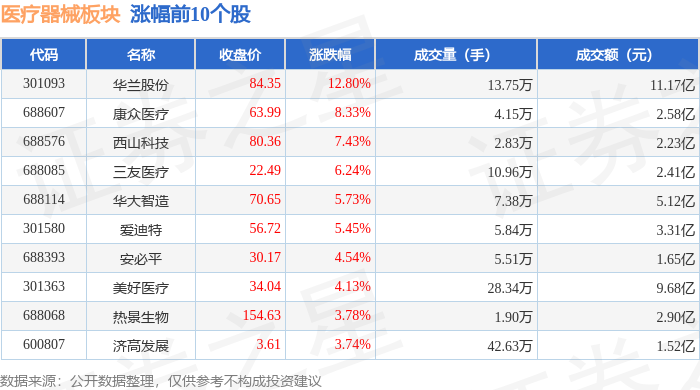
Market Performance - The medical device sector increased by 1.64% on January 23, with Hualan Biological leading the gains [1] - The Shanghai Composite Index closed at 4136.16, up 0.33%, while the Shenzhen Component Index closed at 14439.66, up 0.79% [1] Top Gainers in Medical Device Sector - Hualan Biological (301093) closed at 84.35, up 12.80%, with a trading volume of 137,500 shares and a transaction value of 1.117 billion [1] - Kangzhong Medical (688607) closed at 66.69, up 8.33%, with a trading volume of 41,500 shares [1] - Xishan Technology (688576) closed at 80.36, up 7.43%, with a trading volume of 28,300 shares [1] - Other notable gainers include Sanyou Medical (688085) and BGI Genomics (688114) with increases of 6.24% and 5.73% respectively [1] Market Capital Flow - The medical device sector saw a net inflow of 581 million in main funds, while retail investors experienced a net outflow of 373 million [2][3] - The main funds showed significant interest in Meihua Medical (301363) with a net inflow of 1.73 billion, representing 17.84% of its total [3] - Other companies like Mindray Medical (300760) and Union Medical (688271) also attracted main fund inflows, while experiencing retail outflows [3]
医药果然反弹!医药ETF(159929)收涨近1%,近5日狂揽超1亿元!关注创新、出海、困境反转脉冲三大产业演绎脉络!
Sou Hu Cai Jing· 2026-01-23 07:43
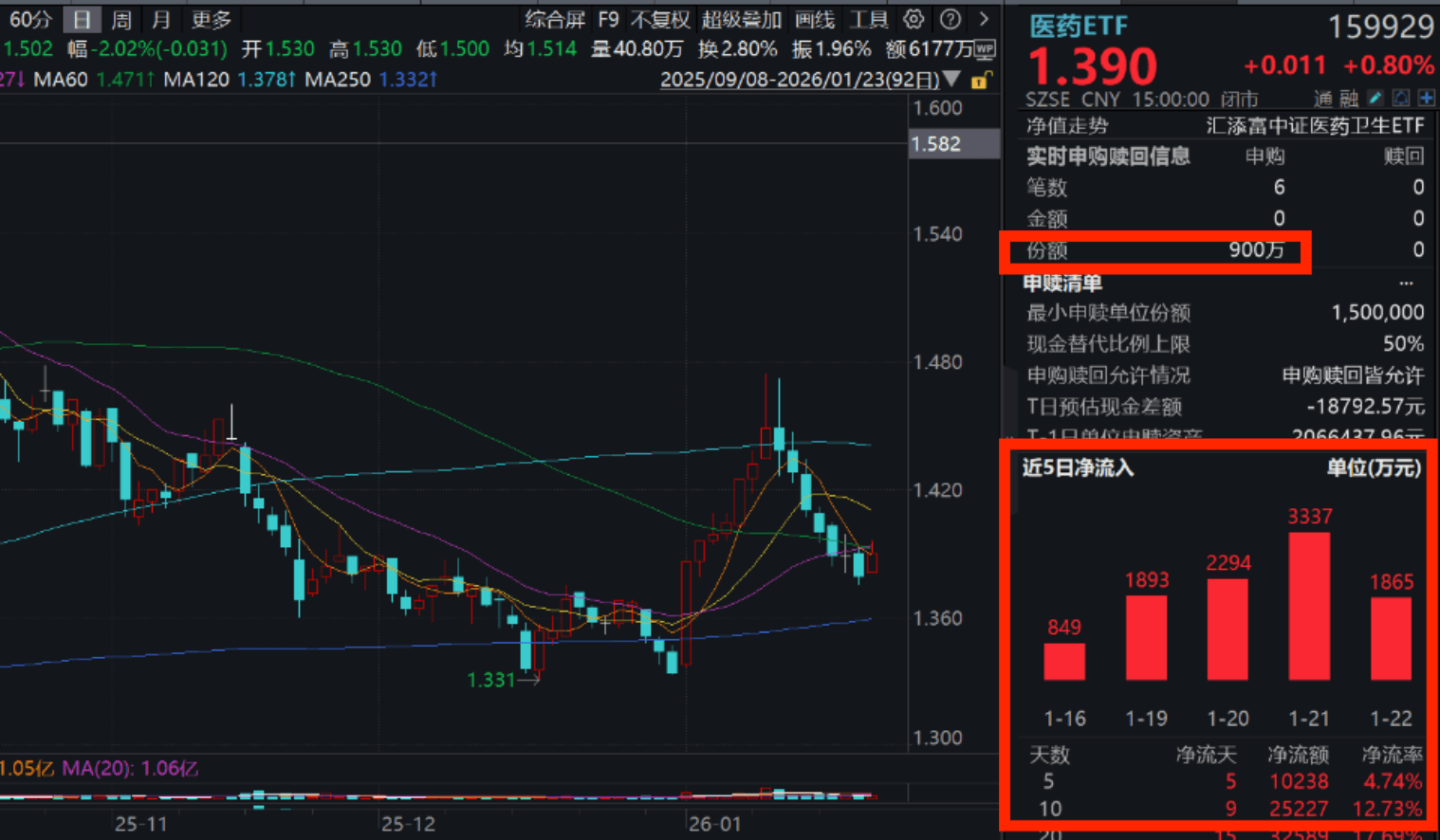
Core Viewpoint - The pharmaceutical sector is experiencing a rebound, with the pharmaceutical ETF (159929) rising by 0.8% and a total trading volume exceeding 86 million yuan, indicating strong investor interest and capital inflow [1]. Group 1: Market Performance - The pharmaceutical ETF (159929) has seen a capital inflow of over 320 million yuan in the last 20 days, with 15 of those days showing increased funding [1]. - The latest financing balance has surged to over 75 million yuan, reflecting continued leverage in the market [1]. - Major stocks within the ETF, such as Mindray Medical and United Imaging, have shown positive performance, with several stocks rising over 1% [4]. Group 2: Sector Analysis - The report highlights a shift in focus within the pharmaceutical sector towards innovative fields such as AI healthcare and medical robotics, moving away from previously strong areas like brain-computer interfaces [3]. - The CRO (Contract Research Organization) sector has also shown some performance, driven by market sentiment and expectations of turning points in the industry [3]. - The top three investment directions identified for 2026 include BD 2.0, small nucleic acids, and supply chain (CXO and upstream), emphasizing the importance of innovation and international expansion [5]. Group 3: Company Highlights - Key companies in the ETF include WuXi AppTec, with an estimated weight of 10.77%, and Hengrui Medicine, with a weight of 9.41%, both of which are significant players in the pharmaceutical industry [2]. - Tempus AI reported a revenue of approximately 1.27 billion USD for 2025, marking an 83% year-on-year growth, showcasing the commercial viability of AI in healthcare [6]. - NVIDIA and Eli Lilly announced a partnership to establish an AI innovation lab, investing up to 1 billion USD over five years to address challenges in drug discovery and development [5].
医药生物行业双周报(2026、1、9-2026、1、22):部分地区取消医院用药数量限制-20260123
Dongguan Securities· 2026-01-23 06:52
Investment Rating - The report maintains a "Market Perform" rating for the pharmaceutical and biotechnology industry, indicating that the industry index is expected to perform within ±10% of the market index over the next six months [4][26]. Core Insights - The SW pharmaceutical and biotechnology industry underperformed the Shanghai and Shenzhen 300 index, with a decline of 0.75% from January 9 to January 22, 2026, lagging behind the index by approximately 0.46 percentage points [11]. - Most sub-sectors within the industry recorded positive returns during the same period, with offline pharmacies and raw materials leading the gains at 3.14% and 2.34%, respectively. In contrast, the pharmaceutical distribution and chemical preparation sectors experienced declines of 3.26% and 2.87% [12][13]. - Approximately 66% of stocks in the industry recorded positive returns, with the top performer, Baolait, showing a weekly increase of 60.88%. Conversely, Luyan Pharmaceutical had the largest decline at 39.07% [13][16]. Summary by Sections 1. Market Review - The SW pharmaceutical and biotechnology industry index showed a decline of 0.75%, underperforming the Shanghai and Shenzhen 300 index by 0.46 percentage points [11]. - Most sub-sectors achieved positive returns, particularly offline pharmacies and raw materials, while pharmaceutical distribution and chemical preparations faced declines [12]. 2. Industry News - Recent policy changes in Hebei Province have lifted restrictions on the quantity of drugs that hospitals can stock, allowing for more flexibility in drug procurement and usage [24]. 3. Company Announcements - Enhua Pharmaceutical announced the approval of its drug registration certificate for a new injection, which is expected to enhance its market position [25]. 4. Industry Outlook - The report suggests a focus on investment opportunities in the brain-computer interface sector, which is highlighted as a key area for future growth. Specific companies to watch include Mindray Medical, Yuyuan Medical, and others across various segments [26][28].
医药生物行业双周报(2026、1、9-2026、1、22)-20260123
Dongguan Securities· 2026-01-23 05:17
Investment Rating - The report gives a "Market Weight" rating for the pharmaceutical and biotechnology industry, indicating that the industry index is expected to perform within ±10% of the market index over the next six months [26]. Core Insights - The SW pharmaceutical and biotechnology industry underperformed the CSI 300 index, declining by 0.75% from January 9 to January 22, 2026, which is approximately 0.46 percentage points lower than the CSI 300 index [11]. - Most sub-sectors within the industry recorded positive returns during the same period, with offline pharmacies and raw materials sectors leading with increases of 3.14% and 2.34%, respectively [12]. - Approximately 66% of stocks in the industry recorded positive returns, with the top performer, Baolait, seeing a weekly increase of 60.88% [13]. - The overall price-to-earnings (P/E) ratio for the SW pharmaceutical and biotechnology industry was approximately 52.01 times as of January 22, 2026, showing little change [19]. Summary by Sections 1. Market Review - The SW pharmaceutical and biotechnology industry lagged behind the CSI 300 index, with a decline of 0.75% from January 9 to January 22, 2026 [11]. - Most sub-sectors achieved positive returns, particularly offline pharmacies and raw materials, which rose by 3.14% and 2.34% respectively [12]. - About 66% of stocks in the industry had positive returns, with Baolait leading at a 60.88% increase [13]. - The industry’s P/E ratio was approximately 52.01 times, relative to the CSI 300's P/E ratio of 3.86 times [19]. 2. Industry News - Recent policy changes in Hebei Province have lifted restrictions on the quantity of drugs that hospitals can stock, allowing for more flexibility in drug procurement [24]. - The National Health Commission issued new medical treatment guidelines for trauma and burn victims to enhance emergency response capabilities [22][23]. 3. Company Announcements - Enhua Pharmaceutical announced the approval of a new drug registration certificate for a non-steroidal anti-inflammatory drug, which is expected to reduce the need for opioid pain relief post-surgery [25]. 4. Industry Outlook - The report suggests a focus on investment opportunities in the brain-computer interface sector, which is highlighted in the 14th Five-Year Plan, with ongoing policy support [26]. - Recommended stocks for attention include leading companies in medical devices, pharmaceutical retail, aesthetic medicine, and innovative drugs, among others [28].
AI医疗爆发,多股年内涨超30%
21世纪经济报道· 2026-01-23 04:53
Core Viewpoint - The AI healthcare sector is experiencing significant growth and interest in 2026, with the AI healthcare index rising over 11% in just 14 trading days, indicating a clear trend in capital market enthusiasm for this sector [1][2]. Market Performance - As of January 22, 2026, the AI healthcare index increased by over 11%, while the CSI Medical Index and Hang Seng Healthcare Index rose by 7.68% and 10.65%, respectively [1]. - Companies like Di'an Diagnostics and Baolait have seen their stock prices surge over 60%, with others like Weining Health and Chengdu Xian Dao also experiencing gains exceeding 30% [1]. Industry Growth Projections - According to Frost & Sullivan, the AI healthcare market in China is projected to grow from 8.8 billion yuan in 2023 to 315.7 billion yuan by 2033, with a compound annual growth rate (CAGR) of 43.1% [1]. Technological Advancements - Major tech companies are actively entering the AI healthcare space, with OpenAI launching a healthcare version of ChatGPT and other firms like Ant Group, Tencent, JD, and ByteDance developing AI healthcare models and applications [5][6]. - AI drug development is identified as the fastest-growing segment within AI healthcare, with companies like Insilico Medicine and WuXi AppTec significantly reducing drug development timelines [6][7]. Commercialization Challenges - Despite the enthusiasm, the commercialization of AI healthcare products is facing challenges, with many companies reporting losses. For instance, 24 out of 47 biomedicine companies forecasted losses or reduced profits for 2025 [10]. - Companies like KingMed Diagnostics and Anbiping are experiencing significant revenue declines, with Anbiping reporting a 28.29% drop in revenue year-on-year [10][11]. Regulatory Developments - Recent government policies are seen as a positive signal for the AI healthcare sector, with initiatives aimed at promoting and standardizing AI applications in healthcare [15][16]. - The National Healthcare Security Administration has clarified pricing for AI-assisted diagnostic services, which is expected to facilitate the integration of AI into routine clinical practice [15][16]. Future Outlook - Industry experts predict that 2026 will be a pivotal year for AI healthcare, with clearer payment structures and stronger financial backing expected to enhance commercialization prospects [16].