速腾聚创

Search documents
速腾聚创20260128
2026-01-29 02:43
速腾聚创 20260128 摘要 速腾聚创与滴滴、广汽等合作交付新型 Robotaxi 车型,每辆搭载 10 颗 速腾聚创激光雷达,标志着 Robotaxi 进入量产阶段,从试点验证走向 工程可复制和商业化对账。 2026 年,速腾聚创与滴滴已展开量产合作,并与小马智行、文远知行、 Momenta、百度萝卜快跑等企业有批量合作协议,海外市场与英伟达 及其生态客户深度合作。 Robotaxi 激光雷达技术升级方向是数字化,主雷达追求更远距离、更 高分辨率和点云密度,补盲雷达注重更大视场角,同时保持测距能力和 点云密度。 L4 级别自动驾驶需要高线数、高密度点云数据,数字化激光雷达通过 3D 堆叠芯片技术实现接收、捕获、传输和处理一体化,满足高精度感知 需求,500 线数字化激光雷达正迅速取代 128 线方案。 滴滴每辆车搭载 10 颗以上激光雷达,满足 L4 级别自动驾驶对环境感知 精度和可靠性的需求,高配备、多传感器组合成为行业新趋势。 Robot Taxi 市场激光雷达配置增配,标配基本是 8 台,追求超远距加零 盲区,确保绝对安全,主流项目采用双 Orin 架构,算力储备充足。 速腾聚创在 Robotax ...
李丰:2026,关于赚钱、AI与竞争逻辑,我的展望和预判
3 6 Ke· 2026-01-29 01:31
Group 1 - The core viewpoint is that the technological explosion of recent years is just the prologue, with significant societal applications and industrial reshuffling beginning now, particularly in AI and hardware integration in China [1][2] - The second half of the AI technology cycle is expected to see China gaining an advantage, as historically, China tends to catch up and surpass the US in the latter stages of technological waves [1][2] - AI combined with hardware presents a strategic opportunity for China, leveraging its manufacturing supply chain advantages for industrial transformation and upgrades [1][2] Group 2 - The current AI boom is unprecedented, driven by significant capital influx and competition between the US and China in areas such as chips, computing power, models, and applications [5][21] - Historical patterns show that every AI breakthrough leads to a wave of applications when combined with structural changes in industries, which is evident in the current AI landscape [8][9] - The investment logic in the AI era is shifting from mere technological innovation to practical applications that generate revenue, indicating a transition from the initial hype to sustainable business models [25][28] Group 3 - China's AI opportunities are significant, particularly in the context of hardware capabilities and the integration of AI with traditional industries, as highlighted by government initiatives [35][39] - The evolution of AI applications in China is expected to follow a three-stage process, with the first stage focusing on large models, the second on general agents and embodied intelligent robots, and the third on practical, revenue-generating applications [27][28] - The development of AI hardware in China is seen as a strategic advantage, with the potential for new product forms that leverage existing supply chains and technological advancements [36][39] Group 4 - The international landscape is shifting, with the US potentially reducing its military presence globally, which may provide China with a strategic window to enhance its international influence [47][49] - The Chinese economy is undergoing structural adjustments, which could be positively impacted by a more favorable international environment, facilitating the transition to new economic drivers [51][52] - The long-term competition between the US and China will increasingly focus on data and energy, with the country that secures a competitive edge in these areas likely to emerge victorious [66]

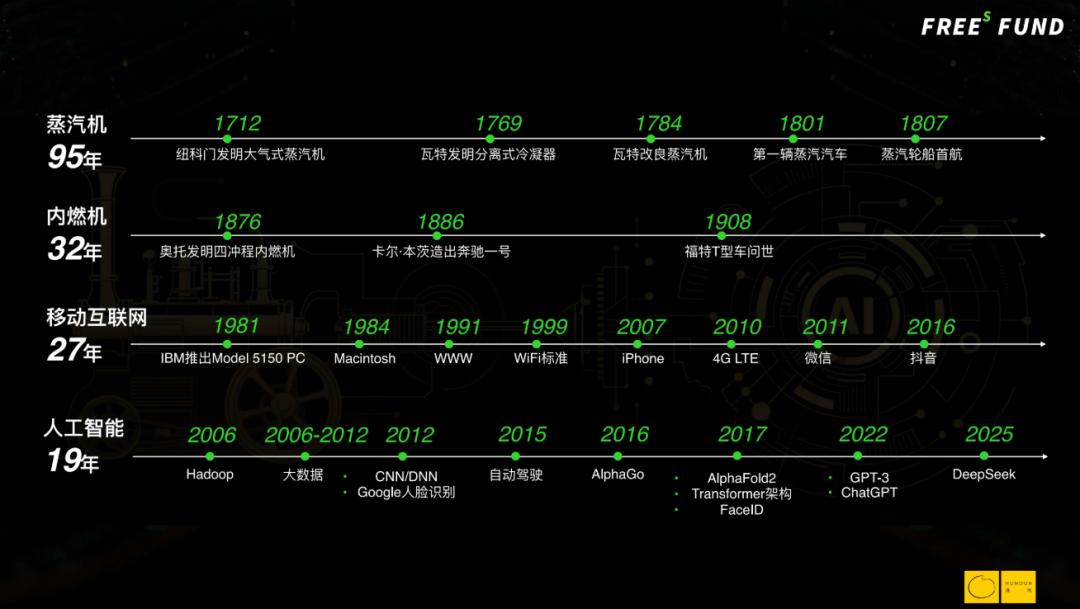
李丰:2026,关于赚钱、AI与竞争逻辑,我的展望和预判
混沌学园· 2026-01-28 12:24
Group 1 - The core viewpoint is that the technological explosion of recent years is just the prologue, with true societal applications and industrial reshuffling beginning now, presenting new opportunities and dividends for the next 5 to 20 years [1][2] - The second half of the AI era will see China gaining advantages, particularly in the combination of AI and hardware, leveraging its manufacturing supply chain for industrial transformation and upgrades [1][2] - The ultimate competition in AI between China and the US will focus on data and energy, with the long-term advantage in these areas determining the outcome of great power competition [1][2] Group 2 - The discussion centers on whether AI represents a productivity revolution, with the importance of participation in AI depending on this belief [2][3] - Historical productivity revolutions have taken time to transition from technological emergence to significant societal impact, indicating that AI will also require a lengthy evolution [3][4] - The current AI wave is unprecedented due to the massive influx of capital, with a significant amount of liquidity in the market driving investment into AI technologies [12][23] Group 3 - The AI evolution has experienced four major waves, with significant breakthroughs leading to applications in facial recognition, autonomous driving, and AI in pharmaceuticals, particularly accelerated by the pandemic [8][10] - The current investment landscape is shifting towards applications that can generate revenue, moving from a focus on technology to practical implementations in various sectors [28][39] - The investment logic in the AI era emphasizes the need for substantial changes across front-end, mid-end, and back-end technologies to create successful companies [46][47] Group 4 - China's strategic opportunity lies in the integration of AI with strong industrial sectors, particularly through the "AI + manufacturing" initiative, which aims to leverage AI for various applications [57][60] - The development of AI applications in China is supported by advancements in hardware and supply chain efficiencies, allowing for competitive pricing and widespread adoption [60][62] - The future of AI applications will focus on vertical domain agents and AI-driven smart hardware, with a clear shift towards practical, revenue-generating solutions [51][39] Group 5 - The international relations landscape is shifting, potentially providing China with a strategic window to enhance its global influence and international business opportunities [74][76] - The RMB is expected to have appreciation potential but not significantly, as the structure of China's foreign trade is evolving towards higher value-added products [79][81] - Data governance is becoming a critical factor in the tech competition between China and the US, with the establishment of a national data bureau indicating a new phase in data management and utilization [90][92]

机器人概念表现分化 卧安机器人(06600)升近19% 机构料今年人形机器人将迎\"0-1\"兑现关键期
Xin Lang Cai Jing· 2026-01-28 10:13
Group 1 - The performance of the robotics sector is mixed, with companies like Woan Robotics (06600) rising by 18.71%, Gangzi Robotics (00370) by 4.44%, and Ubtech (09880) by 2.34%, while others like Yunji (02670) fell by 3.17% and Micron Robotics (02252) by 1.62% [1][2] - Tencent's Senior Executive Vice President, Tang Daosheng, stated that Chinese robotics companies deserve higher valuations in the capital market, emphasizing that the competitive environment forces companies to accelerate technology iteration and application, which has not been fully priced by the market [1][2] - Guojin Securities highlighted that 2026 is a crucial year for humanoid robots, with Tesla's supply chain expected to launch its first mass-produced product in Q1 2026, and large-scale production lines to be completed in H1 2026, leading to a significant increase in domestic shipments from thousands to tens of thousands [1][2]

解码深圳南山区万亿GDP背后的发展含“金”量
Nan Fang Du Shi Bao· 2026-01-28 05:34
Economic Growth - In 2025, Nanshan District successfully entered the trillion GDP club, becoming the first district in China to achieve this milestone with a GDP exceeding 1 trillion yuan, growing from 652.7 billion yuan at the end of the 13th Five-Year Plan, representing an average annual growth rate of over 5.8% [1] - Nanshan's GDP is expected to exceed 1 trillion yuan with a growth rate of over 6% in 2025, driven by strong performance in investment, consumption, and foreign trade [3] Industrial Development - The industrial output value of Nanshan has surpassed 900 billion yuan, with the highest growth rate and contribution to the city's economy [3] - Nanshan has over 200 listed companies and has nurtured more than 6,000 national high-tech enterprises, 36 manufacturing champions, and 394 specialized and innovative "little giant" enterprises [3] Technological Innovation - Nanshan has over 1,300 AI enterprises, contributing approximately 60% to the city's AI industry value, and has established a complete industrial chain for intelligent robots [4] - The district's low-altitude economy has reached a scale of over 80 billion yuan, with significant advancements in drone delivery services [5] Environmental Sustainability - Nanshan has developed a green infrastructure with over 60 kilometers of greenway networks and 197 parks, promoting a harmonious coexistence between nature and urban development [8] - The air quality in Nanshan has consistently maintained an excellent rate of over 90%, with PM2.5 levels better than the EU's second-stage standards [10] Social Welfare - Nanshan has made significant investments in education, adding approximately 5,000 new compulsory education seats and 500 preschool seats, enhancing educational quality [11] - The district has provided over 150,000 job opportunities through various employment initiatives, supporting the local workforce [11]
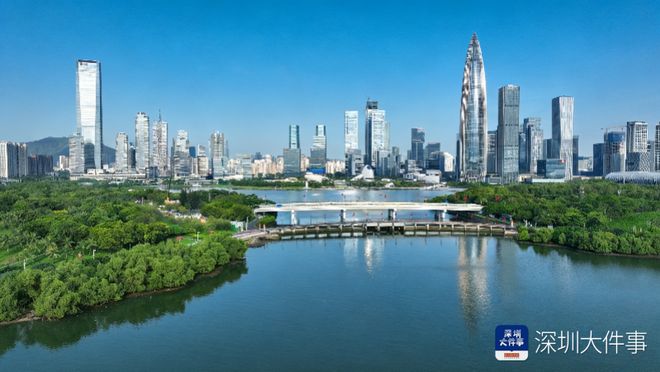
深圳南山,为什么能成为全国首个“万亿城区”?
Bei Jing Ri Bao Ke Hu Duan· 2026-01-28 05:31
地处深圳阳台山南部余脉和塘朗山之间的南山谷地,越疆科技、速腾聚创、优必选等机器人上市公司茁 壮成长,上百家机器人产业链企业持续集聚。 这里,是深圳知名的"机器人谷"。2026年初,记者在这片谷地看到,越来越多机器人正在走进工厂、步 入应用,迸发强劲"新质"动能。 财经聚焦|全国首个"万亿城区"诞生 深圳南山"为什么能"? 1月27日,深圳市南山区八届人大六次会议开幕。记者从会上获悉,2025年南山区成功迈入"万亿城 区"。南山区成为我国首个GDP过万亿元的地市辖区。 方寸之地,酝酿蓬勃动能。土地面积仅占深圳的1/10、经济总量却能占全市约1/4;战略性新兴产业增 加值占比达60%,上市公司超200家……南山,为什么能成为全国首个"万亿城区"?"大块头"如何持续 爆发"大能量"? 在新质生产力培育壮大中激发新动能 低空经济蓬勃发展,产业规模超800亿元;人工智能产业加力提速,集聚人工智能规上企业超1300家; 累计培育国家级高新技术企业超6000家、专精特新"小巨人"企业394家……南山区八届人大六次会议 上,政府工作报告中的一系列数据含"新"量十足,展示区域经济向"高"攀登的发展态势。 中国(深圳)综合开发研 ...
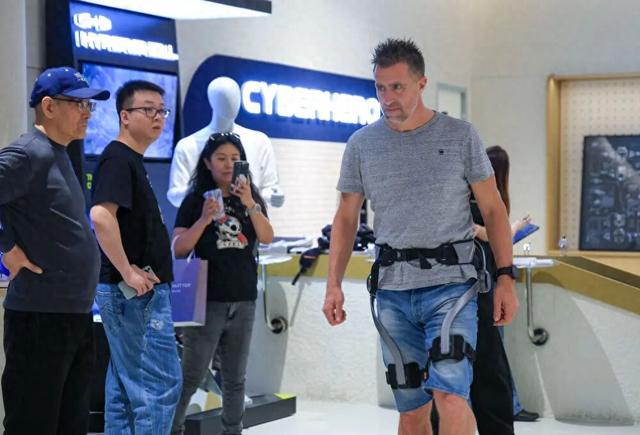
全国首个“万亿城区”诞生 深圳南山“为什么能”?
Xin Hua She· 2026-01-28 02:31
Group 1 - Nanshan District in Shenzhen is set to become the first district in China with a GDP exceeding 1 trillion yuan by 2025, contributing approximately 25% to Shenzhen's overall economy despite occupying only 10% of its land area [1] - The strategic emerging industries in Nanshan account for 60% of its economic output, with over 200 listed companies, showcasing its robust economic dynamism [1][2] - The software and internet industry in Nanshan is projected to generate over 900 billion yuan in revenue by 2025, reinforcing its competitive advantage in industrial clustering [2] Group 2 - The continuous optimization of the business environment is a key factor in Nanshan's development as a "trillion district," with local government initiatives supporting startups and innovation [3][4] - The number of business entities in Nanshan has grown from 530,000 in 2020 to over 600,000 by 2025, and the number of listed companies increased from approximately 180 to 218 during the same period [4] - Nanshan's government has implemented a "six-in-one" action plan to support entrepreneurs, providing comprehensive services to facilitate innovation and entrepreneurship [3] Group 3 - Nanshan is focusing on industrial upgrades and the development of smart, green, and healthy industries, with plans to enhance its hardware support through projects like the Honghuailing Industrial Park [6] - The establishment of a regional venture capital fund with a target size of 50.45 billion yuan aims to support the development of new productive forces in the Guangdong-Hong Kong-Macao Greater Bay Area [7] - Nanshan's foreign trade import and export volume exceeded 900 billion yuan in 2025, highlighting its role as a significant player in international trade [9]
新华每日电讯聚焦:解锁“万亿城区”,深圳南山“为什么能”?
Xin Lang Cai Jing· 2026-01-27 23:43
Core Insights - Nanshan District in Shenzhen is set to become the first district in China to achieve a GDP exceeding 1 trillion yuan by 2025, accounting for approximately 25% of Shenzhen's total economic output [1][2] - The district has a strong focus on strategic emerging industries, with 60% of its economic output coming from these sectors, particularly in robotics and technology [1][2] Economic Development - The robotics industry in Nanshan is a significant driver of economic growth, with companies like UBTECH Robotics achieving nearly 1.4 billion yuan in orders for humanoid robots by the end of 2025 [1][2] - Nanshan's software and internet industry is projected to generate over 900 billion yuan in revenue by 2025, reinforcing its position as a hub for technological innovation [2] - The district has over 1,300 artificial intelligence enterprises and has nurtured more than 6,000 national high-tech enterprises, showcasing its robust industrial ecosystem [2] Business Environment - Continuous optimization of the business environment is a key factor in Nanshan's success, with local government initiatives providing comprehensive support for startups and established companies alike [3][4] - The number of business entities in Nanshan has grown from 530,000 in 2020 to over 600,000 by 2025, with the number of listed companies increasing from approximately 180 to 218 [4] Infrastructure and Innovation - Nanshan is enhancing its industrial infrastructure through initiatives like "industrial stacking," which aims to maximize the use of limited industrial land [6] - The district is committed to advancing smart, green, and health-oriented industries, with a focus on integrating AI into various sectors [6] Investment and Trade - Nanshan's foreign trade is thriving, with total import and export volume exceeding 900 billion yuan in 2025 [9] - The establishment of a global service center in Nanshan aims to facilitate international business operations, providing essential services for companies looking to expand globally [9]

【新华解读】全国首个“万亿城区”诞生 深圳南山“为什么能”?
Xin Hua She· 2026-01-27 22:40
Core Insights - Nanshan District in Shenzhen is set to become the first district in China with a GDP exceeding 1 trillion yuan by 2025, accounting for approximately 25% of Shenzhen's total economic output [1][2] - The district has a strong focus on strategic emerging industries, with 60% of its economic output coming from these sectors, particularly in robotics and technology [1][2] - Nanshan's software and internet industry is projected to generate over 900 billion yuan in revenue by 2025, showcasing its competitive advantage in industrial clustering [2] Industry Development - Nanshan is home to over 200 listed companies and has established itself as a hub for robotics, with companies like UBTECH and others contributing to its reputation as "Robot Valley" [1][2] - The district has seen significant growth in its artificial intelligence sector, with over 1,300 AI enterprises and more than 6,000 national high-tech companies [2][3] - The local government has implemented a "six-in-one" action plan to support startups, enhancing the entrepreneurial ecosystem [3][4] Economic Environment - Nanshan's business environment has been continuously optimized, facilitating rapid responses to entrepreneurs' needs, which has led to an increase in the number of operating entities from 530,000 in 2020 to over 600,000 by 2025 [4] - The district's government has established a dedicated team to assist businesses, resulting in over 10,000 service interactions and 1,074 requests processed in 2025 [4] Future Outlook - Nanshan aims to achieve reasonable growth in quantity and effective improvement in quality by 2026, focusing on smart, green, and health-oriented industries [6] - The establishment of a regional venture capital fund with a target size of 50.45 billion yuan aims to support the development of new productive forces in the Guangdong-Hong Kong-Macao Greater Bay Area [7] - Nanshan's foreign trade is projected to exceed 900 billion yuan in 2025, with initiatives to enhance international business services [9]
财经聚焦|全国首个“万亿城区”诞生 深圳南山“为什么能”?
Xin Hua Wang· 2026-01-27 14:39
Core Viewpoint - Nanshan District in Shenzhen is set to become the first district in China to achieve a GDP exceeding 1 trillion yuan by 2025, showcasing its robust economic growth and innovation-driven development [1][3]. Economic Growth and Industry Development - Nanshan occupies only 1/10 of Shenzhen's land area but contributes approximately 1/4 of the city's total economic output, with strategic emerging industries accounting for 60% of its value-added output [1]. - The software and internet industry in Nanshan is projected to generate over 900 billion yuan in revenue by 2025, reinforcing its industrial clustering advantages [3]. - The district has seen significant growth in its robotics sector, with companies like UBTECH Robotics achieving nearly 1.4 billion yuan in orders for humanoid robots by the end of 2025 [1]. Innovation and Entrepreneurship - Nanshan's continuous optimization of the business environment is a key factor in its development as a "trillion-yuan district," with initiatives like the "Six Ones" action plan supporting startups [5]. - The number of operating entities in Nanshan increased from 530,000 in 2020 to over 600,000 by 2025, and the number of listed companies grew from approximately 180 to 218 [6]. Technological Advancements - The district is home to over 1,300 large-scale artificial intelligence enterprises and has cultivated more than 6,000 national high-tech enterprises [3]. - Nanshan is focusing on the integration of AI into various industries, promoting both "AI industrialization" and "industrial AI" to enhance productivity and innovation [8]. Investment and Global Trade - Nanshan's foreign trade volume exceeded 900 billion yuan in 2025, reflecting its strong position in international markets [11]. - The establishment of the Guangdong-Hong Kong-Macau Greater Bay Area Venture Capital Fund, with a target size of 50.45 billion yuan, aims to support the development of hard technology in the region [9].