
陕西煤业

Search documents
库存去化&寒潮来临,短期煤价有望平稳偏强 | 投研报告
Zhong Guo Neng Yuan Wang· 2026-02-03 09:50
信达证券近日发布煤炭开采行业周报:截至1月15日,沿海八省煤炭库存较上周下降58.30万吨,周环比 下降1.71%;日耗较上周下降10.00万吨/日,周环比下降4.39%;可用天数较上周下降0.50天。内陆十七 省:截至1月15日,内陆十七省煤炭库存较上周下降150.70万吨,周环比下降1.59%;日耗较上周上升 9.90万吨/日,周环比增加2.46%;可用天数较上周下降0.90天。 动力煤矿井产能利用率周环比增加,炼焦煤矿井产能利用率周环比增加。截至1月16日,样本动力煤矿 井产能利用率为90.6%,周环比增加0.3个百分点;样本炼焦煤矿井开工率为88.47%,周环比增加3.1个 百分点。 沿海八省日耗周环比下降,内陆十七省日耗周环比增加。沿海八省:截至1月15日,沿海八省煤炭库存 较上周下降58.30万吨,周环比下降1.71%;日耗较上周下降10.00万吨/日,周环比下降4.39%;可用天数 较上周下降0.50天。内陆十七省:截至1月15日,内陆十七省煤炭库存较上周下降150.70万吨,周环比下 降1.59%;日耗较上周上升9.90万吨/日,周环比增加2.46%;可用天数较上周下降0.90天。 化工耗煤周 ...
煤炭开采板块2月3日跌0.19%,昊华能源领跌,主力资金净流出4亿元
Zheng Xing Xing Ye Ri Bao· 2026-02-03 09:11
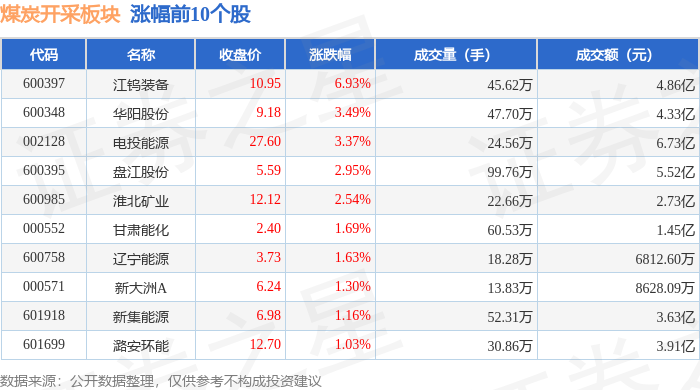
Group 1 - The coal mining sector experienced a decline of 0.19% on February 3, with Haohua Energy leading the drop [1] - The Shanghai Composite Index closed at 4067.74, up 1.29%, while the Shenzhen Component Index closed at 14127.1, up 2.19% [1] - Key stocks in the coal mining sector showed varied performance, with Jiangte Equipment rising by 6.93% and China Shenhua falling by 1.52% [2] Group 2 - The coal mining sector saw a net outflow of 400 million yuan from major funds, while retail investors contributed a net inflow of 301 million yuan [2] - Major funds showed a mixed trend, with Shaanxi Coal and Chemical Industries receiving a net inflow of 42.73 million yuan, while Jiangte Equipment faced a net outflow of 52.98 million yuan [3] - Retail investors favored stocks like SuNeng Co., which had a net inflow of 357.83 million yuan, despite overall sector challenges [3]





煤炭行业月报(2026年1月):25年供需整体宽松,26年开始有所改善-20260203
GF SECURITIES· 2026-02-03 06:31
Core Insights - The coal industry is expected to see an improvement in supply-demand dynamics starting in 2026 after a generally loose supply in 2025 [1] Group 1: Coal Sector Review - The coal sector outperformed the market in January, with a cumulative increase of 8.3% year-to-date, surpassing the CSI 300 index by 6.7 percentage points [16] - The coal sector's price-to-earnings (PE) ratio is currently at 15.7 times, ranking 5th among all sectors, indicating a relatively high valuation [20][26] - The coal sector's price-to-book (PB) ratio stands at 1.51 times, also reflecting a historical high level [24] Group 2: Coal Market Overview - In December, electricity consumption remained flat year-on-year, while coal imports increased by approximately 12% [29] - Domestic coal prices in January showed stability, with power coal prices rising slightly by 2.1% or 14 RMB/ton compared to the end of December [29] - International coal prices saw a notable increase, with Newcastle's 6000 kcal thermal coal price rising by 3.8% to 110.1 USD/ton [45] Group 3: Domestic Demand and Supply - In 2025, domestic coal production increased by 1.2% year-on-year, while coal imports decreased by 9.6% [56] - The total coal production in 2025 reached 483.2 million tons, with significant contributions from Shanxi, Inner Mongolia, and Shaanxi [56] - The demand for electricity in 2025 grew by 5.0%, with the industrial sector showing varied growth rates [46] Group 4: Key Companies and Financial Analysis - Key companies in the coal sector include China Shenhua, Yanzhou Coal, and Shaanxi Coal, all rated as "Buy" with robust dividend policies [6][7] - Financial metrics for these companies indicate a favorable outlook, with expected earnings per share (EPS) growth and attractive valuation ratios [7]


能源化工成2026年稳增长支撑力量
Zhong Guo Hua Gong Bao· 2026-02-03 02:54
Group 1: Economic Growth Targets - Multiple provinces, including Shandong, Shaanxi, and Tianjin, have set economic growth targets for 2026, with a focus on the petrochemical industry as a key area of development [1][2][3] - Shandong aims for a 5% year-on-year increase in the added value of the petrochemical industry, with a target for high-end chemical revenue to account for approximately 60% of the sector [1] - Shaanxi plans to establish 12 trillion-level industrial chains and aims for strategic emerging industries to account for over 30% of its industrial output [2] Group 2: Key Projects and Initiatives - Shandong is advancing major projects such as Qilu Petrochemical and the Shandong Times New Energy Battery Base, with a focus on optimizing the petrochemical industry [1] - Shaanxi is developing fine chemicals and launching projects in clean energy and advanced materials, including the construction of hydrogen energy industry clusters [2] - Tianjin is focusing on green petrochemical projects and aims to establish a green chemical new materials base, with significant investments in technology innovation [3] Group 3: Industry Transformation and Sustainability - Shandong is promoting the transformation and upgrading of the petrochemical industry towards green and low-carbon development [1] - Shaanxi emphasizes the need for energy industry stability and the development of functional materials and biodegradable products [2] - Tianjin is committed to enhancing effective demand and improving project execution in the green chemical sector [3]
能源与制造领跑,防御与弹性并重,国企红利ETF(159515)盘中涨0.26%
Xin Lang Cai Jing· 2026-02-03 02:44
Group 1 - The core viewpoint of the articles emphasizes the performance of high-dividend sectors, particularly state-owned enterprises, in the current market environment, with a focus on the potential for structural shifts in investment strategies towards companies with stable dividends and growth potential [1][2]. - The China Securities State-Owned Enterprises Dividend Index has shown a positive trend, with notable increases in constituent stocks such as Cai Bai Co., Ltd. rising by 10.02% and Zhonglian Heavy Industry by 4.05% as of February 3, 2026 [1]. - The report from Huatai Securities indicates that the risk appetite in January continued to decline, but high-dividend sectors, especially in oil, coal, and steel, performed better than in December, suggesting a marginal recovery in the allocation value of high-dividend stocks [1]. Group 2 - Guojin Securities suggests that the dividend strategy for 2026 should focus on structural shifts, moving from historical dividend ratios to identifying companies with fundamental resilience and potential for increased future dividends [2]. - The resource and traditional manufacturing sectors are highlighted as having the broadest benefits from dividend strategies, driven by factors such as overseas AI investments, manufacturing recovery, and resource protectionism in emerging markets [2]. - The China Securities State-Owned Enterprises Dividend ETF closely tracks the China Securities State-Owned Enterprises Dividend Index, selecting 100 listed companies with high cash dividend yields and stable dividends, reflecting the overall performance of high-dividend securities among state-owned enterprises [2][3].
拥抱低波实物资源 看好煤炭估值修复
2026-02-03 02:05
Summary of Conference Call on Coal Industry Industry Overview - The focus of the conference call was on the coal industry, particularly the recent trends in coal prices and inventory levels [1][2][5]. Key Points and Arguments 1. **Coal Price Trends**: - Coal prices have started to rise, with Qinhuangdao's 5500 kcal coal price increasing by 5 yuan from 691 to 696 yuan. High-calorie coal from Yulin saw a significant increase of over 20 yuan, nearly 4% [1][2]. - Despite the price increase, there remains a notable price inversion between pit and port prices, with Shanxi coal prices around 750 yuan and Inner Mongolia near 800 yuan, compared to port prices below 700 yuan [2]. 2. **Inventory Levels**: - There has been a significant decrease in coal inventory, with Qinhuangdao's inventory down by 2% and the overall inventory at nine northern ports down by 7%, reaching levels lower than in 2023 and 2025 [2][5]. - The current inventory levels indicate a strong correlation with supply and demand dynamics, suggesting a potential for continued price stability [3][5]. 3. **Market Dynamics**: - The market is currently in the latter half of the peak season, with traders expected to remain active in shipping despite the price inversion, anticipating further price increases [2][3]. - The expectation is for minor fluctuations in coal prices, potentially reaching 700-750 yuan, but significant price surges are not anticipated [3]. 4. **International Market Influences**: - International coal prices are also on the rise, with Australian and Indonesian coal prices increasing by approximately 1%. The Australian price is around 705 yuan, while Indonesian coal is priced above 720 yuan [6]. - Indonesia is expected to reduce its coal export quotas significantly, from 790 million tons last year to an anticipated 600 million tons, raising concerns about supply constraints [6][7]. 5. **Government Policies**: - The Indonesian government is implementing policies to control coal prices and maintain tax revenues, which may lead to reduced production and tighter supply [7][9]. - Domestic policies in China are also focused on stabilizing coal supply, with no significant increases in production expected during the 15th Five-Year Plan period [19][20]. 6. **Investment Opportunities**: - The coal sector is viewed as a stable investment option amidst market volatility, with companies like Yancoal and China Shenhua being highlighted for their dividend yields and resilience [22][23]. - The focus is on selecting companies that offer both safety and growth potential, particularly those with strong fundamentals and dividend policies [23][24]. 7. **Future Outlook**: - The overall sentiment is cautiously optimistic, with expectations for a gradual recovery in coal prices and continued interest from investors seeking stable assets [26]. - The coal market is expected to remain tight, with both domestic and international factors contributing to a favorable outlook for coal investments in the near term [26]. Additional Important Content - The call emphasized the importance of coal as a stable asset class in a volatile market, with a focus on the need for investors to seek out reliable investment opportunities [14][22]. - The discussion included insights into the broader energy market, noting the impact of rising oil and gas prices on coal demand and pricing dynamics [11][15]. This summary encapsulates the key insights and discussions from the conference call regarding the coal industry, highlighting price trends, inventory levels, market dynamics, and investment opportunities.


煤炭开采板块2月2日跌5.3%,大有能源领跌,主力资金净流出6.1亿元
Zheng Xing Xing Ye Ri Bao· 2026-02-02 09:22
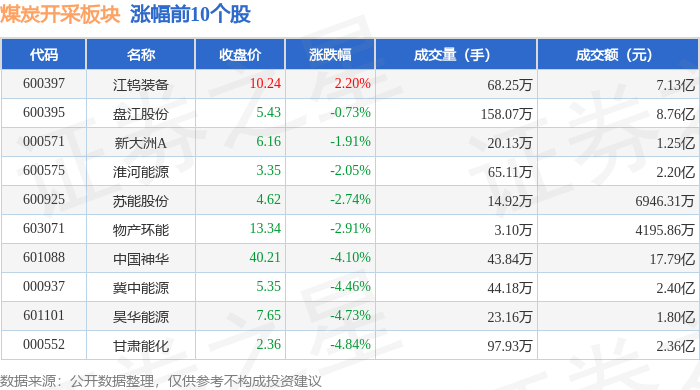
证券之星消息,2月2日煤炭开采板块较上一交易日下跌5.3%,大有能源领跌。当日上证指数报收于 4015.75,下跌2.48%。深证成指报收于13824.35,下跌2.69%。煤炭开采板块个股涨跌见下表: | 代码 | 名称 | 收盘价 | 涨跌幅 | 成交量(手) | 成交额(元) | | | --- | --- | --- | --- | --- | --- | --- | | 600397 | 江铝装备 | 10.24 | 2.20% | 68.25万 | | 7.13亿 | | 600395 | 盘江股份 | 5.43 | -0.73% | 158.07万 | | 8.76亿 | | 000571 | 新大洲A | 6.16 | -1.91% | 20.13万 | | 1.25亿 | | 600575 | 淮河能源 | 3.35 | -2.05% | 65.11万 | | 2.20亿 | | 600925 | 赤能股份 | 4.62 | -2.74% | 14.92万 | | 6946.31万 | | 603071 | 物产环能 | 13.34 | -2.91% | 3.10万 | 4195.86万 | ...

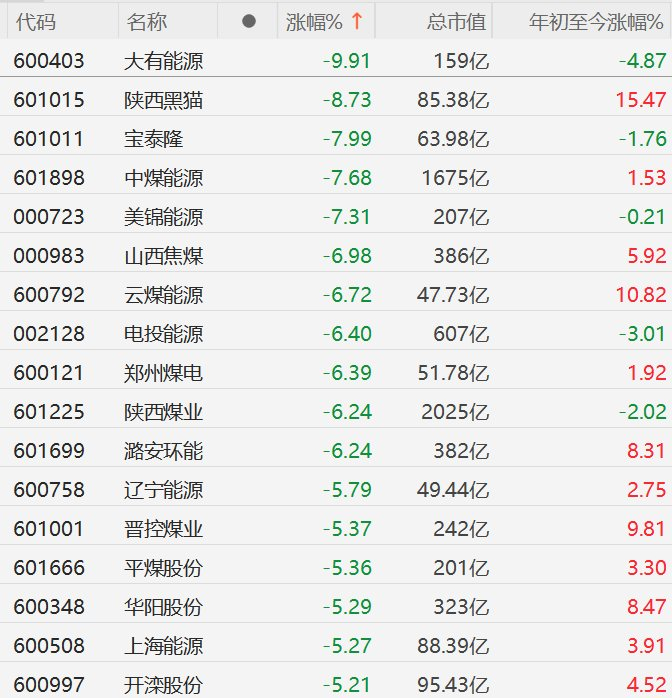
A股煤炭股集体下挫,大有能源触及跌停,陕西黑猫跌超8%
Ge Long Hui A P P· 2026-02-02 05:55
Group 1 - The coal stocks in the A-share market experienced a collective decline, with Daya Energy hitting the daily limit down and Shaanxi Black Cat dropping over 8% [1] - Other companies such as Baotailong, China Coal Energy, and Meijin Energy fell more than 7%, while Shanxi Coking Coal, Yunmei Energy, and several others dropped over 6% [1] - The overall trend indicates a significant downturn in the coal sector, affecting multiple companies with varying degrees of decline [1] Group 2 - Daya Energy saw a decrease of 9.91% with a total market value of 15.9 billion [2] - Shaanxi Black Cat declined by 8.73%, holding a market capitalization of 8.538 billion [2] - Baotailong's stock fell by 7.99%, with a market value of 6.398 billion [2] - China Coal Energy dropped by 7.68%, with a market capitalization of 167.5 billion [2] - Meijin Energy decreased by 7.31%, valued at 20.7 billion [2] - Shanxi Coking Coal fell by 6.98%, with a market value of 38.6 billion [2] - Yunmei Energy declined by 6.72%, holding a market capitalization of 4.773 billion [2] - Other companies such as Electric Power Investment Energy, Zhengzhou Coal Electricity, and Shaanxi Coal Industry also reported declines ranging from 5.21% to 6.40% [2]


能源ETF广发(159945)开盘跌5.00%,重仓股中国神华跌0.67%,中国石油跌2.90%
Xin Lang Cai Jing· 2026-02-02 04:18
Group 1 - The Energy ETF Guangfa (159945) opened down 5.00%, trading at 1.253 yuan [1] - Major holdings in the Energy ETF Guangfa include China Shenhua down 0.67%, China Petroleum down 2.90%, China Petrochemical down 1.69%, Shaanxi Coal and Chemical down 1.66%, China National Offshore Oil down 4.70%, and others showing varied performance [1] - The performance benchmark for the Energy ETF Guangfa is the CSI All Share Energy Index, managed by Guangfa Fund Management Co., with a return of 31.88% since its inception on June 25, 2015, and a return of 11.60% over the past month [1]


陕西省政府工作报告全文出炉:确保西康、西十高铁等建成投运
Sou Hu Cai Jing· 2026-02-02 04:02
推进延安千万吨炼化一体化、榆能百万吨煤制芳烃等项目,力争工业投资增长10%。 加快延榆、康渝高铁建设,确保西康、西十高铁、西安东站和府谷、定边机场建成投运。 开工周至至乾县、改扩建西安至永寿等高速公路,力争延安东绕城、洛卢高速公路建成通车。 【大河财立方消息】2月2日,2026年陕西省政府工作报告全文出炉。 经济社会发展的主要预期目标是:生产总值增长5%左右,固定资产投资增速保持在全国平均水平以 上,一般公共预算收入增长3%,居民收入增速高于经济增速、高于全国平均水平,城镇新增就业40万 人以上,城镇调查失业率5.5%左右,居民消费价格涨幅2%左右,完成国家下达的粮食生产、单位生产 总值二氧化碳减排目标任务。 2026年重点工作: 实施省级重点项目640个、完成投资3500亿元以上。 推进古贤水利枢纽、蒋家窑则水库、引汉济渭二期、宝鸡峡灌区改造等项目建设。 力争新增规模以上企业1000家,千亿级产业链达到12条,工业增加值增长6.5%,工业中战略性新兴产 业占比30%以上。深化能源工业"稳控转",加快释放煤炭优质产能,力争黄蒿界等6处煤矿、产能1400 万吨/年建成试运转。 着力稳定油气产量,促进延长石油千万 ...