携程集团

Search documents
多家外资巨头看涨中国资产,A股能不能慢牛?什么叫动辄得咎
Sou Hu Cai Jing· 2025-08-18 11:09
Group 1 - The A-share market is experiencing a structural market rather than a healthy slow bull market, indicating that the current trend may revert to previous market conditions [1] - On August 18, A-shares saw significant gains, with the Shanghai Composite Index reaching a nearly 10-year high and the North Star 50 Index hitting an all-time high, with a trading volume of 2.76 trillion yuan, marking a new annual record [3] - Citic Securities noted that global liquidity easing, phased tariff reductions, and performance catalysts are creating investment opportunities in the Asian market, particularly benefiting the semiconductor industry amid AI competition and domestic substitution [3] Group 2 - Michael Burry, known for predicting the 2008 housing crisis, has shifted his stance on Chinese stocks, selling put options on major companies like Alibaba and JD.com while buying call options, indicating a bullish outlook [10] - Several foreign investment giants have expressed optimism about Chinese assets, with Goldman Sachs reporting increased interest from global investors in the Chinese stock market, highlighting three core competitive advantages of Chinese assets [11] - The advantages include a complete modern industrial system, increased R&D investment leading to brand premium, and significant long-term investments in core technology sectors, positioning China competitively in AI, semiconductors, and renewable energy [11]


航旅纵横,成不了12306
虎嗅APP· 2025-08-18 09:47
Core Viewpoint - The article discusses the launch of the "official direct sales platform" by Hanglv Zongheng, which integrates resources from 38 airlines to sell tickets directly, aiming for transparency and eliminating hidden fees, but faces skepticism regarding its pricing strategy and potential competition with existing OTA platforms [5][6][16]. Group 1: Launch and Support - Hanglv Zongheng announced the integration of 38 airlines to create a direct sales platform for tickets, promising "0 markup, 0 bundling, 0 tricks" [6]. - Major airlines like Air China, China Southern Airlines, and China Eastern Airlines have expressed support for this initiative, positioning it as a significant direct sales channel [16][17]. - The platform is compared to "the civil aviation version of 12306," indicating its official backing and potential to reshape the ticketing landscape [6][8]. Group 2: Pricing and Market Position - Despite the promise of "source tickets," prices on Hanglv Zongheng are often higher than those on OTA platforms like Ctrip, with differences ranging from 50 to 100 yuan for certain routes [8][10]. - The pricing structure in the airline industry is complex, with airlines setting base fares influenced by various factors, and the final price often includes additional fees from OTAs or agents [10][12]. - Hanglv Zongheng's "source tickets" are not necessarily cheaper, as the platform aims to build trust through transparency rather than competing solely on price [12][14]. Group 3: Industry Dynamics - The relationship between airlines and OTAs has been historically contentious, with airlines seeking to reduce dependency on OTAs and increase direct sales [19][22]. - The introduction of Hanglv Zongheng is seen as a strategic move to balance the power dynamics between airlines and OTAs, allowing airlines to gain more control over pricing and distribution [22][23]. - The push for direct sales is further supported by regulatory changes aimed at increasing the proportion of direct sales by airlines [20][21]. Group 4: Challenges and Future Outlook - Hanglv Zongheng faces significant challenges in competing with established OTAs, particularly in user experience, customer service, and comprehensive travel solutions [26][27]. - The platform's ability to attract price-sensitive customers may be limited, as many users prioritize price over transparency, making it difficult to disrupt the existing OTA market [29][30]. - While Hanglv Zongheng may capture a niche market of users seeking transparency, it is unlikely to significantly alter the competitive landscape in the short term [30].

“五星级服务”豪宅,会抢走酒店生意吗?
Xin Lang Cai Jing· 2025-08-18 06:25
Core Insights - The emergence of branded residential properties, such as W Residences Singapore Marina View, combines luxury hotel services with high-end living, catering to affluent individuals seeking both comfort and exclusivity [1][2] - The trend of "residential hotelization" has become prevalent, with many high-end residential projects emphasizing five-star hotel services as a key selling point [2][3] - The evolution of hotel-branded residences can be categorized into three phases, with the current phase (3.0) focusing on shared spaces and integrated services [3][4] Market Trends - The integration of hotel services into residential properties has become a common practice, with developers responding to changing consumer demands for luxury and personalized services [2][5] - High-end residential properties are increasingly adopting hotel-like amenities and services, leading to a redefined competitive landscape in the luxury real estate market [2][5] - The demand for branded residences is driven by the desire for a unique lifestyle experience, where buyers are not just purchasing property but also a brand identity [5][9] Consumer Preferences - Affluent buyers are drawn to hotel-branded residences for their combination of privacy, luxury, and high-quality service, which traditional high-end apartments may lack [5][6] - The value of branded residences extends beyond physical space, as they offer networking opportunities and access to exclusive services, making them attractive to high-net-worth individuals [9][10] - The rise of luxury brands entering the residential market reflects a shift in consumer preferences towards personalized and high-end living experiences [10][11] Developer Strategies - Developers leverage hotel brands to enhance property value and attract affluent buyers, with brand scarcity becoming a critical factor in high-end real estate [8][9] - The collaboration between developers and hotel brands creates a symbiotic relationship, where both parties benefit from shared resources and customer data [7][8] - The business model for hotel-branded residences often involves lower capital investment for hotel brands, allowing for flexible expansion into the luxury residential market [7][14] Future Outlook - The boundaries between hotels and residential properties are increasingly blurring, with both sectors adapting to meet evolving consumer demands for comfort and luxury [11][12] - The trend of integrating hotel services into residential living is expected to continue, as high-net-worth individuals seek unique living environments that offer both privacy and luxury [11][15] - The future of hotel-branded residences will likely involve further innovation in service delivery and property management, enhancing the overall living experience for residents [15]

安徽财贸学院教授葛晓滨:平台经济“反内卷”的核心在于重构竞争逻辑
Sou Hu Cai Jing· 2025-08-18 03:37
Core Viewpoint - The platform economy is currently trapped in a "low-price competition" and "subsidy war," necessitating urgent solutions to break this cycle and promote healthy development [1][22]. Group 1: Current Situation of Platform Economy - The platform economy is experiencing systemic characteristics of "involution," with low-price subsidies leading to a cycle of "low price - low quality - further price reduction," degrading both product quality and pricing [11]. - Non-market methods such as "choose one from two," exclusive rebates, and forced traffic allocation are increasing costs for merchants and squeezing their survival space [11]. - Algorithmic recommendations and punitive mechanisms are transferring competitive pressure down the supply chain, exerting hidden pressure on small market players [11]. Group 2: Deep-rooted Causes - The market structure is imbalanced, with high concentration among leading platforms forcing smaller players into subsidy competitions, resulting in unhealthy competition [12]. - Capital logic dominates, with financing agreements emphasizing GMV as a core indicator, leading to short-term behaviors that suppress long-term value cultivation [12]. - There is a lack of innovation momentum, with limited competitive methods restricted to price wars and traffic battles, hindering sustainable competitiveness [12]. - Regulatory frameworks addressing emerging issues like algorithm pricing and data blocking are still underdeveloped, lacking a complete constraint mechanism [12]. Group 3: Core Contradictions - The fundamental conflict lies between "maximizing short-term traffic" and "sustaining long-term ecological viability," manifesting in several ways: - Homogeneous competition suppresses innovation incentives [13]. - The pursuit of capital profit conflicts with market fairness [13]. - Consumer preferences for short-term low prices clash with long-term quality rights [13]. - The need for global value chain competition contradicts domestic inefficient involution [13]. Group 4: Negative Impacts of Involution - On the platform level, profitability is weakened, with cash flow heavily reliant on external financing, reducing risk resistance [14]. - The industry faces compressed profit margins, with innovation investments yielding to marketing expenses, slowing technological iteration [15]. - Nationally, resource allocation issues arise as production factors tilt towards subsidies and traffic purchases, with insufficient investment in R&D and manufacturing upgrades [16]. Group 5: Transition Strategies - Transitioning from "traffic involution" to "value creation" involves: - Upgrading from "consumer algorithms" to "industry algorithms" to optimize capacity forecasting and inventory management, reducing operational costs [17]. - Shifting evaluation metrics from GMV to Total Value to Ecosystem (TVE), incorporating user retention, merchant profitability, and worker rights into a comprehensive evaluation system [18]. - The core of "anti-involution" in the platform economy is to reconstruct competitive logic, focusing on "value innovation" rather than "traffic arbitrage" [18].

智通港股沽空统计|8月18日
智通财经网· 2025-08-18 00:27
Core Insights - The article highlights the top short-selling stocks in the market, focusing on their short-selling ratios, amounts, and deviation values [1][2][3] Short-Selling Ratios - The top three stocks by short-selling ratio are: - China Resources Beer-R (80291) at 100.00% - Bank of China Hong Kong-R (82388) at 88.69% - Kuaishou-WR (81024) at 80.08% [1][2] Short-Selling Amounts - The leading stocks by short-selling amount are: - Alibaba-SW (09988) with a short-selling amount of 2.949 billion - Tencent Holdings (00700) with 2.711 billion - Meituan-W (03690) with 2.333 billion [1][3] Deviation Values - The stocks with the highest deviation values are: - China Resources Beer-R (80291) at 51.62% - Kuaishou-WR (81024) at 43.86% - Bank of China Hong Kong-R (82388) at 39.84% [1][2][3]




2025中国文旅博览会9月在武汉开幕 2000余家展商参展覆盖全产业链
Chang Jiang Shang Bao· 2025-08-18 00:05
Core Viewpoint - The 2025 China Cultural Tourism Industry Expo aims to enhance the integration of culture and tourism, showcasing technological advancements and innovative experiences in the industry [1][2]. Group 1: Event Overview - The expo will take place from September 12 to 14, 2025, at the Wuhan International Expo Center, covering an exhibition area of 100,000 square meters [1]. - The theme of the expo is "Deepening Cultural and Tourism Integration, Enjoying a Better Life," featuring over 2,000 exhibitors from 27 provinces and major companies like China Telecom, Ant Group, Tencent Games, and Ctrip [1][2]. Group 2: Technological Integration - The expo will highlight the latest applications in digital clusters, immersive experiences, low-altitude tourism, and smart navigation, showcasing the deep integration of culture and tourism with AI, big data, and digital technologies [2]. - A special feature will include a robot intelligence recommendation officer to provide interactive experiences for visitors [2]. Group 3: Consumer Experience - The expo aims to create a vibrant consumer atmosphere with activities such as cultural performances, technology experiences, and food tastings, making it a festival for the public [3][4]. - Over 50 unique activities will be organized during the expo, including a cultural IP parade and international performances, enhancing the overall experience for attendees [4][5]. Group 4: Exhibitor Participation - The expo will feature a combination of indoor and outdoor exhibition areas, with 40,000 square meters dedicated to outdoor displays and 60,000 square meters for indoor showcases [4]. - More than 2,000 exhibitors will participate, including leading companies and over 300 industry leaders, facilitating numerous cooperation projects [4][6]. Group 5: Additional Activities - To further enhance the expo's impact, Wuhan will launch a series of activities during the National Day and Mid-Autumn Festival, including parades and performances to create a festive atmosphere [6].
携程发布“智旅未来”计划 助酒店降低流量焦虑
Mei Ri Shang Bao· 2025-08-17 22:18
Core Insights - The Chinese hotel industry is experiencing intensified competition with a projected total of 348,700 establishments and 17.64 million rooms by the end of 2024, surpassing the peak levels of 2018-2019 [1] - Ctrip's "Smart Travel Future" hotel empowerment plan aims to address challenges in language, technology, and traffic, focusing on enhancing service quality to achieve sustainable growth [1] Group 1: Industry Overview - The hotel industry in China is facing increasing competition due to a growing number of establishments and rooms, indicating a saturated market [1] - User decision-making is becoming more rational and diverse, posing challenges for hotels to maintain sustainable growth [1] Group 2: Ctrip's Strategy - Ctrip plans to optimize its review ecosystem to alleviate hotels' traffic concerns, enhancing trust through improved review descriptions and selection mechanisms [1] - The company aims to shift the industry focus from "traffic competition" to "service excellence" by encouraging hotels to prioritize service quality [1] Group 3: User Experience Enhancements - Ctrip is implementing features like intelligent room upgrade recommendations and a "stay first, pay later" payment option to boost user confidence and conversion rates [2] - Personalized recommendations and streamlined filtering options are being introduced to help users quickly find suitable hotels, significantly improving conversion rates for family-oriented packages [2] Group 4: Future Directions - Ctrip intends to continue developing the "Smart Travel Future" plan, collaborating with hotels to overcome challenges in language and technology, aiming for high-quality and sustainable growth [2]
陆家嘴财经早餐2025年8月17日星期日
Wind万得· 2025-08-16 22:33
Group 1 - The U.S. and Russia are working towards agreements that could resolve the Ukraine conflict and improve bilateral relations, with significant business investment potential identified [3] - Ukraine's President emphasized the necessity of including Ukraine in discussions regarding critical issues, particularly territorial matters [3] Group 2 - The State-owned Assets Supervision and Administration Commission (SASAC) is implementing a comprehensive regulatory system aimed at enhancing oversight of state-owned enterprises, driven by concerns over systemic risks and operational autonomy [4] - The current consumption shortfall in China is viewed as a structural issue, necessitating investment-driven policies to stimulate consumption and support economic growth [4] Group 3 - The Shanghai Composite Index has seen a rise, leading to increased interest in stock account openings, with new accounts reaching 1.9636 million in July, a 70.54% year-on-year increase [5] - Insurance funds are progressing in long-term investment trials, with the establishment of several private fund management companies, increasing the total to seven [5] - There is a notable shift in listed companies' funding strategies, with a decrease in wealth management product subscriptions and an increase in equity investments [5] Group 4 - Several high-performing funds have announced purchase limits to manage growth and optimize long-term performance [6] - The recent rise in A-shares has prompted a shift in deposits towards the stock market, benefiting brokerage firms [6] - China Shenhua has proposed an asset acquisition from its controlling shareholder, which will enhance its resource reserves and optimize its business layout [6] Group 5 - The China Securities Regulatory Commission has approved West Securities as a major shareholder of Guorong Securities, marking a significant step towards establishing a comprehensive investment banking platform [7] - An insider trading case involving Zhengdan Co. has resulted in significant penalties, highlighting regulatory scrutiny in the market [7] Group 6 - China has developed a comprehensive carbon reduction policy framework, with numerous strategic industry clusters and green factories established [8] - The first gold medal in the World Humanoid Robot Competition was awarded to a robot demonstrating advanced precision and stability [8] - Bank-affiliated insurance companies reported a 12.38% increase in insurance revenue in the first half of the year, reflecting a shift in the banking insurance channel [8] Group 7 - The transaction volume of auctioned properties in key cities has decreased, but the total transaction value has dropped significantly, indicating a potential market adjustment [9] - Railway construction investment reached 433 billion yuan in the first seven months, marking a 5.6% year-on-year increase [9] - The number of devices using the HarmonyOS has surpassed ten million, indicating a critical phase in its commercialization [9] Group 8 - China's coal consumption ratio is projected to decrease from 56.8% in 2020 to 53.2% by 2024, while non-fossil energy consumption is expected to rise [10] - Chinese innovative drugs now account for 38% of the global market, with a significant number of new drugs launched recently [10] Group 9 - The U.S. Treasury has ceased its new regulatory program aimed at cryptocurrency oversight, reflecting a trend towards relaxed regulation in the sector [11] - Gemini, a cryptocurrency exchange, reported significant revenue and losses in the first half of the year as it prepares for a potential IPO [11] Group 10 - Minsheng Bank will terminate its public fund distribution partnerships in response to new regulatory guidelines, indicating a shift in banking practices [12] - OpenAI is reportedly preparing to sell shares worth approximately $60 billion, with negotiations ongoing [12] Group 11 - The U.S. has expanded tariffs on steel and aluminum imports, affecting hundreds of products, which will take effect soon [13] - Tech giants have urged the U.S. Treasury to maintain current renewable energy subsidies, which are crucial for ongoing projects [13] - China has shifted its soybean procurement focus to South America, indicating a strategic adjustment in sourcing [13] Group 12 - Michael Burry has reversed his position on Chinese stocks, moving from bearish to bullish by purchasing call options on major companies [14] Group 13 - China's holdings of U.S. Treasury bonds increased slightly, marking a notable trend in international capital flows [15] - The People's Bank of China emphasizes quality over quantity in credit policy, focusing on structural improvements in the financial system [15] Group 14 - China's summer grain wheat purchases have exceeded 80 million tons, with government support stabilizing prices [16] Group 15 - The Bank of England is expected to maintain a cautious stance on interest rate cuts, reflecting resilience in the UK economy [17]
智通ADR统计 | 8月16日
智通财经网· 2025-08-15 23:53
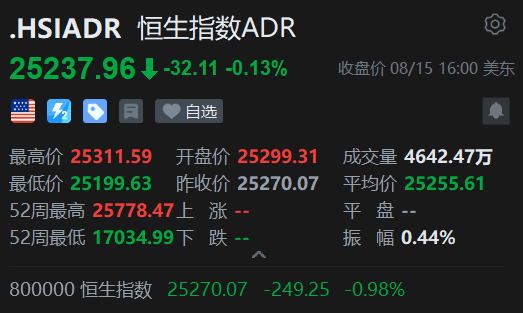
Market Overview - The Hang Seng Index (HSI) closed at 25,237.96, down by 32.11 points or 0.13% on August 15 [1] - The index reached a high of 25,311.59 and a low of 25,199.63 during the trading session [1] Major Blue-Chip Stocks Performance - HSBC Holdings closed at HKD 99.966, down 0.33% from the previous close [2] - Tencent Holdings closed at HKD 591.706, down 0.05% from the previous close [2] Stock Price Movements - Tencent Holdings (00700) increased by HKD 2.00, or 0.34%, to HKD 592.00 [3] - Alibaba Group (09988) decreased by HKD 3.70, or 3.04%, to HKD 118.10 [3] - China Construction Bank (00939) fell by HKD 0.18, or 2.26%, to HKD 7.80 [3] - HSBC Holdings (00005) decreased by HKD 0.10, or 0.10%, to HKD 100.30 [3] - Xiaomi Group (01810) dropped by HKD 0.35, or 0.66%, to HKD 52.85 [3] - AIA Group (01299) fell by HKD 1.95, or 2.54%, to HKD 74.95 [3] - Meituan (03690) decreased by HKD 2.70, or 2.17%, to HKD 121.70 [3] - NetEase (099999) dropped by HKD 7.60, or 3.66%, to HKD 200.20 [3] - Hong Kong Exchanges and Clearing (00388) increased by HKD 0.20, or 0.05%, to HKD 439.40 [3] - Industrial and Commercial Bank of China (01398) fell by HKD 0.19, or 3.09%, to HKD 5.96 [3] - Ping An Insurance (02318) decreased by HKD 0.30, or 0.52%, to HKD 57.60 [3] - BYD Company (01211) dropped by HKD 1.00, or 0.88%, to HKD 112.80 [3] - Bank of China (03988) fell by HKD 0.09, or 1.98%, to HKD 4.45 [3] - Kuaishou Technology (01024) decreased by HKD 0.40, or 0.53%, to HKD 74.80 [3] - Ctrip (09961) increased by HKD 1.80, or 0.37%, to HKD 489.00 [3] - Tencent Music (01698) decreased by HKD 0.90, or 0.89%, to HKD 99.90 [3] - BeiGene (06160) increased by HKD 6.50, or 3.51%, to HKD 191.50 [3]



在济南遇见文化中国 !“你好!中国”亚洲旅行商欢乐济南行
Sou Hu Cai Jing· 2025-08-15 17:51
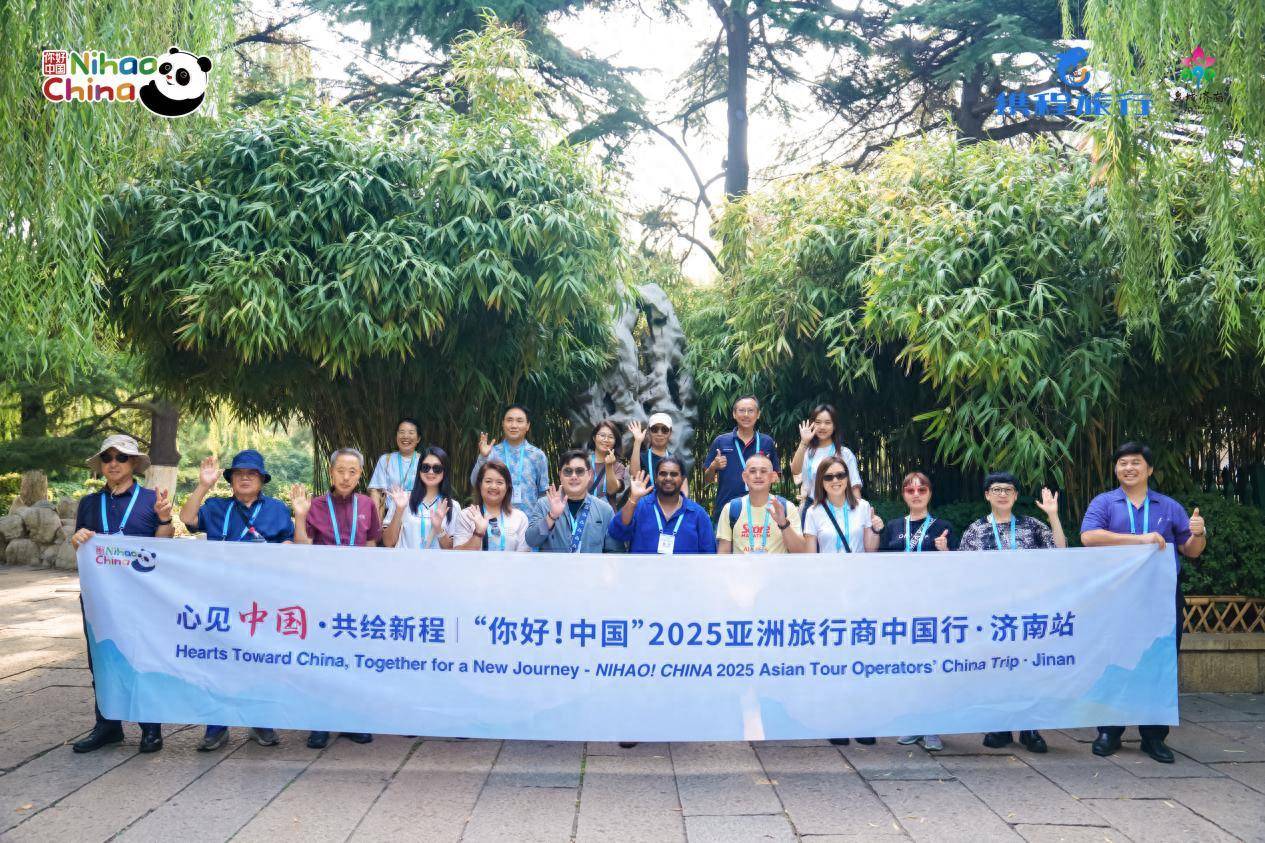
Group 1 - The "Hello! China" Asian Travel Agents event was launched on August 14, aimed at enhancing cooperation channels between Jinan and Asian travel agents, promoting inbound tourism development and international tourism destination construction in Jinan [1] - The event featured diverse thematic routes and various experiential activities to enrich the collaboration between Jinan and travel agents [1] - Travel agents from across Asia experienced Jinan's unique charm, particularly at the Baotu Spring scenic area, which is renowned for its clear water and historical cultural relics [3] Group 2 - Jinan is recognized as a historical and cultural city, with significant sites such as the Chengziya ruins, which are crucial for the study of Chinese civilization origins [5] - The event included visits to major exhibitions at the Shandong Provincial Museum, showcasing various cultural experiences and technological innovations [5] - The culinary highlight of the trip was the "Spring Water Feast," which features local ingredients and reflects the unique culinary culture of Jinan [9] Group 3 - The historical Mingfu City, with over 600 years of history, provided a picturesque setting for travel agents to experience traditional Jinan culture during a night tour [11] - The tour included visits to the Baihuazhou historical cultural district and the towering Chaoran Tower, allowing participants to appreciate the blend of history and modernity in Jinan's nightlife [11]