招商银行

Search documents
孩子存1000元比你存20万利息高?各大银行盯上了压岁钱
Xin Lang Cai Jing· 2026-02-19 06:34
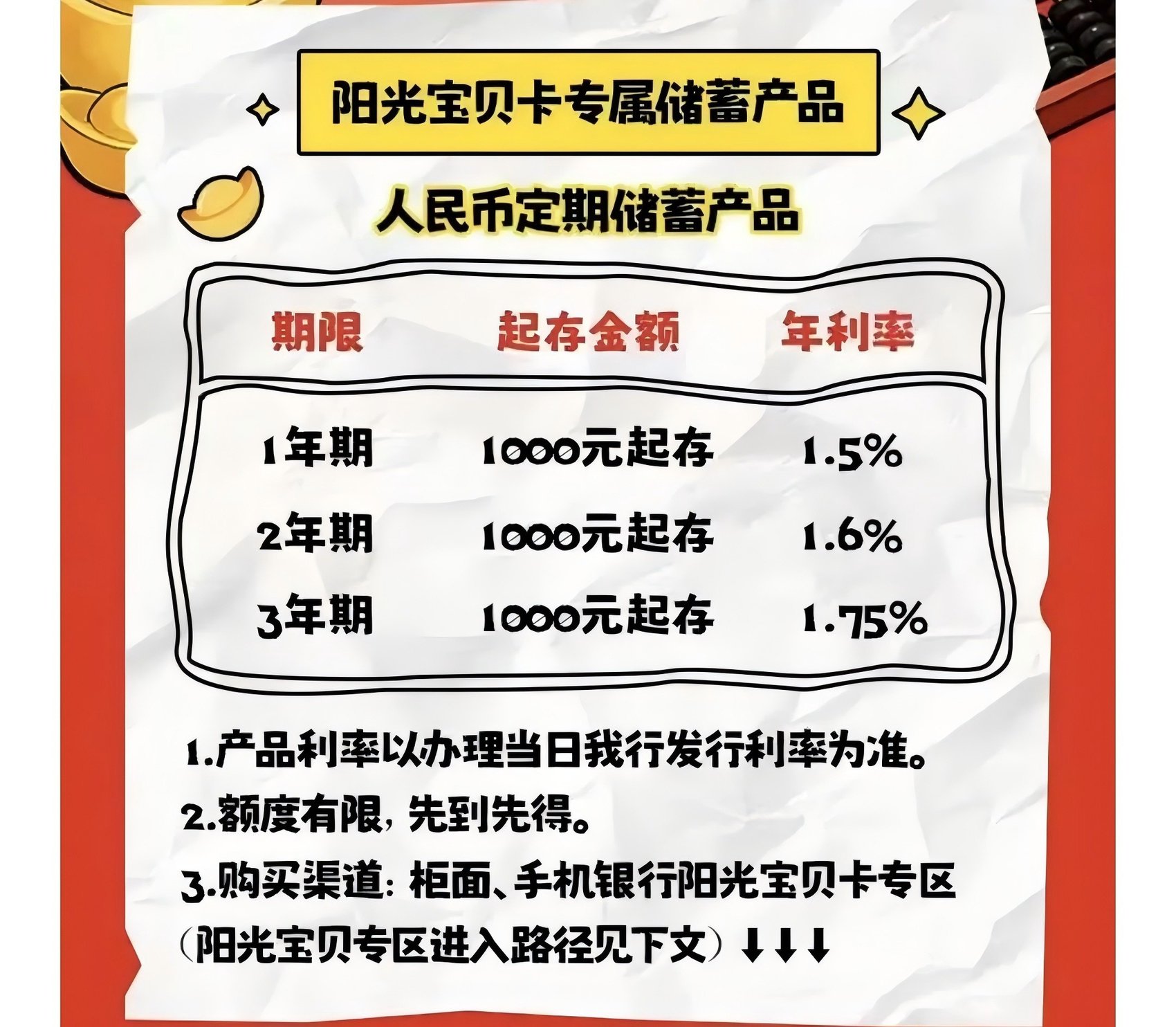
Group 1 - Parents are increasingly managing their children's New Year's money by depositing it into bank accounts, with some accumulating nearly 70,000 yuan over the years [1] - Banks are actively marketing special deposit products for New Year's money, with some offering higher interest rates than standard rates [1] - For example, Beijing Rural Commercial Bank offers a special savings product with interest rates of 1.5%, 1.6%, and 1.75% for different terms, compared to standard rates of 1.15%, 1.2%, and 1.3% [1] Group 2 - China Merchants Bank has launched a "2026 New Year's Money New Strategy" campaign, providing services to help parents manage their children's bank accounts [2] - The campaign includes a lottery for customers who open special accounts with a minimum asset requirement of 50,000 yuan [2] Group 3 - Guangfa Bank has introduced a "Freedom Card" for children, allowing parents to monitor spending and set limits through the bank's app [3] - Many parents are finding it difficult to find deposit products with interest rates above 2% due to declining market rates [3] Group 4 - Some parents are shifting from traditional deposit products to low-risk financial products with better returns, such as funds and insurance [4] - For instance, one parent has allocated a portion of their child's New Year's money to index funds, achieving a return of approximately 40% [4] Group 5 - Insurance products are becoming a popular choice for managing children's New Year's money, with parents seeking long-term benefits and stability [5] - Banks are also promoting non-deposit products, such as insurance and gold, as part of their marketing strategies for New Year's money [5]

省大数据局印发数智贵州建设2026年工作要点
Xin Lang Cai Jing· 2026-02-18 12:08
1.发展以智算为重点的算力产业。加快培育服务器、机架、电源设备等算力硬件制造产业。大力发展云 服务、云计算等算力运营服务产业,持续壮大云服务"首位产业"。培育数据中心运维、安全、算力适配 等算力配套产业。组织开展算力产业供需对接。集聚华为云生态企业累计达到150家。(责任单位:省大 数据局、省工业和信息化厅,各市〔州〕、贵安新区数据管理部门。除专门列出外,以下任务均涉及各 市〔州〕、贵安新区数据管理部门,不再重复) 2.发展以建设高质量数据集为重点的数据产业。加快推进博彦科技、东软等企业或项目落地见效,培育 壮大数据企业矩阵。支持企业开放数据标注需求,"一企一策"推动已建数据中心数据标注业务落地。积 极争创建设国家数据产业集聚区、数据标注试点。全省从事数据标注人员达到2万人以上。(责任单位: 省大数据局、贵州大数据集团) 3.发展以行业大模型应用为重点的人工智能产业。深入实施"人工智能+"行动,推进政务、广电等重点 领域人工智能应用,培育10个以上行业大模型应用标杆,打造100个以上人工智能典型应用场景。推动5 个生成式人工智能服务通过备案或登记。建设人工智能应用推广中心。用好省人工智能实验室,积极争 取人工 ...

孩子存1000元,比你存20万利息高!咋回事?
凤凰网财经· 2026-02-18 11:08
Core Viewpoint - The article discusses how banks are marketing specialized savings products for children's New Year's money, reflecting a trend towards financial education and long-term customer relationships with families [3][10]. Group 1: Bank Marketing Strategies - Many banks are launching marketing campaigns targeting children's New Year's money, offering specialized savings accounts and financial management tools for parents [5][8]. - For example, China Merchants Bank has introduced a service called "Golden Little Aster" that includes features for managing children's bank accounts and educational funds [5]. - Beijing Rural Commercial Bank offers a "Sunshine Baby Card" with higher interest rates than standard deposits, indicating a competitive approach to attract young savers [8]. Group 2: Investment Trends - As interest rates decline, parents are increasingly turning to investment products like wealth management and insurance instead of traditional savings accounts for managing their children's money [11][12]. - Some parents report difficulty finding savings products with interest rates above 2%, prompting a shift towards low-risk investment options that offer better returns [11]. - For instance, one parent mentioned investing in index funds, which have yielded returns of approximately 40% [11]. Group 3: Financial Education and Long-term Planning - Experts suggest that banks are focusing on children's financial products to cultivate long-term relationships with families and instill financial habits in children [10][17]. - The article emphasizes the importance of safety and long-term growth in managing children's savings, recommending options like stable wealth management products and educational insurance [17]. - Parents are encouraged to allocate some funds for children's personal spending to help develop their financial literacy [17].

智通AH统计|2月18日
智通财经网· 2026-02-18 08:20
Group 1 - The article highlights the top three companies with the highest AH premium rates: Northeast Electric (00042) at 785.25%, Beijing Jingcheng Machinery Electric (00187) at 291.45%, and Sinopec Oilfield Service (01033) at 284.04% [1] - The bottom three companies with the lowest AH premium rates are CATL (03750) at -16.62%, WuXi AppTec (02359) at -6.17%, and China Merchants Bank (03968) at -3.27% [1] - The article provides a detailed ranking of the top ten and bottom ten AH stocks based on their premium rates and deviation values, indicating significant disparities in market valuations between A-shares and H-shares [1][2] Group 2 - The top three companies with the highest deviation values are Beijing Jingcheng Machinery Electric (00187) at 23.16%, Dongjiang Environmental Protection (00895) at 18.78%, and Zhongzhou Securities (01375) at 16.54% [1] - Conversely, the companies with the lowest deviation values include Morning Paper (01812) at -52.60%, Junda Co., Ltd. (02865) at -34.18%, and Changfei Optical Fiber Cable (06869) at -34.18% [1][2] - The article emphasizes that the deviation value represents the difference between the current premium rate and the average premium rate over the past 30 days, providing insights into market trends [2]

年内近30家村镇银行注销解散
2 1 Shi Ji Jing Ji Bao Dao· 2026-02-18 08:02
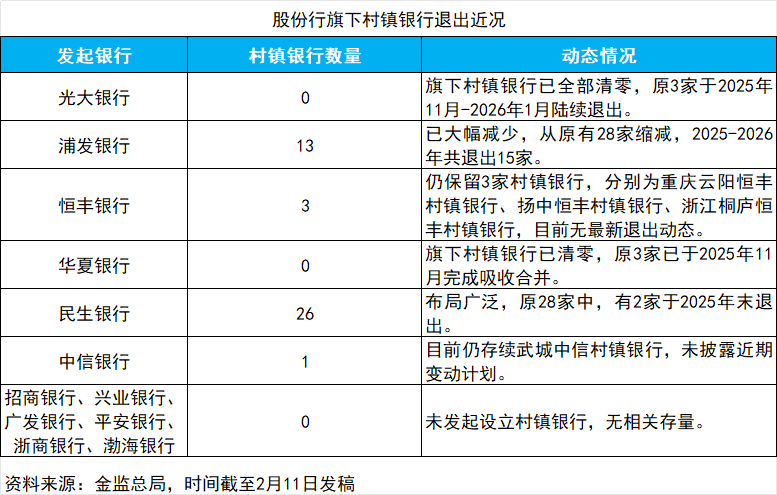
2026年开年,股份行整合与退出旗下村镇银行的步伐加快,"村改支"的行业浪潮已席卷股份制银行领域。 日前,21世纪经济报道记者注意到,截至今年1月底,光大银行(601818)在三个月内迅速完成了旗下三家村 镇银行的退出,实现了存量机构的全面"清零"。与此同时,浦发银行(600000)也正以"村改支"模式密集推进 整合,仅在2月5日、6日就接连有旗下两家村镇银行退出,成为近期股份行中退出动作最为频繁的机构。 专业人士指出,这一系列退出行动属于"主动申请+合规审批"的良性模式。早在2025年10月,湖南、江苏两地 金融监管部门就已批复同意两家机构解散,并明确主发起行光大银行承继所有权利义务,同时要求机构在批复 后15个工作日内缴回金融许可证。这一环节明确了"主发起行兜底"的核心原则,为后续的人员安置与资产交割 奠定了坚实基础。 值得注意的是,尽管上述三家村镇银行在2024年全部实现盈利,但其2025年的业绩却出现了分化。比如,光大 银行2025年半年报显示,截至2025年6月末,韶山光大村镇银行总资产为8.32亿元,净资产为2.46亿元,但上半 年亏损116.88万元。 股份行整合路径分化 浦发银行退出步伐最快 ...


年内近30家村镇银行注销解散
21世纪经济报道· 2026-02-18 07:53
Core Viewpoint - The article highlights the accelerated pace of integration and exit of village banks by joint-stock banks, marking a shift from rapid expansion to a focus on high-quality development in the industry [1][6]. Group 1: Recent Developments in Village Bank Exits - As of the end of January 2026, Everbright Bank has completed the exit of its three village banks, achieving a total "zero" status for its village banking operations [1][3]. - Shanghai Pudong Development Bank (SPDB) is also actively pursuing the "village to branch" model, with two of its village banks exiting in early February 2026, making it one of the most active banks in this regard [1][5]. - Nearly 30 village banks have been deregistered since the beginning of 2026, significantly higher than the same period last year [1][6]. Group 2: Integration and Exit Strategies - The exit actions by Everbright Bank are characterized as a "proactive application + compliance approval" model, with the bank inheriting all rights and obligations of the exited banks [3][4]. - The trend indicates a shift towards a more specialized and high-quality development phase for village banks, as the government emphasizes risk management and transformation of local financial institutions [6][10]. - The restructuring of over 230 village banks in 2025 through mergers, acquisitions, and exits reflects a deep reshaping of the industry, driven by both state-owned and joint-stock banks [6][9]. Group 3: Differentiated Approaches Among Joint-Stock Banks - SPDB has notably accelerated its exit process, reducing its village banks from 28 to approximately 13, with significant exits occurring between July 2025 and February 2026 [8][9]. - In contrast, Minsheng Bank has retained a broader network of village banks, exiting only two out of 28, indicating a different strategic focus [9]. - Other banks like Huaxia Bank and several others have completed their exits, while some banks have not engaged in village banking at all, highlighting varied strategies across the sector [7][9]. Group 4: Implications for Industry Personnel - The integration and exit of village banks signal a transition for employees, potentially moving from subsidiary roles to formal positions within parent banks, which may offer better resources and processes [9][10]. - However, this transformation also poses challenges, including changes in job roles and assessment systems, as well as potential impacts on existing business structures and client relationships [9][10].

股份制银行差异化竞争,头部效应显著
Xin Lang Cai Jing· 2026-02-18 05:56
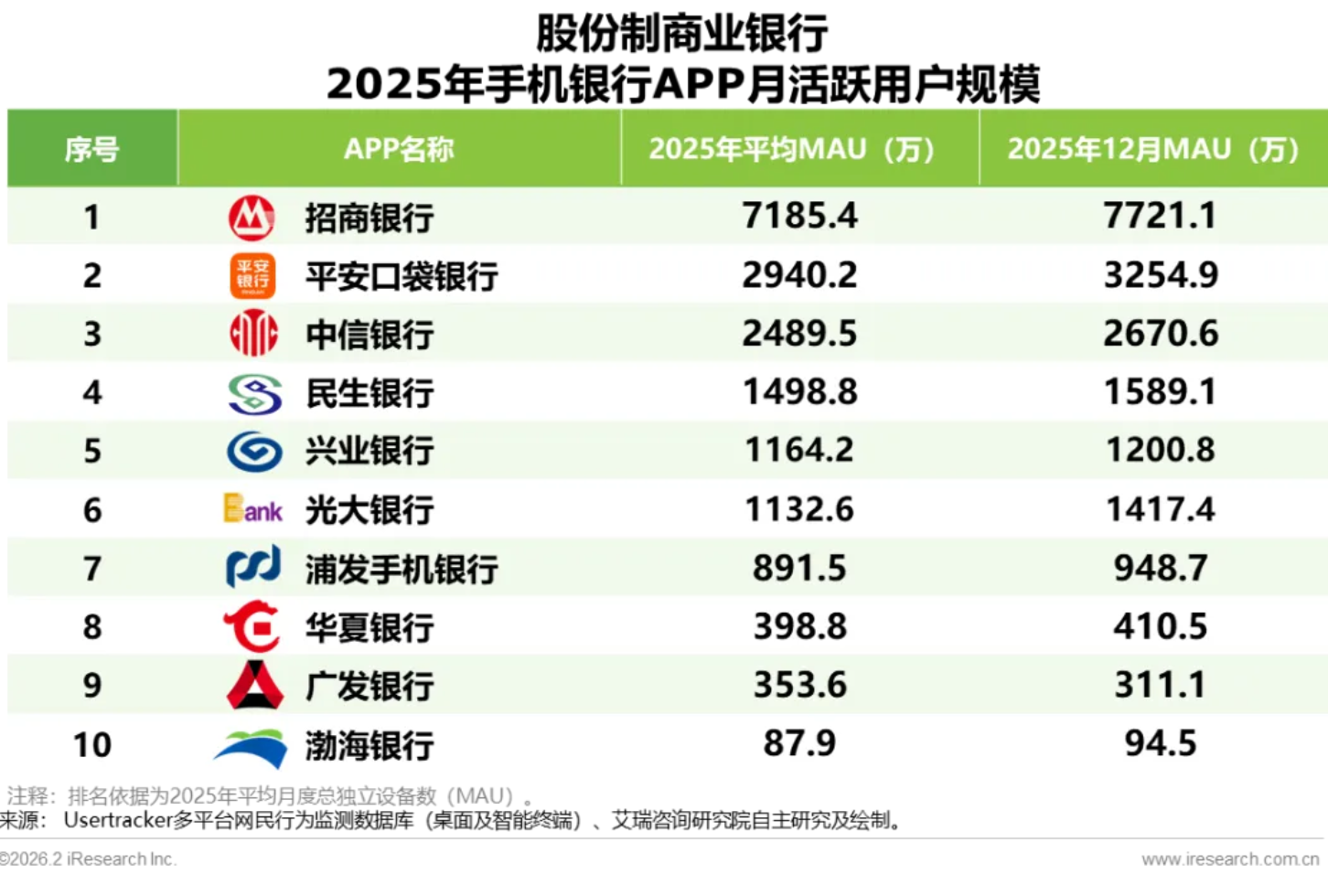
Core Insights - The mobile banking user base in China is expected to peak in 2025, shifting the industry focus from acquiring new users to enhancing existing user engagement [1] - Financial institutions must achieve extreme efficiency and precision in their ecosystems to survive in this new environment [1] Industry Overview - According to an iResearch report, joint-stock banks are adopting differentiated survival strategies, leading to significant head effects [1] - China Merchants Bank leads joint-stock banks with 71.854 million monthly active users (MAU), surpassing some state-owned banks due to its focus on wealth management and intelligent interaction [1] - Ping An Bank and CITIC Bank form the second tier, maintaining MAUs between 20 million and 30 million, with Ping An Bank leveraging AI to reconstruct service chains and CITIC Bank integrating consumer ecosystems [1] Competitive Landscape - Third-tier institutions, such as Minsheng Bank and Everbright Bank, have seen their MAUs drop to between 10 million and 20 million, indicating a tightening survival space [1] - Local banks are experiencing growth by focusing on their local markets, with city commercial banks like Jiangsu Bank and Beijing Bank maintaining MAUs above 3 million [1] - Among rural commercial banks and rural credit cooperatives, Fujian Rural Credit has surpassed 4.5 million MAUs, capturing traffic in county and rural areas [1] Challenges for Private Banks - The situation for private banks is dire, with the top 50 list for 2025 nearly extinct due to a lack of physical branches, local living ecosystems, and high customer acquisition costs, leading to a loss of competitiveness in the mobile banking sector [1] - In the era of stock competition, ecological and regional capabilities are becoming the key to success [1]




国有大行主导手机银行市场,生态嵌入构筑护城河
Jing Ji Guan Cha Wang· 2026-02-18 05:47
Core Insights - The Chinese mobile banking market is entering a stage of stock competition in 2025, with monthly active users (MAU) stabilizing between 648 million and 739 million [2] - State-owned commercial banks dominate the market due to their ecological embedding advantages, with Agricultural Bank of China leading at 249 million MAU, followed by Industrial and Commercial Bank of China (194 million) and China Construction Bank (109 million) [2] - Private banks are expected to collectively exit the top 50 MAU rankings in 2025 due to a lack of offline branch support and local living ecosystems [2] Group 1: Major Players - Agricultural Bank of China has the highest MAU at 249 million, followed by Industrial and Commercial Bank of China with 194 million and China Construction Bank with 109 million, forming the first tier of banks [2] - China Bank and Postal Savings Bank have MAUs exceeding 50 million, constituting the second tier [2] - China Merchants Bank leads the joint-stock banks with 71.85 million MAU, while Ping An Bank and CITIC Bank form the second tier, with other joint-stock banks generally below 20 million MAU [2] Group 2: Market Dynamics - The core advantage of state-owned banks lies in their "full-scenario integration" capabilities, embedding services deeply into high-frequency life scenarios such as government affairs, social security, healthcare, and education [2] - Agricultural Bank of China extends its services to rural areas through intelligent service matching and customer customization, while Industrial and Commercial Bank of China utilizes its "Gong Xiao Zhi" model for interactive service [2] - Regional banks like Jiangsu Bank, Beijing Bank, and Ningbo Bank show stable performance by focusing on local markets, with some rural commercial banks like Fujian Rural Credit exceeding 4.5 million MAU, indicating the sustainability of localized operations in the stock market [2]




流量红利枯竭 存量博弈下银行APP被迫断臂求生
Jing Ji Guan Cha Wang· 2026-02-18 05:44
Core Insights - The Chinese mobile banking market is transitioning from "scale expansion" to "value cultivation," indicating a saturation of user growth and the end of the traffic dividend period [2] - Different types of banks are exhibiting varied development trends in this new landscape [2] State-Owned Commercial Banks - The six major state-owned banks dominate the mobile banking market, with Agricultural Bank of China leading with over 250 million monthly active users (MAUs) [2] - The top three banks, including Industrial and Commercial Bank of China and China Construction Bank, have MAUs of nearly 200 million and over 100 million, respectively [2] - All six major banks reported positive month-on-month growth in MAUs, with ICBC leading at a 6.1% growth rate [2] Joint-Stock Commercial Banks - Joint-stock banks are seeking to carve out a niche in the saturated market, with China Merchants Bank leading among them with over 70 million MAUs [3] - Some banks like Everbright Bank and CITIC Bank showed significant month-on-month growth rates of 11.0% and 9.2%, respectively [3] - The performance of joint-stock banks is mixed, with some experiencing negative growth [3] Urban Commercial Banks - Urban commercial banks are growing rapidly, with 17 banks making it to the top 50 list, led by Ningbo Bank with 3.644 million MAUs and a growth rate of 43.9% [3] - The growth is attributed to localized strategies that enhance customer engagement [3] Rural Commercial Banks and Credit Cooperatives - Rural commercial banks and credit cooperatives also performed well, with 17 banks in the top 50, led by Fujian Rural Credit with 781.6 thousand average MAUs [4] - 12 out of these 17 banks reported positive month-on-month growth [4] Private Banks - Private banks are facing significant challenges, with only WeBank making it to the top 50 list in the first half of 2025, experiencing a 27.3% decline in MAUs [4] - The competitive landscape has shifted, making it difficult for online-only private banks to maintain their initial advantages [4] Conclusion - State-owned banks leverage "ecosystem" advantages to solidify their market position, while joint-stock banks focus on "professional" opportunities [5] - Urban commercial banks establish a strong local presence, whereas private banks struggle to survive in the competitive environment [5] - The future of banking will require a focus on creating irreplaceable value for users through technology and insights into user behavior [5]

2.7分钟定生死 手机银行存量厮杀谁在“断臂”,谁在“吃肉”?
Jing Ji Guan Cha Wang· 2026-02-18 04:57
Core Insights - The report by iResearch indicates that the monthly active users (MAU) of mobile banking apps in China have stabilized after fluctuating between 648 million and 739 million, signaling a ceiling in user growth and a shift from acquiring new users to enhancing existing user engagement [2] - User behavior is undergoing a structural reversal, with the effective daily usage time per device dropping from 4.9 minutes in 2023 to around 2.7 minutes by mid-2025, leading to a focus on high-frequency, short-duration, and functional usage [2] - Financial institutions are compelled to streamline operations and focus resources on core transaction scenarios to survive in this competitive landscape, where efficiency and precision are paramount [2] Mobile Banking Market Overview - The top three banks in terms of MAU are Agricultural Bank of China (2.49 billion), Industrial and Commercial Bank of China (1.94 billion), and China Construction Bank (1.09 billion), with all six major state-owned banks ranking in the top ten [3][5][6] - Private banks, represented by WeBank and MYbank, have faced significant setbacks, with many dropping out of the top 50 MAU rankings by 2025 [4] Competitive Landscape - State-owned banks are solidifying their dominance through extensive customer bases and integrated ecosystems, leveraging services embedded in high-frequency life scenarios such as government services and healthcare [7] - Joint-stock commercial banks are adopting a "specialized and precise" survival strategy, with China Merchants Bank leading among them with 71.85 million MAU, focusing on wealth management and intelligent interaction [8][10] - Regional banks are thriving by deeply engaging with local markets, while private banks struggle due to high customer acquisition costs and lack of local ecosystem support [13][14] Future Outlook - The mobile banking market is transitioning from a phase of scale expansion to one of value cultivation, with state-owned banks building moats through ecosystems, joint-stock banks seeking niches through specialization, and regional banks solidifying their local roots [14] - The ability to create irreplaceable value in a limited user engagement environment will be crucial, with technology applications such as AI reshaping service processes and enhancing risk management [15][16]