航发动力

Search documents
华创证券:我国商用航空发动机市场潜力巨大,关注产业链三条线索
3 6 Ke· 2026-01-23 00:59
Core Viewpoint - The commercial aviation engine market in China has significant potential, with projections indicating a total market size exceeding 2.6 trillion yuan over the next 20 years, translating to an annualized scale of over 130 billion yuan [1] Group 1: Market Potential - The after-sales market is expected to reach approximately 100 billion yuan annually, contributing to a combined total of 240 billion yuan per year from both the engine market and after-sales services [1] Group 2: Investment Recommendations - The report suggests focusing on three key areas within the domestic aviation engine supply chain: - Core supporting companies, including Hangzhou Engine, Aero Engine Technology, and Aero Engine Control [1] - Suppliers of high-temperature alloys and other basic components, with continued recommendations for Yingliu Co., and attention to Wanze Co., Hangya Technology, and Hangyu Technology [1] - Raw material suppliers, highlighting AVIC High-tech [1]


华创交运航空强国系列研究(二):技术壁垒到估值高地,全球视角看商用航空发动机产业链
Huachuang Securities· 2026-01-22 13:25
Investment Rating - The report maintains a recommendation for the commercial aviation engine industry, indicating a positive investment outlook [1]. Core Insights - The commercial aviation engine is referred to as the "crown jewel" of modern industry, with engines accounting for approximately 25% of the total value of commercial aircraft [4][20]. - The report emphasizes the significant growth potential of China's commercial aviation engine market, projecting a total market size exceeding 2.6 trillion yuan over the next 20 years, with an annualized scale of over 130 billion yuan [5][11]. - The commercial aviation engine supply chain is characterized by high barriers to entry, with a global oligopoly dominated by a few major manufacturers [5][6]. Summary by Sections Industry Overview - The report introduces the commercial aviation engine as a critical component of modern industrial capabilities, highlighting China's reliance on imported engines and the low marketization rate of domestic engines, which is less than 1% [4][21]. Commercial Aviation Engine Analysis - The structure of commercial aviation engines includes key components such as fans, compressors, combustion chambers, and turbines, with the hot section being the most critical and challenging to manufacture [26][33]. - The aftermarket services for engines can generate revenues up to four times the initial sale price, indicating a lucrative long-term profit potential [4][18]. Business Model Exploration - The primary manufacturers operate under a "super blade + long-term blade" profit model, leveraging significant discounts on initial sales to capture market share while securing long-term service contracts for profitability [5][6]. - Suppliers in the engine manufacturing chain are positioned as "hidden champions," benefiting from high entry barriers and the need for extensive certification processes [5][6]. Global Valuation Perspective - The average price-to-earnings (PE) ratio for major engine manufacturers is reported at 30.2 times, with leading companies like GE Aerospace at 42 times, indicating robust valuation metrics driven by order backlog and aftermarket growth [5][6]. - Core suppliers exhibit an even higher average PE of 68.5 times, reflecting their scarcity and stable demand characteristics [5][6]. China's Commercial Aviation Engine Market - The report highlights the Longjiang series of engines as a key initiative to reduce reliance on foreign technology and enhance domestic capabilities [5][11]. - The projected growth of the Chinese aviation market is supported by forecasts indicating a compound annual growth rate (CAGR) of 4.4% from 2024 to 2044, with expectations of 10,175 aircraft by 2044 [5][11]. Investment Recommendations - The report suggests focusing on three key areas within the domestic aviation engine supply chain: core component suppliers, high-temperature alloy manufacturers, and raw material suppliers [5][11].

一则大消息!掀起一个涨停潮
格隆汇APP· 2026-01-22 12:04
Core Viewpoint - The article discusses the resurgence of the commercial aerospace sector in China, highlighting significant developments and investment opportunities driven by government policies and technological advancements [12][42]. Group 1: Market Dynamics - The recent rebound in the A-share market reflects a broader recovery in the technology sector, particularly in the commercial aerospace segment, with over 20 stocks hitting the daily limit up [3][14]. - The Aerospace ETF (159227) has shown a remarkable performance, increasing by 53.64% since its launch in May last year, and has been included in the top ten core ETFs for global investment in China by 2026 [4][14]. Group 2: Industry Developments - Five key commercial aerospace companies, including Xinghe Power and Blue Arrow Aerospace, are progressing towards IPOs, aiming to raise funds for ambitious projects [9][11]. - China's commercial aerospace industry is projected to reach a scale of 2.5 to 2.8 trillion yuan by 2025, with an annual growth rate exceeding 20% and over 600 companies expected to operate in this sector [13][22]. Group 3: Technological Advancements - Significant advancements in technology are being made, such as the construction of the first offshore liquid rocket launch and recovery platform in Yantai, and successful tests of manned spacecraft landing systems [13][21]. - The development of reusable rocket technology is identified as a critical factor for reducing launch costs and enhancing capacity, with expectations for multiple successful test flights in 2026 [43][44]. Group 4: Investment Opportunities - The commercial aerospace sector is viewed as a major investment opportunity, with the potential for substantial returns as the industry matures and expands [36][42]. - The Aerospace ETF (159227) is highlighted as a strategic investment tool, focusing on high-purity military applications and leading commercial aerospace content, with a market size of 2.975 billion yuan and an average daily trading volume of 843 million yuan [41][39].




商业航天企业IPO新进展!航空航天ETF(159227)劲升3.83%,近10日净流入超12亿
Ge Long Hui A P P· 2026-01-22 06:42
Core Insights - The commercial aerospace sector is experiencing renewed activity, driven by global competition for space resources, supportive policies, technological advancements, and financing [1] Group 1: Market Performance - The Aerospace ETF (159227) increased by 3.83%, maintaining its position as the largest in its category, with over 70% of its index weight attributed to commercial aerospace concepts [2] - The General Aviation ETF (Hua Xia, 159230) rose by 2.55%, focusing on low-altitude economy stocks [2] Group 2: Company Developments - Three commercial aerospace companies, including Xinghe Power, Xingji Glory, and Tianbing Technology, updated their listing guidance, while Blue Arrow Aerospace's IPO application was accepted, and China Aerospace completed its counseling filing, indicating a push from five core companies in the launch vehicle sector towards becoming the "first stock of commercial aerospace" [1] - Blue Origin, owned by Jeff Bezos, announced plans to deploy up to 5,408 communication satellites to create a new satellite network service [1] Group 3: Industry Advancements - CCTV Finance reported that China's commercial aerospace sector is entering a "fast lane" of development, with multiple companies competing vigorously [1] - China's first offshore liquid rocket launch and recovery test platform is set to be operational [1]
国防ETF(512670)涨超3.1%,海内外共振催化商业航天
Xin Lang Cai Jing· 2026-01-22 06:12
Group 1 - The commercial aerospace industry is experiencing significant growth, with several companies, including Xinghe Power, Interstellar Glory, and Tianbing Technology, advancing their IPO preparations, aiming to become the "first stock of commercial aerospace" [1] - The third Beijing Commercial Aerospace Industry High-Quality Development Promotion Conference will be held on January 23-24, focusing on themes of innovation and development, with participation from government, aerospace institutions, leading enterprises, and financial institutions [1] - The commercial aerospace sector is entering a golden era driven by both demand and supply, with rapid development in private rocket companies and a shift from national to commercial aerospace [1] Group 2 - As of January 22, 2026, the CSI Defense Index has risen by 3.31%, with notable increases in stocks such as Triangle Defense (up 19.99%) and Steel Research High-Tech (up 12.84%) [2] - The CSI Defense Index reflects the overall performance of listed companies in the defense industry, including those providing weaponry and equipment to the national armed forces [2] - The top ten weighted stocks in the CSI Defense Index account for 42.34% of the index, including companies like Aerospace Electronics and Aero Engine Corporation of China [2]
航天航空板块早盘直线拉升,卫星制造+发射市场空间五年复合增速48%,卫星ETF广发(512630)、军工ETF广发(512680)双双涨超3%
Xin Lang Cai Jing· 2026-01-22 02:57
Core Viewpoint - The commercial aerospace sector in China is experiencing rapid growth due to breakthroughs in reusable rocket technology and accelerated large constellation networking, which are expected to yield significant industry benefits [1][2]. Group 1: Industry Developments - The launch frequency of China's commercial aerospace has increased, with the Long March 12 rocket's launch cycle shortened by 4 days, showcasing enhanced efficiency and commitment to meeting launch schedules [1]. - The upcoming launches of new rockets such as the Lijian-2, Zhuque-3, and Long March 12A are anticipated to mark a period of rapid development in China's commercial aerospace sector during the 14th Five-Year Plan [1]. - The global competition for low Earth orbit resources is intensifying, with an estimated capacity limit of approximately 60,000 satellites in near-Earth orbit, and around 57,000 low Earth orbit satellites expected to be deployed by 2029 [2]. Group 2: Market Growth Projections - The satellite manufacturing and launch market in China is projected to grow from 26.8 billion yuan in 2026 to 127.9 billion yuan by 2030, reflecting a compound annual growth rate (CAGR) of 48.1% [1]. - The military and aerospace sectors are becoming core investment directions, driven by strategic initiatives in manned lunar missions and deep space exploration [2]. Group 3: ETF Performance - The military ETF Guangfa (512680) saw a rise of over 3%, with significant gains in constituent stocks such as Triangle Defense and Steel Research, indicating strong market interest [2]. - The satellite ETF Guangfa (512630) also experienced a peak increase of over 3%, with notable performances from stocks like Electronic Science and Technology and Aerospace Universe [2]. - The satellite ETF Guangfa reached a latest scale of 1.472 billion yuan, with a net inflow of 394 million yuan over the past 10 trading days [3].
国防ETF(512670)上涨3%,商业航天资本化进程加速
Xin Lang Cai Jing· 2026-01-22 02:52
Group 1 - The commercial aerospace sector is experiencing a revival, with companies like Star River Dynamics, Interstellar Glory, and Tianbing Technology updating their listing guidance, while Blue Arrow Aerospace's IPO application has been accepted and China Aerospace has completed its guidance filing, marking a significant push towards becoming the "first commercial aerospace stock" [1] - The core energy technology for satellites, solar wings, is evolving from rigid to flexible designs, significantly reducing size and weight, which aids in satellite lightweight integration, supports multi-satellite stacking launches, and lowers launch costs, facilitating rapid deployment of satellite internet [1] - Space photovoltaic technology utilizes high-intensity space sunlight to efficiently meet the energy needs of satellites and space stations, with potential for wireless energy transmission to provide clean power to the ground, becoming a focal point in global technological competition [1] Group 2 - As of January 22, 2026, the CSI Defense Index (399973) has risen by 3.14%, with notable increases in component stocks such as Triangle Defense (up 13.95%), Western Materials (up 10.00%), and Steel Research High-Tech (up 9.66%) [1] - The Defense ETF (512670) closely tracks the CSI Defense Index and has increased by 3.00%, with the latest price reported at 1.03 yuan [1] - The top ten weighted stocks in the CSI Defense Index as of December 31, 2025, include Aerospace Electronics, Aero Engine Corporation, AVIC Shenyang Aircraft, and others, collectively accounting for 42.34% of the index [2]
宏观对话行业-科技叙事还能走多远
2026-01-22 02:43
Summary of Key Points from Conference Call Records Industry Overview - **Macro Industry**: The discussion centers around the technology sector, particularly the impact of AI on the macroeconomic landscape in the U.S. and China, as well as investment opportunities in various sub-sectors like commercial aerospace and humanoid robotics [1][3][17][19]. Core Insights and Arguments AI and Economic Growth - AI capital expenditures are projected to drive U.S. economic growth, with major tech companies expected to spend approximately $350 billion to $360 billion by 2025, accounting for about 1% of GDP and growing at a rate of 60%-70% [1][3]. - The contribution of AI to macroeconomic growth is estimated to be around 0.6%-0.7% [1][3]. - By 2026, capital expenditures from the top five U.S. tech companies are expected to reach $500 billion to $510 billion, indicating sustained investment-driven growth, albeit at a potentially slower pace [3][5]. AI's Impact on Various Industries - AI technology is having a comprehensive impact on the semiconductor industry, leading to price increases in mature processes and the rise of domestic computing power [1][12][14]. - The storage sector is also benefiting from AI, with new technologies driving demand for NAND and DRAM [11][12]. - In the commercial aerospace sector, investment opportunities are concentrated in rocket assembly, core aerospace engines, and satellite payloads, with companies like BoLite and Zhenlei Technology highlighted as key players [1][17]. Concerns and Risks - There are growing concerns about a potential bubble in the AI sector, particularly as discussions around the transition from short-term to long-term economic benefits intensify [6][9][13]. - The stability of macroeconomic policies is crucial to ensure a smooth transition and to mitigate risks associated with the AI narrative [5][6]. China's Technological Landscape - China has surpassed Japan in R&D spending, becoming the second-largest globally, and leads in PCT patent applications, indicating significant advancements in technology [8][7]. - However, the impact of these advancements on labor productivity remains limited, primarily reflecting in capital markets rather than the real economy [7][8]. Additional Important Insights - The humanoid robotics industry is transitioning from component manufacturing to key assembly stages, with companies in Tesla's supply chain, such as Sanhua and Topband, being noteworthy [2][20][21]. - Investment opportunities in the commercial aviation sector are expected to rise due to increased domestic production capabilities, particularly in engine manufacturing [18]. - AI applications in retail are opening new growth avenues, with companies leveraging AI tools to enhance operational efficiency and consumer engagement [25]. - The development of AI glasses is anticipated to grow significantly, with a projected increase in global shipments and sales exceeding 50% over the next five years [26]. Conclusion - The overall sentiment is cautiously optimistic regarding the future of AI and its integration into various industries, with a focus on the importance of stable macroeconomic policies and the potential for significant technological advancements to drive productivity and economic growth [15][16].



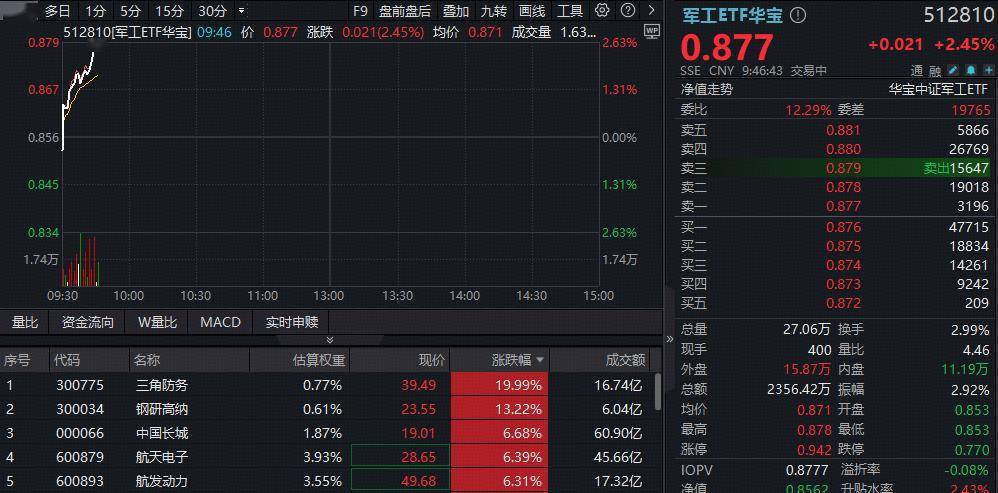
ETF盘中资讯|军工异动,三角防务20CM涨停!高人气军工ETF华宝(512810)直线冲高2.45%
Sou Hu Cai Jing· 2026-01-22 02:43
Group 1 - The military industry sector is showing strong performance, with the China Securities Military Industry Index constituents experiencing significant gains, including a 20% limit up for Triangle Defense and over 13% increase for Steel Research High-tech [1] - The military ETF, Huabao (512810), surged by 2.45%, with trading volume quickly surpassing 21 million yuan [1] - The upcoming Third Beijing Commercial Aerospace Industry High-Quality Development Promotion Conference aims to discuss new opportunities in commercial aerospace, with the Beijing Economic Development Zone set to launch several innovative service platforms and industry projects [2] Group 2 - The 14th Five-Year Plan emphasizes the high-quality advancement of national defense and military modernization, accelerating the upgrade of advanced weaponry, indicating a new development period for military equipment [2] - China's global competitiveness in shipbuilding, aerospace, and satellite navigation has been steadily improving, positioning the national defense and military industry as a crucial area for new productive forces [2] - The military ETF Huabao (512810) covers various popular themes such as commercial aerospace, low-altitude economy, large aircraft, satellite navigation, military information technology, and controllable nuclear fusion, serving as an efficient tool for investing in core military assets [2]

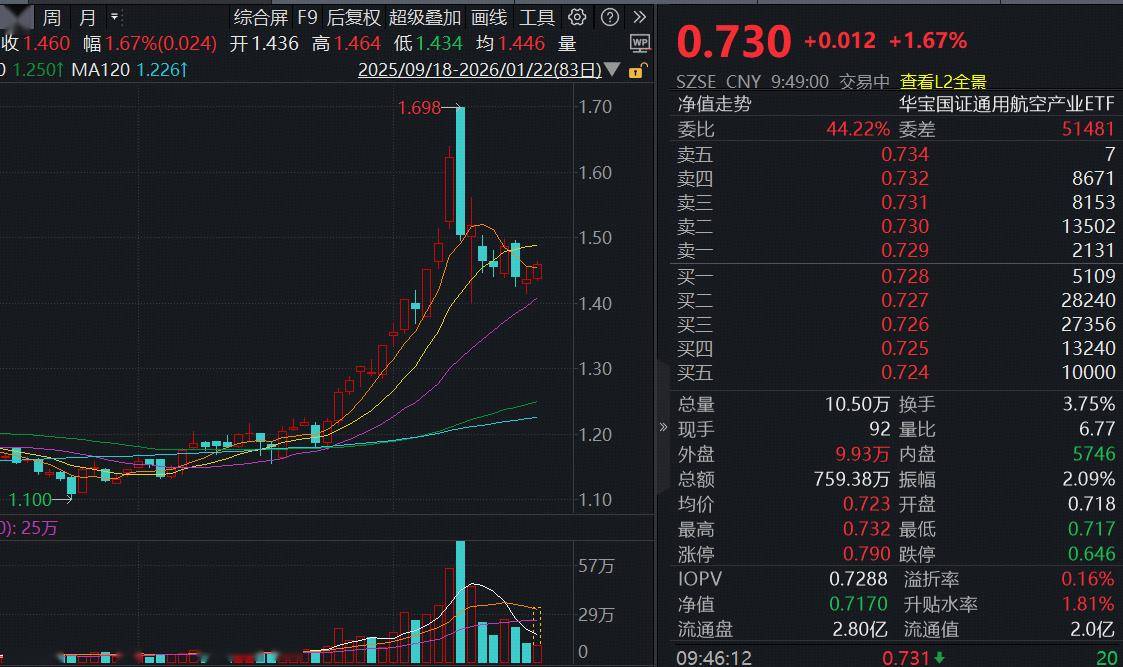
ETF盘中资讯|46%!上海明确无人机适飞空域,通用航空ETF(159231)开盘上涨1.67%冲击连阳
Sou Hu Cai Jing· 2026-01-22 02:25
Core Viewpoint - The commercial aerospace sector is experiencing a rebound, with significant stock price increases for companies like航发动力 and 航天电子, indicating renewed investor interest in this industry [1]. Group 1: Commercial Aerospace Developments - The Shanghai government plans to open a "free flight zone" for drones covering 46% of the city by February 1, 2026, along with a digital management system [2][3]. - By 2028, the core industry scale of Shanghai's low-altitude economy is projected to reach approximately 80 billion CNY, aiming to establish a complete industrial chain for new low-altitude aircraft [3]. - Recent updates from commercial aerospace companies such as 星河动力 and 星际荣耀 indicate progress towards IPOs, with five core enterprises in the launch vehicle sector now actively pursuing public listings [3]. Group 2: Investment Opportunities - The General Aviation ETF Huabao (159231) covers 50 aerospace stocks, with over 88% exposure to low-altitude economy concepts and over 65% to commercial aerospace, making it a strategic tool for investors in China's aerospace industry [4]. - The ETF has shown a price increase of 1.67%, indicating positive market sentiment and potential for further growth [1][4].