
速腾聚创

Search documents
滴滴广汽埃安Robotaxi R2正式交付,速腾聚创10激光雷达方案落地
Ge Long Hui· 2026-01-27 00:52
Group 1 - GAC Aion and Didi Autonomous Driving have officially delivered the new generation L4 Robotaxi model R2 at GAC Aion's factory on January 23 [1] - The first batch of R2 vehicles has obtained road testing licenses for intelligent connected vehicles in Guangzhou [1] - The R2 model is equipped with 10 LiDARs provided by Suoteng Juchuang, featuring a configuration of "4 main radars + 6 supplementary blind-spot radars" for 360-degree environment perception [1] Group 2 - The delivery of the R2 model follows the announcement of this configuration plan in November of the previous year [1] - The R2 model is planned to gradually integrate into urban smart mobility networks with demonstration applications starting in 2026 in cities like Guangzhou and Beijing [1]


汽车行业双周报:2025年汽车销量同比+9.4%,2026年销量预计稳中有升
Zhong Guo Yin He Zheng Quan· 2026-01-26 14:24
Investment Rating - The report maintains a "Buy" rating for the automotive industry, particularly recommending leading passenger car companies and those involved in the intelligent and humanoid robotics supply chains [5]. Core Insights - In 2025, China's automotive sales are projected to increase by 9.4% year-on-year to 34.4 million units, with domestic sales rising by 6.7% to 27.3 million units, driven by the continued implementation of vehicle replacement policies [1][2][9]. - Exports are expected to grow by 12.1% to 7.1 million units, surpassing 7 million for the first time, supported by the increasing international market influence of domestic brands and high growth in new energy vehicle (NEV) exports [2][10]. - NEV sales are forecasted to rise by 28.2% to 16.49 million units, with a penetration rate increasing by 7.0 percentage points to 47.9% [2][10]. - For 2026, automotive sales are expected to grow by 1% to 34.75 million units, with NEV sales projected to increase by 15.2% to 1.9 million units, despite some policy adjustments that may have diminishing returns [3][11]. Summary by Sections Sales Forecast - 2025 automotive sales in China are expected to reach 34.4 million units, with domestic sales at 27.3 million units and exports at 7.1 million units [2][10]. - NEV sales are anticipated to hit 16.49 million units, with a penetration rate of 47.9% [2][10]. Market Dynamics - The strong domestic demand and high export growth are expected to sustain a high level of market activity in 2025 [2][10]. - The international market influence of domestic brands is projected to continue growing, particularly in the NEV sector [3][11]. Policy Impact - The "Two New" policies are expected to provide ongoing support for the domestic market, although adjustments in tax incentives may lead to marginally reduced effects [3][11]. - The 2026 forecast includes a slight increase in automotive sales, supported by continued policy optimization and favorable export conditions [3][11]. Stock Performance - The automotive sector's performance over the past two weeks showed a growth of 2.94%, ranking 12th among 30 sectors, with commercial vehicles performing the best [12][14]. - Notable stock performances included significant gains for companies like Aikelan and Junda, while others like Tianpu and Yueling saw declines [12][14]. Valuation Metrics - The report provides various valuation metrics, with price-to-earnings ratios for different segments, indicating the relative valuation of passenger cars, commercial vehicles, and parts suppliers [15][17].

汽车行业双周报:2025年汽车销量同比+9.4%,2026年销量预计稳中有升-20260126
Yin He Zheng Quan· 2026-01-26 14:04
Investment Rating - The report maintains a "Buy" rating for the automotive industry, particularly recommending leading passenger car companies and those involved in the intelligent and humanoid robotics supply chains [5]. Core Insights - In 2025, China's automotive sales are expected to increase by 9.4% year-on-year to 34.4 million units, with domestic sales rising by 6.7% to 27.3 million units, driven by the continued implementation of vehicle replacement policies [1][2][9]. - Exports are projected to grow by 12.1% to 7.1 million units, marking the first time exports exceed 7 million units, supported by the increasing international market influence of domestic brands and high growth in new energy vehicle (NEV) exports [2][10]. - NEV sales are anticipated to rise by 28.2% to 16.49 million units, with a penetration rate increasing by 7.0 percentage points to 47.9% [2][10]. - For 2026, automotive sales are forecasted to grow by 1% to 34.75 million units, with NEV sales expected to increase by 15.2% to 1.9 million units, supported by ongoing policy optimization and expansion in overseas markets [3][11]. Summary by Sections Sales Forecast - 2025 automotive sales are projected at 34.4 million units, with domestic sales at 27.3 million units and exports at 7.1 million units [2][10]. - NEV sales are expected to reach 16.49 million units, with a penetration rate of 47.9% [2][10]. Market Dynamics - The automotive market is experiencing strong domestic demand and high export growth, contributing to a high level of market activity in 2025 [2][10]. - The influence of domestic brands in international markets is increasing, particularly in the NEV segment, which is driving export growth [2][10]. Policy Impact - The "Two New" policies are expected to continue providing support for the domestic automotive market in 2026, despite some adjustments in tax incentives [3][11]. - The transition to NEVs is accelerating in the commercial vehicle market, with significant achievements in overseas market expansion for domestic NEV products [2][10].
综合行业周报:RoboX进展顺利,家用机器人新品密集亮相
KAIYUAN SECURITIES· 2026-01-26 01:24
Investment Rating - The industry investment rating is "Positive" (maintained) [1] Core Views - The automotive sector is awaiting a turning point in passenger vehicle sales, with RoboX company making steady progress [5][7] - The tools sector is seeing significant developments, including the establishment of the QuanFeng Vietnam park and exciting new products showcased at CES [6][27] Automotive Sector Summary - The Hang Seng Automotive Theme Index increased by 2.2%, outperforming the Hang Seng Index (-0.4%) and the Hang Seng Technology Index (-0.4%) [5][13] - In December 2025, the passenger vehicle market reached a new high with retail sales of 2,374.5 million units, including 1,280.9 million units of new energy vehicles, marking a 17.6% year-on-year growth [14] - January 2026 passenger vehicle sales are expected to see a slight year-on-year increase, with an estimated total market retail of around 1.8 million units [15] - New vehicle launches have been relatively quiet, with the Geely Galaxy V900 being the only notable release [19][20] - RoboX plans to deploy 100,000 fully customized Robotaxis globally by 2030, enhancing commercial operations [22] Tools Sector Summary - The establishment of the QuanFeng (Vietnam) New Energy Intelligent Manufacturing Base marks a significant step in global strategic layout [39] - At CES 2026, several innovative home robot products were showcased, including the G-Rover by Stone Technology, which features a dual-wheel leg architecture [40] - Milwaukee Tools opened a flagship experience center in the UK, enhancing strategic value and user engagement [53]
敲钟、烧钱、出局:智能驾驶2025“狂飙”实录
智通财经网· 2026-01-25 02:40
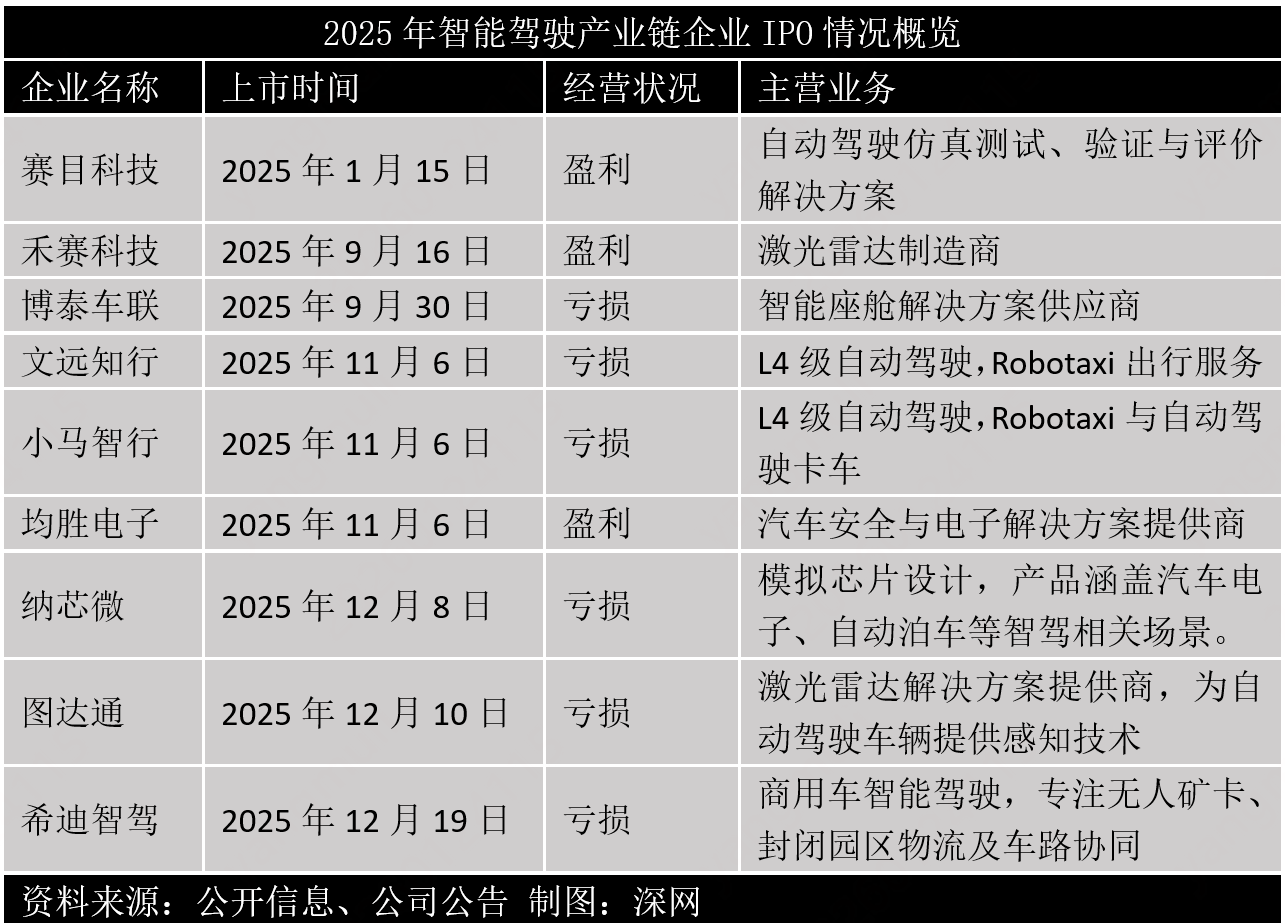
Group 1 - The core point of the article highlights the end of a significant IPO wave in the smart driving industry, with the last company, Xidi Zhijia, ringing the bell on the Hong Kong Stock Exchange in December 2025, marking the ninth company to go public that year [1][6] - The focus of the capital market is shifting from "listing stories" to questioning "post-listing performance," with funds becoming more selective towards companies that have demonstrated initial commercialization capabilities [2][20] - The industry is expected to undergo a significant reshuffle, moving from a phase of "hundreds of flowers blooming" to one of "integration and elimination," as the market becomes more rational [3][17] Group 2 - In 2025, the smart driving industry saw a collective explosion in the capital market, with companies from various segments, including solution providers and core sensor manufacturers, rushing to list or file for IPOs [6][7] - Notable companies that went public include Saimo Technology, which became the first smart driving company to list in 2025, and others like Pony.ai and WeRide, which achieved dual listings in both the US and Hong Kong [6][8] - The successful IPOs predominantly feature leading companies in their respective niches, such as Hesai Technology, which holds a 33% market share in the ADAS lidar market [9] Group 3 - Despite the IPO successes, many companies face significant challenges, including ongoing losses and high R&D expenditures, with only three out of the nine listed companies achieving profitability [12][10] - The high R&D spending is a major factor contributing to the widespread losses, with some companies reporting R&D expenses exceeding 300% of their revenue [12][10] - The commercialization process is slow, with many companies struggling to achieve profitability due to the lengthy validation cycles of smart driving technologies [13][14] Group 4 - The industry is experiencing a rapid and ruthless reshuffle, with a significant reduction in financing, dropping from 932 billion yuan in 2021 to 350 billion yuan in 2025, accelerating the elimination of weaker players [18][19] - The shift in capital judgment criteria indicates that investors are now more focused on verifiable operational capabilities and clear paths to profitability, moving away from merely technical narratives [20][19] - The market concentration is expected to increase, with only those companies that can achieve large-scale production, cost control, and strong ecosystem partnerships likely to survive in the long run [20][19]
汽车产量“十强省”大变局
第一财经· 2026-01-23 13:42
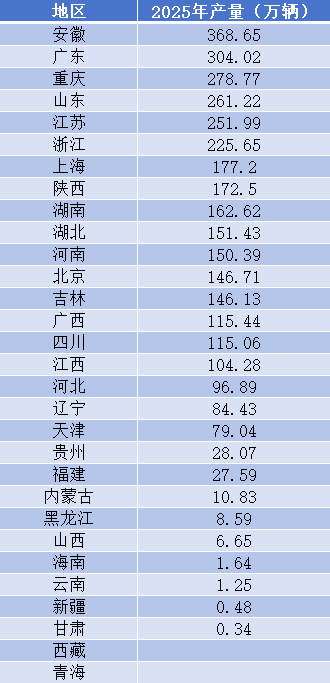
Core Viewpoint - The automotive industry in China is undergoing a significant transformation, with a notable shift in regional production dynamics as of 2025, where Anhui has surpassed Guangdong in vehicle production, marking a historic change in the industry landscape [3][5][8]. Production Rankings - In 2025, the top ten provinces for automotive production are Anhui (3.6865 million), Guangdong (3.0402 million), Chongqing (2.7877 million), Shandong (2.6122 million), Jiangsu (2.5199 million), Zhejiang (2.2565 million), Shanghai (1.772 million), Shaanxi (1.725 million), Hunan (1.6262 million), and Hubei (1.5143 million) [4][5]. - Anhui's production growth is attributed to three main factors: changes in statistical rules, accumulated industrial advantages, and export growth [5][7]. Statistical Changes - The National Bureau of Statistics has shifted the automotive production statistics from "registered location" to "production location" starting in 2025, which has significantly impacted the reported production figures [6][8]. - This change has resulted in a substantial increase in reported production for Anhui, with major manufacturers like BYD and NIO contributing to this growth [6][7]. New Energy Vehicles - Anhui's rapid production increase is largely driven by the surge in new energy vehicle (NEV) production, with 1.794 million NEVs produced in 2025, accounting for 48.7% of its total automotive output, significantly higher than Guangdong's 32% [7][8]. - The province has also become the first to export over 1 million vehicles, with a total of 1.228 million vehicles exported in 2025, representing 18% of the national total [7][8]. Competitive Landscape - Despite Anhui's rise in production, Guangdong remains dominant in terms of production value, with nearly double the output value of Anhui and a higher average vehicle price [8][9]. - The competition between Anhui and Guangdong reflects a broader shift in the automotive industry, with traditional powerhouses like Jilin and Hubei losing their top ten positions, indicating a significant regional restructuring [9][10]. Future Trends - The future of the automotive industry in China is expected to trend towards a more diversified and specialized production landscape, with a narrowing gap in production numbers among the top provinces [11]. - Provinces with strong export capabilities and high localization rates, such as Anhui and Chongqing, are likely to continue rising in the rankings, while the ability to convert production volume into revenue will become increasingly critical for success [11].
汽车产量“十强省”大变局:究竟谁是第一汽车大省?
Di Yi Cai Jing· 2026-01-23 11:26
Core Insights - The automotive industry in China is undergoing a significant transformation, with a notable shift in regional production rankings expected by 2025, as new players rise and traditional powerhouses decline [1][7] Group 1: Production Rankings - In 2025, the top ten provinces for automotive production are expected to be Anhui, Guangdong, Chongqing, Shandong, Jiangsu, Zhejiang, Shanghai, Shaanxi, Hunan, and Hubei, with production figures of 3.6865 million, 3.0402 million, 2.7877 million, 2.6122 million, 2.5199 million, 2.2565 million, 1.772 million, 1.725 million, 1.6262 million, and 1.5143 million respectively [2][3] - Anhui has surpassed Guangdong to become the leading province in automotive production for the first time, marking a historic shift in the industry [4][5] Group 2: Factors Influencing Change - The change in rankings is attributed to three main factors: changes in statistical rules, accumulated industrial advantages in Anhui, and export growth [4][5] - The adjustment in statistical methods from "corporate registration location" to "production location" has significantly impacted the reported production figures, with major manufacturers like BYD and NIO contributing to Anhui's rise [4][5] Group 3: New Energy Vehicles - Anhui's rapid growth in automotive production is largely driven by a surge in new energy vehicle (NEV) production, with 1.794 million NEVs produced in 2025, accounting for 48.7% of its total output, significantly higher than Guangdong's 32% [5][6] - The province has also become the first to export over one million vehicles, with a total of 1.228 million vehicles exported in 2025, representing 18% of the national total and a 28.7% increase [5][6] Group 4: Competitive Landscape - Despite Anhui's rise, Guangdong still maintains a significant lead in terms of production value, with its automotive output value nearly double that of Anhui, and a higher average vehicle price [6] - The competitive landscape is characterized by a divergence in strengths, with Guangdong excelling in high-end elements and global branding, while Anhui focuses on manufacturing efficiency and supply chain integration [6][7] Group 5: Emerging Forces - The traditional automotive powerhouses are facing challenges from emerging provinces like Shandong, Jiangsu, and Zhejiang, which have all surpassed the two million vehicle mark for the first time [7][8] - The shift in rankings reflects a broader trend of new forces challenging established players, with provinces like Hunan and Henan also making significant gains in production [8][9] Group 6: Future Trends - The future of the automotive industry in China is expected to trend towards a more diversified and specialized production landscape, with production gaps among the top provinces narrowing [9] - Factors such as export capabilities and the ability to convert production volume into revenue will become increasingly critical in determining future success in the industry [9]
速腾聚创根据首次公开发售后股份激励计划授出58.39万股股份奖励
Zhi Tong Cai Jing· 2026-01-22 10:23
Group 1 - The company, Sutech Jun Chuang (02498), announced the grant of a total of 583,900 shares as part of its employee incentive plan to 23 grantees (employees of the group) [1]
速腾聚创(02498)根据首次公开发售后股份激励计划授出58.39万股股份奖励
智通财经网· 2026-01-22 10:23
Core Viewpoint - The company, Sutech Jun Chuang (02498), announced the grant of a total of 583,900 shares to 23 beneficiaries (employees of the group) under its share incentive plan, effective January 22, 2026 [1] Group 1 - The total number of shares granted is 583,900 [1] - The beneficiaries of the share grant include 23 employees of the group [1] - The effective date for the share grant is January 22, 2026 [1]
速腾聚创(02498.HK)授出总计58.39万股奖励股份
Ge Long Hui· 2026-01-22 10:19
Core Viewpoint - The company, Sutech Jun Chuang (02498.HK), announced the granting of a total of 583,874 shares to 23 employees under its post-IPO share incentive plan, aimed at aligning employee interests with those of shareholders and enhancing company value [1]. Group 1 - The share incentive plan is designed to motivate employees to achieve outstanding performance and to attract and retain talent for the company's ongoing operations and development [1]. - The company believes that this initiative will further promote its success and development, ultimately benefiting shareholders [1].