
宁波银行

Search documents
中信银行再度出手,罕见调降两款代销基金风险评级,有北交所主题基金被调至“高风险”
Xin Lang Cai Jing· 2025-10-10 06:33
Core Viewpoint - CITIC Bank announced on October 9 that it will adjust the risk ratings of 17 asset management products starting from October 15, 2025, marking the fourth adjustment of the year [1][3]. Group 1: Risk Rating Adjustments - This adjustment includes a rare downgrade of two FOF products managed by E Fund, changing their risk rating from PR3 to PR2, while the majority of other funds saw an increase in their risk ratings [4][8]. - Other banks, including Agricultural Bank of China, China Construction Bank, and Minsheng Bank, have also adjusted their fund product risk ratings this year, with most adjustments being upward [3][8]. Group 2: Industry Context - The adjustments are part of a broader trend where banks are optimizing the risk ratings of their public fund products to better reflect their risk profiles and comply with suitability principles [3][9]. - A researcher from a state-owned bank indicated that these adjustments help in meeting the regulatory requirements for investor suitability and protecting investor interests [3][9]. Group 3: Specific Product Changes - Among the products adjusted, two funds from Huatai-PineBridge were upgraded from PR4 to PR5, indicating a higher risk level, while a pension-themed product from ICBC was upgraded from PR3 to PR4 [5][7]. - The adjustments reflect the ongoing evaluation of fund products based on market conditions, with a focus on ensuring that investors are aware of the risks associated with their investments [9].


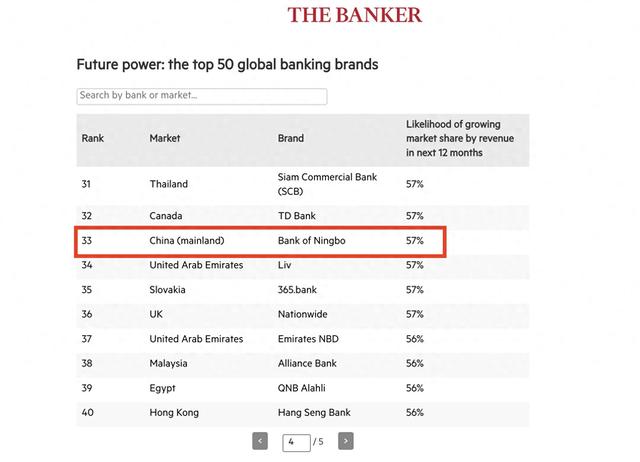
工商银行、宁波银行上榜!英国《银行家》公布全球增速最快50家银行
Guan Cha Zhe Wang· 2025-10-10 06:20
Core Insights - The report by Kantar identifies the fastest-growing retail banks globally, highlighting a shift in brand perception and potential future value creation, with Brazilian, Japanese, and South African banks leading the list, while traditional giants like HSBC and JPMorgan are absent [1][2]. Group 1: Rankings and Key Players - The top three banks in the ranking are Nubank (Brazil), Capitec (South Africa), and Rakuten Bank (Japan), showcasing innovative approaches to banking in their respective markets [2]. - Nubank, established in 2013, revolutionized the market with a free credit card managed via an app, addressing issues of financial exclusion and high fees [2]. - Capitec stands out for its simplified banking model, offering core services through a single account, enhancing convenience and transparency [2]. - Rakuten Bank leverages artificial intelligence to recommend products based on customer history and integrates with social applications for easy transfers [2]. Group 2: Performance of Traditional Banks - European banks performed poorly in the rankings, with only Air Bank from the Czech Republic making it into the top ten, indicating a struggle for traditional banks to regain consumer trust post-2008 financial crisis [2]. - Experts note that large banks have faced negative perceptions due to past scandals, leading to a belief that they prioritize profits over social responsibility [2]. Group 3: Chinese Banks' Position - The inclusion of Industrial and Commercial Bank of China (ICBC) at 22nd and Bank of Ningbo at 33rd indicates China's growing competitiveness in brand building and customer recognition on the global stage [1][2]. - ICBC's efforts in digital transformation and customer service have been acknowledged, while Bank of Ningbo's entry reflects the advancements of smaller Chinese banks in operational refinement and brand development [2]. Group 4: Industry Context - The release of this ranking coincides with significant changes in the global banking industry, where traditional banks face challenges in rebuilding customer trust and adapting to digital transformation [6][7]. - For Chinese banks, this ranking serves as both recognition and a warning, emphasizing the need to enhance brand strength and focus on digitalization, customer experience, and social responsibility to secure long-term customer trust [7].


银行行业专题:全球十年复盘:哪些银行可以跑出超额收益-国信证券
Sou Hu Cai Jing· 2025-10-10 02:25
Core Insights - The report from Guosen Securities analyzes the performance of 154 banks across 17 global markets from 2015 to 2025, highlighting the core investment logic in the banking sector and suggesting that Chinese banks are undervalued with significant potential for valuation recovery [1][2][6]. Global Banking Index Performance - Economic fundamentals are the primary drivers of banking index performance, with Indian and US banking indices leading with cumulative gains of 196% and 147% respectively from early 2015 to September 2025, benefiting from strong economic growth [1][2]. - Japanese and European banking indices, which were sluggish from 2015 to 2019, rebounded post-2021 due to the exit from zero/negative interest rates and economic recovery, achieving cumulative gains of 140% and 60% respectively [1][2]. - The Korean banking index has historically been below 0.5x price-to-book (PB) ratio, expected to recover to 0.65x by the end of 2024 after interest rate cuts [1][2]. - The Shenyin Wanguo banking index has only seen an 18% increase, with a PB ratio of 0.53x, reflecting pessimistic market expectations due to pressures from economic structural transformation in China [1][2]. Individual Bank Performance - Over 60% of the sampled banks outperformed their domestic market indices, with one-third surpassing the S&P 500 index. Notably, banks in high-growth regions like Vietnam saw stock price increases between 531% and 584% [2][6]. - Major US banks, such as JPMorgan Chase, experienced a 574% increase, while specialized banks like First Citizens Bank rose by 668% [2][6]. - In China, only two banks, China Merchants Bank and Ningbo Bank, outperformed the S&P 500, with increases of 277% and 252% respectively, indicating significant individual stock differentiation [2][6]. Valuation Insights - Chinese banks are globally undervalued, with an average PB ratio of 0.52x compared to 1.29x for 240 global banks. This is lower than South Korea (0.55x), Japan (0.82x), and the US (1.38x) [2][6]. - The disparity between PB ratios and return on equity (ROE) for Chinese banks suggests market pessimism regarding future ROE expectations. For instance, China Merchants Bank has an ROE of 14.95% with a PB of 0.97x, while JPMorgan Chase has an ROE of 18.19% with a PB of 2.57x [2][6]. Economic Resilience and Future Outlook - Despite recent economic pressures, China's economy is expected to demonstrate medium to long-term resilience, supported by innovation, industrial upgrades, urbanization, consumption, and regional development [2][6]. - The report emphasizes the potential for significant valuation recovery in Chinese banks, driven by structural economic improvements and a more optimistic outlook for the banking sector [2][6].


国信证券晨会纪要-20251010
Guoxin Securities· 2025-10-10 01:12
Group 1: Film Industry Insights - The National Day box office reached 1.808 billion yuan, showing a slight decline of 14.1% compared to 2024 [9] - The number of viewers and average ticket price were 49.335 million and 36.6 yuan, reflecting a year-on-year decrease of 5.3% and 9.4% respectively [9] - The box office trend during the holiday showed a pattern of initial decline followed by recovery, with a notable increase of 20.8% on October 7 [9] - Key films such as "The Volunteer Army" and "731" performed well, contributing significantly to the overall box office [9] - Policy support for content supply recovery and the application of AIGC technology are expected to enhance efficiency in the industry [9] Group 2: Banking Sector Analysis - The investment focus in the banking sector is heavily influenced by macroeconomic conditions, with quality bank stocks showing good long-term investment value [10] - U.S. and Indian bank indices have maintained high PB valuations, reflecting strong economic growth, although they have not achieved excess returns since 2020 [11] - Japanese and European bank indices have shown recovery since 2021, benefiting from policy stimuli that ended the zero/negative interest rate era [11] - In contrast, the Korean banking index remains low at around 0.65x PB, while China's banking index is at approximately 0.53x, indicating market pessimism [11] - A total of 102 out of 154 banks in the analyzed markets outperformed the market index, highlighting the importance of selective stock picking [12] Group 3: Insurance Sector Risk Assessment - Tianan Insurance's bond default marks a significant risk exposure in the insurance sector, reflecting a trend towards breaking rigid payment structures in China's financial market [13] - The default is expected to accelerate the clearing of risks among smaller insurance companies, leading to a more optimized industry landscape [13] Group 4: AI and E-commerce Service Providers - E-commerce service providers are facing operational bottlenecks due to the fading online growth, prompting a shift towards self-owned brands and AI technology integration [14][15] - Companies like Ruoyuchen and Qingmu Technology are successfully developing their own brands and enhancing operational capabilities through AI [15] - The focus on self-owned brands and AI integration is seen as a critical competitive advantage for future growth in the sector [15][16] Group 5: ZTE Corporation Overview - ZTE is actively participating in the construction of intelligent computing infrastructure, aiming to become a leader in domestic computing and connectivity [18] - The company reported a revenue of 71.55 billion yuan in the first half of 2025, marking a 15% year-on-year increase, although net profit decreased by 11.5% [18] - ZTE's second revenue stream, represented by computing and terminal products, has seen nearly 100% growth, contributing over 35% to total revenue [18] - The company is positioned to benefit from the growing demand for AI infrastructure, with significant investments expected from major cloud service providers [17]
大A的荣耀不再属于“性价比”投资者
虎嗅APP· 2025-10-09 23:56
Core Viewpoint - The article discusses the performance of deep value fund managers during different market conditions, highlighting their underperformance in the current bull market compared to growth-style fund managers, particularly in sectors like technology and innovation [4][20]. Group 1: Performance Comparison - In the past three years of bear markets, deep value fund managers performed relatively well, with many managing over 10 billion in assets [5]. - As of September 24, 2023, mainstream deep value fund managers like Xu Yan and Jiang Cheng had annual returns below 20%, while the average return of the CSI Active Equity Fund Index reached 34.11% [6][12]. - The article notes that deep value fund managers typically focus on low-valuation, stable companies, which leads to lower returns in bull markets but better performance in bear markets [14][19]. Group 2: Investment Philosophy - Deep value fund managers invest from an owner's perspective, focusing on long-term intrinsic value rather than short-term market fluctuations [16]. - They emphasize "quality and price," seeking high-quality companies that are undervalued due to market sentiment [17]. - Safety margins are crucial in their investment decisions, as they aim to protect against errors and downside risks [17][18]. Group 3: Market Trends and Strategies - The current bull market has favored growth-style funds, particularly those heavily invested in technology, with some achieving over 200% annual returns [7]. - Deep value fund managers often hold significant positions in traditional sectors like finance and real estate, which have underperformed in the current market [14][19]. - The article suggests that deep value funds should be considered for core portfolio allocations, especially for conservative investors [23][24]. Group 4: Selection Criteria - Not all low-valuation stocks represent deep value; some may belong to contrarian or cyclical strategies [29]. - Investors should focus on the stability of deep value fund managers' styles, as many have shifted towards growth or other strategies over time [36][38]. - The article advises that deep value funds can serve as a bottom-layer allocation in a diversified portfolio, balancing risk and return [24][26].






中航月月鑫30天持有期债券型证券投资基金基金份额发售公告
Shang Hai Zheng Quan Bao· 2025-10-09 18:33
Fund Overview - The fund is named "AVIC Monthly Xin 30-Day Holding Period Bond Fund" and has been registered with the China Securities Regulatory Commission [10] - The fund is a bond-type open-ended fund with a 30-day holding period [11] Fund Subscription Details - The subscription period is from October 13, 2025, to October 24, 2025, through direct sales and other sales institutions [4][17] - Each investor can subscribe up to 10 million RMB per day, with specific exceptions for certain types of investors [3][13] - The total fundraising target is capped at 5 billion RMB, with a minimum fundraising amount of 200 million RMB [15][39] Fund Management and Custody - The fund is managed by AVIC Fund Management Co., Ltd., and the custodian is Ningbo Bank Co., Ltd. [1][40] Investor Eligibility - The fund is open to individual investors, institutional investors, qualified foreign investors, and other investors permitted by law [13][15] - Financial institutions' proprietary accounts are currently not eligible for subscription [3][13] Subscription Process - Investors must open a fund account with the management company to subscribe [19] - Subscription applications must be fully paid according to the sales institution's regulations [20] - The fund allows multiple subscriptions during the fundraising period, but applications cannot be withdrawn once accepted [20][26] Fund Share and Fees - The fund shares are issued at a par value of 1.00 RMB [12] - A subscription fee applies to Class A shares, while Class C shares do not incur a subscription fee but charge a service fee [21][24] Fund Operation and Confirmation - The fund operates on a contract basis with a minimum holding period of 30 days, during which investors cannot redeem or transfer shares [11][17] - Subscription confirmations depend on the registration institution's results, and investors should verify their subscription status [25]
区域银行冲向科技金融
券商中国· 2025-10-09 11:16
Core Viewpoint - The article emphasizes the importance of fintech as a leading business segment for banks and financial institutions, highlighting the proactive approach of these entities in embracing technological advancements [1]. Group 1: Development of Fintech in Regional Banks - Many regional banks, particularly city and rural commercial banks, are following the lead of larger banks in developing fintech, although their progress may be limited by resources [2]. - Zhejiang Rural Commercial Bank has reported that since launching its fintech pilot in Jiaxing, the proportion of technology enterprise loans has exceeded 30% of corporate loans, covering 7,200 tech enterprises [2]. - Various county-level rural commercial banks in Jiaxing have begun to establish specialized mechanisms for fintech, such as dedicated departments and service models [3]. Group 2: Challenges and Strategies - The development of fintech is challenging for regional banks, which need to root their efforts in local economic structures and overcome internal limitations [5]. - A listed rural commercial bank indicated that it had been considering fintech since 2017, but only completed team formation in 2021, reflecting the long-term commitment required [4]. Group 3: Growth in Technology Loans - Despite smaller loan scales compared to larger banks, regional banks are accelerating their technology loan offerings, with significant growth rates reported [6]. - For instance, Jiangsu Bank's technology loan balance reached 2,740 billion yuan, growing by 17.80% year-on-year, while Hangzhou Bank's technology loans increased by 21.77% [7]. - Other regional banks, such as Qilu Bank and Qingdao Bank, also reported substantial growth in technology loans, with increases of 17.60% and 20.85% respectively [7]. Group 4: Organizational Structure and Specialization - Banks are adapting their organizational structures to support fintech, with many establishing dedicated departments and specialized branches [9]. - For example, Ningbo Bank has set up a technology finance department to provide comprehensive services to tech enterprises, while Qingdao Bank has developed a specialized mechanism for fintech [10]. - Hangzhou Bank has created a well-structured fintech system with multiple regional centers and specialized institutions [11].




全球十年复盘:哪些银行可以跑出超额收益
Guoxin Securities· 2025-10-09 11:07
Investment Rating - The report suggests a positive investment outlook for quality banks in China, indicating significant valuation recovery potential [2][3]. Core Insights - The core conclusion emphasizes not to underestimate the resilience of China's economy, with a substantial space for bank valuation recovery. The investment focus should be on quality banks with stable operations and those with specialized business models [2][3]. - The report highlights that the investment in the banking sector is primarily driven by macroeconomic factors, with a strong correlation between bank profitability and economic performance [33][56]. Summary by Sections Global Banking Index Performance - The report outlines the performance of various banking indices over the past decade, noting that the Indian CNX Nifty Bank Index has seen a cumulative increase of 196%, while the Shenyin Wanguo Bank Index has only increased by 18% [5][19]. - It indicates that the Shenyin Wanguo Bank Index has lagged behind other global indices, primarily due to the economic pressures faced in China since 2022 [57][58]. Investment Recommendations - The report recommends focusing on high-quality cyclical stocks that are expected to outperform as the economic fundamentals improve, particularly in the fourth quarter and early next year [3]. - Specific banks such as Ningbo Bank and China Merchants Bank are highlighted as key investment opportunities, along with a recommendation to monitor banks like Changshu Bank and Chongqing Rural Commercial Bank [3][82]. Bank Performance Analysis - Among the 154 sample banks analyzed, 102 outperformed the domestic market index, with notable performances from banks in strong economic growth regions such as the UAE and Vietnam [82]. - The report notes that the performance of banks varies significantly based on their economic environment, governance, and market conditions, with private banks in India showing better performance compared to state-owned banks [89].


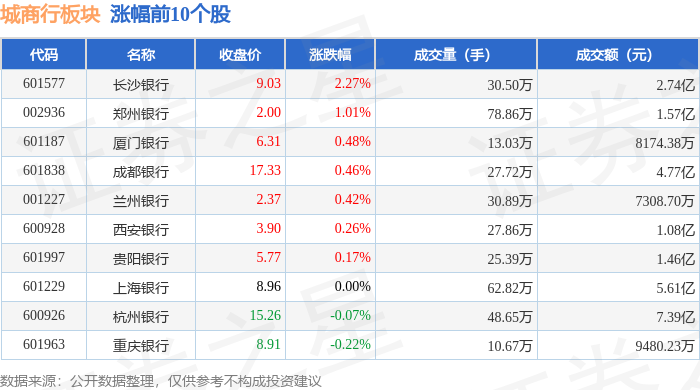
城商行板块10月9日跌0.34%,苏州银行领跌,主力资金净流出7.64亿元
Zheng Xing Xing Ye Ri Bao· 2025-10-09 09:03
Core Insights - The city commercial bank sector experienced a decline of 0.34% on October 9, with Suzhou Bank leading the drop [1] - The Shanghai Composite Index closed at 3933.97, up 1.32%, while the Shenzhen Component Index closed at 13725.56, up 1.47% [1] Stock Performance - Notable gainers included: - Changsha Bank: Closed at 9.03, up 2.27% with a trading volume of 305,000 shares and a turnover of 274 million yuan [1] - Zhengzhou Bank: Closed at 2.00, up 1.01% with a trading volume of 788,600 shares and a turnover of 157 million yuan [1] - Notable decliners included: - Suzhou Bank: Closed at 8.07, down 1.10% with a trading volume of 512,100 shares and a turnover of 413 million yuan [2] - Ningbo Bank: Closed at 26.18, down 0.95% with a trading volume of 391,800 shares and a turnover of 1.024 billion yuan [2] Capital Flow - The city commercial bank sector saw a net outflow of 764 million yuan from institutional investors, while retail investors contributed a net inflow of 230 million yuan [2][3] - Specific stock capital flows indicated: - Ningbo Bank: Institutional net inflow of 25.45 million yuan, retail net inflow of 30.74 million yuan [3] - Qingdao Bank: Institutional net inflow of 21.20 million yuan, but retail net outflow of 32.20 million yuan [3]


消费贷“贴息”新政首月成效几何?有大行豪揽签约客户超60万户
Feng Huang Wang· 2025-10-09 05:20
Core Viewpoint - The "Consumer Loan Interest Subsidy Policy" implemented from September 1 has seen mixed responses from banks, with some reporting growth in consumer loan balances while others indicate minimal changes in application and issuance rates [1][3]. Group 1: Policy Implementation and Bank Responses - The new policy has been in effect for a month, with state-owned banks reporting a 30% year-on-year growth in consumer loan balances by the end of September [1][2]. - Some banks, including major state-owned banks, have signed over 600,000 clients for the subsidy service, indicating a proactive approach to promote consumer loans [2]. - However, many banks have not observed significant changes in consumer loan applications and issuances, with some citing a lack of expected high growth [3]. Group 2: Participation and Market Dynamics - Currently, only six major state-owned banks and twelve joint-stock banks are participating in the subsidy program, limiting its potential impact [4]. - There is a belief that involving more local banks could enhance the effectiveness of the policy, as some smaller banks may have better local market knowledge and relationships [4][5]. - Despite the competitive landscape, some banks are adopting a conservative approach to consumer loan issuance due to pressure from non-performing loans [8]. Group 3: Future Outlook and Challenges - The consumer loan sector is viewed as a critical area for banks, with expectations of increased lending in the fourth quarter and early next year [7]. - The competition among banks is intensifying, particularly as state-owned banks increase their lending, which poses challenges for mid-sized banks [8]. - Concerns have been raised regarding the proper use of consumer loans, with reports of potential misuse and the emergence of fraudulent activities [8].