
成长风格投资

Search documents
国泰海通证券3月基金投资策略:A股延续上涨行情,重视主投周期和科技领域基金
GUOTAI HAITONG SECURITIES· 2026-03-01 08:26
Group 1 - The report indicates that the A-share market continued its upward trend in February 2026, despite experiencing short-term fluctuations at the beginning of the month. The recommendation is to maintain a balanced investment style while slightly favoring growth, particularly in the technology sector and cyclical industries [1][7][59]. - The report highlights that the focus of China's economic strategy is shifting towards domestic demand, which is expected to drive economic recovery and stabilize property prices. This shift is seen as a long-term national strategy rather than a short-term policy [9][10][11]. - The report identifies high-prospect industries for investment, including non-ferrous metals, machinery, steel, defense, basic chemicals, and communications, suggesting a rotation strategy towards these sectors through ETFs [61]. Group 2 - The report notes that the performance of growth-style funds has outpaced that of balanced and value-style funds, with specific sectors like midstream manufacturing and upstream cyclical industries showing strong returns [44][45]. - The report mentions that in February 2026, a total of 109 new funds were established, with a total fundraising amount of 906.40 billion, marking the highest level for the same period in four years. The enthusiasm for equity funds remains high due to the recovering A-share market [51][52]. - The report emphasizes the importance of selecting funds with strong stock-picking and risk control capabilities, particularly in the context of the ongoing recovery in the A-share market [59].
市场风险偏好将进入修复期
Changjiang Securities· 2026-02-08 11:52
- The report highlights the monthly performance of strong stocks, indicating that despite the adjustment of heavyweight stocks, small-cap stocks provided a hedge, but the overall market profitability was weak, with total market turnover dropping from 3.99 trillion yuan on January 14 to 2.16 trillion yuan on February 6[6] - The top 20 stocks with the highest gains in February are listed, including sectors such as space photovoltaics, batteries, copper connections, innovative drugs, real estate, and more, with the highest gain reaching 80.52% for *ST立方[6] - The report provides a detailed analysis of the maximum gains in various sectors since the start of the bull market, with telecommunications and metal materials/mining sectors achieving the highest gains of 218% and 217%, respectively, from February 5, 2024, to February 7, 2026[9]
永赢基金李文宾:坚守高质量成长,聚焦前瞻性配置
ZHESHANG SECURITIES· 2026-01-17 15:13
- 李文宾专注于成长风格,注重挖掘高质量成长型企业,并通过前瞻性行业配置和选股交易实现超额收益[1][2][3] - 李文宾的代表产品包括万家成长优选A和永赢科技驱动A,前者在其管理期间年化收益率为12.81%,后者年化收益率为88.09%[2][14][27][29] - 李文宾的投资理念包括三个核心问题:真成长还是假成长、成长空间、成长质量和确定性[12] - 李文宾在行业配置上具有较高的胜率,14个半年期中13期的前五大重仓行业包含当期全市场涨幅前30%的行业[35] - 李文宾在选股中偏好高质量成长企业,重仓股营收同比增速和ROE均值显著高于中证800成长指数[47][48][49][50][51] - 李文宾善于挖掘冷门黑马股,44%的重仓股在重仓起始时的持仓基金数量不超过50只[52][53][54][55] - 李文宾的左侧止盈策略有效规避了回调风险,75%的个股在调出重仓后下季度下跌[58][60][61] - 李文宾后市关注AI、创新药、可控核聚变和反内卷相关的周期性产业[62]
巴菲特的护城河理论:企业长期盈利的秘密 | 螺丝钉带你读书
银行螺丝钉· 2026-01-10 13:52
Core Viewpoint - The article discusses the investment philosophy of Warren Buffett, particularly focusing on the concept of "economic moats" and how it influences value investing strategies. It contrasts different investment styles, including growth investing and value investing, and highlights the importance of understanding a company's competitive advantages for long-term investment success [3][31][42]. Group 1: Investment Styles - The article introduces two distinct investment styles represented by different investment masters: growth investing, exemplified by firms like Baidu, and value investing, represented by Buffett [5][12]. - Growth investing focuses on identifying sectors with significant future potential and making early investments, even in companies that are not yet publicly listed [13][14]. - Value investing, particularly Buffett's approach, has evolved from deep value strategies to a focus on purchasing high-quality companies at reasonable prices for long-term holding [27][30]. Group 2: Economic Moats - Economic moats are essential for identifying companies with sustainable competitive advantages, which are crucial for long-term profitability [36][42]. - Buffett's moat theory emphasizes the importance of a company's ability to maintain its competitive edge over time, which is vital for delivering substantial returns to investors [37][38]. - The article provides an example of how Buffett invested in Apple when it had established itself as a leader in the smartphone market, demonstrating the application of the moat concept in investment decisions [43]. Group 3: Historical Context - The evolution of Buffett's investment strategies is traced from his early "cigar butt" approach during World War II, where he capitalized on undervalued companies, to a more sophisticated strategy post-war that focused on a basket of undervalued stocks [16][22]. - The article notes that the investment landscape changed significantly after the war, leading to a shift in strategies among value investors, including the adoption of low P/E and low P/B strategies [23][25]. - The influence of peers like Charlie Munger and John Bogle on Buffett's investment philosophy is highlighted, showcasing how collaboration and shared insights can shape investment approaches [27][28].


每日钉一下(2025年收官,A股港股表现怎么样呢?)
银行螺丝钉· 2026-01-09 14:08
Group 1: A-shares Performance - In 2025, the overall A-share market, represented by the CSI All Share Index, increased by 24.60% [6] - The CSI 300 Index, representing large-cap stocks, rose by 17.66% [7] - The CSI 500 Index, representing mid-cap stocks, saw a significant increase of 30.39% [8] - The CSI 1000 Index, representing small-cap stocks, increased by 27.49% [9] - In 2024, large-cap stocks performed better, but in 2025, small-cap stocks outperformed [9] Group 2: Hong Kong Stocks Performance - The Hong Kong stock market also experienced an overall increase, with the Hang Seng Index rising by 27.77% [14] - The Hang Seng Dividend Low Volatility Index, representing value stocks, increased by 18.97% [14] - The Hong Kong Technology Index, representing growth stocks, surged by 34.97% [14] - The performance of the Hang Seng Index surpassed that of the CSI 300 Index, indicating stronger performance in Hong Kong stocks [14] Group 3: Investment Style Trends - In 2025, growth style stocks became stronger, with the CSI 300 Growth Index rising by 29.52% compared to a 6.41% increase in the CSI 300 Value Index [13] - Over a longer time frame, both growth and value styles show similar long-term returns, although they differ in their performance phases [13] - The value style had been strong for three consecutive years from 2022 to 2024 [12]

用第一性原理解锁长期投资:柏基战胜纳斯达克的秘诀 | 螺丝钉带你读书
银行螺丝钉· 2026-01-03 14:08
Core Viewpoint - The article emphasizes the importance of understanding first principles in investment strategies, particularly in the context of growth investing and index funds, as exemplified by the investment philosophy of Baoki [4][12][60]. Group 1: Investment Philosophy - Baoki is recognized as a successful institution in growth-style investing, focusing on future trend predictions [3][4]. - The first principle in investing is highlighted as low cost, which is derived from the teachings of John Bogle, the father of index funds [12][13]. - The article argues that despite market inefficiencies, index funds have become dominant in the A-share market over the past decade [23][25]. Group 2: First Principles in Investment - The first principle is defined as the most fundamental propositions within a system [7]. - The article uses index funds as an example to illustrate that all stocks combined equal the market index, and thus, the collective returns of all shareholders equal the market index returns, minus fees [14][16]. - It is noted that different market participants incur varying fees, and index funds typically have lower costs, leading to superior long-term returns [20][21]. Group 3: Identifying Trends and Principles - Baoki's approach to identifying trends involves engaging with academic circles and individuals with deep insights across various fields [32][37]. - The article mentions that understanding first principles can help in recognizing emerging technologies and market trends [39]. - Historical data shows that a small percentage of stocks generate the majority of market returns, emphasizing the challenge of predicting which companies will succeed [42][45]. Group 4: Patience in Investment - The article stresses the necessity of patience in investing, suggesting that even with the right trends and principles, it takes time for investments to yield results [48][50]. - Baoki evaluates investments over a 10-year horizon, contrasting with the shorter evaluation periods typical in the industry [51][52]. - The article concludes that successful investors, including renowned figures like Warren Buffett, share a common trait of patience in their investment strategies [56][60].

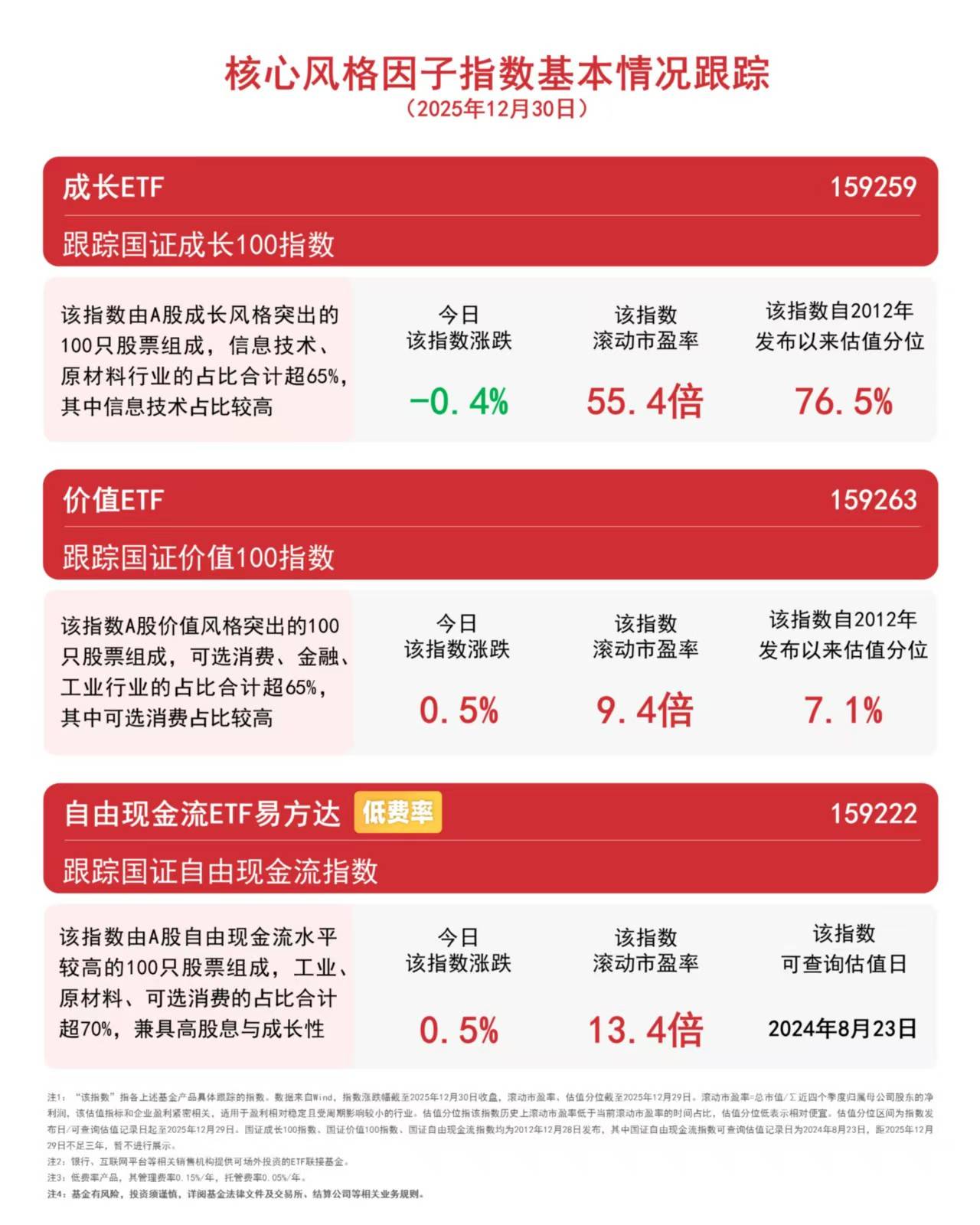
有色金属、石油石化板块走强,关注价值ETF(159263)、自由现金流ETF易方达(159222)等投资机会
Sou Hu Cai Jing· 2025-12-30 10:17
Group 1 - The market experienced fluctuations today, with sectors such as non-ferrous metals and oil & petrochemicals showing strength, leading to an increase in related indices [1] - By the market close, the Guozheng Value 100 Index and Guozheng Free Cash Flow Index both rose by 0.5%, while the Guozheng Growth 100 Index fell by 0.4% [1] - The Value ETF (159263) saw a net subscription of 36 million units throughout the day [1] Group 2 - The Guozheng Value 100 Index employs a three-dimensional screening system based on "high dividends + high free cash flow + low price-to-earnings ratio" to select value stocks, demonstrating stable historical performance [3] - The Guozheng Free Cash Flow Index selects stocks based on free cash flow rates, combining high dividends with growth potential [3] - The Value ETF (159263) and the E Fund Free Cash Flow ETF (159222) track the aforementioned indices, providing investors with opportunities to capitalize on related investment styles [1][3]
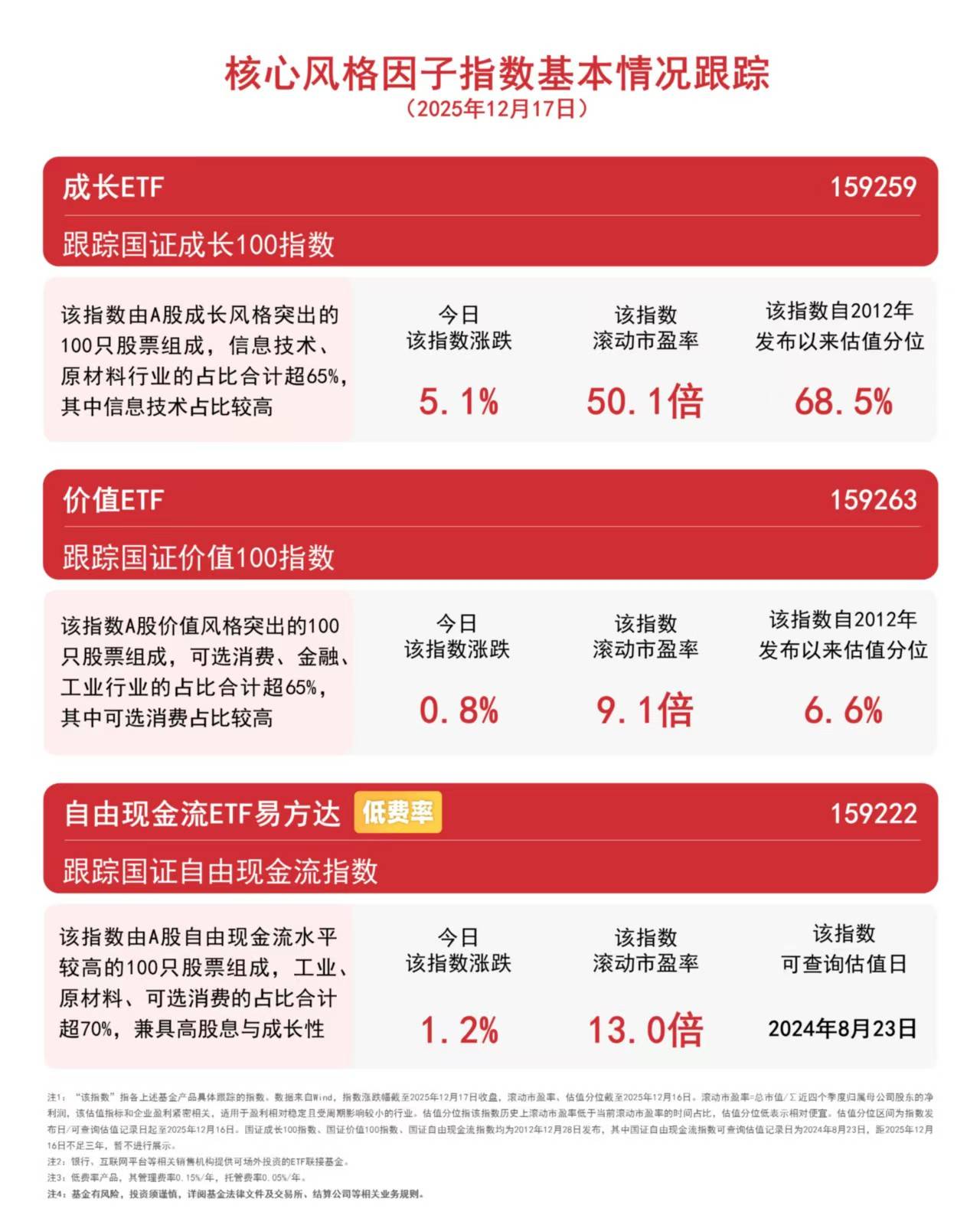
科技方向再次走强,成长ETF(159259)标的指数涨超5%
Sou Hu Cai Jing· 2025-12-17 11:28
Core Viewpoint - The market showed strong performance in the afternoon, particularly in the technology sector, with the Guozheng Growth 100 Index rising by 5.1%, indicating a robust interest in growth-style investments [1]. Group 1: Market Performance - The Guozheng Growth 100 Index increased by 5.1%, while the Guozheng Free Cash Flow Index rose by 1.2%, and the Guozheng Value 100 Index went up by 0.8% [1]. - The trading volume for the Growth ETF (159259) reached approximately 130 million yuan, significantly higher than previous days, reflecting active market participation [1]. Group 2: Index Composition - The Guozheng Growth 100 Index focuses on A-share stocks with a strong growth style, with over 70% of its weight concentrated in the electronics, communications, and computer sectors, aligning with the core areas of AI computing power [1]. - The Growth ETF (159259) is the only product tracking this index, providing investors with opportunities to capitalize on growth-style investments [1]. Group 3: Sector Analysis - The Guozheng Growth 100 Index consists of 100 stocks, with the information technology and materials sectors accounting for over 65% of the index, highlighting a significant emphasis on technology [3]. - The Guozheng Value 100 Index, which tracks 100 value-style stocks, has over 65% of its weight in consumer discretionary, financial, and industrial sectors, with consumer discretionary having a high proportion [3]. - The Guozheng Free Cash Flow Index includes 100 stocks with high free cash flow levels, with industrial, materials, and consumer discretionary sectors making up over 70%, combining high dividends and growth potential [3].
业绩与规模双杀,大成基金为何读不懂2025?|基金观察
Sou Hu Cai Jing· 2025-12-15 02:09
Core Viewpoint - In 2025, while the A-share market thrives led by technology growth, Dacheng Fund's equity products significantly lag behind, resulting in a decline in scale and contrasting sharply with overall market performance [1]. Group 1: Market Performance - The stock market is experiencing a robust year, with the CSI 300 index rising by 14.82% as of December 10, 2025, and the Shanghai Composite Index briefly surpassing 4000 points [2]. - The total share of equity funds in the market increased from 199.208 billion shares at the beginning of the year to 223.348 billion shares, marking a growth of 12.1% [4]. Group 2: Dacheng Fund's Performance - Dacheng Fund's equity fund share decreased from 24.38 billion shares at the beginning of the year to 20.09 billion shares, a decline of 17.6% [4]. - The flagship product, Dacheng Gaoxin A, achieved a return of only 15.76% this year, ranking 723 out of 969 in its category [6][7]. - Dacheng Gaoxin A's year-to-date performance is below its benchmark of 18.09% and the CSI 300's 16.69% [7]. Group 3: Investment Style and Strategy - Dacheng Fund has a significant reliance on a "deep value" investment style, with over 70% of its actively managed equity products concentrated among three key fund managers [8]. - The overall allocation to growth style investments at Dacheng Fund is only 21%, which is below the industry average of over 30% [8]. - The fund manager Xu Yan's products have maintained around a 14% return this year, focusing on independent research rather than chasing market trends [8]. Group 4: Challenges and Future Outlook - Dacheng Fund's performance in 2025 reflects a mismatch between its deep value investment style and the prevailing market growth style, highlighting challenges in investment style diversification and market adaptability [29]. - The company emphasizes a "long-termism" philosophy, suggesting that the evaluation of its strategies should consider long-term returns rather than short-term market movements [29].
【晨星焦点基金系列】:瑞士百达策略收益基金:灵活捕捉全球多资产配置机会的香港互认基金
Morningstar晨星· 2025-11-27 01:05
Core Viewpoint - The fund adopts a flexible global asset allocation strategy aimed at achieving long-term capital growth and income while managing downside risks. The strategy allows for dynamic adjustments across various asset classes to adapt to changing market conditions [5][10]. Fund Overview - Fund Code: 968175 - Fund Type: Flexible USD Mixed Equity and Bond - Benchmark Index: Morningstar Europe USD Investment Target Risk Balanced Allocation Index (USD) - Fund Size: 14.78 billion CNY as of November 24, 2025 - Fund Managers: Huang Siyuan, Fan Zhizhen, Guo Shaoyu - Fund Company: Swiss Pictet Asset Management - Annual Comprehensive Fee Rate: 1.69%, slightly above the peer median of 1.63% [1][13]. Historical Performance - From May 2017 to October 2025, the fund achieved an annualized return of 7.93%, outperforming the Morningstar peer benchmark by 90 basis points and ranking in the 14th percentile among similar funds [1][11]. - The fund's volatility, measured by standard deviation, was 8.98%, lower than the peer average of 9.30% during the same period [11]. Asset Allocation Strategy - The fund's asset allocation is flexible, with stock positions ranging from 20% to 70%, bond positions from 15% to 60%, and cash positions sometimes reaching 20%. Additionally, investments in gold, alternative assets, and real estate typically do not exceed 5% [5][6]. - The investment themes include long-term structural growth, cyclical opportunities, and diversified income, allowing the fund managers to adjust allocations based on market conditions [5][6]. Management Team - The fund is managed by Huang Siyuan, who has 23 years of investment management experience, supported by Fan Zhizhen and Guo Shaoyu, who have 10 and over 20 years of experience, respectively. The team collaborates closely, leveraging resources from Pictet's global multi-asset department [2][4]. Investment Style - The fund's investment style has shifted from a balanced/value approach before 2020 to a growth-oriented style since then. This flexibility in style impacts the fund's performance based on the manager's asset and stock selection [10][11].
