
特变电工

Search documents
特变电工跌2.02%,成交额6.61亿元,主力资金净流出1.27亿元
Xin Lang Cai Jing· 2025-09-16 02:41
Company Overview - TBEA Co., Ltd. is located in Changji City, Xinjiang Uygur Autonomous Region, established on February 26, 1993, and listed on June 18, 1997. The company's main business includes power transmission and transformation, new energy, and energy-related services [1][2]. Financial Performance - For the first half of 2025, TBEA achieved operating revenue of 48.401 billion yuan, a year-on-year increase of 1.17%, and a net profit attributable to shareholders of 3.184 billion yuan, up 4.93% year-on-year [2]. - Since its A-share listing, TBEA has distributed a total of 15.118 billion yuan in dividends, with 6.591 billion yuan distributed in the last three years [3]. Stock Performance - As of September 16, TBEA's stock price decreased by 2.02%, trading at 14.56 yuan per share, with a total market capitalization of 73.569 billion yuan. The stock has increased by 16.57% year-to-date, with a 1.29% decline over the last five trading days [1]. - The stock's trading volume on September 16 was 6.61 billion yuan, with a turnover rate of 0.89% [1]. Shareholder Information - As of June 30, 2025, TBEA had 319,300 shareholders, a decrease of 4.42% from the previous period, with an average of 15,826 circulating shares per shareholder, an increase of 4.62% [2]. - The top ten circulating shareholders include Hong Kong Central Clearing Limited, holding 222 million shares, an increase of 66.6393 million shares from the previous period [3].
主题投资 | 123家『新疆振兴』涉及上市公司初筛选
Sou Hu Cai Jing· 2025-09-15 13:10
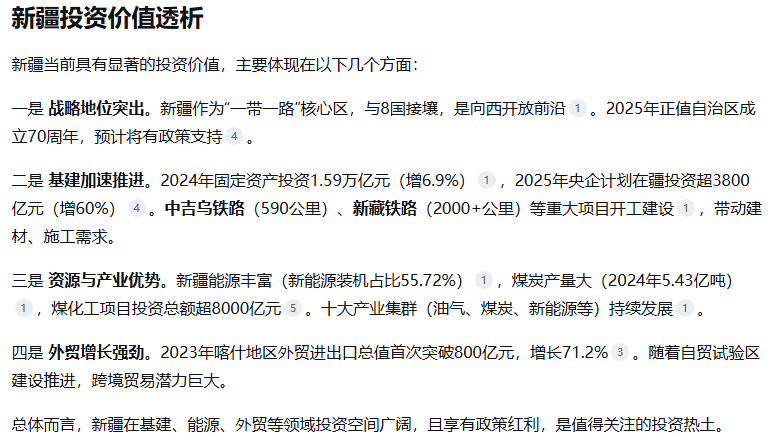
Core Viewpoint - The focus is on identifying companies with inherent competitive advantages after stripping away thematic elements, particularly in the context of the "Xinjiang Revitalization" theme [1]. Group 1: Company Selection and Financial Metrics - A total of 123 companies related to the "Xinjiang Revitalization" theme were initially screened down to 14 companies through a three-step process [1]. - The current market includes 280 companies involved in "humanoid robots," with 122 listed on A-shares, 2 on Hong Kong stocks, and 1 company listed on both [3]. - The top three companies by market capitalization are SANY Heavy Industry at 179 billion, China Oil Capital at 140.8 billion, and Shenwan Hongyuan at 127.4 billion [5]. - The median operating revenue for companies in this theme is 3.13 billion, while the average is 10.9 billion [7]. - The top three companies by net profit attributable to shareholders are SANY Heavy Industry, Shenwan Hongyuan, and Longyuan Power, with a median net profit of 0.08 billion and an average of 0.44 billion [9]. Group 2: Trading and Profitability Metrics - The top three companies by average daily trading volume over the past month are China Oil Capital at 4.7 billion, Supply and Marketing Collective at 2 billion, and TBEA at 1.9 billion [11]. - The median gross profit margin for companies in this theme is 20.6% [13]. - The median net profit margin is 2.7% [15]. - The median return on equity (ROE) for these companies is 0.0% [17]. Group 3: R&D and Capitalization - The data regarding R&D expenses and capitalization rates are based on the latest annual reports available [19].




林伯强:气候风险冲击农村能源安全丨能源思考
Di Yi Cai Jing· 2025-09-15 12:28
Core Viewpoint - Climate risks are increasingly impacting rural energy systems, necessitating enhanced infrastructure and targeted policy recommendations to mitigate these effects [1][4]. Rural Energy Infrastructure Status - The government is placing significant emphasis on rural energy infrastructure, supported by policies and financial assistance such as low-interest loans and subsidies [2]. - Notable progress has been made in rural energy infrastructure, with increased investment in rural power grids and a significant expansion in coverage [2]. - The rapid development of renewable energy, particularly through initiatives like the photovoltaic poverty alleviation program, has led to a substantial increase in installed capacity [2]. Future Development Focus - Future development will prioritize renewable energy, especially distributed energy systems, and smart grid construction to enhance resilience against climate risks [3]. - The share of fossil fuels in rural energy systems is decreasing, with a broad outlook for renewable energy development [3]. Impact of Climate Risks - Climate risks directly damage energy infrastructure, increasing operational risks for rural energy systems [4][5]. - The costs associated with adapting rural energy infrastructure to climate risks are rising, leading to increased operational burdens [4][6]. - Climate risks contribute to decreased stability and efficiency in energy transportation, impacting overall effectiveness and increasing costs [6]. Strategies to Address Climate Risks - Selecting appropriate locations for energy infrastructure to enhance resilience against climate risks is crucial [7]. - Establishing a climate warning mechanism to improve preemptive capabilities against extreme weather events is necessary [8]. - Promoting advanced energy technologies and improving the smart management of rural energy infrastructure will bolster resilience [9]. - Training energy personnel on climate risk awareness is essential to reduce failure rates in energy infrastructure [10].
2025中国企业500强发布!营业收入达110.15万亿元


2 1 Shi Ji Jing Ji Bao Dao· 2025-09-15 08:52
Core Insights - The "2025 China Top 500 Enterprises" list was released by the China Enterprise Confederation on September 15, highlighting the leading companies in the country [1] - State Grid Corporation, China National Petroleum Corporation, and China Petroleum & Chemical Corporation ranked as the top three companies on the list [1] Financial Performance - The total operating revenue of the 2025 China Top 500 Enterprises reached 110.15 trillion yuan, with the entry threshold rising for the 23rd consecutive year to 47.96 billion yuan, an increase of 579 million yuan [1] - The total net profit attributable to the parent company amounted to 4.71 trillion yuan, reflecting a growth of 4.39% [1] Scale of Enterprises - The number of enterprises with operating revenues exceeding 100 billion yuan significantly increased, with 267 companies in the 2025 list surpassing this threshold, an increase of 14 from the previous year [1] - Companies with revenues over 100 billion yuan accounted for 53.4% of the total [1]
电网设备板块9月15日跌0.18%,*ST惠程领跌,主力资金净流出3079.13万元
Zheng Xing Xing Ye Ri Bao· 2025-09-15 08:43
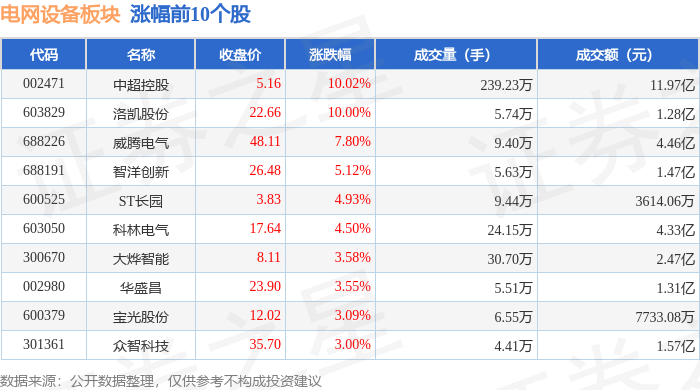
Market Overview - The net outflow of main funds in the power equipment sector was 30.79 million yuan, while retail investors saw a net inflow of 92.98 million yuan [2][3] - The overall performance of the power equipment sector showed a decline of 0.18% on the previous trading day, with the Shanghai Composite Index closing at 3860.5, down 0.26% [1] Stock Performance - *ST Huicheng led the decline in the power equipment sector, with a closing price of 4.22 yuan, down 4.95% [2] - Zhongchao Holdings saw a significant increase of 10.02%, closing at 5.16 yuan, with a trading volume of 2.39 million shares [1] - Other notable gainers included Longkai Co., which rose by 10.00% to 22.66 yuan, and Weiteng Electric, which increased by 7.80% to 48.11 yuan [1] Trading Volume and Value - The trading volume for Zhongchao Holdings was 2.39 million shares, with a transaction value of approximately 1.197 billion yuan [1] - The total transaction value for the power equipment sector was highlighted, with significant contributions from stocks like Jinlongyu, which had a transaction value of 860 million yuan despite a decline of 3.42% [2] Fund Flow Analysis - The main funds showed a net inflow in stocks like Wanma Co. and TBEA, while experiencing outflows in stocks like Longkai Co. and Jindian Technology [3] - The net inflow of retail investors was particularly notable in Zhongchao Holdings, indicating strong retail interest despite the overall sector decline [3]

再提光伏反内卷,光伏龙头ETF(516290)冲高回落微涨,近5日吸金超4000万元!阳光电源大涨超3%,储能需求超预期!
Xin Lang Cai Jing· 2025-09-15 06:53
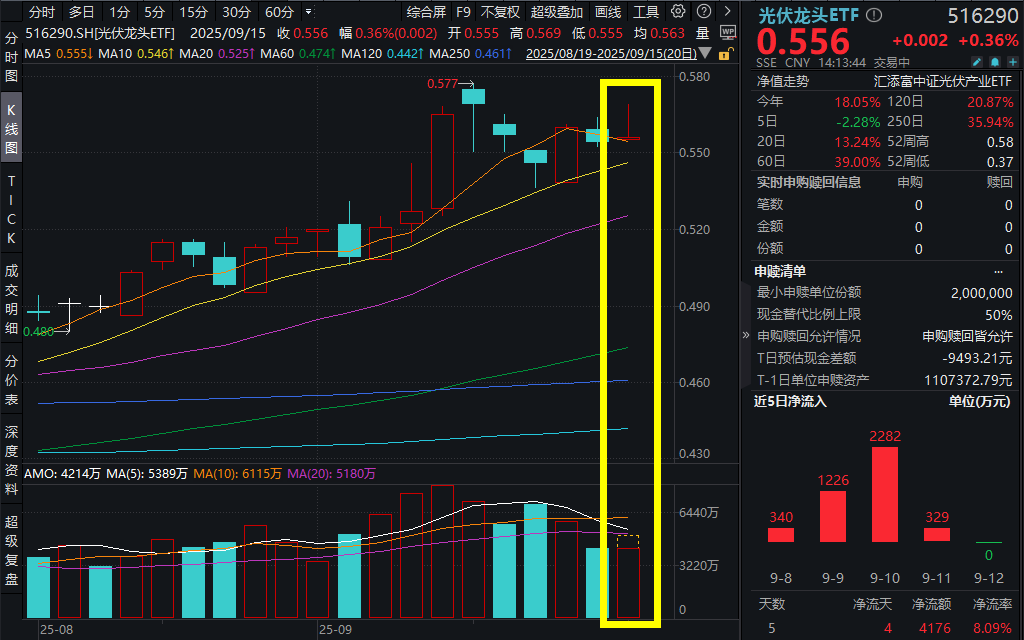
Core Insights - The A-share market showed a mixed performance on September 15, with the new energy sector leading the gains, particularly the photovoltaic (PV) sector, as evidenced by the slight increase of 0.36% in the leading photovoltaic ETF (516290) [1] - The photovoltaic ETF (516290) experienced a net inflow of over 40 million yuan in the past five days, with four consecutive days of inflows [1] - The Ministry of Industry and Information Technology (MIIT) has emphasized the need for self-discipline in the photovoltaic industry to address supply-demand imbalances, indicating a potential policy-driven recovery for the sector [4] Market Performance - The component stocks of the photovoltaic ETF (516290) exhibited mixed performance, with notable gains from Yangguang Electric (over 3%) and slight increases from TCL Technology and TBEA, while stocks like Robotech and Kehua Data saw minor declines [3] - The recent government initiatives aim to stabilize the photovoltaic industry and promote healthy development, which may lead to a reversal in the sector's fortunes [4] Price Trends - The price of polysilicon has rebounded significantly, rising from 34,400 yuan/ton at the end of June to 47,100 yuan/ton by the end of July, marking a 36.9% increase [4] - The price index for polysilicon used in silicon ingots increased from 46 yuan/kg to 48 yuan/kg, translating to approximately 5.95 USD/kg [4] Future Outlook - Analysts suggest that the ongoing efforts to curb irrational competition in the photovoltaic sector may lead to a recovery in polysilicon prices and overall market conditions [6] - The core drivers for potential price increases in Q4 include policy support, stabilization of industrial silicon prices, and the implementation of production limits, which may enhance cost recovery across the supply chain [6] - The photovoltaic sector is expected to experience a fundamental recovery, with positive sentiment anticipated as the industry navigates through current challenges [6]

新能源ETF(516160)强势走高,盘中涨超4%,宁德时代涨超13%,机构:储能产业盈利拐点显现
Xin Lang Cai Jing· 2025-09-15 03:20
Group 1 - The core viewpoint of the news highlights the strong performance of the New Energy ETF (516160), which saw a significant increase of over 4% during trading, with a turnover of 4.21% and a transaction volume of 253 million yuan [1] - The China Securities Index for new energy rose by 2.95%, with notable increases in constituent stocks such as Hunan YN Energy (up 13.87%), Jing Sheng Mechanical Electrical (up 11.40%), and CATL (up over 13%) [1] - Recent government initiatives, including the "New Energy Storage Scale Construction Special Action Plan (2025-2027)," aim for a new energy storage capacity of 180 GW by 2027, driving direct investment of approximately 250 billion yuan [1] Group 2 - The storage industry is gaining attention due to overseas demand recovery and price increases, with a focus on the new energy storage "doubling plan" providing ongoing support for installations [2] - The capacity compensation mechanism is evolving, transforming storage from a cost item to a profit item, which is expected to enhance profitability in the sector [2] - The penetration rate of China's new energy vehicle market surpassed 30% in 2023 and is projected to exceed 50% in 2024, indicating a competitive landscape with a focus on strong product offerings and stable supply chains [2] Group 3 - The New Energy ETF (516160) closely tracks the China Securities New Energy Index, which includes companies involved in renewable energy production, application, storage, and related equipment [3] - The top ten weighted stocks in the index include CATL, Sungrow Power Supply, Longi Green Energy, and others, reflecting the overall performance of the new energy sector [3]

SST固态变压器近况更新
2025-09-15 01:49
Summary of SST Solid-State Transformer Conference Call Industry Overview - The data center power supply architecture is evolving from traditional UPS to HVDC and SST to reduce AC-DC conversion losses and improve energy efficiency [1][2] - SST utilizes high-frequency electronic transformers to replace traditional power frequency transformers, significantly enhancing efficiency and reducing footprint [1] Key Points and Arguments - **Efficiency and Space Reduction**: SST can reduce the footprint by nearly three times compared to traditional UPS for a 2 MW power requirement, with construction cycles shortened from 12 months to approximately one quarter [1][4] - **Cost Structure**: The current cost per watt for SST is around 7-8 RMB, expected to stabilize at 5-6 RMB post-mass production. The main cost components include power devices (40%-50%), high-frequency transformers (25%), and low-voltage DC circuit breakers (10%) [1][6][9] - **Market Dynamics**: The overseas SST market is dominated by joint ventures like Hitachi Energy, ABB, Eaton, and Schneider, while domestic players include China XD Group and TBEA [1][11] - **Future Projections**: By 2030, Schneider anticipates shipping 1,000 SST units in China, with an overall market size expected to reach 10,000 units and a total capacity of approximately 30 GW [1][11] Cost Comparison - **SST vs. Traditional Solutions**: SST costs are approximately 2 to 4 times higher than traditional UPS due to supply chain complexities and labor costs in the U.S. [2][13] - **Domestic vs. Overseas Pricing**: Domestic UPS averages 0.5-0.6 RMB per watt, while joint venture brands are around 1 RMB per watt. HVDC offers a 20%-30% premium over traditional UPS [6][9] Technological Advancements - **Third-Generation SST**: This generation further enhances efficiency through the use of silicon carbide and gallium nitride power devices, reducing energy loss and fault rates [3][10] - **Technical Barriers**: Key barriers include rectification processes, electromagnetic compatibility, thermal management, and supply chain management for high-frequency transformers and semiconductor devices [17][18] Market Entry Strategies - **Domestic Firms in North America**: To penetrate the North American market, domestic firms should consider entering through low-voltage distribution products, as seen with Jinpan and Igor's progress in distribution transformers [19] - **Partnerships and Collaborations**: Companies like Schneider and Eaton are actively seeking partnerships to enhance their technology offerings, particularly in liquid cooling and HVDC [21][22] Demand and Supply Insights - **Major Demand Players**: Companies like Microsoft and Meta show significant interest in SST technology, while Google prefers traditional HVDC architectures [23] - **Supply Chain Dynamics**: The supply chain is characterized by a mix of domestic and joint venture companies, with a focus on integrating new technologies into existing frameworks [11][12] Conclusion - The SST industry is poised for growth, with expectations of reaching G-Watt scale by 2026-2027, driven by increasing interest from major tech companies and advancements in technology [23]
新疆:“同心共舞”点亮万家灯火
Jing Ji Ri Bao· 2025-09-14 05:59
Core Insights - The Xinjiang region is experiencing significant development in its power transmission capabilities, particularly through the ±1100 kV Changji Converter Station, which enhances the efficiency of electricity transmission across multiple provinces [1][2] - The Jiquan DC project has successfully integrated various energy sources, including coal, wind, and solar power, with a growing proportion of renewable energy being transmitted [2] - The collaboration between local government and companies like TBEA has been crucial in advancing technology and supporting sustainable development in the energy sector [2][3] Group 1: Infrastructure and Technology - The Changji Converter Station is a key component of the Jiquan DC project, with a total line length of 3,293 kilometers and an annual electricity transmission capacity exceeding 62 billion kWh [1] - TBEA has developed the highest voltage level and most advanced technology in the industry with its ±1100 kV converter transformer, showcasing the company's leadership in the power transmission sector [2] - The company has overcome over 20 technical challenges related to converter valves and transformers, demonstrating its innovation capabilities [2] Group 2: Resource Utilization and Innovation - The transformation of crude oil into specialized transformer oil at PetroChina Karamay has addressed issues related to corrosion, heat dissipation, and insulation, significantly increasing the value of the product [3] - The development of dielectric cooling liquids by Karamay Petrochemical has extended the application of oil products, contributing to the local cloud computing industry [3] - The region is shifting from resource dependency to innovation-driven development, reflecting a broader trend of industrial transformation in Xinjiang [3]
“同心共舞”点亮万家灯火
Jing Ji Ri Bao· 2025-09-13 22:05
Group 1 - The Xinjiang region is experiencing significant development in its power transmission capabilities, particularly through the ±1100 kV Changji Converter Station, which plays a crucial role in the "Jiquan DC Project" that connects six provinces and regions [1] - The Jiquan DC Project has an annual electricity transmission capacity exceeding 62 billion kWh, showcasing its importance in the national power grid [1] - The project has evolved from the first "Double 800" ultra-high voltage DC transmission line in 2014 to the current 1100 kV level, marking a qualitative leap in technology [1][2] Group 2 - The Jiquan DC Project integrates various energy sources, including thermal, wind, and solar power, with the proportion of renewable energy increasing year by year [2] - TBEA Co., Ltd. is highlighted as a key player in the project, demonstrating advanced manufacturing capabilities and having overcome over 20 technical challenges in the field of power transmission and transformation [2] - The local government plays a supportive role in the development of the industry, emphasizing green, low-carbon, and sustainable growth while enhancing the industrial layout [2] Group 3 - The production of special transformer oil from ordinary crude oil at PetroChina Karamay Petrochemical Co., Ltd. addresses issues related to corrosion, heat dissipation, and insulation in transformers [3] - The development of dielectric cooling liquids has expanded the utility of local resources, contributing to the cooling needs of data centers in the cloud computing industry [3] - The region is transitioning from resource dependency to innovation-driven development, reflecting a broader industrial transformation in Xinjiang [3]