
中国平安

Search documents
上证深一度 | 具身机器人也有自己的保单 险企竞逐机器人保险业务
Shang Hai Zheng Quan Bao· 2026-01-08 00:06
Group 1 - The core viewpoint of the articles highlights the rapid growth of the robot rental market, which is expected to reach a scale of 100 billion yuan by 2026, leading to increased demand for insurance products tailored for robots [1][2] - The first "insurance + rental" policy for humanoid robots has been launched by Ping An Property & Casualty Insurance, which includes comprehensive coverage such as third-party liability and product quality liability, addressing the limitations of traditional insurance models [3][4] - Major insurance companies like PICC and Taikang are actively developing robot insurance products, offering flexible coverage options to meet diverse market needs, indicating a shift towards a dynamic financial ecosystem that supports the entire lifecycle of the robot industry [4][5] Group 2 - The development of robot insurance faces challenges such as data barriers, difficulty in risk assessment, and unclear liability definitions, which need to be addressed through collaboration and innovation within the industry [6][7] - Experts suggest that establishing a data-sharing platform involving regulatory bodies, technology companies, and insurance institutions is crucial for overcoming pricing and data challenges in robot insurance [6][7] - The insurance sector is moving from providing static risk coverage to creating a comprehensive financial ecosystem that supports the dynamic needs of the robot industry, reflecting a fundamental upgrade in the financial industry's support logic for robotics [4][5]


【钛晨报】直播电商监管新规出台,明确四类主体责任;工信部等八部门印发《“人工智能+制造”专项行动实施意见》;违反技术出口管制?Meta收购Manus案或生变数
Tai Mei Ti A P P· 2026-01-07 23:40
Regulatory Developments - The State Administration for Market Regulation and the National Internet Information Office jointly released the "Live E-commerce Supervision Management Measures," focusing on four main entities: platform operators, live room operators, marketing personnel, and service agencies, to enforce responsibilities and delineate behavioral boundaries [2][3] - The measures specify the responsibilities of live e-commerce platform operators, including identity verification, information reporting, training for marketing personnel, risk identification, and consumer rights protection [2] - Clear behavioral boundaries are established, prohibiting false advertising, commercial defamation, and the sale of illegal goods or services by live room operators and marketing personnel [2] Industry Impact - The measures aim to strengthen regulatory tools by incorporating traffic control and regulating AI-generated content, ensuring that new technologies do not facilitate the generation or dissemination of false information [3] - The implementation of these regulations is expected to enhance the operational integrity of the live e-commerce sector and protect consumer rights [2][3] Corporate Actions - ByteDance denied rumors regarding plans to enter the automotive industry, clarifying that there are no current intentions to manufacture vehicles [6] - Xiaomi's CEO Lei Jun confirmed that there are no plans for a new model, the Xiaomi SU3, amidst various speculations [7] Market Movements - The Chinese central bank reported an increase in gold reserves for the 14th consecutive month, with reserves reaching 7.415 million ounces (approximately 2306.323 tons) as of the end of December [27] - Domestic flight ticket prices have significantly dropped post-New Year, with some fares as low as 210 yuan (approximately 1.1% of the original price) for routes like Guangzhou to Shanghai [28]


智通港股通资金流向统计(T+2)|1月8日
智通财经网· 2026-01-07 23:35
Group 1 - The top three stocks with net inflows are Yingfu Fund (02800) with 6.826 billion, Hang Seng China Enterprises (02828) with 2.151 billion, and Kuaishou-W (01024) with 1.553 billion [1] - The top three stocks with net outflows are Tencent Holdings (00700) with -0.920 billion, China Mobile (00941) with -0.365 billion, and China Hongqiao (01378) with -0.257 billion [1] - In terms of net inflow ratio, Jiangsu Ninghu Expressway (00177) leads with 68.66%, followed by COSCO Shipping Ports (01199) with 62.64%, and Beijing Enterprises Water Group (00371) with 62.27% [1] Group 2 - The top ten stocks by net inflow include Xiaomi Group-W (01810) with 1.020 billion and Southern Hang Seng Technology (03033) with 0.944 billion [2] - The top ten stocks by net outflow also include China People's Insurance Group (01339) with -0.255 billion and GCL-Poly Energy (03800) with -0.213 billion [2] - The net outflow ratio for China National Building Material (03323) is -48.46%, followed by Gao Xin Retail (06808) at -48.27% and Swire Properties (01972) at -47.79% [3]


险资举牌热潮或将延续,银行股为何受青睐?
Guo Ji Jin Rong Bao· 2026-01-07 23:23
Core Viewpoint - Ping An Life has disclosed that it will increase its stake in Agricultural Bank of China H-shares to 20% by December 30, 2025, triggering a mandatory disclosure under Hong Kong market rules [1] Group 1: Investment Activities - This marks the fourth time Ping An Life has increased its stake in Agricultural Bank H-shares, having previously surpassed 5%, 10%, and 15% in February, May, and August 2025 respectively [4] - In 2025, Ping An Life also acquired 7.169 million shares of Postal Savings Bank H-shares, raising its stake to 5.01%, and subsequently increased its holdings to 10% and 15% in May and August [6] - Additionally, Ping An Life made multiple acquisitions of China Merchants Bank H-shares throughout 2025, surpassing 5%, 10%, 15%, and 20% in January, March, June, and December respectively [6] Group 2: Industry Trends - The enthusiasm for insurance capital to acquire shares has surged, with a total of 35 instances of share acquisitions in 2025, the highest since 2016 [5] - The preference for bank stocks among insurance companies is attributed to their average dividend yield exceeding 5%, which is significantly higher than the cost of liabilities (approximately 2% to 2.5%) [7] - The new financial instrument standards allow high-dividend bank stocks to be classified as FVOCI assets, reducing profit statement volatility [7] Group 3: Future Outlook - The trend of insurance capital actively acquiring shares is expected to continue into 2026, driven by low interest rates and the need for stable returns [8][10] - Analysts suggest that the motivations behind these acquisitions can be categorized into two types: one focused on stable dividend cash flows and the other on investing in mature, monopolistic enterprises with solid ROE [9][10] - The stock prices of major insurance companies have seen significant increases in 2025, with gains of 46.02% for New China Life, 35.87% for Ping An, and others [10]


货币市场日报:1月7日
Xin Hua Cai Jing· 2026-01-07 18:33
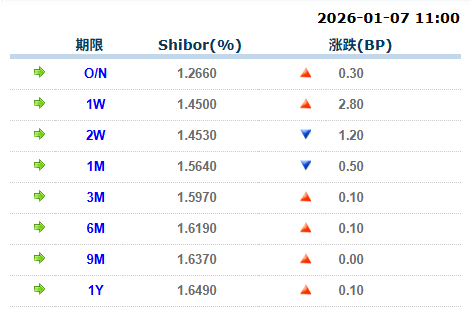
Group 1 - The People's Bank of China conducted a 286 billion yuan 7-day reverse repurchase operation at an interest rate of 1.40%, maintaining the previous rate, resulting in a net withdrawal of 500.2 billion yuan due to 528.8 billion yuan of reverse repos maturing on the same day [1] - The Shanghai Interbank Offered Rate (Shibor) showed slight fluctuations, with the overnight Shibor rising by 0.30 basis points to 1.2660%, and the 7-day Shibor increasing by 2.80 basis points to 1.4500% [2][3] - In the interbank pledged repo market, short-term funding rates remained stable, with the weighted average rates for overnight and 7-day repos increasing by 0.5 basis points and 3.0 basis points, respectively, while transaction volumes for these repos saw significant increases [5] Group 2 - The overall funding environment on January 7 was balanced and slightly loose, with overnight rates for repos trading in the range of 1.20% to 1.40%, indicating a stable funding situation throughout the day [10] - In the secondary market for negotiable certificates of deposit, trading sentiment was generally moderate, with yields for 1-month, 3-month, and 6-month deposits showing an upward trend, reflecting a slight increase in market rates [11] - The People's Bank of China announced plans for a 1.1 trillion yuan buyout reverse repo operation on January 8, with a term of 90 days, indicating ongoing liquidity management efforts [13]
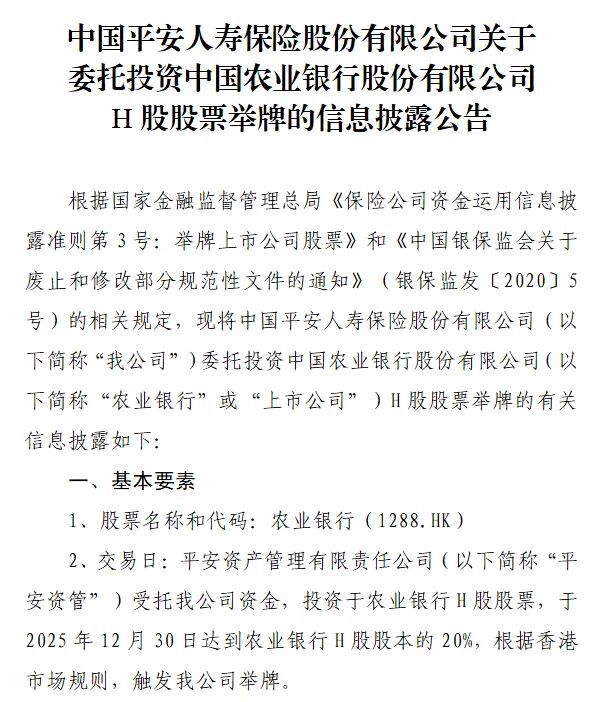
从5%到20%!平安人寿四度举牌农行H股,银行股为何受青睐?
Guo Ji Jin Rong Bao· 2026-01-07 15:40
Core Viewpoint - Ping An Life has disclosed that it will increase its stake in Agricultural Bank of China H-shares to 20% by December 30, 2025, triggering a mandatory disclosure under Hong Kong market rules [1]. Group 1: Investment Activities - This marks the fourth time Ping An Life has increased its stake in Agricultural Bank H-shares, having previously surpassed 5%, 10%, and 15% in February, May, and August 2025 respectively [4]. - In addition to Agricultural Bank, Ping An Life has also acquired shares in Postal Savings Bank and China Merchants Bank, with holdings reaching 5.01%, 10%, 15%, and 20% at various points in 2025 [6]. - Overall, in 2025, insurance capital made a total of 35 stake increases, the highest since 2016, indicating a growing trend in insurance investments [5][8]. Group 2: Reasons for Preference in Bank Stocks - Insurance companies are favoring bank stocks due to their average dividend yield exceeding 5%, which is significantly higher than the cost of liabilities (approximately 2% to 2.5%), making them attractive as "quasi-fixed income" assets [7]. - The new financial instrument standards allow high-dividend bank stocks to be classified in a way that stabilizes profit and loss statements, further encouraging investment [7]. - The stable performance and dividend consistency of bank stocks align with the long-term investment strategies of insurance companies, which seek value and stability [7]. Group 3: Future Outlook - The trend of insurance capital actively participating in equity markets is expected to continue, driven by low interest rates and regulatory support for long-term investments [8][10]. - Analysts suggest that the demand for bank stocks will persist, with insurance companies likely to focus on stable dividend-paying stocks and those with strong return on equity (ROE) [9][10]. - The stock prices of major insurance companies have shown significant increases in 2025, reflecting market confidence in the insurance sector's fundamentals [10].
农行,再度被举牌
2 1 Shi Ji Jing Ji Bao Dao· 2026-01-07 14:08
记者丨叶麦穗 编辑丨杨希 农行H股继续被平安举牌。香港联交所股权披露信息近日显示,2025年12月30日,平安人寿以5.7854港 元的平均价增持9558.2万股农业银行H股股份,合计耗资约5.53亿港元。在此次增持后,平安人寿持有 的农行H股股份由19.79%增至20.1%,触发举牌。 随着平安人寿的收尾举牌,2025年险资的举牌次数 达到39次,仅次于2015年的62次,为历史第二高。 险资扎堆H股 此前,平安人寿曾于2025年2月17日、5月12日、8月26日分别举牌农行H股,持有农行H股的比例分别达 到5%、10%、15%。以此计算,截至2025年12月30日,平安人寿持有约61.8亿股农行H股,持仓市值近 350亿港元。 除此之外,农行2025年三季报显示,平安人寿还在当年三季度新进农行A股前十大股东序列,至三季度 末持有农行49.13亿股A股股份,持股比例约1.4%。 在农行的股本结构中,H股占比不足9%。若平安人寿在去年四季度未减持农行A股,其合计持有的农行 股份超过3%。 就银行股2025年股价表现来看,农行A股股价年内涨幅达52.66%,稳居A股上市银行第一;农行H股年 内涨幅达40.83% ...

证券研究报告、晨会聚焦:非银葛玉翔:OCI选择权的两面性,税务追溯对现金流影响有限-20260107
ZHONGTAI SECURITIES· 2026-01-07 13:24
Core Insights - The report discusses the dual nature of the OCI (Other Comprehensive Income) option in the context of the tax adjustments for insurance companies transitioning to new accounting standards, indicating that the impact on cash flow from tax retroactivity is limited [3][4][6]. Summary by Sections Tax Adjustment Overview - The Ministry of Finance and the State Administration of Taxation issued a notice regarding the tax treatment for the transition to new insurance contract standards, effective from 2026, allowing companies to smooth out tax differences over five years [3][6]. - The overall impact of this tax adjustment on listed insurance companies is deemed limited, as most have already implemented the new standards since early 2023 [3][4]. Profitability and Tax Rates - Listed insurance companies have seen record high profits, with pre-tax profits in the first three quarters of 2025 exceeding the total for 2024, while actual tax rates have remained low, indicating a disconnect between tax obligations and operational performance [4][5]. - The average effective tax rates from 2020 to Q3 2025 were 10%, 8%, -1%, -6%, 12%, and 17%, with some companies reporting negative tax rates in certain years [4]. Impact of New Accounting Standards - The core difference in profits under the old and new accounting standards is attributed to the 750 curve, which has declined, affecting net profit levels, particularly for life insurance companies [5]. - The new standards provide an OCI option that mitigates the impact of interest rate declines on net profit, but it also removes the tax shield previously available under the old standards [5]. Cash Flow Implications - The tax adjustments are expected to have a minimal impact on operating cash flows, with the average effect on listed insurance companies estimated at 2.27%, while companies like Xinhua and China Life may experience a more significant impact of around 14% [6]. - The choice of how to account for retained earnings from the new standards will influence the actual cash flow effects, with options to either include them in the taxable income for 2026 or spread them over five years [6]. Investment Recommendations - The report suggests monitoring major listed insurance companies such as China Life, Ping An, China Pacific Insurance, Xinhua Insurance, and China Property & Casualty Insurance for potential investment opportunities [7].

中国平安,熬过来了
虎嗅APP· 2026-01-07 13:23
Core Viewpoint - China Ping An's stock price has surged recently, reaching over 70 yuan, with a market capitalization exceeding 1.3 trillion yuan, marking a significant recovery from its low in 2022 and approaching its historical high from 2020 [2][3]. Group 1: Stock Performance and Market Sentiment - The stock price of China Ping An has shown a remarkable increase of 160% from its low of 28.54 yuan in October 2022, and it is now close to its historical high of 82.60 yuan [2]. - In 2025, China Ping An's stock performance was notably strong, particularly in the fourth quarter, with a 25% increase compared to the third quarter, outperforming the overall market [3]. - Morgan Stanley has included China Ping An in its core recommendation list, raising its target price for A-shares from 70 yuan to 85 yuan and for H-shares from 70 HKD to 89 HKD [3]. Group 2: Business Challenges and Risks - Despite the positive stock performance, China Ping An faces challenges, including ongoing disputes with Huaxia Happiness, where it is a significant shareholder and creditor, leading to legal actions due to unresolved debt restructuring issues [4][5]. - The market, however, seems to overlook these challenges, as evidenced by the substantial capital inflow into the stock, with nearly 100 billion yuan invested in the CSI A500 ETF, of which China Ping An is a major component [6]. Group 3: Fundamental Changes and Strategic Focus - China Ping An is undergoing significant changes in its business strategy, focusing on core financial services and healthcare, while scaling back on loss-making technology ventures [10][11]. - The company is enhancing its competitive edge in life insurance and healthcare by integrating services and optimizing its product offerings, particularly in the areas of medical care and elderly care [11][12]. - Organizational changes are being implemented to foster a younger and more professional workforce, with key leadership positions being filled by younger executives [11]. Group 4: Financial Performance and Investment Strategy - In terms of financial performance, China Ping An reported a net profit of 1,328.56 million yuan for the first three quarters of 2025, with an 11.47% growth rate, although this was the lowest among its peers [17]. - The company has adopted a conservative investment strategy, focusing on fixed-income assets while increasing its allocation to equities, particularly high-dividend stocks in the banking sector [22][27]. - The investment performance has improved, with a non-annualized comprehensive investment return rate of 5.4% for the first three quarters of 2025, reflecting a shift towards a more stable investment approach [22][23]. Group 5: Market Position and Competitive Landscape - China Ping An is recognized as one of the most competitive companies in the insurance sector, with strong capabilities in product development, distribution channels, and technology application [38]. - Despite its strengths, the company does not significantly outperform other leading firms in the industry, which limits its ability to capture additional market share [38]. - The insurance market is expected to continue growing, driven by long-term trends such as aging demographics and increasing demand for wealth management and healthcare solutions [36].

具身智能机器人把我弄伤了,谁来赔?
Mei Ri Jing Ji Xin Wen· 2026-01-07 13:10
Core Insights - The emergence of embodied intelligent robots is accelerating their penetration into various application scenarios, highlighting the need for insurance coverage as these devices become more prevalent in public spaces [1][3] - Major insurance companies have begun to develop specialized insurance products for robots, covering property damage, third-party liability, and product quality risks, thereby establishing a risk management framework for their commercial use [1][2] Group 1: Insurance Product Development - Leading insurance companies have launched products that cover core risks such as robot body damage and third-party liability, with coverage limits reaching several hundred thousand yuan per unit [2] - The insurance for robot body damage operates on a "full coverage" logic similar to auto insurance, encompassing various scenarios including operational errors and cyber-attacks [2] - Third-party liability insurance includes coverage for design defects, external interaction module failures, and accidents during use, with flexible terms for different stakeholders [2][6] Group 2: Market Demand and Trends - The commercialization of embodied intelligent robots is driving a surge in insurance demand, with predictions that the robot leasing market could reach 10 billion yuan by 2026 [3][4] - The insurance landscape is evolving to address new risks associated with robots, extending coverage from basic operational errors to include disaster incidents and transportation damage [4][5] Group 3: Challenges in Insurance Services - The insurance sector faces challenges in data accumulation, with confidentiality of core technology data raising the bar for risk assessment [6] - The mismatch between the flexible needs of startup robot manufacturers and traditional insurance models creates barriers to product innovation and implementation [6] - The current conservative pricing of insurance products is attributed to a lack of real data, necessitating ongoing adjustments as more operational and risk data becomes available [7]