
招商公路

Search documents
招商公路(001965) - 2025年第三次临时股东会决议公告
2025-11-11 10:45
招商局公路网络科技控股股份有限公司 证券代码:001965 证券简称:招商公路 公告编号:2025-72 2025 年第三次临时股东会决议公告 本公司及董事会全体成员保证信息披露的内容真实、准确、完整,没有虚 假记载、误导性陈述或重大遗漏。 特别提示: 1、本次股东会无增加、变更、否决议案的情况; 2、本次会议采取现场投票与网络投票结合的表决方式。 一、会议召开和出席情况 2025 年 10 月 27 日,招商局公路网络科技控股股份有限公司(以下简称"公 司"或"招商公路")董事会以公告方式向全体股东发出召开公司 2025 年第三 次临时股东会的通知。本次会议以现场会议与网络投票相结合的方式召开。其中, 通过深圳证券交易所交易系统进行网络投票的具体时间为:2025 年 11 月 11 日 9:15—9:25,9:30—11:30 和 13:00—15:00;通过深圳证券交易所互联网系统投 票的具体时间为 2025 年 11 月 11 日 9:15—15:00。现场会议于 2025 年 11 月 11 日下午 14:50 分在公司 11 层会议室召开。 本次会议召集人为公司董事会,根据《公司章程》规定,经全体董 ...

招商公路(001965):Q3业绩同增4%,财务费用持续优化
Guolian Minsheng Securities· 2025-11-11 07:04
Investment Rating - The investment rating for the company is "Buy" (maintained) [6] Core Views - The company reported a 4% year-on-year decline in revenue for the first three quarters of 2025, totaling 8.703 billion yuan, and a 3.56% decrease in net profit attributable to shareholders, amounting to 4.012 billion yuan. In Q3 2025, revenue was 3.040 billion yuan, down 1.70% year-on-year but up 6.28% quarter-on-quarter, while net profit reached 1.509 billion yuan, reflecting a 3.91% year-on-year increase and a 28.45% quarter-on-quarter increase [4][12] Summary by Sections Financial Performance - In Q3 2025, the company achieved revenue of 3.040 billion yuan, a year-on-year decline of 1.70%, with operating costs rising by 7.28% to 1.990 billion yuan. The gross profit was 1.050 billion yuan, down 15.19% year-on-year, resulting in a gross margin of 34.54%, which is a decrease of 5.49 percentage points year-on-year. This decline was attributed to reduced toll revenue due to construction disruptions and increased maintenance costs during the national inspection year [13] Financial Expenses and Investment Income - Financial expenses decreased by 18% year-on-year, amounting to 352 million yuan, while investment income rose by 2.01% to 1.226 billion yuan in Q3 2025. The management expenses increased by 22.33% to 173 million yuan, with management expense ratio at 5.67% [14] Investment Strategy - The company maintains a steady investment pace, focusing on high-quality asset acquisitions. In H1 2025, it completed a capital increase in the Zhejiang Zhijiang project and is currently expanding the Tianjin section of the Beijing-Tianjin-Tanggu Expressway. The company plans to reduce its holdings in Anhui Expressway by up to 5.1277 million shares, not exceeding 3% of its total shares [15] Earnings Forecast and Investment Recommendation - The company is expected to generate revenues of 13.069 billion yuan, 13.496 billion yuan, and 13.975 billion yuan for 2025, 2026, and 2027, respectively, with year-on-year growth rates of 2.82%, 3.27%, and 3.55%. Net profit attributable to shareholders is projected to be 5.577 billion yuan, 5.945 billion yuan, and 6.220 billion yuan for the same years, with growth rates of 4.78%, 6.59%, and 4.63%. The earnings per share (EPS) are forecasted to be 0.82 yuan, 0.87 yuan, and 0.92 yuan [16]
十年磨一剑——天津“金创区”探路先锋的创新答卷
Shang Hai Zheng Quan Bao· 2025-11-10 17:59
Core Insights - Tianjin's Financial Innovation and Operation Demonstration Zone (referred to as "Jin Chuang District") has achieved significant milestones over the past decade, promoting systemic innovation and providing a model for financial reform and innovation in the Beijing-Tianjin-Hebei region and nationwide [4][5][9] Financial Development Achievements - The recently released "Tianjin Green Finance Development Index" showcases the city's achievements in green finance, with over ten national "firsts" established, including the first standardized green financing lease and commercial factoring standards [6][9] - Since 2021, the balance of green loans in Tianjin has increased by an average of 100 billion yuan annually, surpassing 840 billion yuan as of September this year, with 217 million yuan allocated to carbon reduction projects, resulting in a reduction of 6.33 million tons of carbon emissions [6][9] Financing and Leasing Innovations - The financing leasing and commercial factoring sectors in Tianjin have grown significantly, with over 50 national "firsts" achieved, including the first cross-border RMB leasing for mining machinery and container exports [7][9] - The commercial factoring asset scale has exceeded 300 billion yuan, maintaining the top position in the country, while the financing leasing scale has reached 2.3 trillion yuan, accounting for approximately one-quarter of the national market [7][9] Shipping Finance Development - Tianjin has established a shipping finance development index and improved financial response mechanisms for port enterprises, with major banks setting up shipping finance centers to enhance financial services [8][9] Policy and Strategic Support - The central bank and Tianjin government have jointly issued policies to support high-quality development in Tianjin, providing a robust framework for the Jin Chuang District [9][10] - The city has implemented targeted financial tools to address local economic challenges, including specialized loans for urban village revitalization and infrastructure public REITs projects [10][11] Financial Services for Key Industries - Tianjin has launched initiatives to support key industrial chains, with new credit issuance of 139.3 billion yuan and 36.2 billion yuan in loans in the first three quarters of this year [11][12] - The city is developing a comprehensive financial service system for technology enterprises and small businesses, enhancing financial accessibility and support [11][12] Financial Innovation and Historical Integration - The Jin Chuang District serves as a testing ground for financial reforms, with a focus on innovation and sharing successful practices to inspire other regions [12][13] - Tianjin's financial sector has seen significant growth, with deposits exceeding 5 trillion yuan and loans surpassing 4.8 trillion yuan, contributing to a rising share of financial value added in the city's GDP from 8.8% in 2014 to an expected 14.2% in 2024 [13]

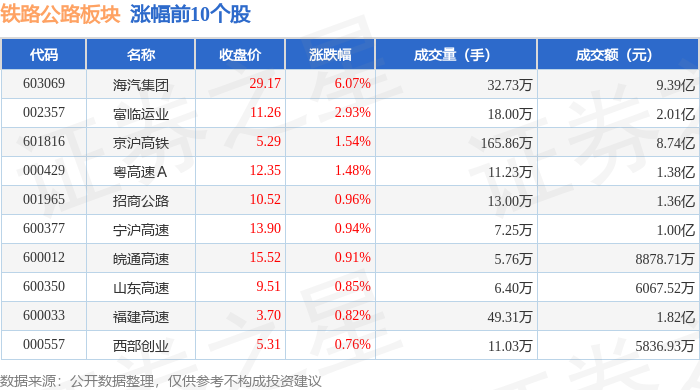
铁路公路板块11月10日涨0.84%,海汽集团领涨,主力资金净流出5.84亿元
Zheng Xing Xing Ye Ri Bao· 2025-11-10 08:48
Core Insights - The railway and highway sector experienced a rise of 0.84% on November 10, with Haikong Group leading the gains [1] - The Shanghai Composite Index closed at 4018.6, up 0.53%, while the Shenzhen Component Index closed at 13427.61, up 0.18% [1] Railway and Highway Sector Performance - Haikong Group (603069) closed at 29.17, with a gain of 6.07% and a trading volume of 327,300 shares [1] - Other notable performers included: - Fulian Yuan (002357) at 11.26, up 2.93% with a trading volume of 180,000 shares [1] - Beijing-Shanghai High-Speed Railway (601816) at 5.29, up 1.54% with a trading volume of 1,658,600 shares [1] - The sector saw a net outflow of 584 million yuan from institutional investors, while retail investors contributed a net inflow of 483 million yuan [2][3] Fund Flow Analysis - Major stocks like Beijing-Shanghai High-Speed Railway experienced a net outflow of 18.48 million yuan from institutional investors, while retail investors contributed a net inflow of 35.08 million yuan [3] - Zhongyuan Expressway (600020) had a net inflow of 14.89 million yuan from institutional investors, but a net outflow of 9.30 million yuan from retail investors [3] - Overall, the sector's fund flow indicates a mixed sentiment among different types of investors, with retail investors showing more confidence [2][3]


周期半月谈 - 周期板块3季报综述和近期观点
2025-11-10 03:34
Summary of Key Points from Conference Call Records Industry Overview Tungsten Industry - The tungsten industry has shown outstanding performance, with tungsten concentrate prices increasing by 30% year-on-year in the first three quarters and a quarterly increase of 40% in Q3, reaching a historical high [1][5] - Integrated tungsten companies such as Xiamen Tungsten and China Tungsten High-tech, along with downstream tool companies like Dingtai High-tech and Oko Yi, have seen improvements in gross margins and profitability [1][4] - Integrated tungsten companies reported a gross margin of 19.2% in Q3, up 0.5 percentage points quarter-on-quarter, while downstream tool companies had a gross margin of 37.7%, an increase of 3.8 percentage points [1][4] Nonferrous Metals Industry - The overall performance of the nonferrous metals industry in Q3 2025 was below expectations, with gold prices rising by only about 3% and aluminum and copper showing marginal increases of 3% and 2% respectively [3] - Despite the underperformance, the tungsten sector stood out, with significant price increases and strong demand [3][5] Petrochemical and Chemical Industry - The petrochemical sector experienced a 1.2% year-on-year decline in revenue in Q3, but net profit attributable to shareholders grew by 29% [11] - Sub-sectors such as fluorochemicals and private refining saw significant profit increases, with fluorochemicals' net profit rising by 320% [11] - The chemical industry has been in a decline for over three years, but profitability is expected to bottom out in 2025 and gradually increase from 2026 [13] Future Outlook Nonferrous Metals - The supply elasticity of nonferrous metals is expected to weaken over the next 3 to 5 years due to constrained supply and increasing demand from sectors like electric power, AI, military, and high-end manufacturing [1][7] - The market outlook for nonferrous metals remains optimistic, with expectations of good performance from metals like gold, copper, aluminum, tungsten, and cobalt from current adjustments until spring 2026 [7] Petrochemical and Chemical - A decline in capital expenditure among petrochemical companies since the end of 2023 suggests a potential turning point in the capacity cycle [12] - The chemical industry is expected to see a rebound in profitability starting in 2026, driven by significant changes in supply dynamics and reduced capital expenditures [13] Construction Materials - The construction materials sector showed signs of recovery, with revenue and profit declines narrowing significantly in Q3 [19] - The cement sector remains weak domestically but has significant growth potential in overseas markets, particularly in Africa [19][20] Express Delivery Industry - The express delivery sector has made notable progress in reducing competition, with significant performance disparities among companies [23] - The upcoming peak seasons are expected to improve the performance of express delivery companies significantly [23] Cross-Border Logistics - The cross-border logistics sector faced challenges due to changes in tariff policies, leading to a decline in performance [24] - However, stable tariff policies and upcoming demand peaks in North America and Europe may provide rebound opportunities [24] Additional Insights - The chemical sector is experiencing a significant shift with a focus on reducing capital expenditures and improving profitability through technological upgrades and new project launches [15] - The phosphoric acid market is expected to benefit from strong demand driven by energy storage applications, with high profitability likely to persist due to long construction cycles for new capacity [16] - Companies with relatively low valuations in the chemical sector, such as Wanhua and Hualu, are recommended for potential growth even in a weak demand environment [15]
招商交通运输行业周报:交运行业三季报基本符合预期-20251109
CMS· 2025-11-09 08:03
Investment Rating - The report maintains a "Recommendation" rating for the transportation industry [3] Core Insights - The transportation industry is experiencing a recovery, with various segments showing potential for growth, particularly in shipping, infrastructure, aviation, and express delivery [7][19][22][20] Shipping - The shipping sector is seeing mixed price movements, with the SCFI for the US East route down 17.2% and the Southeast Asia route up 6.4% [11] - The report highlights the importance of monitoring the price increases in container shipping and the potential recovery in oil tanker rates due to improved US-China trade relations [16][12] Infrastructure - Key metrics indicate a decline in truck traffic and railway cargo, while port throughput has increased significantly, suggesting a shift in market dynamics [17][18] - The report emphasizes the potential for dividend stocks in the infrastructure sector, particularly in ports, which are currently undervalued [19] Aviation - The aviation sector shows a positive trend with a 7.2% year-on-year increase in passenger volume, driven by improved demand and a low base effect [22] - The report suggests that the industry is poised for profitability in 2026, with a focus on valuation recovery and potential investment opportunities in major airlines [22] Express Delivery - The express delivery sector is benefiting from a reduction in price competition, with a notable increase in business volume and revenue [20] - The report indicates that the "anti-involution" policies are helping to stabilize prices and improve profitability in the sector [20] Logistics - The logistics segment is experiencing stable performance, with cross-border air freight prices showing a week-on-week increase [23] - The report notes the importance of monitoring the daily traffic at key ports and the implications for logistics operations [23]




高速公路收费涨价了吗?
2025-11-07 01:28
Summary of Key Points from Conference Call Records Industry Overview - The highway industry in China has approximately 86,000 kilometers of operational toll roads as of the end of 2021, with listed companies holding about 5% of these assets, primarily managing early-stage, profitable segments like Shandong Highway and Guangdong Transportation [1][3] - The construction cost of highways has surged from 32 million yuan per kilometer in 2011 to approximately 150 million yuan in 2021, leading to an expanded revenue gap and increased industry debt risk [1][3] - In 2021, the industry generated over 600 billion yuan in revenue, while expenditures reached 1.1 trillion yuan, resulting in a deficit of 500 billion yuan [1][4] Future Construction Demand - As of the end of 2024, China has completed 124,100 kilometers of national highways, with an additional 30,000 to 40,000 kilometers under construction, nearing the planned target of 162,000 kilometers [5] - Future demand for highway construction is expected to decline, with only limited needs in specific regions, such as border areas, which have low investment value [5] Toll Road Policy Framework - The toll road policy framework consists of laws, regulations, and policies, including the Highway Law and the Regulations on the Administration of Toll Roads [2] - There are two types of toll roads: government-backed and operational toll roads, with the former being built using loans and the latter by profit-driven enterprises [2][3] Pricing and Revenue Challenges - The pricing standards for toll roads are determined by provincial governments and are influenced by various factors, including technical standards, total investment, price indices, and traffic volume [6] - The potential for adjusting toll rates is limited due to concerns about traffic volume impacts, which could lead to reduced revenues [6][10] - The introduction of differentiated toll pricing aims to enhance resource utilization efficiency and is being actively promoted by the government [7][8][10] Financial Stability and Investment Risks - Highway companies exhibit stable cash flows, making them attractive for defensive investment strategies, despite facing long-term risks such as expiring toll collection periods and reduced new project opportunities [12][13] - The upcoming expiration of many operational toll roads in 2025 and 2026 could significantly impact adjacent government-backed toll roads, as traffic may shift to free roads, reducing revenues for toll roads [21][22] Government and Stakeholder Dynamics - Local governments must balance public sentiment and debt resolution when considering toll increases, often leading to complex negotiations and decisions [17][19] - The hearing mechanism for toll adjustments may not fully reflect public opinion due to selective participation and potential biases in the process [15] Conclusion - The highway industry faces significant challenges due to rising construction costs, revenue deficits, and the impending expiration of toll collection periods. The focus on differentiated pricing and the need for strategic government interventions will be crucial in navigating these challenges and ensuring the sustainability of highway operations in China [1][4][21][22]
招商基金招商公路高速公路封闭式基础设施证券投资基金基金份额解除限售的公告
Shang Hai Zheng Quan Bao· 2025-11-06 18:43
Group 1: Public REITs Basic Information - The strategic placement shares of the fund will be locked for 12 months from the listing date, with the release date set for November 21, 2025. A total of 278,900,000 shares will be released, accounting for 55.78% of the total fund shares [1] - Before the release of the strategic placement shares, the tradable shares in the secondary market amount to 81,810,000, which is 16.36% of the total fund shares. After the release, the total tradable shares will be 360,710,000, representing 72.14% of the total fund shares [1] Group 2: Infrastructure Project Performance - The infrastructure project is the Anhui Bo-Fu Expressway, managed by the Anhui Bo-Fu Expressway Co., Ltd. The project spans 101.3 kilometers with three toll stations and two service areas [4][5] - As of the announcement date, the project is operating stably, with a toll revenue (including tax) of 33,723 million yuan for the period from January to September 2025, reflecting a year-on-year growth of 7.1%. The average daily traffic volume is 15,637 vehicles, up 8.7% year-on-year [5] Group 3: Impact on Fund Shareholders' Rights - The closing price of the fund on November 6, 2025, was 7.401 yuan per share, representing a 5.85% increase from the issuance price. The predicted distributable amount for 2025 is 317,600,868.47 yuan [6] - The net cash flow distribution rate for an investor buying at the issuance price of 6.992 yuan per share is projected to be 9.08%, while for an investor buying at the market price of 7.401 yuan, it is projected to be 8.58% [6]
安徽皖通高速公路股份有限公司 关于持股5%以上股东权益变动触及1%刻度的提示性公告
Zhong Guo Zheng Quan Bao - Zhong Zheng Wang· 2025-11-06 03:37
Core Points - The major shareholder, China Merchants Highway Network Technology Holdings Co., Ltd. (招商公路), has reduced its stake in Anhui Wantuo Expressway Co., Ltd. (安徽皖通高速公路股份有限公司) by selling 1,320,200 A-shares from October 31 to November 4, 2025 [1][2] - Following the reduction, China Merchants holds 402,871,301 A-shares, representing 23.58% of the total share capital, while its wholly-owned subsidiary, Cornerstone Holdings Limited (佳选控股), holds 92,396,000 H-shares, accounting for 5.41% [1][2] - The total shareholding of China Merchants and its subsidiary amounts to 495,267,301 shares, which is 28.99% of the total share capital [1][2] Shareholding Changes - The shareholding percentage of China Merchants and its concerted actions decreased from 29.06% to 28.99% due to the recent sale [2] - This reduction in stake does not lead to any changes in the controlling shareholder or actual controller of the company, nor does it significantly impact the corporate governance structure or ongoing operations [2] Future Plans - The share reduction is part of a previously disclosed plan, and it does not trigger a mandatory tender offer [2] - As of the announcement date, the share reduction plan has not been fully executed, and further sales will depend on market conditions [2]

安徽皖通高速公路股份有限公司
Shang Hai Zheng Quan Bao· 2025-11-05 20:28
Core Viewpoint - The announcement details a reduction in shareholding by a major shareholder,招商局公路网络科技控股股份有限公司, which has decreased its stake in 安徽皖通高速公路股份有限公司 from 29.06% to 28.99% through the sale of 1,320,200 A-shares between October 31 and November 4, 2025 [2][3]. Group 1: Shareholding Changes - 招商局公路 has reduced its direct holding of A-shares to 402,871,301, representing 23.58% of the total share capital [2]. - Through its wholly-owned subsidiary, 佳选控股有限公司, 招商局公路 holds an additional 92,396,000 H-shares, accounting for 5.41% of the total share capital [2]. - The total combined shareholding of 招商局公路 and 佳选控股 in 安徽皖通 is now 495,267,301 shares, which is 28.99% of the total share capital [2]. Group 2: Impact and Future Plans - The reduction in shareholding will not lead to changes in the controlling shareholder or the actual controller of the company, nor will it significantly impact the company's governance structure or ongoing operations [3]. - This share reduction is part of a previously disclosed plan and does not trigger a mandatory tender offer [3]. - 招商局公路's reduction plan is not yet complete, and future sales of A-shares will depend on market conditions [3].