Anthropic

Search documents
硬刚OpenAI,中国团队杀入Agentic AI全球前二,一战封神
3 6 Ke· 2026-02-11 08:04
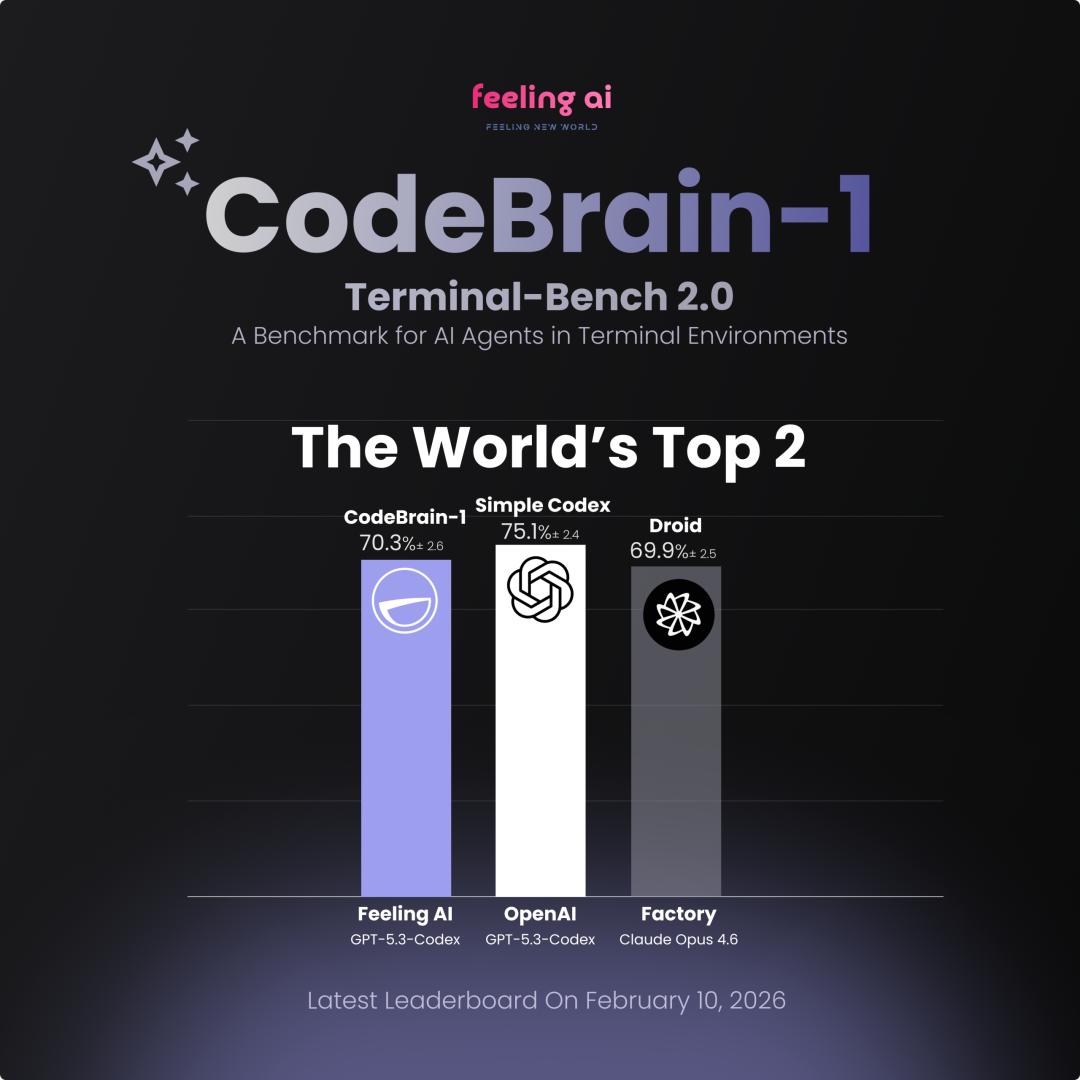
Core Insights - Feeling AI's CodeBrain-1 has achieved a remarkable second place in the Terminal-Bench 2.0 ranking, just behind OpenAI's latest flagship model, indicating a significant advancement in China's capabilities in Agentic AI and autonomous coding [1][6][27] - The competition between AI giants has shifted from mere parameter optimization to practical application in real-world scenarios, emphasizing the importance of model architecture and long-term operational sustainability [4][10] Company Performance - CodeBrain-1 scored 72.9% in the Agentic Terminal Coding Task, showcasing its superior coding capabilities, while OpenAI's 5.3-Codex achieved a score of 77.3% [4][11] - Feeling AI's recent release of MemBrain 1.0 has set new SOTA records in various memory benchmarks, significantly outperforming existing systems [8][10] Technological Advancements - CodeBrain-1 focuses on two critical aspects: Useful Context Searching and Validation Feedback, which enhance task completion efficiency and error correction [14][16] - The model's ability to dynamically adjust plans and strategies allows it to operate effectively in real terminal environments, improving success rates in task execution [16][25] Market Positioning - The Terminal-Bench 2.0 serves as a rigorous benchmark for AI models, requiring them to perform complex tasks in a closed-loop environment, which distinguishes it from traditional coding tests [21][22] - Feeling AI's performance in this competitive landscape highlights the potential for Chinese teams to redefine engineering standards in AI, positioning them as key players in the global market [27][28]

日本股市屡创新高 但这波涨势或许“十分脆弱”
Xin Lang Cai Jing· 2026-02-11 07:28
受日本国内政治信心回升及执政党经济议程推动,日本股市屡创新高,但专家警告称,股市与经济基本 面已出现脱节。 日本日经225指数近日接连创下多项纪录,先后突破56000点、57000点并逼近58000点关口,这波行情主 要由所谓的"高市早苗交易"推动——此前首相高市早苗在众议院选举中以压倒性优势获胜。 周三因假日休市的日本股市,在周二曾将日经指数推高至57960点的高位。该指数今年以来已累计上涨 约15%。 市场观察人士表示,政治乐观情绪成为本轮上涨的重要支柱,而高市早苗获得的强势选举授权则点燃了 行情。投资者对扩大支出、减税以及更积极的经济议程抱有期待。 但分析师提醒,市场热情已跑在政策资金来源明确化之前,且日本当前股市根基愈发脆弱:易受汇率波 动、全球冲击以及股价与基本面缺口扩大的影响。 投资管理公司Port Shelter首席执行官Richard Harris表示,仅凭经济强劲程度难以支撑当前涨幅:"这并 非由基本面驱动。无论看汇率走势还是经济表现……都没有特别强劲的因素能解释股市的这波行情。" 日本政府11月公布的数据显示,截至9月的三个月里,日本经济环比萎缩0.4%,为六个季度以来首次收 缩;按年率计 ...
xAI再失两名联合创始人,创始团队流失过半加剧人才危机
Huan Qiu Wang Zi Xun· 2026-02-11 07:19
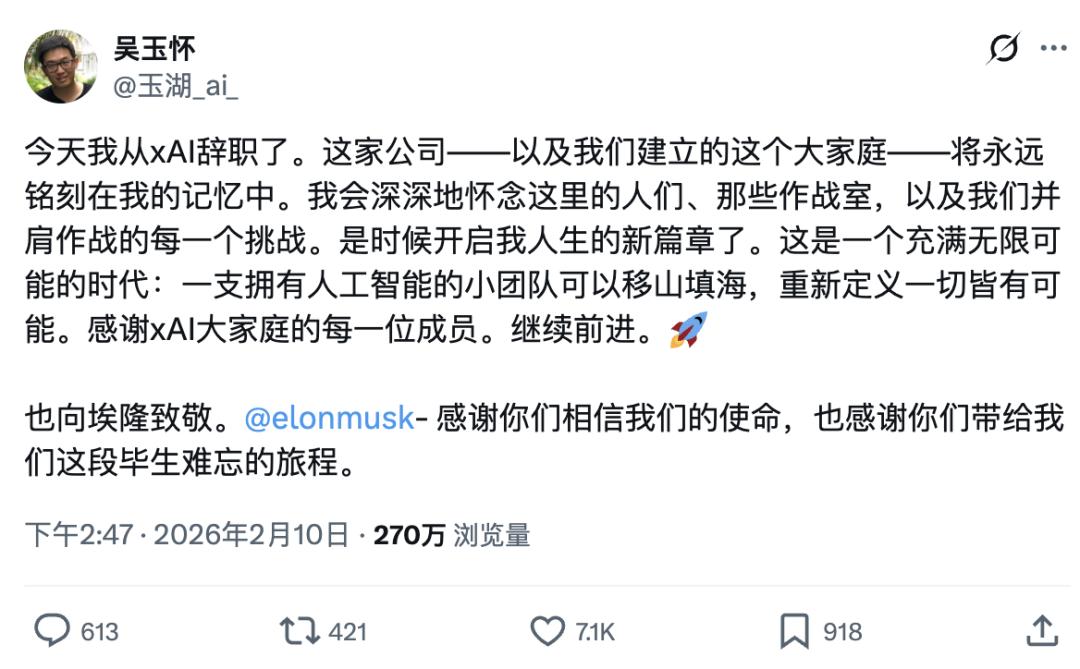
来源:环球网 【环球网科技综合报道】2月11日消息,据cna报道称,埃隆·马斯克旗下人工智能公司xAI遭遇新一轮高 层动荡,联合创始人吴东伟(Dongwei Wu)与巴吉米(Jimmy Ba)近日分别在社交平台X上宣布已从 公司离职,成为xAI自2023年成立以来第10位和第11位离开的创始成员。至此,xAI最初的12人联合创 始人团队仅剩6人,流失率高达50%。 据《金融时报》援引知情人士消息,巴吉米的离职源于其技术团队内部在提升AI模型性能方面承受的 巨大压力。随着马斯克加速推动xAI追赶OpenAI、Anthropic等领先对手,工程团队面临高强度开发节奏 与战略方向分歧,导致核心人才持续出走。 此次人事变动恰逢xAI重大组织调整前夕。数日前,马斯克旗下SpaceX正式宣布将收购xAI,整合后的 新实体估值达1.25万亿美元,并计划于2026年下半年上市。该交易旨在为马斯克"在太空部署AI数据中 心"的长期愿景提供资本与技术协同支持。 然而,频繁的高管与创始成员流失正引发外界对xAI技术稳定性与治理结构的担忧。过去一年中,xAI 已有多位关键人物离职,包括基础设施负责人Uday Ruddarraju、联 ...

人工智能周报(26年第6周):Anthropic发布Claude Opus 4.6-20260211
Guoxin Securities· 2026-02-11 07:10
Investment Rating - The report assigns a "Neutral" investment rating for the AI industry in 2026 [1] Core Insights - Major tech companies are significantly increasing their investments in AI, focusing on talent acquisition, computing power infrastructure, and marketing expenditures. The competition for consumer-facing AI Agent products is expected to intensify during the Spring Festival period in China [2] - The report suggests focusing on companies with the most certainty in computing power and large models, including Alibaba, Baidu, and Tencent [2] Summary by Sections Company Dynamics - SpaceX has fully acquired xAI, with a post-merger valuation of $1.25 trillion. The merger will allow xAI to operate as a subsidiary of SpaceX, integrating its Grok model with Starlink satellite data [17] - Meta has launched a series of AI advertising tools, including AI Video Generation 2.0, which simplifies the creative production process for advertisers [20] - Kunlun Technology has released the Skywork desktop version, a local multi-model AI office agent that prioritizes data security and ease of use [21] - OpenAI has launched two core products, including an upgraded programming model and an enterprise-level AI platform [22] - Meta is testing an independent AI video application called Vibes, focusing on AI-generated content [23] - Google, Amazon, Meta, and Microsoft have announced a combined investment of $610 billion in AI infrastructure for 2026 [24] Underlying Technology - Step 3.5 Flash model by JUMP Star has been released, utilizing a sparse MoE architecture to address computing power challenges [25] - Alibaba's Tongyi Qianwen team has open-sourced the Qwen3-Coder-Next programming model, achieving high performance with low computational costs [26] - Anthropic has released Claude Opus 4.6, significantly expanding the context window to 1 million tokens [26] - The Chinese Academy of Sciences has introduced the "Flying Fish-1.0" model, focusing on coupling computation technology [27] Industry Policy - The Ministry of Industry and Information Technology has issued a notice to improve AI computing power infrastructure through a national interconnected node system [28] Investment Recommendations - The report emphasizes the importance of monitoring companies with strong positions in computing power and large models, particularly during the rapid deployment of AI Agent products [29]
从巴菲特「补票」谷歌,看懂字节、阿里与腾讯的AI入口大战
Sou Hu Cai Jing· 2026-02-11 06:55
Group 1 - The core battle for AI entry and ecosystem among domestic tech giants in China has intensified, with Tencent leading by investing 10 billion to capture user attention, while ByteDance and Alibaba are also aggressively targeting C-end users [1] - Warren Buffett's regret over missing early investment opportunities in Google highlights the importance of ecosystem in tech investments, as he recently sold Apple shares to buy Google stock, marking a significant strategic shift for Berkshire Hathaway [2][4] - Buffett's investment logic remains unchanged, focusing on businesses with strong ecosystems, as seen in his previous heavy investment in Apple's iOS ecosystem and now in Google's AI ecosystem [7][14] Group 2 - Google's transition from a single product leader to establishing a comprehensive AI ecosystem has attracted Buffett's investment, indicating a shift in competitive dynamics in the AI era [8][25] - The competition in the AI landscape has evolved from individual capabilities to a comprehensive ecosystem battle, with Google's success demonstrating the viability of a full-stack ecosystem combining chips, models, cloud, and applications [13][14] - The integration of AI into Google's advertising and cloud services has driven growth, with cloud revenue increasing by 33.5% year-over-year to reach $15.16 billion in Q3 2025, showcasing the effectiveness of AI in enhancing user engagement and operational efficiency [23][24] Group 3 - Other tech giants like Amazon, Meta, and Microsoft face challenges in the AI race, with Amazon's AWS losing market share due to late entry into generative AI, and Meta struggling with model capabilities and lack of cloud services [27][29][30] - OpenAI and Anthropic are also under pressure to establish their ecosystems, relying on partnerships for cloud and hardware support, while Google has built a comprehensive AI ecosystem from the ground up [34][32]


xAI 关键人物跑路,马斯克 AI 野心遭重创
3 6 Ke· 2026-02-11 06:13
Core Insights - The departure of Tony Wu, a co-founder of xAI, marks a significant loss for the company, especially in the critical area of AI reasoning capabilities, which is essential for advancing towards general artificial intelligence [1][2][3] - xAI has experienced a high turnover rate, with nearly half of its founding team leaving within a year, raising concerns about its stability and future prospects in a competitive AI landscape [5] Group 1: Impact of Departures - Tony Wu's role was crucial as he was responsible for AI reasoning, a key technology that differentiates advanced models like GPT-4 from true general AI [2][4] - The loss of Wu is particularly detrimental given the rapid pace of AI development, where losing a key technical leader can lead to significant delays in research and development [4][14] - The departure of Wu follows that of Igor Babuschkin, indicating potential underlying issues within xAI that could hinder its progress [1][5] Group 2: Management Style and Talent Retention - The management style of Elon Musk, characterized by extreme pressure and a focus on rapid execution, may not align well with the creative and iterative nature of AI research [8][9] - There is a growing sentiment that top AI talent prefers environments that allow for focused research and decision-making autonomy, which may not be present at xAI [11][13] - Comparatively, companies like OpenAI and Anthropic, which are led by AI researchers, provide a more conducive atmosphere for talent retention [13][14] Group 3: Industry Context - The AI industry is currently experiencing a "talent war," with top researchers in high demand and lucrative offers from multiple leading firms [11][12] - The scarcity of skilled AI professionals is likened to the demand for nuclear physicists in the past, emphasizing the competitive landscape for talent [12] - The ability to attract and retain talent is critical, as the most valuable resource in AI development is individuals who can innovate and advance machine reasoning capabilities [15]
FIERCE COMPETITION: How Nasdaq is luring multi-trillion dollar companies
Youtube· 2026-02-11 06:00
Core Insights - Three major companies, SpaceX, OpenAI, and Anthropic, are expected to go public this year, generating significant investor interest [1] - The combined valuation of these companies is approximately $2.65 trillion, with IPO proceeds projected to reach $160 billion, quadrupling the average from the post-pandemic IPO drought [2] IPO Market Dynamics - NASDAQ is currently leading in the number of IPOs for 2026, with 23 more listings than the New York Stock Exchange [3] - The NASDAQ President highlighted the importance of attracting these companies to the exchange, emphasizing the potential for mega IPOs this year [4][6] - NASDAQ's unique value proposition includes access to the NASDAQ 100 index, which lists all trillion-dollar companies, making it attractive for large-cap IPOs [7] Company Valuations and Strategies - SpaceX is valued at approximately $800 billion, and there are discussions about its potential early inclusion in market benchmarks like the NASDAQ 100 [8][12] - The NASDAQ is considering rule changes that would allow for early entry into the NASDAQ 100 for newly public companies, potentially within 10 days of listing [14] Historical Context and Future Outlook - The IPO market is showing signs of recovery, with an increase in companies ready to go public, rising from 180 to 210 [18] - The overall market backdrop is solid, with favorable GDP growth and a healthy interest rate environment, suggesting that 2026 could surpass last year's IPO activity [19][20] International IPO Trends - There is a growing trend of large IPOs from European and Asian companies entering the US market, attracted by higher valuations and liquidity [21][22]

AI淘金热变成AI恐慌潮!华尔街新共识:躲开一切可能被颠覆的公司
Hua Er Jie Jian Wen· 2026-02-11 05:58
Core Viewpoint - Wall Street is experiencing a significant shift in investment logic, with investors rapidly selling stocks of companies that may be disrupted by AI, leading to widespread panic and sell-offs across various sectors [1][2]. Group 1: Impact on Wealth Management - The recent sell-off was triggered by Altruist Corp.'s launch of the AI tax strategy tool Hazel, which caused major wealth management firms like Charles Schwab and Raymond James to see stock declines of over 7%, marking the largest drop since April [1][2]. - Altruist's CEO Jason Wenk noted that the market reaction was surprising, erasing billions in market value for several investment firms, and emphasized that the architecture used to build Hazel could replace many roles in wealth management that typically require entire teams [2][3]. Group 2: Broader Industry Concerns - The fear of AI disruption has expanded from the software industry to financial services, asset management, and legal services, particularly after new tools from companies like Anthropic and Insurify were introduced [1][3]. - Insurify's launch of a ChatGPT-based application for comparing auto insurance rates led to significant stock declines among U.S. insurance brokers, reflecting investor concerns about the survival of intermediary services that could be replaced by AI [3]. Group 3: Market Sentiment and Valuation Sensitivity - Despite the prevailing panic, some market participants question the speed and extent of AI disruption, suggesting that technological upheaval often takes longer to materialize than anticipated [4]. - The current sell-off also highlights a general anxiety regarding high valuations in the market, where even minor negative signals can lead to significant stock price declines, indicating a highly sensitive investment environment [5].
X @The Wall Street Journal
The Wall Street Journal· 2026-02-11 04:30
Anthropic has entrusted Amanda Askell to endow its AI chatbot, Claude, with a sense of right and wrong https://t.co/hBRaAhyPKv ...
AI“淘汰焦虑”愈演愈烈!华尔街如今的交易逻辑:只要怕被AI替代,先抛了再说
美股IPO· 2026-02-11 04:01
Core Viewpoint - The market is experiencing heightened anxiety regarding the potential disruption caused by artificial intelligence (AI), leading to significant stock sell-offs across various sectors, particularly those perceived to be at risk of being replaced by AI technologies [1][3][4]. Group 1: Market Reactions - A recent sell-off was triggered by the launch of a tax strategy tool by Altruist Corp, resulting in stock price declines of over 7% for major firms like Charles Schwab, Raymond James, and LPL Financial, marking some of the largest single-day drops since last April [3]. - The market sentiment has shifted from seeking AI winners to rapidly withdrawing from any companies that exhibit even a slight risk of being replaced by AI [8]. - The introduction of AI products has led to widespread panic, with significant declines in stock prices across software, financial services, asset management, and legal services sectors [9][10]. Group 2: Industry Perspectives - Gabelli Funds manager John Belton noted that companies facing potential disruption are experiencing indiscriminate sell-offs, reflecting a broader market fear [4]. - The software industry is particularly affected, with AI companies like Anthropic launching new tools that have caused stock prices to plummet across multiple sectors [9]. - There is skepticism regarding the market's rapid shift from fearing an AI bubble to fearing its disruptive potential, with some experts suggesting that the actual impact of technological disruption often unfolds more slowly than anticipated [11][12]. Group 3: Future Outlook - The future of AI technology adoption remains uncertain, with historical challenges in the banking sector from cryptocurrencies and electronic services failing to disrupt its dominance [10]. - Experts caution against premature conclusions about AI's impact, emphasizing that the AI revolution is still in its early stages and that the market is eager to make judgments without sufficient evidence [13].