浦发银行

Search documents
浦发银行可转债摘牌 转股比例高达99.67%
Xin Hua Cai Jing· 2025-10-28 13:19
Core Points - The "giant" convertible bond of Shanghai Pudong Development Bank (SPDB) has officially been delisted from the Shanghai Stock Exchange, with a conversion rate of 99.67%, exceeding market expectations, indicating investor confidence in its profitability and future development [2] - The SPDB convertible bond, issued in November 2019, had a total issuance scale of 50 billion yuan, making it the largest convertible bond at that time [2] - Major shareholders, including China Mobile, have provided capital support through the secondary market or bond conversion, with China Mobile converting approximately 90 million SPDB convertible bonds into about 71.9 million shares, increasing its stake to 18.18% [2] - Reports indicate that over 60% of the total convertible bonds have been converted, suggesting limited potential selling pressure for the market to absorb [2] - The management's clear strategy and execution in promoting bond conversion and capital replenishment reflect their determination [2] Capital Structure Impact - Following the full conversion of the SPDB convertible bonds, the core Tier 1 capital will be significantly supplemented, with the capital adequacy ratio expected to increase by 0.1 percentage points to around 9% [3] - This enhancement in capital structure will support future credit issuance and provide a capital foundation for the implementation of the "Five Major Tracks" strategy [3]


转股比例达99.67%,浦发转债“退场”
Bei Jing Shang Bao· 2025-10-28 12:33
北京商报讯(记者 孟凡霞 周义力)10月28日,浦发银行发布公告称,该行浦发转债自2020年5月4日起 进入转股期,截至2025年10月27日,累计已有人民币498.37亿元浦发转债转为该行普通股,累计转股股 数为39.54亿股,占浦发转债转股前该行已发行普通股股份总额的13.4701%;未转股的浦发转债金额为 人民币1.63亿元,占浦发转债发行总量的比例为0.3258%。以此推算,浦发转债转股比例约为99.67%。 浦发转债于2025年10月23日开始停止交易,10月22日为浦发转债最后交易日,10月27日为最后转股日。 自2025年10月28日起,浦发转债在上海证券交易所摘牌。公告表示,根据中登上海分公司提供的数据, 浦发转债到期兑付数量约162.92万张,到期兑付总金额人民币约1.79亿元,兑付资金发放日为2025年10 月28日。 ...
为何10月以来股份制银行CD发力明显?
Tianfeng Securities· 2025-10-28 11:24
Investment Rating - Industry Rating: Outperform the market (maintained rating) [8] Core Insights - Since October, the issuance of certificates of deposit (CDs) by joint-stock banks has significantly increased, with a notable rise in pricing demands, particularly among joint-stock banks [2][14] - The NSFR (Net Stable Funding Ratio) for joint-stock banks may face pressure by the end of the year, primarily due to the trend of short-term deposits and a significant decline in credit growth [3][30] - There is a need for proactive measures to address the asset-liability gap pressure expected in early 2026, with a focus on issuing CDs to meet funding needs [4][31] - The usage rate of the备案额度 (recorded quota) for joint-stock banks is lagging behind previous years, indicating a potential need to issue short-term CDs to secure future quotas [5][41] - The expected central price for 1Y CDs is around 1.70%, influenced by the current monetary policy stance and the average cost of liabilities for banks [6][54] Summary by Sections 1. Increase in CD Issuance - The net financing of CDs by joint-stock banks reached 520.8 billion, the highest level for the same period since 2021 [14] - The issuance of CDs has shown a balanced approach between short and long terms, with significant net financing in 3M, 6M, and 1Y CDs [14][15] 2. NSFR Pressure - The NSFR for most joint-stock banks is between 105%-110%, which, while above the regulatory minimum, still requires careful management [3][19] - The trend of short-term deposits is worsening, leading to increased pressure on the NSFR [22][30] 3. Preparing for Asset-Liability Gaps - Anticipated credit growth in Q1 2026 may reach 100% of the total, necessitating early issuance of CDs to meet funding demands [4][33] - General deposit growth is expected to face challenges in early 2026 due to various factors, including the cancellation of manual interest compensation [36][38] 4. Slow Usage of Quota - As of October 27, the usage rate of the备案额度 for joint-stock banks was only 59.1%, significantly lower than in previous years [5][41] - Some banks may issue short-term CDs to occupy quota space and ensure stability in future applications [45][48] 5. Expected CD Rate - The average cost of liabilities for joint-stock banks is approximately 1.71%, with the expected rate for 1Y CDs around 1.70% [6][54] - The current monetary policy is expected to remain supportive, preventing significant increases in CD rates [52][54]
浦发银行(600000) - 上海浦东发展银行股份有限公司关于“浦发转债”到期兑付结果暨股份变动的公告
2025-10-28 10:49
本公司董事会及全体董事保证本公告内容不存在任何虚假记载、误导性陈述 或者重大遗漏,并对其内容的真实性、准确性和完整性承担法律责任。 重要内容提示: 一、浦发转债的发行上市概况 公告编号:临2025-065 证券代码:600000 证券简称:浦发银行 优先股代码:360003 360008 优先股简称:浦发优1 浦发优2 转债代码:110059 转债简称:浦发转债 上海浦东发展银行股份有限公司 关于"浦发转债"到期兑付结果暨股份变动的公告 经中国证券监督管理委员会《关于核准上海浦东发展银行股份有限公司公开 发行可转换公司债券的批复》(证监许可〔2019〕1857号)核准,上海浦东发展 银行股份有限公司(以下简称"公司")公开发行了50,000万张可转换公司债券 (以下简称"可转债""浦发转债"),每张面值人民币100元,发行总额人民 币500亿元,期限6年。经上海证券交易所自律监管决定书〔2019〕247号文同意, 公司500亿元可转债于2019年11月15日起在上海证券交易所挂牌交易,债券简称 "浦发转债",债券代码"110059"。 到期兑付数量:1,629,180张 到期兑付总金额:人民币179,209, ...
浦发银行扩容科技(特色)支行至510家
Zhong Jin Zai Xian· 2025-10-28 10:27
Core Viewpoint - The establishment of 510 technology (specialty) branches by Pudong Development Bank marks a significant upgrade in its technology financial service network, enhancing its commitment to the "digital intelligence" strategy and supporting the development of technology enterprises across their entire lifecycle [1][2]. Group 1: Development of Technology Branches - The number of technology (specialty) branches has increased from 156 to 510, indicating a comprehensive upgrade in coverage, service capability, and ecological collaboration [2]. - The technology (specialty) branches serve as crucial platforms for supporting technology enterprises, utilizing a "group large technology innovation" service system and an integrated service model that includes commercial banking, investment banking, and ecological services [2]. Group 2: Service Model and Ecosystem - Pudong Development Bank employs a "5+7+X" product matrix for the full lifecycle of technology enterprises, providing specialized financial services in various innovation environments such as laboratories and industrial parks [2]. - The bank aims to optimize service processes and explore financial service models tailored to local technology enterprise needs, thereby enhancing the practical experience of technology financial innovation [2]. Group 3: Future Goals and Collaborations - The collective launch of the technology (specialty) branches is seen as a new starting point for deepening collaboration with governments, exchanges, investment institutions, and research institutes [2]. - Pudong Development Bank is committed to nurturing technology enterprises and contributing to the establishment of a globally influential technology innovation hub in Shanghai, ultimately supporting the goal of building a strong technology nation [2].
固定收益专题:二永债如何配
GOLDEN SUN SECURITIES· 2025-10-28 09:40
Report Industry Investment Rating No information provided in the content. Core Viewpoints of the Report - Recently, the market risk appetite has declined, and the high - elasticity secondary and perpetual (Er Yong) bonds have seen dual benefits of falling interest rates and narrowing spreads. Since October, the yields of 10 - year treasury bonds and 5 - year AAA - secondary capital bonds have both declined, with the latter having a significantly larger decline. The spreads have also narrowed, with the secondary capital bond spreads compressing more significantly [1][8]. - The supply of Er Yong bonds remains weak, and the background of asset shortage continues. The issuance of Er Yong bonds has decreased this year, and the net financing scale is expected to decline further next year. Meanwhile, the demand for Er Yong bonds may fluctuate due to factors such as regulations on public fund redemption fees and new accounting standards for insurance [10][14]. - The amplifying effect of Er Yong bonds as "interest rate amplifiers" has weakened recently, mainly due to the reduced trading attribute. The main demand force for Er Yong bonds has changed, deepening their allocation characteristics and weakening trading attributes [2][15]. - The credit spreads of 5 - year Er Yong bonds have a large compression space. The current credit spreads of Er Yong bonds are only slightly lower than those of ultra - long credit bonds, and their investment value should not be ignored [3][24]. - The pricing fitting model estimates that the yield of 5 - year AAA - secondary capital bonds may decline to around 2.07% next year. There are three investment ideas based on the scale - valuation bubble chart: band - trading of state - owned bank Er Yong bonds, extending duration for high - rated Er Yong bonds, and credit - sinking with controlled duration [4][42]. Summary According to Related Catalogs Supply and Demand Analysis - **Supply**: This year, with treasury bonds supplementing the core tier - one capital of large state - owned commercial banks, the issuance of Er Yong bonds has decreased. For example, the net financing of Bank of Communications and Bank of China's secondary capital bonds from January to October 24 was - 40 billion yuan and - 10 billion yuan respectively. The overall net financing scale of Er Yong bonds from January to September was lower than that of the same period last year. Next year, the maturity scale of Er Yong bonds will remain at a high level of 1.12 trillion yuan, and the net financing scale is expected to decline further [10]. - **Demand**: Regulations on public fund redemption fees may have a negative impact on bond funds, leading to the sale of Er Yong bonds. Although the new regulations have not been officially implemented, the adjustment range may be limited. In the future, in the context of asset shortage, funds will still increase bond allocation, but the redemption and allocation process will have a phased impact on the market. Also, from 2026, non - listed insurance companies will implement new accounting standards, which may affect their enthusiasm for allocating Er Yong bonds [14]. Er Yong Bond Turnover Statistics - From January to September this year, the monthly turnover rate of Er Yong bonds remained relatively stable. The average monthly turnover rate of secondary capital bonds was 18.14%, with an average monthly trading volume of 769.1 billion yuan, and the average monthly turnover rate increased by 0.8% compared to last year. The average monthly turnover rate of bank perpetual bonds was 20.35%, with an average monthly trading volume of 519.2 billion yuan, and the average monthly turnover rate decreased by 1.00% compared to last year [2][18]. - Among state - owned banks, Industrial and Commercial Bank of China and China Construction Bank had relatively high trading activity; among joint - stock banks, China Minsheng Bank, Shanghai Pufa Bank, Ping An Bank, China Merchants Bank, and China CITIC Bank were more active; among city and rural commercial banks with assets over one trillion yuan, Bank of Jiangsu, Bank of Hangzhou, Bank of Beijing, and Huishang Bank had relatively high trading activity [2][20]. Credit Spread Compression Space - As of October 23, the credit spreads of 1 - year, 3 - year, and 5 - year AAA - secondary capital bonds were 8.81bp, 19.99bp, and 41.29bp respectively, at historical percentiles of 0.6%, 14.2%, and 79.7% since 2024. The credit spreads of 1 - year, 3 - year, and 5 - year AA - secondary capital bonds were 15.2bp, 31.2bp, and 63.7bp respectively, at historical percentiles of 0.0%, 18.0%, and 64.1% since 2024 [3][24]. - The current credit spread of 5 - year AAA - secondary capital bonds is only slightly lower than that of 7 - year AA + medium - term notes. Since the end of 2024, the credit spread of 5 - year AAA - secondary capital bonds has mostly been lower than that of 7 - year AA + medium - term notes, and the two have been relatively close since September [3][26]. Pricing Fitting Model - The pricing fitting model uses five variables: the funding price R007, weekly net financing of Er Yong bonds, weekly net financing of urban investment bonds, secondary weekly demand for Er Yong bonds, and the turnover rate of Er Yong bonds to fit the yield of secondary capital bonds [29]. - Assuming different scenarios for R007, weekly net financing of Er Yong bonds, weekly net financing of urban investment and industrial bonds, secondary weekly demand, and turnover rate, the yield center of 5 - year AAA - secondary capital bonds may be at 1.91%, 2.07%, or 2.23% [4][38]. Full Review of Er Yong Bond Scale and Valuation - The outstanding scale of AAA - secondary capital bonds accounts for 96%, with an average valuation of 2.12%. The outstanding scale of AAA - bank perpetual bonds accounts for 96.2%, with an average valuation of 2.35% [4][39]. - There are three investment ideas based on the scale - valuation bubble chart: band - trading of state - owned bank Er Yong bonds, extending duration for high - rated Er Yong bonds (e.g., those of Ping An Bank, Minsheng Bank, Everbright Bank, and Bohai Bank), and credit - sinking with controlled duration (e.g., those of Yingkou Bank, Shengjing Bank, and Great Wall Huaxi Bank) [4][42].
官宣!河北普惠型补充医疗保险“河北医惠保”正式上线
Cai Fu Zai Xian· 2025-10-28 09:36
Core Points - "Hebei Medical Insurance" was officially launched on October 28, 2025, in Shijiazhuang, with participation from various leaders and organizations, marking a significant step in enhancing healthcare coverage in Hebei Province [1][3] Group 1: Product Overview - The insurance is available for basic medical insurance participants and new citizens in Hebei Province, with premiums set at 99 yuan/year for ages 0-20, 139 yuan/year for ages 21-50, and 179 yuan/year for ages 51 and above, providing up to 6 million yuan in medical coverage for all age groups [2][13] - The product is designed as a beneficial supplement to basic medical insurance, addressing gaps in coverage and activating healthcare resources to meet public health needs more effectively [3][11] Group 2: Key Features - The insurance is guided by the Hebei Provincial Medical Security Bureau, ensuring compliance, transparency, and reliability in product design and operation [11] - It allows for broad eligibility, with no restrictions on age, occupation, or health status, including coverage for pre-existing conditions with specified deductibles and payout ratios [12] - The coverage includes inpatient medical expenses within and outside the basic medical insurance scope, specific domestic and overseas drug costs, and CAR-T treatment expenses, with a total maximum coverage of 6 million yuan [14] - It features zero deductible for 95 types of global specialty drugs and 5 types of CAR-T treatments, addressing high-incidence diseases in Hebei and reducing the financial burden on patients [15] - The claims process is designed to be convenient, with immediate payouts upon discharge and synchronized settlements with basic medical insurance, facilitating a one-stop service for patients [17]

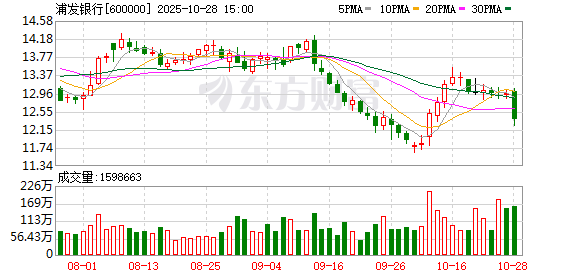
浦发银行跌4.47% 涨幅垫底银行板块
Zhong Guo Jing Ji Wang· 2025-10-28 09:16
Group 1 - The core point of the article is that Shanghai Pudong Development Bank (浦发银行) experienced a significant decline in its stock price, closing at 12.39 yuan, with a drop of 4.47% [1] - The banking sector overall saw a slight decrease, with a decline of 0.22%, indicating a broader trend affecting banks [1] - Shanghai Pudong Development Bank was the largest decliner within the banking sector for the day [1]
青岛这场会,解锁科技金融 “新经验”→
Jin Rong Shi Bao· 2025-10-28 09:05
Core Viewpoint - The focus on developing a robust technology finance ecosystem is increasingly becoming a priority, with multiple policy initiatives launched by various government departments to enhance technology finance services and support high-level technological self-reliance [1][2]. Group 1: Policy Initiatives - On June 29, 2024, the People's Bank of China and six other departments issued a work plan to solidify technology finance efforts [1]. - On October 16, 2024, the People's Bank of China and the Ministry of Science and Technology released a notice to improve technology finance services in key regions [1]. - The policy push includes support for the issuance of technology innovation bonds, with announcements made on May 7 and May 14, 2024 [1]. Group 2: Experience Exchange Conference - An experience exchange conference was held on October 16, organized by the People's Bank of China Qingdao Branch and the Financial Times, focusing on building a supportive technology finance ecosystem [2]. - Key figures from the financial regulatory bodies and local financial institutions attended the conference, sharing insights on the achievements and experiences in Qingdao's technology finance sector [2][3]. Group 3: Achievements and Innovations - Qingdao has established a sound technology finance system, optimized financial product offerings for tech innovation enterprises, and promoted the launch of a "technology board" in the bond market [2]. - The conference featured stories from various representatives illustrating how technology finance initiatives, such as the newly formed "Qingdao Technology Finance Alliance," are facilitating efficient financing for technology enterprises [3]. Group 4: Future Directions - The successful exchange conference is seen as a significant step towards building a platform for sharing technology finance experiences and fostering a positive technology finance ecosystem [4]. - The People's Bank of China emphasized the importance of ongoing policy implementation and the need for collaborative efforts to enhance technology finance services [3].
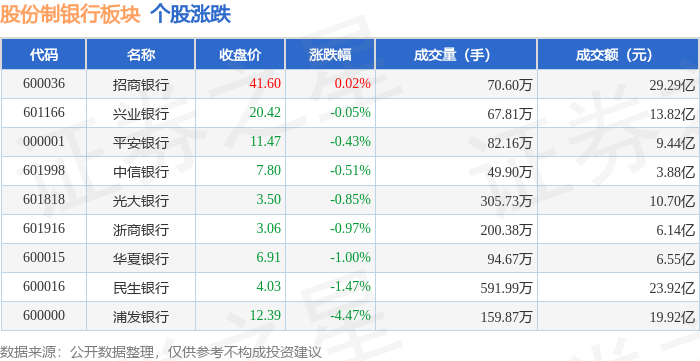
股份制银行板块10月28日跌0.99%,浦发银行领跌,主力资金净流出8.54亿元
Zheng Xing Xing Ye Ri Bao· 2025-10-28 08:40
Market Performance - The banking sector experienced a decline of 0.99% on October 28, with Pudong Development Bank leading the drop [1] - The Shanghai Composite Index closed at 3988.22, down 0.22%, while the Shenzhen Component Index closed at 13430.1, down 0.44% [1] Individual Bank Performance - Among the listed banks, China Merchants Bank saw a slight increase of 0.02% in its closing price, while Pudong Development Bank faced the largest decline at 4.47% [1] - The trading volumes and transaction amounts for various banks were significant, with China Merchants Bank recording a transaction amount of 2.929 billion yuan [1] Capital Flow Analysis - The banking sector saw a net outflow of 854 million yuan from major funds, while retail investors contributed a net inflow of 10.14 million yuan [1] - Specific banks like Industrial Bank and Everbright Bank experienced notable capital movements, with Industrial Bank seeing a net inflow of 26.78 million yuan from retail investors despite a net outflow from major funds [1]