
京东方

Search documents
9月22日深证国企ESGR(470055)指数涨0.02%,成份股冠捷科技(000727)领涨
Sou Hu Cai Jing· 2025-09-22 10:20
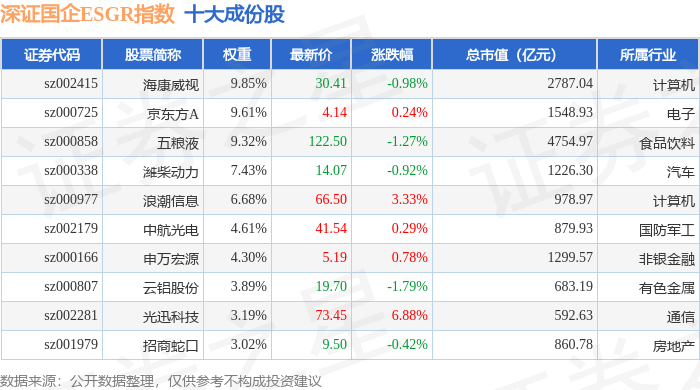
Core Points - The Shenzhen State-owned Enterprise ESGR Index (470055) closed at 1582.19 points on September 22, with a slight increase of 0.02% and a trading volume of 39.461 billion yuan, resulting in a turnover rate of 1.48% [1] - Among the index constituents, 19 stocks rose while 30 stocks fell, with Qanji Technology leading the gainers at a 10.04% increase, and Shougang Co., Ltd. leading the decliners with an 8.73% drop [1] Index Constituents Summary - The top ten constituents of the Shenzhen State-owned Enterprise ESGR Index are as follows: - Hikvision (sz002415) with a weight of 9.85%, latest price at 30.41, and a decrease of 0.98% [1] - BOE Technology Group (sz000725) with a weight of 9.61%, latest price at 4.14, and an increase of 0.24% [1] - Wrigley (sz000858) with a weight of 9.32%, latest price at 122.50, and a decrease of 1.27% [1] - Weichai Power (sz000338) with a weight of 7.43%, latest price at 14.07, and a decrease of 0.92% [1] - Inspur Information (sz000977) with a weight of 6.68%, latest price at 66.50, and an increase of 3.33% [1] - AVIC Optoelectronics (sz002179) with a weight of 4.61%, latest price at 41.54, and an increase of 0.29% [1] - Shenwan Hongyuan (sz000166) with a weight of 4.30%, latest price at 5.19, and an increase of 0.78% [1] - Yun Aluminum (sz000807) with a weight of 3.89%, latest price at 19.70, and a decrease of 1.79% [1] - Lightwave Technology (sz002281) with a weight of 3.19%, latest price at 73.45, and an increase of 6.88% [1] - China Merchants Shekou (sz001979) with a weight of 3.02%, latest price at 9.50, and a decrease of 0.42% [1] Capital Flow Analysis - The net inflow of main funds into the constituents of the Shenzhen State-owned Enterprise ESGR Index totaled 103 million yuan, while speculative funds saw a net outflow of 721 million yuan, and retail investors had a net inflow of 618 million yuan [1] - Detailed capital flow for key stocks includes: - Qanji Technology with a net inflow of 507 million yuan from main funds [2] - Lightwave Technology with a net inflow of 502 million yuan from main funds [2] - Inspur Information with a net inflow of 276 million yuan from main funds [2] - BOE Technology Group with a net inflow of 38.54 million yuan from main funds [2] - Shenwan Hongyuan with a net inflow of 31.09 million yuan from main funds [2]


vivo X300系列发布会定档10月13日,将搭载蔡司2亿像素超级主摄
Feng Huang Wang· 2025-09-22 08:34
Core Insights - The vivo X300 series is set to be officially launched on October 13, featuring significant upgrades in its imaging system through collaboration with Zeiss [1] - The standard X300 model will include a 200-megapixel main camera with CIPA stabilization rated at 4.5, while the higher-end X300 Pro will feature an 85mm 200-megapixel APO telephoto lens with CIPA stabilization rated at 5.5 [1] - The X300 Pro will also enhance video recording capabilities, introducing 4K 60fps portrait video recording on an Android device for the first time, along with support for dual focal lengths at 4K 120fps Dolby Vision HDR and 10-bit Log video shooting [1] Performance and Experience - The vivo X300 series will be powered by MediaTek's latest Dimensity 9500 flagship processor, complemented by the new generation Blueprint Imaging Chip V3+ for dual-core performance [2] - It will feature a hardware-level 1nit display from BOE's Q10 Plus and run on the latest OriginOS 6 operating system, incorporating connectivity features with the Apple ecosystem [2]
不止三折叠,中国给高端屏立标杆|供应链隐形冠军
Tai Mei Ti A P P· 2025-09-22 07:08
Core Insights - China has transitioned from a manufacturing powerhouse to a leader in intelligent manufacturing, particularly in the display panel industry, achieving a market size of 396.2 billion yuan in 2022, accounting for 68.2% of the global market share [1][3] - Tianma Microelectronics has emerged as a significant player in the OLED market, ranking third globally in flexible OLED smartphone displays and first in LTPS smartphone display modules since 2018 [3][4] - The global AMOLED smartphone panel shipment is projected to reach approximately 420 million units in the first half of 2025, with Chinese manufacturers holding a 51.7% market share, reflecting a 1 percentage point increase year-on-year [4][9] Industry Trends - The adoption of OLED technology is accelerating across various sectors, including automotive displays, which are expected to grow from $480 million in 2023 to $2.18 billion by 2027 [9] - Tianma is focusing on enhancing the reliability and performance of OLED displays for automotive applications, indicating a shift towards more stringent standards compared to consumer electronics [9][10] Company Developments - Tianma is investing approximately 1.57 billion yuan in R&D for flexible AMOLED technologies, aiming to cover all major domestic smartphone brands with its products [10][15] - The company has developed a G-shaped foldable display with advanced SLOD technology, which reduces power consumption by 30% and extends lifespan significantly compared to single-layer displays [11][15] - Tianma's TM18 factory, the largest single-site flexible AMOLED factory in China, has seen a significant improvement in profitability, with over a 50% year-on-year increase in its flexible AMOLED mobile business [15][20] Product Innovations - Tianma has launched a new high-end OLED technology brand, "Tianma Tiangong Screen," focusing on eye protection and high refresh rates, with capabilities supporting up to 240Hz [16][19] - The "Tiangong Screen" features a peak brightness of 8000 nits and covers 95% of the BT.2020 color gamut, enhancing visual experience and detail precision [17][19] Financial Performance - In the first half of 2025, Tianma reported total revenue of 17.475 billion yuan, a year-on-year increase of 9.93%, and a net profit of 206 million yuan, marking a turnaround from previous losses [20]


立讯精密一字涨停,重磅牵手OpenAI!MSCI中国A50ETF(560050)冲高涨近1%,上一交易日吸金!指数重磅调仓,有何亮点?
Xin Lang Cai Jing· 2025-09-22 05:59
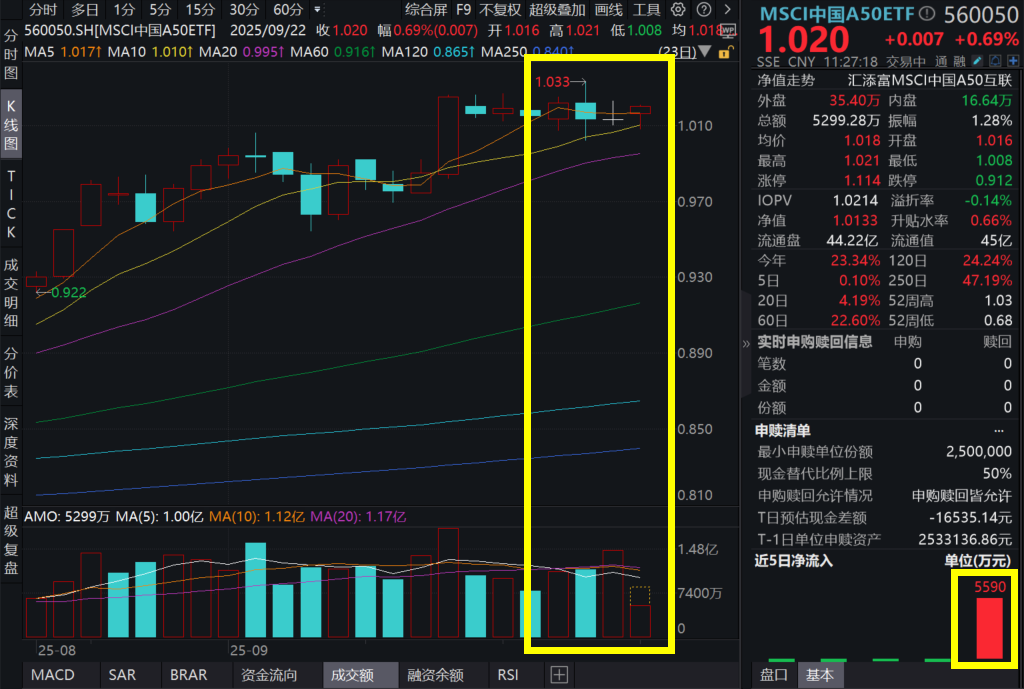
Core Viewpoint - The MSCI China A50 ETF (560050) is experiencing a positive market trend, with a notable increase in trading volume and performance, indicating strong investor interest and potential growth opportunities in the Chinese stock market [1][5]. Group 1: Market Performance - As of September 22, the MSCI China A50 ETF rose by 0.69%, with a trading volume exceeding 53 million yuan, following a previous day of strong capital inflow of over 55 million yuan [1]. - The index's constituent stocks showed mixed performance, with notable gains from companies like Luxshare Precision (10% increase) and Industrial Fulian (over 8% increase), while others like CATL and Kweichow Moutai experienced slight declines [2][3]. Group 2: Index Composition and Adjustments - The MSCI China A50 index underwent a periodic adjustment on August 26, adding stocks like Zhongji Xuchuang and China Shipbuilding while removing stocks such as BOE Technology and Yili [5]. - The weight of the information technology sector in the MSCI China A50 index increased significantly from 18.3% to 22.7% following the adjustment, reflecting a growing emphasis on technology within the index [5][6]. Group 3: Industry Trends and Insights - The MSCI China A50 index is characterized by a unique compilation method that emphasizes leading companies within each sector, ensuring a balanced representation of industries while focusing on technology leaders [9][11]. - The index's total market capitalization stands at 29.2 trillion yuan, with a median market cap of 385.8 billion yuan, indicating a strong large-cap focus compared to other indices [15][16]. Group 4: Financial Performance - The constituent stocks of the MSCI China A50 index have maintained robust financial health, with total revenue exceeding 14 trillion yuan and net profit over 1.7 trillion yuan over the past five years [15]. - For 2024, the index's constituent stocks are projected to see a revenue growth of 2.5% and a net profit growth of 8.3% year-on-year, highlighting their resilience and potential for future growth [15][18]. Group 5: Long-term Performance - The MSCI China A50 index has outperformed its peers in terms of returns and risk characteristics, particularly during the technology-driven market rally in August, showcasing its ability to capitalize on emerging trends [20]. - Year-to-date, the MSCI China A50 index has recorded a return of 17.5%, significantly higher than other comparable indices, indicating its strong performance in the current market environment [20].






手机厂商与面板巨头加深捆绑
2 1 Shi Ji Jing Ji Bao Dao· 2025-09-22 04:47
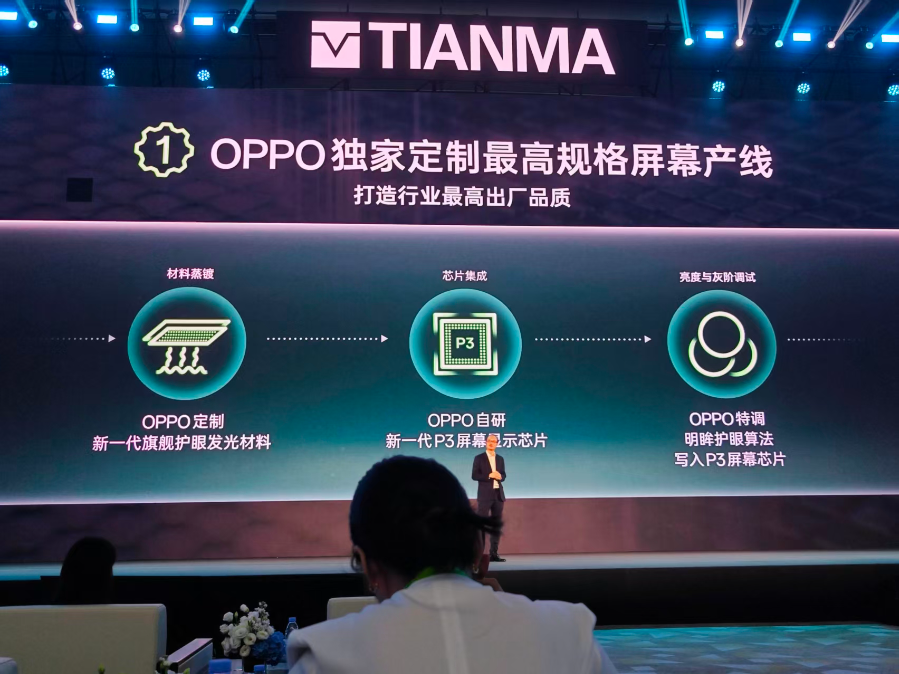
Core Viewpoint - The smartphone industry is witnessing a shift from a traditional "buyer-supplier" relationship to a collaborative model where manufacturers engage deeply in the definition, development, and production of display technologies, reshaping the competitive landscape of the display panel industry [2][4][8]. Group 1: New Collaboration Paradigm - Smartphone manufacturers are no longer passive purchasers but are becoming strategic partners with panel manufacturers, engaging in joint research and deep customization [2][4]. - OPPO has invested over 1 billion in establishing its own "display science production line," allowing it to control the entire process from design to production [4][5]. - The collaboration between Xiaomi and TCL Huaxing has evolved into a long-term partnership, creating an "innovation display joint laboratory" to streamline technology development and production [5][8]. Group 2: Industry Dynamics - The traditional supply chain structure is being transformed from a linear model to a networked "industry alliance," enhancing the bargaining power of smartphone manufacturers [8][9]. - Chinese panel manufacturers are expected to capture over 70% of the global smartphone panel market by 2025, providing manufacturers with more options and stronger negotiation capabilities [8][10]. - The shift to deep collaboration is accelerating technological iteration and redefining market competition rules, moving the focus from macro parameters to underlying technologies [10][11]. Group 3: Technological Advancements - The competition in the smartphone market is increasingly centered around display technology, with companies like OPPO and Tianma developing advanced features such as precise light control at ultra-low brightness [10][11]. - The joint development model allows manufacturers to align market needs with technological paths early in the research phase, significantly reducing the time from lab to market [10][11]. - The relationship between Apple and Samsung exemplifies a unique "co-opetition," where stringent standards and large orders from Apple drive Samsung to innovate continuously [6][10].
手机厂商与面板巨头加深捆绑
21世纪经济报道· 2025-09-22 04:41
Core Viewpoint - The article discusses the evolving relationship between smartphone manufacturers and panel suppliers, highlighting a shift from a traditional procurement model to a collaborative co-creation model, which enhances competitive advantages in the smartphone market [2][10]. Group 1: New Collaboration Paradigm - Smartphone manufacturers are no longer passive "purchasers" but are deeply involved in defining, developing, and producing display technologies, forming strategic partnerships with panel giants [2][5]. - This shift from "procurement" to "co-creation" is a natural outcome of the smartphone industry's transition from product-level competition to supply chain-level competition, accelerating technology iteration and reshaping the global display panel industry's power dynamics [2][10]. Group 2: Case Studies of Collaboration - OPPO has invested over 1 billion in establishing its own "display science production line" and has customized a dedicated production line with Tianma, allowing it to control the entire process from design to production [5][11]. - Xiaomi and TCL Huaxing have established an "Innovation Display Joint Laboratory," creating a complete closed loop from technology research to mass production, which enhances their collaborative growth [6][10]. - The relationship between Apple and Samsung is characterized by a unique "co-opetition," where Apple drives Samsung's technological innovation through stringent standards and large orders, influencing industry technology trends [7][10]. Group 3: Industry Impact and Market Dynamics - The deepening collaboration between smartphone manufacturers and panel suppliers is fundamentally reshaping the supply chain's power structure and the speed of technology iteration [9][10]. - The rise of Chinese panel manufacturers like BOE and TCL Huaxing is changing the competitive landscape, with predictions that their market share in the global smartphone panel market will exceed 70% by 2025 [10]. - The traditional linear supply chain is evolving into a networked "industry alliance," where smartphone manufacturers provide precise market demands and panel manufacturers contribute their expertise in materials and processes [10][11]. Group 4: Future Considerations - The deep customization and joint development require significant upfront investment, raising questions about whether these costs will be passed on to consumers, potentially increasing flagship smartphone prices [12]. - The trend towards exclusive custom screens may reduce their universality, leading to higher repair costs for consumers, prompting ongoing observation of whether the industry will continue down a path of deeper customization or establish new, higher industry standards [12].

中国城市房地产保值率排名2025
Sou Hu Cai Jing· 2025-09-22 02:35
Group 1 - The core viewpoint of the article is that China's real estate market is transitioning from a "universal rise era" to a "structural differentiation era," with significant variations in property value retention across different cities [3][10][19] - The article emphasizes that the long-term outlook for real estate is influenced by population trends, medium-term factors are related to land, and short-term factors are driven by financial conditions [3][9] - The report identifies the top ten cities with the highest property value retention rates as Urumqi, Shanghai, and Beijing, all exceeding 80% [4][11][12] Group 2 - Urumqi's property value retention is supported by its strategic position as a core node in the "Belt and Road" initiative and its low bubble property characteristics [5][20][24] - Shanghai's high property value retention is attributed to its unique economic foundation and the concentration of global capital, with a retention rate of 89.4% [5][27][30] - Beijing benefits from its capital status, high-quality population, and irreplaceable educational resources, resulting in a property value retention rate of 85% [5][33][37] Group 3 - The article discusses the differentiation in property value retention across regions, with the Yangtze River Delta and Pearl River Delta cities performing better than those in the Northeast [13][14] - It highlights that the property value retention rates in the western cities are generally higher due to their economic resilience and population attraction [14][19] - The report notes that the historical peak of property prices significantly affects retention rates, with cities that peaked later showing stronger retention capabilities [16][19] Group 4 - The article suggests that the medium to long-term real estate market still has development potential, with a projected housing demand of approximately 5.5 billion square meters from 2025 to 2030 [52][53] - It outlines three potential measures to revitalize the real estate sector, including the establishment of a large housing bank and continued interest rate cuts [55]

立讯精密和OpenAI达成协议盘中涨停,消费电子ETF(561600)涨超1.9%
Xin Lang Cai Jing· 2025-09-22 02:01
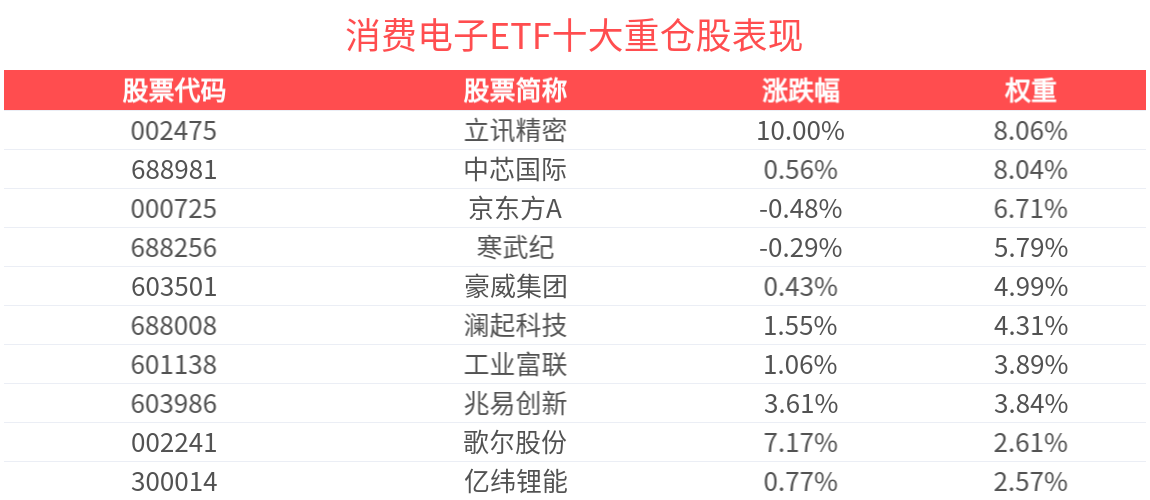
Group 1 - Lixun Precision, a well-known "fruit chain" company in China, has reportedly reached an agreement with OpenAI to jointly develop future OpenAI hardware [1] - OpenAI has been focusing on AI hardware this year, currently in the prototype design stage, with known features including a "pocket-sized" device capable of context awareness, understanding commands, surrounding environment, historical dialogues, and user intentions [1] - The hardware may take forms such as glasses, wearable pins, or recording pens, with the first batch expected to be released by the end of 2026 or early 2027 [1] Group 2 - As of September 22, 2025, the CSI Consumer Electronics Theme Index (931494) rose by 2.09%, with Lixun Precision (002475) up by 10.00%, Liying Intelligent Manufacturing (002600) up by 7.41%, and GoerTek (002241) up by 7.17% [1] - The Consumer Electronics ETF (561600) increased by 1.97%, with the latest price reported at 1.24 yuan [1] - The CSI Consumer Electronics Theme Index tracks 50 listed companies involved in component production and complete brand design and manufacturing, reflecting the overall performance of consumer electronics-related securities [1] Group 3 - As of August 29, 2025, the top ten weighted stocks in the CSI Consumer Electronics Theme Index include Cambricon (688256), Lixun Precision (002475), SMIC (688981), and others, collectively accounting for 54.8% of the index [2] - The weight of Lixun Precision in the index is 8.06%, with a price increase of 10.00% [4] - Other notable stocks include SMIC with a weight of 8.04% and a price increase of 0.56%, and BOE Technology Group (000725) with a weight of 6.71% and a price decrease of 0.48% [4]
京东方_Mini_微型 LED 最新进展_B6 工厂升级以把握不断增长的终端应用;中性评级
2025-09-22 01:00
Summary of BOE (000725.SZ) Conference Call Company Overview - **Company**: BOE Technology Group Co., Ltd. (000725.SZ) - **Industry**: Display Technology, specifically focusing on Mini / Micro LED technology Key Points Industry and Company Developments - BOE is transitioning its Gen-5.5 B6 plant in Inner Mongolia from LCD/OLED production to Mini/Micro LED technology, indicating a strategic shift towards advanced display technologies to meet rising end application demands [1] - The Zhuhai Micro LED plant is set to begin mass production in 2024, targeting applications in AR/VR headsets and smart wearables, showcasing BOE's commitment to expanding its Micro LED business [1] - In September 2025, BOE acquired new equipment to enhance its Micro LED production capabilities, further emphasizing its growth strategy in this sector [1] Financial Performance - The revenue contribution from BOE's Micro LED segment increased significantly from 0.5% in the first half of 2022 to 4.3% in the first half of 2025, reflecting a strong growth trajectory [1] Market Trends and Projections - The demand for Micro LED technology is expected to rise due to its superior characteristics, such as higher peak brightness, better color performance, lower screen burn-in risk, and faster response times compared to traditional LCD and OLED displays [6] - The shipment of Micro LED displays is projected to reach 34.6 million units by 2031, driven by continuous product launches from display manufacturers, indicating a positive outlook for market demand [6] Product Innovations - Notable product launches include: - **Garmin Fenix 8 Pro**: A smart watch featuring a Micro LED display with a peak brightness of 4,500 nits, enhancing visibility in outdoor conditions [9] - **Tianma Automotive Display**: A Micro LED automotive display with a peak brightness of 1,700 nits, designed for smart driving applications [12] - **RayNeo X3 Pro AR Glasses**: Featuring a Micro LED display with a peak brightness of 6,000 nits, ensuring clear visibility even in bright outdoor light [12] Investment Outlook - Goldman Sachs maintains a Neutral rating on BOE with a 12-month target price of RMB 4.79, reflecting a potential upside of 16% from the current price of RMB 4.13 [11] - The target EV/EBITDA multiple is set at 4.9x, aligned with the company's average, indicating a cautious but optimistic view on BOE's future performance in the cyclical panel industry [11] Risks and Considerations - Key risks include: - Variability in the growth rate of flexible OLED shipments - Uncertainty regarding market share gains in large-sized LCD panels and small-sized flexible OLEDs - Potential delays in ramping up production at new factories, particularly for large-sized LCD panels and flexible OLEDs [12] Conclusion - BOE is strategically positioning itself in the growing Micro LED market through significant investments and product innovations, with a positive revenue growth trajectory. However, potential risks related to market dynamics and production capabilities should be monitored closely.

中国制造向“新”而行拥抱全球
Guang Xi Ri Bao· 2025-09-21 16:01
Group 1 - The threshold for entering the "2025 China Manufacturing Enterprises Top 500" list has increased by 303 million yuan compared to the previous year, reaching 17.365 billion yuan [1] - The total revenue of the top 500 manufacturing enterprises has grown from 40.24 trillion yuan at the end of the 13th Five-Year Plan to 51.68 trillion yuan [1] - The total assets of these enterprises have increased from 44.33 trillion yuan to 53.31 trillion yuan [1] Group 2 - The average revenue growth rate for industries such as material handling equipment manufacturing, motorcycle and parts manufacturing, and communication equipment manufacturing ranks among the top five [1] - The number of companies in the communication equipment manufacturing sector has increased from 15 to 20, while the semiconductor and integrated circuit sectors have seen an increase from 6 to 9 [1] - Traditional industries are also showing signs of transformation, with companies like China Railway Rolling Stock Corporation rising in rank [1] Group 3 - The R&D intensity of the top 500 manufacturing enterprises is 2.45%, reflecting a 0.03 percentage point increase compared to the previous year [1] - The number of valid patents has reached 1.6632 million, with invention patents totaling 803,800, marking increases of 11.34% and 12.07% respectively [1] - Industries such as engineering machinery and boiler manufacturing have seen average R&D investment growth rates exceeding 100% [1] Group 4 - The proportion of overseas revenue has increased from 17.39% to 19.10%, while overseas assets and employees have also seen similar increases [1] - Companies like Chery Holding Group have improved their rankings significantly, reflecting the growth of Chinese manufacturing in the global market [1] - The future direction for Chinese manufacturing is towards digital transformation and integration into the global value chain [1]