
平安银行

Search documents
央行:调整后的一级交易商考评办法将从2025年启用,考评期内行为不当的一级交易商将被暂停参与公开市场操作
Sou Hu Cai Jing· 2025-09-12 10:45
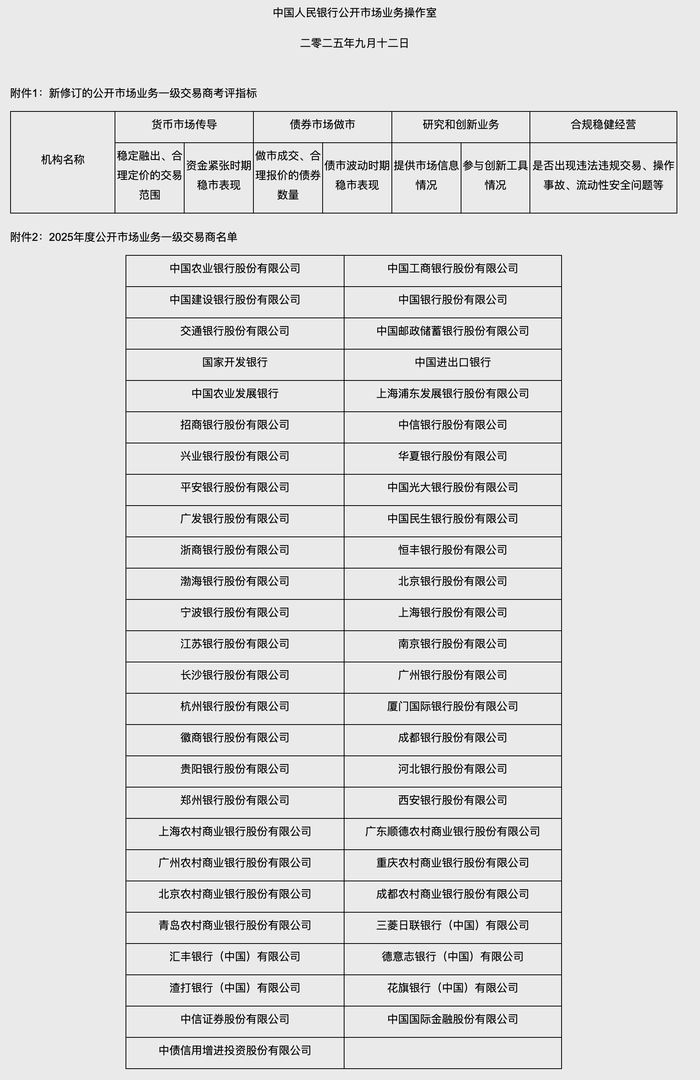
Core Viewpoint - The People's Bank of China (PBOC) has established a new evaluation mechanism for primary dealers in the open market, which will be implemented in 2025, aiming to enhance the transmission of monetary policy and adapt to the evolving financial market [1]. Group 1: Evaluation Mechanism - The PBOC's evaluation mechanism for primary dealers was first established in 2004 and adjusted in 2018 to support smooth open market operations [1]. - The new evaluation method will focus on optimizing and simplifying assessment indicators, categorizing institutions for evaluation, and strengthening the linkage with bond market makers [1]. - The list of primary dealers for the year 2025 will remain unchanged, and any dealer exhibiting inappropriate behavior during the evaluation period may be suspended from participating in open market operations [1]. Group 2: Institutions Involved - A comprehensive list of institutions that will be evaluated includes major banks such as Agricultural Bank of China, Industrial and Commercial Bank of China, China Construction Bank, and Bank of China, among others [3][4]. - The evaluation will consider factors such as stable lending, reasonable pricing, market performance during tight funding periods, and compliance with operational standards [3].







平安银行今日大宗交易溢价成交35万股,成交额416.15万元
Xin Lang Cai Jing· 2025-09-12 08:59
Group 1 - On September 12, Ping An Bank executed a block trade of 350,000 shares, with a transaction value of 4.1615 million yuan, accounting for 0.37% of the total trading volume for that day [1][2] - The transaction price was 11.89 yuan, which represents a premium of 1.45% compared to the market closing price of 11.72 yuan [1][2] - The buyer of the shares was from China Merchants Securities Co., Ltd., while the seller was from Ping An Securities Co., Ltd. [2]

股份制银行板块9月12日跌1.96%,浦发银行领跌,主力资金净流出18.81亿元
Zheng Xing Xing Ye Ri Bao· 2025-09-12 08:38
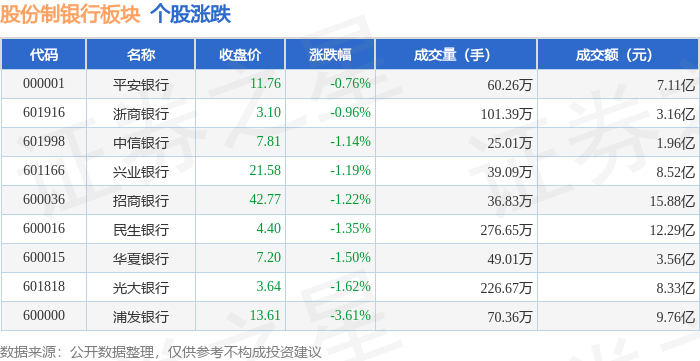
证券之星消息,9月12日股份制银行板块较上一交易日下跌1.96%,浦发银行领跌。当日上证指数报收于 3883.69,上涨0.22%。深证成指报收于12996.38,上涨0.13%。股份制银行板块个股涨跌见下表: 从资金流向上来看,当日股份制银行板块主力资金净流出18.81亿元,游资资金净流入10.61亿元,散户资 金净流入8.21亿元。股份制银行板块个股资金流向见下表: | 代码 | 名称 | 主力净流入 (元) | 主力净占比 游资净流入 (元) | | 游资净占比 散户净流入 (元) | | 散户净占比 | | --- | --- | --- | --- | --- | --- | --- | --- | | 601998 | 中信银行 | = 538.73万 | 1.74% | -164.87万 | -0.53% | -373.86万 | -1.21% | | 600000 | 浦发银行 | -3950.12万 | -2.09% | 9335.15万 | 4.94% | -5385.03万 | -2.85% | | 601916 | 浙商银行 | -5587.77万 | -10.77% | 1751.5 ...

银行配置价值不改,银行ETF指数(512730)下跌触及MA20,机构称理财子或将受益新规
Xin Lang Cai Jing· 2025-09-12 07:28
Group 1 - The China Banking Index (399986) declined by 1.54% as of September 12, 2025, with major stocks like Shanghai Pudong Development Bank (600000) leading the drop at 3.68% [1] - The Bank ETF Index (512730) also fell by 1.40%, closing at 1.69 yuan, indicating a market pullback in the afternoon [1] - The China Securities Regulatory Commission (CSRC) is seeking public opinion on a draft regulation aimed at reducing subscription fees for publicly raised securities investment funds, which may impact short-term fund yields [1] Group 2 - Open-source securities noted that residents prefer high liquidity products, with the "minimum holding period" type of financial products showing the most growth from January to May 2025 [2] - The new regulations may enhance the attractiveness of short-term financial products, which are expected to benefit from the "deposit migration" trend, leading to accelerated growth in scale [2] - The Bank ETF Index closely tracks the China Banking Index, providing investors with analytical tools to assess the performance of various industry companies [2] Group 3 - As of August 29, 2025, the top ten weighted stocks in the China Banking Index include China Merchants Bank (600036), Industrial Bank (601166), and others, collectively accounting for 65% of the index [3]
信用卡“大退潮”:半年缩水2000亿,年轻人开始告别“卡奴人生”
3 6 Ke· 2025-09-12 07:18
Core Insights - The trend of young people moving away from credit cards is increasing, with a significant decline in credit card usage and ownership among the younger generation [2][6][11] Group 1: Decline in Credit Card Usage - The number of credit cards and combined lending cards in China decreased by 52 million in the first half of 2025 compared to 2023, marking 11 consecutive quarters of decline [2] - The average number of credit cards held by individuals aged 90s has dropped from 5 to 2.3, while the 00s generation shows a 42% rate of being cardless [2][6] - As of the second quarter of 2023, the total number of credit cards in circulation was 715 million, down 0.83% from the previous quarter and over 11% from the peak of 807 million in 2022 [4] Group 2: Financial Performance of Banks - In the first half of 2025, the credit card loan balance of six major state-owned banks and eight joint-stock banks totaled 7.52 trillion yuan, a decrease of 197.57 billion yuan or 2.56% from the beginning of the year [2][3] - Among 14 listed banks, 11 reported a contraction in credit card loan balances, with China Bank experiencing the largest decline of 13.88% [3] - The total credit card transaction amount across 12 banks shrank by 1.42 trillion yuan, a year-on-year decrease of 11.05% [3] Group 3: Changing Consumer Behavior - Young consumers are increasingly favoring alternative payment methods like "Huabei" and digital bank cards, with 45% of 95s believing these options are more convenient [6][7] - The topic of "cancelling credit cards" has gained significant traction on social media, indicating a cultural shift towards "debt-free" living among younger generations [6][7] - Issues such as hidden fees, annual fees, and reduced benefits have discouraged many users from maintaining their credit cards [7] Group 4: Industry Transformation - The credit card industry is transitioning from a phase of rapid expansion to one focused on value extraction from existing customers [4][11] - Over 40 banks have received approval to terminate credit card centers, signaling a shift towards refined operations rather than aggressive growth [8] - Banks are adjusting their credit card offerings, with many reducing benefits and increasing requirements for premium cards [9][10] Group 5: Future Directions - The future of credit cards is expected to focus on meeting the diverse needs of high-end customers and providing essential payment and credit conveniences for basic customers [10][11] - The rise of mobile payment solutions is reshaping the credit landscape, prompting traditional credit card services to reevaluate their value propositions [8][11]


银保渠道,挥别“代销”?
2 1 Shi Ji Jing Ji Bao Dao· 2025-09-12 02:09
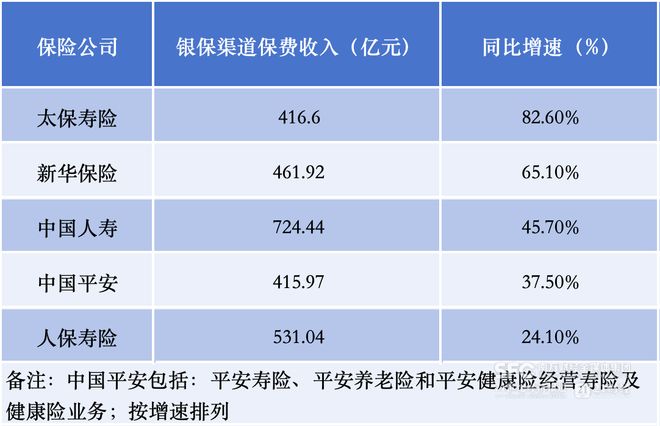
Core Insights - The insurance channel through banks is showing signs of recovery after a period of transformation, with its revenue share returning to 50% for the first time in 15 years [1][2] - The recovery is driven by multiple factors including policy changes, market dynamics, and a shift towards deeper strategic cooperation between banks and insurance companies [1][4][11] Policy Changes - The "reporting and banking integration" policy has been a significant catalyst for the transformation of the bank-insurance channel, aiming to standardize fee structures and reduce costs [4][5] - The cancellation of the "one-to-three" restriction allows banks to collaborate with more insurance companies, further enhancing cooperation opportunities [6][7] Market Dynamics - The bank-insurance channel is becoming a strategic alternative for insurance companies as individual insurance channels face growth challenges [11][12] - Banks are increasingly viewing bank-insurance business as a key driver for non-interest income, especially in a low-interest-rate environment [12][13] Performance Metrics - In the first half of the year, the bank-insurance channel's premium income growth outpaced individual insurance channels, with major insurance companies reporting significant year-on-year growth [2][3] - Key performance indicators show that the new business value from bank-insurance channels has increased significantly, with some companies reporting over 100% growth [3][9] Strategic Cooperation - The bank-insurance collaboration is evolving from a simple product distribution model to a deeper strategic alliance focused on customer needs [15][17] - Insurance companies are enhancing their strategies by improving product offerings, expanding distribution networks, and leveraging digital tools to increase efficiency [16][17] Customer Demand - There is a notable shift in customer preferences towards long-term, stable insurance products, driven by demographic changes and economic conditions [13][14] - The current market indicates that a small percentage of bank customers are utilizing insurance products, highlighting significant potential for growth in this area [14]
中海宏洋(00081.HK)签订最高等值30 亿元人民币贷款协议
Xin Lang Cai Jing· 2025-09-12 01:17
Core Viewpoint - China Overseas Grand Oceans Group Limited has signed a loan agreement with seven prominent banks for a maximum amount equivalent to RMB 3 billion, marking the highest overseas bank loan in the company's history, which reflects strong market confidence in its financial stability and commitment to high-quality development [3][4]. Group 1: Loan Agreement - The loan agreement involves participation from major banks including Bank of China (Hong Kong), DBS Bank (Hong Kong), and others, indicating robust support from both domestic and foreign banks [3]. - The funds raised from this loan are entirely new capital, representing a significant breakthrough in the offshore loan market for the real estate industry [3][4]. Group 2: Company Performance - In the first half of 2025, the company entered 19 cities, with two-thirds of its main sales cities ranking in the top three, and eight cities achieving the market leader position [4]. - The company has maintained a debt-to-asset ratio below 70% for the first time and a net debt ratio of 33.5%, showcasing its financial health [4]. - The company has invested RMB 7.1 billion in land acquisition this year, adding a total value of RMB 19.6 billion, with efficient project operations and positive land price recovery [4].

持续加码技术投入 上市银行加力数智转型
Jing Ji Ri Bao· 2025-09-12 01:11
Core Insights - Digital finance is continuously evolving, becoming a powerful tool for enhancing efficiency and innovation in financial institutions [1] - Listed banks are steadily increasing their support for the real economy while achieving stable development, driven by robust digital finance [1] Group 1: Investment in Digital Finance - In 2024, six major state-owned commercial banks reported a total investment of 125.459 billion yuan in financial technology, a 2.15% increase from 2023 [2] - The total number of technology personnel in these banks has surpassed 100,000 for the first time [2] - Continuous investment has led to improved operational performance, with China Construction Bank achieving precise customer identification and marketing through technology and data [2] Group 2: Digital Transformation Achievements - Beijing Bank reported a revenue of 36.218 billion yuan and a net profit of 15.053 billion yuan in the first half of the year, reflecting a year-on-year growth of 1.02% and 1.12% respectively [3] - The bank has accelerated its transformation into an AI-driven commercial bank, establishing an integrated AI system with over 300 application scenarios [2][3] Group 3: Technological Support and Infrastructure - Major banks are enhancing their digital technology capabilities to lay a solid foundation for future strategic layouts [4] - China Bank has accelerated its digital transformation, with a total of 40,000 cloud platform servers and 352 applications connected to its distributed technology platform by mid-2025 [4] - Shanghai Pudong Development Bank has built a comprehensive digital infrastructure, achieving a full-stack domestic computing platform and a collaborative model service matrix [4] Group 4: Risk Management and Compliance - Digital finance is increasingly playing a crucial role in risk management and compliance [6] - Ping An Bank has deepened the application of intelligent algorithms to enhance its risk control system, improving efficiency across various processes [6] Group 5: Integration of Digital and Intelligent Finance - Listed banks view digital finance, particularly AI technology, as essential for improving operational efficiency and customer experience [7] - Everbright Bank has developed an intelligent policy assistant that enhances compliance execution efficiency by linking policy documents with business scenarios [7] - The bank has also launched an intelligent analysis tool that integrates AI and business intelligence, covering over 2,000 data indicators [7][8]

银行上半年“人均月薪”有多少?招商、兴业超4.5万元
Xin Lang Cai Jing· 2025-09-12 00:55
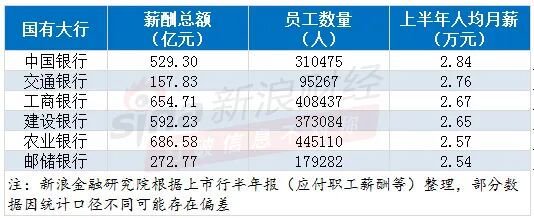
Summary of Key Points Core Viewpoint - The recent strong performance of the banking sector has drawn attention to the salary situation of listed banks, with significant differences in average salaries between state-owned banks and joint-stock banks [1][2]. Salary Data of State-Owned Banks - In the first half of 2025, the average monthly salary for employees in state-owned banks ranged from 25,400 to 28,400 yuan, with Agricultural Bank having the lowest average salary at 25,100 yuan [4][11]. - The total salary expenditure for Agricultural Bank reached 68.658 billion yuan, ranking first among state-owned banks, followed by Industrial and Commercial Bank with 65.471 billion yuan [3][4]. Salary Data of Joint-Stock Banks - Joint-stock banks generally offered higher average monthly salaries, with China Merchants Bank and Industrial Bank exceeding 45,000 yuan, specifically 50,100 yuan and 45,700 yuan respectively [6][7]. - The total salary expenditure for China Merchants Bank was 35.484 billion yuan, leading among joint-stock banks, while several others exceeded 10 billion yuan [5][6]. Employee Count Changes - Many banks reported a reduction in employee numbers, with Agricultural Bank reducing its workforce by 9,606 employees, and Industrial and Commercial Bank by over 6,700 employees [8][12]. - In contrast, China Merchants Bank was the only bank to increase its employee count, adding 867 employees [10][12]. Performance-Based Salary Mechanisms - Several banks have implemented performance-based salary mechanisms, including deferred payment and clawback provisions for high-risk positions, as seen in the practices of Minsheng Bank and Shanghai Pudong Development Bank [13][14]. - The trend of extending salary resources to county-level operations is noted, with Agricultural Bank allocating over 50% of its recruitment plan to county areas to support rural revitalization efforts [16].


私行业务跑出加速度 成银行扩中收重要引擎
Zhong Guo Zheng Quan Bao· 2025-09-11 22:15
Core Insights - The private banking business has shown significant growth in both client numbers and assets under management (AUM), becoming a key driver for retail banking growth amid pressure on net interest margins [1][4]. Client Growth - Major state-owned banks have a strong advantage in private banking client numbers, with Agricultural Bank of China reporting 279,000 clients, an increase of 23,000 since the beginning of the year [2]. - China Construction Bank, Bank of China, and Bank of Communications reported private banking clients of 265,500, 216,900, and 102,600 respectively, while Postal Savings Bank had 41,400 clients, reflecting a growth of over 21% [2]. - Among joint-stock banks, China Merchants Bank leads with 182,700 clients, followed by Ping An Bank and CITIC Bank, both exceeding 90,000 clients [2]. - Several city commercial banks also reported impressive growth, with Ningbo Bank's private banking clients increasing by 20.27% to 30,000 [2]. AUM Growth - Private banking AUM growth outpaced overall retail AUM growth, with Agricultural Bank, Bank of China, China Construction Bank, and Bank of Communications reporting AUM of CNY 3.5 trillion, CNY 3.4 trillion, CNY 3.18 trillion, and CNY 1.39 trillion respectively, reflecting growth rates of 11.11%, 8.28%, 14.39%, and 7.20% [4]. - Joint-stock banks like Ping An Bank, CITIC Bank, and Industrial Bank reported private banking AUM exceeding CNY 1 trillion, with Minsheng Bank and Zheshang Bank showing AUM growth of over 10% [4]. Strategic Focus - Banks are increasingly focusing on deepening client service, with strategies tailored to high-net-worth individuals, such as China Construction Bank's integrated client management and Postal Savings Bank's innovative client activities [5]. - Future developments in private banking are expected to emphasize digitalization, service ecosystem integration, and global investment options, leveraging technologies like AI and blockchain for enhanced client service [6].