
基金销售费用新规

Search documents
选错亏1%!基金A/C怎么选?2026费率新规全拆解
Sou Hu Cai Jing· 2026-02-14 08:01
Core Viewpoint - The article highlights the confusion among retail investors regarding the fee structures of A and C class mutual funds, leading to potential losses due to improper selection based on investment duration [4][6]. Fee Structure - The new mutual fund fee regulations effective February 2026 clarify the charging logic for A and C class funds, with A class having an initial subscription fee of 1.5% reduced to 0.15% on major platforms, while C class has no subscription fee but incurs a daily service fee of 0.2%-0.8% [3][4]. - A class funds are suitable for long-term investors (holding for over one year), as they incur a one-time fee, making them more cost-effective over time compared to C class funds [4][6]. - C class funds are better for short-term investors, as they have no upfront fees and lower holding costs, but can accumulate higher fees over time if held longer than 109 days [4][5][6]. Common Mistakes - New investors often make the mistake of choosing A class funds for short-term trading, leading to immediate losses due to both subscription and redemption fees [4][6]. - Holding C class funds for extended periods can also result in higher cumulative fees compared to A class, negating the initial cost advantage [5][6]. Investment Strategy - A simple guideline is provided: choose C for short-term investments and A for long-term holdings, and avoid redeeming within the first 7 days to prevent unnecessary losses [6]. - The article emphasizes the importance of understanding fee structures to avoid losing money unnecessarily, which can accumulate to significant amounts over time [6].


2026年投资展望系列之十三:2026信用债机构行为新动向
HUAXI Securities· 2026-01-14 13:24
1. Report Industry Investment Rating - Not mentioned in the provided content 2. Core Viewpoints of the Report - In 2026, the scale of wealth management may grow steadily, but the proportion of credit bond allocation is likely to decline. The behavior of funds will be the core indicator of the credit bond market, and the concentrated opening of amortized bond funds may boost the demand for credit bonds with specific maturities. The growth rate of credit bond ETFs may slow down [1][2][4][5][6] 3. Summary by Relevant Catalogs 3.1 2026 Wealth Management Scale May Grow Steadily, Credit Bond Allocation Proportion Is Hard to Rise - **2026 wealth management scale growth may be in the range of 2.7 - 3.4 trillion yuan**: From 2024 - 2025, the scale of bank wealth management grew steadily, with annual increments exceeding 3 trillion yuan. The core driver was asset re - allocation during the downward cycle of deposit rates. It is estimated that the growth of wealth management scale in 2026 may be in the range of 2.7 - 3.4 trillion yuan [2][13][24] - **The proportion of credit bond allocation in wealth management shows a downward trend**: In 2025, due to the rectification of net - value smoothing methods, the proportion of bond allocation and credit bond allocation in wealth management decreased. In 2026, in the context of full net - value management and a low - spread environment, the proportion of credit bond allocation may be difficult to increase [26] - **Wealth management bond allocation shows seasonal characteristics and focuses on coupon cost - effectiveness**: In 2025, the willingness of wealth management to increase credit bond allocation decreased, mainly concentrating on bonds within 3 years. The bond allocation rhythm of wealth management is affected by scale changes and shows seasonal characteristics [30] - **The net purchase of inter - bank certificates of deposit by other asset management products exceeded that of credit bonds**: In 2025, the proportion of net purchases of credit bonds by other asset management products decreased significantly, while they increased the allocation of inter - bank certificates of deposit, which reflects the wealth management's large - scale increase in inter - bank certificates of deposit through entrusted asset management products for liquidity management [35][36] 3.2 In 2026, Fund Behavior Is the Core Indicator of the Credit Bond Market - **In 2026, the growth rate of bond fund scale may be under pressure**: The new regulations on fund sales fees in December 2025 may weaken the attractiveness of short - term bond funds, and if the pattern of a strong stock market and a weak bond market continues in 2026, it may suppress the growth of bond fund scale [4][43] - **The proportion of funds allocating credit bonds increased, and the duration operation is flexible**: In 2025, the willingness of funds to increase credit bond allocation increased, mainly due to the large expansion of credit bond ETFs and the relative advantage of credit bond coupon strategies in a volatile market. Funds mainly net - bought credit bonds within 5 years in 2025, with flexible duration operations [50][53] - **The concentrated opening of amortized bond funds may drive the demand for credit bond allocation with specific maturities**: In 2026, the concentrated opening of amortized bond funds is expected to exceed 60 billion yuan. If some products turn to a credit - style, it may boost the demand for credit bonds with corresponding maturities, especially medium - to high - grade 5 - year and 3 - year varieties [6][63] - **The growth rate of credit bond ETF scale may slow down**: In 2025, credit bond ETFs achieved leap - forward development, but in 2026, it may be difficult to reproduce the large - scale new issuance, and the scale growth may mainly rely on existing products to attract incremental funds. The scale change of credit bond ETFs is also greatly affected by interest rate trends [6][67][68]
基金周报:22届基金业金牛奖评选结果揭晓,易方达率先完成ETF规范命名-20260105
Guoxin Securities· 2026-01-05 02:52
========= - The weekly report highlights that the median excess return of index-enhanced funds last week was -0.08%, while the median return of quantitative hedge funds was 0.10%[2][35] - Since the beginning of the year, the median excess return of index-enhanced funds has been 4.67%, and the median return of quantitative hedge funds has been 1.24%[2][35] - The report also mentions that the best-performing category of funds this year has been alternative funds, with a median return of 52.59%[2][33] =========

买基金更省钱,证监会:份额持有超一年不再收销售服务费
Sou Hu Cai Jing· 2025-12-31 15:01
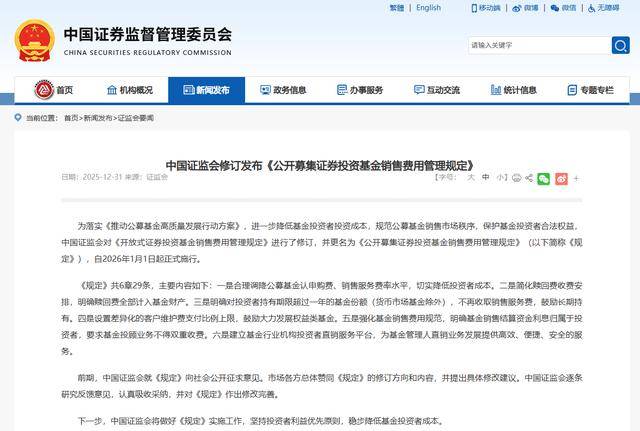
Core Viewpoint - Starting from 2026, investors in China will benefit from reduced costs when purchasing mutual funds due to the revised regulations by the China Securities Regulatory Commission (CSRC) aimed at lowering fund investment costs [1][2]. Group 1: Fee Structure Changes - The new regulations will lower the subscription fees for public mutual funds, with specific caps: active equity funds will have a maximum subscription fee of 0.8% of the subscription amount, mixed funds at 0.5%, and index and bond funds at 0.3% [1]. - Redemption fees will be fully allocated to the fund's assets, with specific rates based on the holding period: less than 7 days incurs a fee of at least 1.5%, 7 to 30 days at least 1%, and 30 to 180 days at least 0.5% [1]. Group 2: Sales Service Fees - For funds that do not charge subscription fees, sales institutions can charge a sales service fee, capped at 0.4% per year for equity and mixed funds, 0.2% for index and bond funds, and 0.15% for money market funds [2]. - Funds held for over one year will not incur additional sales service fees, except for money market funds and other CSRC-approved funds [2]. Group 3: Implementation Timeline - The new regulations will take effect on January 1, 2026, and fund managers must adjust their fee structures within 12 months to comply with the new rules [2].
信用 | 韬光养晦
Sou Hu Cai Jing· 2025-12-09 02:36
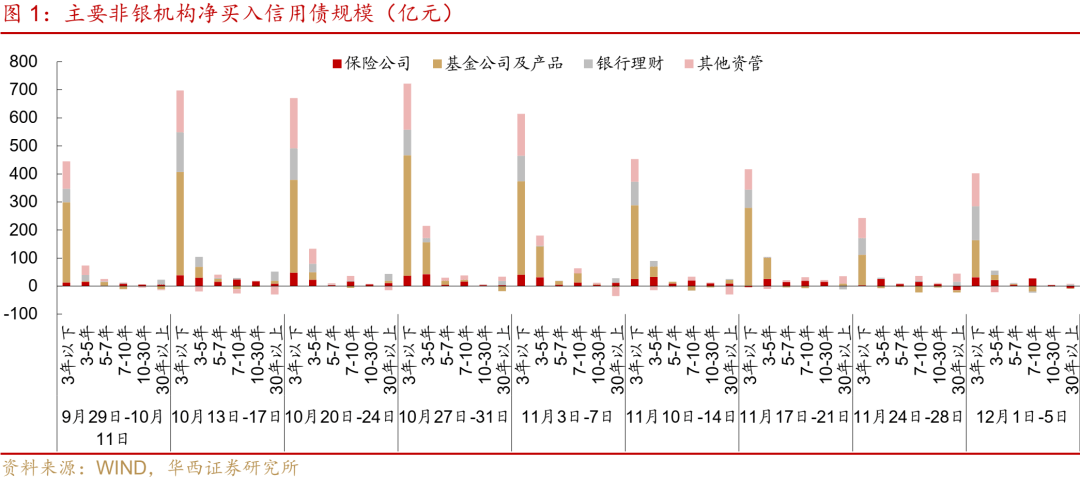
Core Viewpoint - The bond market is experiencing adjustments due to weaker expectations for further "loose monetary policy" and a decline in net purchases of credit bonds by funds, indicating a cautious market sentiment as the year-end approaches [1][4][5]. Group 1: Market Conditions - From December 1-5, the funding environment remained stable, but the central bank's bond purchases were below expectations, leading to a weakening of the market's "loose monetary policy" expectations [1][4]. - Credit bond yields have risen, with varying performances in spreads; high-grade city investment bonds showed weaker performance with spreads widening by 3-5 basis points for 1-year and 10-year bonds [1][4]. - The net purchases of credit bonds by funds significantly decreased, with recent weeks showing net purchases of 63.3 billion and 130.9 billion yuan, compared to an average of around 400 billion yuan in October to early November [1][4][5]. Group 2: Investment Strategies - The central bank continues to support the funding environment, favoring short- to medium-term products, while expectations for interest rate cuts have receded, leading to weaker trading demand [2][9]. - It is recommended to focus on defensive products with medium to short durations to ensure liquidity in portfolios, while maintaining caution towards high-volatility, low-liquidity long-term products [2][9]. - Attention should be given to 1-3 year AA(2) and above credit bonds, which have a certain yield and good liquidity; 9,317 billion yuan of AA+ rated bonds have yields between 2%-2.4% [2][9]. Group 3: Credit Bond Performance - The performance of bank perpetual bonds has lagged behind that of public bonds, with yields rising across the board, particularly in the mid to long-term segments [3][14]. - The credit spreads for bank perpetual bonds have generally widened, with 4-year and 10-year bonds seeing spreads increase by 4-9 basis points [3][14]. - Despite the volatility risks associated with bank perpetual bonds, their yields have reached near-year highs, making them attractive for accounts seeking absolute returns [3][17]. Group 4: City Investment Bonds - City investment bonds saw a slight negative net financing, with issuance of 918 billion yuan and maturing bonds of 946 billion yuan, indicating a net outflow of 27 billion yuan [20]. - The issuance rates for medium to long-term city investment bonds have increased, particularly for 3-5 year bonds, which saw a rise of 10 basis points [20][22]. - The trading volume for city investment bonds has decreased, with transaction numbers showing a decline, particularly in longer maturities [22].
2026年投资展望系列之二:2026银行二永债,交易为主下沉为辅
HUAXI Securities· 2025-12-04 06:01
1. Report Industry Investment Rating No information about the industry investment rating is provided in the report. 2. Core View of the Report In 2026, the investment strategy for bank Tier 2 and perpetual bonds should focus on trading, with limited value in credit quality downgrading. The demand side of bank Tier 2 and perpetual bonds may face pressure, mainly with structural impacts, while the net supply is likely to remain at a low level, and small and medium - sized banks may continue to increase issuance. The credit spread of medium - and long - term AAA - rated Tier 2 and perpetual bonds still has an upper limit and a lower limit, but trading difficulties have increased, and short - term downgrading of these bonds may not yield significant excess returns [2][7][68]. 3. Summary by Relevant Catalogs 3.1 2025, Bank Tier 2 and Perpetual Bonds: Primary Market Contraction and Secondary Market Differentiation - **Net financing contraction**: In 2025, the net financing of bank Tier 2 and perpetual bonds decreased year - on - year. The total issuance was 1.58 trillion yuan, with a net financing of 432.7 billion yuan, a year - on - year decrease of 86.4 billion yuan. The decrease was mainly due to the reduced supply from joint - stock and small and medium - sized banks [12]. - **Differentiated performance**: The yield of bank Tier 2 and perpetual bonds showed an "M" - shaped oscillatory trend in 2025. Short - term and low - grade bonds performed strongly, with significant narrowing of credit spreads, while long - term bonds underperformed [31]. 3.2 2025, Changes in Institutional Behavior - **More active trading**: In 2025, the trading of bank Tier 2 and perpetual bonds became more active. The average daily trading volume increased significantly compared to the previous year, and the proportion of trading volume in all credit bonds rose from 31% in 2024 to 39% [1]. - **Increased allocation by major non - bank institutions**: In 2025, funds, wealth management products, insurance, and other asset management products all net - bought other types of bonds (mainly bank Tier 2 and perpetual bonds) in the secondary market. Among them, funds, wealth management products, and insurance increased their allocation efforts year - on - year [39]. 3.3 2026, Outlook on the Supply and Demand of Bank Tier 2 and Perpetual Bonds - **Demand side pressure with structural impacts**: Under the new regulations on fund sales fees, short - term and medium - short - term bond funds may face redemption pressure, leading to selling pressure on Tier 2 and perpetual bonds. Wealth management products are undergoing rectification of net - value smoothing methods, reducing their positions in these bonds. The full implementation of the new insurance I9 accounting standard in 2026 may suppress the demand for long - term bonds [2][3]. - **Low net supply, potential increase from small and medium - sized banks**: From 2024 - 2025, the net financing of state - owned banks' Tier 2 and perpetual bonds was significantly reduced and may remain low in the future. Although the capital adequacy ratios of joint - stock, city, and rural commercial banks are above the regulatory requirements, they have shown a downward trend this year. If interest rates remain low next year, small and medium - sized banks may increase issuance [63]. 3.4 2026, Focus on Trading, Limited Value in Downgrading - **Credit spread characteristics**: The credit spread of medium - and long - term AAA - rated Tier 2 and perpetual bonds still has an upper limit and a lower limit. In 2025, the credit spread of 3 - year bonds had a slightly lower central value and a compressed fluctuation range; the central values of 5 - year and 10 - year bonds increased, with the 5 - year bond's fluctuation range narrowing and the 10 - year bond's upper and lower limits rising [68][69][73]. - **Trading difficulties**: The yield of Tier 2 and perpetual bonds has been oscillating in a narrow range at a low level, and the "amplification of interest rate fluctuations" attribute has weakened year - on - year, increasing trading difficulties. In 2026, more precise timing is needed to enhance returns [81][84]. - **Low downgrading value**: The credit risk of Tier 2 and perpetual bonds is controllable, but the cost - effectiveness of short - term and low - grade bonds has decreased significantly. In the future, short - term downgrading may not yield significant excess returns [92][95].
2025信用月报之十一:信用利差低位还能持续多久-20251201
HUAXI Securities· 2025-12-01 15:01
1. Report's Industry Investment Rating - There is no mention of the industry investment rating in the report. 2. Core Viewpoints of the Report - Since mid - July 2025, credit spreads have been in a low - level oscillation pattern. The duration of the low - level credit spreads depends on interest rate trends and liquidity. The shift from low - level oscillation to widening is usually accompanied by rising interest rates and institutional behavior disturbances [15]. - During the low - level oscillation of credit spreads, different varieties perform differently. High - cost - effective varieties favored by institutions have larger compression amplitudes. The amplitude of credit spreads of each variety is not small, especially in longer periods, and the cost - effectiveness can be judged by the position of credit spreads in the oscillation range [23][24]. - In December, institutions still have the willingness to allocate assets in advance for the next year. If interest rates oscillate downward and the capital side is stable, it is conducive to maintaining the low - level oscillation of credit spreads, but the buying power of credit bonds usually weakens, which may restrict the market performance [27]. 3. Summary According to the Directory 3.1 Credit Spreads in the Low - Level Oscillation Period: How to Allocate 3.1.1 Credit Bonds: The Cost - Effectiveness of 3 - Year Varieties Increases - In November, interest rates were in a low - volatility oscillation and rose slightly. Credit bond yields generally increased, with high - rating varieties, 3 - year, and 10 - year bonds performing relatively weakly. Credit spreads showed a differentiated trend, with 1 - year spreads basically unchanged, 3 - year spreads widening by 3 - 6bp, and spreads of AA+ and below 5 - year bonds narrowing by 5 - 8bp [11]. - The buying power of credit bonds weakened from strong to weak in November, and the proportion of transactions within 1 year continued to increase. Funds still had a large net purchase of credit bonds, while the net purchase of credit bonds by wealth management products, other asset management products, and money market funds decreased year - on - year [11][12]. - Since mid - July 2025, credit spreads have shown a low - level oscillation pattern. By reviewing the three previous periods of low - level credit spread oscillation since 2021, three rules were summarized. The duration of low - level credit spreads depends on interest rate trends and liquidity; different varieties perform differently during the low - level oscillation; and the amplitude of credit spreads in the low - level oscillation period is not small, and cost - effective varieties can be judged by their positions [15][23][24]. - In December, institutions still have the willingness to allocate assets in advance, but the decline in interest rates driven by transactions may be less than in previous Decembers due to the new regulations on fund sales fees. If interest rates oscillate downward and the capital side is stable, it is conducive to maintaining the low - level oscillation of credit spreads, but the buying power usually weakens [27]. - Currently, the credit spreads of 3 - year and 10 - year varieties have relatively high cost - effectiveness. It is recommended to control the duration of credit bond allocation and seize structural opportunities. In December, the opening scale of amortizing bond funds is still large, which may boost the demand for 2 - 3 - year credit bonds. For accounts with stable liability ends, they can pre - layout medium - to high - grade 5 - year varieties [32][35]. 3.1.2 Bank Perpetual and Tier - 2 Bonds: Wait for the New Regulations on Fund Sales Fees to be Implemented - In November, the yields of bank perpetual and tier - 2 bonds generally increased, with large - scale banks performing weaker. The spreads of large - scale bank bonds mostly widened, while the spreads of 4 - 5 - year AA - perpetual bonds narrowed. Compared with medium - and short - term notes of the same term, large - scale bank bonds were generally oversold [39]. - Currently, bank perpetual and tier - 2 bonds are waiting for the official release of the new regulations on fund sales fees. The trading sentiment of trading accounts is cautious, but the demand of some allocation accounts has increased. In December, due to the weak buying power of credit bonds and potential valuation fluctuations, accounts with unstable liability ends are advised to participate cautiously, while some accounts with stable liability ends can consider allocating medium - to high - grade varieties [40][44]. 3.2 Urban Investment Bonds: Net Financing Declined Year - on - Year, and Ultra - Long - Term Bonds Performed Well - In November, the net financing of urban investment bonds was positive, but both year - on - year and month - on - month declined. The issuance of medium - and long - term bonds increased, and the weighted average issuance interest rate generally decreased [47]. - The net financing performance of each province was differentiated in November, with about one - third of the provinces having negative net financing. The yields of urban investment bonds showed a differentiated performance, with medium - to high - grade varieties generally increasing and low - grade long - term varieties slightly decreasing [48][50]. - From the perspective of broker transactions, the buying sentiment of urban investment bonds weakened in November, with the TKN ratio and low - valuation ratio both decreasing. The trading of medium - and long - term bonds was active in the first three weeks, and the trading proportion of AA(2) bonds increased slightly [57]. 3.3 Industrial Bonds: Supply Increased Significantly, and the Proportion of Medium - and Long - Term Issuance Rose - In November, the issuance and net financing of industrial bonds increased significantly year - on - year. The issuance of medium - and long - term bonds increased, and the issuance interest rate generally decreased, with a larger decline in the 3 - 5 - year term [60][61]. - The yields of industrial bonds showed a differentiated performance, with medium - to high - grade yields generally increasing and 3 - 5 - year low - grade yields declining against the trend. The spreads of 3 - 5 - year AAA, 3 - year AA+ and AA widened, while the spreads of other varieties mostly narrowed [64]. - The yields of public bonds in various industries generally increased slightly. High - grade medium - and long - term varieties performed weaker, while the 3 - 5 - year AA yields generally declined [67]. 3.4 Bank Perpetual and Tier - 2 Bonds: Supply Increased, and Trading Sentiment Weakened - In November, the supply of bank perpetual and tier - 2 bonds increased significantly, with both issuance and net financing increasing year - on - year. The yields of these bonds generally increased, with large - scale bank medium - and long - term varieties performing weaker. The spreads of large - scale bank bonds mostly widened, and compared with medium - and short - term notes, some varieties performed weakly [70][72]. - From the perspective of broker transactions, the number of transactions of bank perpetual and tier - 2 bonds increased significantly month - on - month, but the trading sentiment weakened. The TKN ratio and low - valuation ratio of secondary capital bonds and perpetual bonds decreased, and the trading of urban commercial bank capital bonds also showed a weakening sentiment, with the trading of urban commercial bank perpetual bonds extending the duration [77].
沪深ETF规模逾5.1万亿元 市场主导者优势延续
Xin Lang Cai Jing· 2025-09-19 20:43
Core Insights - The latest fund market data from Shanghai and Shenzhen stock exchanges shows that as of the end of August, the total number of ETFs in Shanghai is 736 with a total market value of 37,161.16 billion yuan, while Shenzhen has 531 ETFs with a total market value of 14,143.59 billion yuan, leading to a combined ETF scale exceeding 51,000 billion yuan, reflecting a steady increase from the previous month [1] Group 1: ETF Market Overview - The total market value of ETFs in Shanghai and Shenzhen has surpassed 51,000 billion yuan, indicating a robust growth trend [1] - Traditional leading brokerage firms such as Huatai Securities, Northeast Securities, China Galaxy, and Dongfang Wealth maintain their positions at the forefront of the ETF business scale [1] Group 2: Industry Trends and Regulatory Changes - In the context of persistently low interest rates compressing fixed-income asset returns, ETFs are becoming a crucial tool for institutional asset allocation due to their efficient and flexible characteristics [1] - Recent regulatory discussions regarding new fund sales fee regulations are expected to enhance the cost and operational advantages of ETFs, potentially reshaping investor portfolios and opening long-term growth opportunities for the nascent ETF-FOF market in China [1]
沪深ETF规模逾5.1万亿元
Zhong Guo Zheng Quan Bao· 2025-09-19 20:18
Core Insights - The total market value of ETFs in Shanghai and Shenzhen has exceeded 5.1 trillion yuan, showing a steady increase from the previous month [1][2] - The low interest rate environment is driving institutional investors to utilize ETFs as a key asset allocation tool, enhancing their appeal [1][3] - Recent regulatory changes regarding fund sales fees are expected to further amplify the cost and operational advantages of ETFs, potentially reshaping investor portfolios [1][4] Market Overview - As of the end of August, the Shanghai Stock Exchange had 736 ETFs with a total market value of 37,161.16 billion yuan, reflecting a 10.86% increase [1] - The Shenzhen Stock Exchange had 531 ETFs with a total market value of 14,143.59 billion yuan [1] - The combined ETF market in both exchanges reached 51,304.75 billion yuan, indicating a steady growth trend [1] Trading Activity - In August, the trading volume of equity ETFs in Shanghai was approximately 31,087.23 billion yuan, accounting for 47.49% of the total ETF trading volume [2] - The top three non-money market ETFs by trading volume in Shanghai were Short-term Bond ETF, Hong Kong Securities ETF, and Convertible Bond ETF, with trading volumes of 5,637.09 billion yuan, 4,130.80 billion yuan, and 2,484.97 billion yuan respectively [2] - In Shenzhen, the top three non-money market ETFs were the Sci-Tech Innovation Bond ETFs, with trading volumes of 1,470.83 billion yuan, 1,422.43 billion yuan, and 1,407.04 billion yuan [2] Brokerage Performance - The leading brokerages in Shanghai for ETF trading in August were Huatai Securities, CITIC Securities, Guotai Junan, Huabao Securities, and Dongfang Securities, maintaining their positions from the previous month [2] - In Shenzhen, the top brokerages for ETF trading were Northeast Securities, Dongfang Wealth, Dongfang Securities, Dongwu Securities, and Founder Securities [2] Future Growth Potential - The current low interest rate environment is pushing investors to seek new asset allocation strategies, with ETFs emerging as a significant vehicle for "fixed income plus" and Smart Beta strategies [3] - Recent regulatory proposals aim to lower subscription and redemption fees, which could enhance the attractiveness of ETFs and encourage greater allocation in ETF-FOF products [3][4] - The potential shift in investor behavior towards long-term holding of funds is expected to benefit the ETF market significantly [4]
银行配置价值不改,银行ETF指数(512730)下跌触及MA20,机构称理财子或将受益新规
Xin Lang Cai Jing· 2025-09-12 07:28
Group 1 - The China Banking Index (399986) declined by 1.54% as of September 12, 2025, with major stocks like Shanghai Pudong Development Bank (600000) leading the drop at 3.68% [1] - The Bank ETF Index (512730) also fell by 1.40%, closing at 1.69 yuan, indicating a market pullback in the afternoon [1] - The China Securities Regulatory Commission (CSRC) is seeking public opinion on a draft regulation aimed at reducing subscription fees for publicly raised securities investment funds, which may impact short-term fund yields [1] Group 2 - Open-source securities noted that residents prefer high liquidity products, with the "minimum holding period" type of financial products showing the most growth from January to May 2025 [2] - The new regulations may enhance the attractiveness of short-term financial products, which are expected to benefit from the "deposit migration" trend, leading to accelerated growth in scale [2] - The Bank ETF Index closely tracks the China Banking Index, providing investors with analytical tools to assess the performance of various industry companies [2] Group 3 - As of August 29, 2025, the top ten weighted stocks in the China Banking Index include China Merchants Bank (600036), Industrial Bank (601166), and others, collectively accounting for 65% of the index [3]