
娃哈哈

Search documents
钟慧娟,首次登顶中国女首富
Zheng Quan Shi Bao· 2025-10-30 04:50
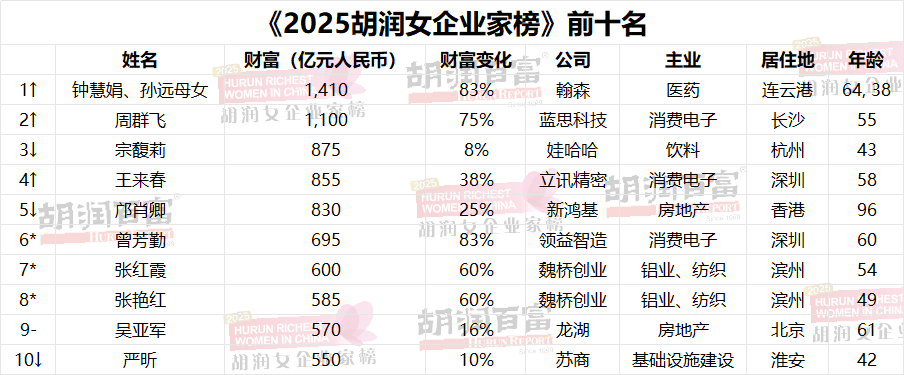
Core Insights - The 2025 Hurun Women Entrepreneurs List reveals that the total wealth of the top 50 female entrepreneurs in China reached 1.9 trillion yuan, a significant increase of 32% compared to last year [1] - The threshold for entry into the list has risen to 16 billion yuan, an increase of 40 million yuan (33%) from the previous year [1] - The average age of the top 50 female entrepreneurs is 60 years, which is 2 years older than last year, aligning with the average age of the top 50 male entrepreneurs on the Hurun Rich List [1] Company Performance - The wealthiest female entrepreneur, Zhong Huijuan of Hansoh Pharmaceutical, has a net worth of 141 billion yuan, marking an increase of 64 billion yuan (83%) from last year [3][4] - The second wealthiest, Zhou Qunfei of Lens Technology, saw her wealth grow by 47 billion yuan (75%) to 110 billion yuan, moving up three places in the rankings [4][5] - The third position is held by Zong Fuli of Wahaha, with a wealth of 87.5 billion yuan, who has shifted down two places from last year [5] Industry Distribution - The industrial products sector remains the largest source of wealth for female entrepreneurs, accounting for 15% of the top 50 [7][8] - The real estate sector follows closely with a 13% share, while the life and health sector ranks third at 12% [7][8] - Food and beverage, as well as non-ferrous metals and mining, each represent 10% of the industry distribution among the top female entrepreneurs [7][8] Wealth Source - 66% of the female entrepreneurs on the list are self-made, an increase from 58% last year, while 34% inherited their wealth, down from 42% [9]


钟慧娟,首次登顶中国女首富!
Zheng Quan Shi Bao· 2025-10-30 04:33
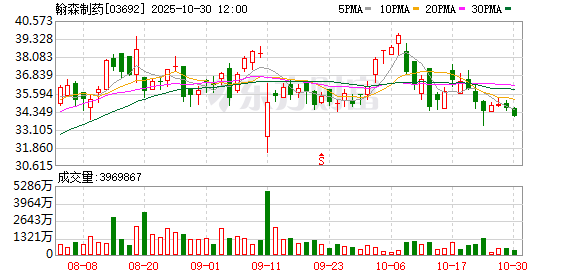
Group 1 - The 2025 Hurun Women Entrepreneurs List reveals that the total wealth of the top 50 female entrepreneurs in China amounts to 1.9 trillion yuan, a significant increase of 32% compared to last year [2] - The threshold for entry into the list has risen to 16 billion yuan, an increase of 4 billion yuan (33%) from the previous year [2] - The average age of the top 50 female entrepreneurs is 60 years, which is 2 years older than last year, aligning with the average age of the top 50 male entrepreneurs on the Hurun Rich List [2] Group 2 - Among the top 10 female entrepreneurs, three are new faces: Zeng Fangqin from Lingyi Technology, Zhang Hongxia from Weiqiao Venture, and Zhang Yanhong [4] - The wealth of the new richest woman in China, Zhong Huijuan and her daughter, is 141 billion yuan, marking an increase of 83% from last year [5] - The founder of Lens Technology, Zhou Qunfei, ranks second with a wealth of 110 billion yuan, reflecting a 75% increase from the previous year [6] Group 3 - The industrial products sector remains the largest source of wealth for female entrepreneurs, accounting for 15% of the list, followed by real estate at 13% and life health at 12% [9] - The food and beverage industry, along with non-ferrous metals and mining, each represent 10% of the wealth distribution among the top female entrepreneurs [9] - The proportion of self-made female entrepreneurs has increased to 66%, up from 58% last year, while those inheriting wealth have decreased to 34% from 42% [11]

钟慧娟,首次登顶中国女首富!
证券时报· 2025-10-30 04:22
Core Insights - The 2025 Hurun Women Entrepreneurs List reveals that the total wealth of the top 50 female entrepreneurs in China reached 1.9 trillion yuan, a significant increase of 32% compared to last year [1] - The threshold for entry into the list has risen to 16 billion yuan, an increase of 40 million yuan (33%) from the previous year [1] - The average age of the top 50 female entrepreneurs is 60 years, which is 2 years older than last year, aligning with the average age of the top 50 male entrepreneurs on the Hurun Rich List [1] Wealth Distribution - The wealth of the top 50 female entrepreneurs has remained stable over the past five years but has doubled compared to ten years ago [1] - 66% of these entrepreneurs are self-made, while 34% inherited their wealth [1][9] Notable Rankings - Zhong Huijuan and her daughter Sun Yuan from Hansoh Pharmaceutical became the richest women in China for the first time, with a wealth of 141 billion yuan, an increase of 64 billion yuan (83%) from last year [2][3] - The top ten list includes three newcomers: Zeng Fangqin from Lingyi Technology, Zhang Hongxia from Weiqiao Pioneering Group, and Zhang Yanhong [3] Industry Analysis - The industrial products sector is the largest source of wealth for female entrepreneurs, accounting for 15% of the list, followed by real estate at 13% and life health at 12% [7][8] - The food and beverage sector, along with non-ferrous metals and mining, each account for 10% [7] Company Performance - Lens Technology's founder Zhou Qunfei saw her wealth increase by 47 billion yuan (75%), ranking second on the list with 110 billion yuan [4][5] - Wahaha's Zong Fuli ranked third with a wealth of 87.5 billion yuan, despite a drop in ranking [5] - Luxshare Precision's Wang Laichun increased her wealth by 23.5 billion yuan, ranking fourth with 85.5 billion yuan [5] Changes in Wealth Sources - The proportion of self-made female entrepreneurs increased to 66%, up from 58% last year, while those inheriting wealth decreased to 34% from 42% [9]

翰森制药钟慧娟首次登顶中国女首富,娃哈哈宗馥莉下滑至第三
Xin Lang Cai Jing· 2025-10-30 03:53
Core Insights - The 2025 Hurun Women Entrepreneurs List was released, highlighting the rise of female entrepreneurs in China, with a notable focus on wealth accumulation and industry representation [1][4]. Group 1: Key Highlights from the List - Zhong Huijuan, founder of Hansoh Pharmaceutical, became China's richest woman with a wealth of 141 billion RMB, marking her as the first female billionaire from the life sciences sector [1][4]. - Zhong Huijuan and her daughter, Sun Yuan, hold shares valued at over 200 billion HKD, reflecting significant growth in Hansoh's market value due to innovative drugs and international collaborations [1][2]. - The list shows a strong performance in the consumer electronics sector, with Zhou Qunfei of Lens Technology ranking second with a wealth of 110 billion RMB, an increase of 47 billion RMB [2][3]. Group 2: Trends and Changes - The threshold for entering the top ten increased by 13 billion RMB from the previous year, now set at 55 billion RMB, indicating a growing wealth concentration among female entrepreneurs [3]. - The list features eight "post-80s" entrepreneurs, with the youngest being Qu Fang from Xiaohongshu, showcasing a trend of younger female entrepreneurs emerging in the market [3]. - Notably, five individuals experienced a decrease in wealth, primarily from the real estate sector, with Yang Huiyan of Country Garden seeing a significant drop of 10.5 billion RMB [3].
宗馥莉罕见公开露面!多人确认其没有继续任职于娃哈哈;英伟达市值破5万亿美元;特斯拉已准备好任命新CEO;香飘飘将开线下店丨邦早报
创业邦· 2025-10-30 00:08
Group 1 - Zong Fuli, the president of Hongsheng Group, has returned to the headquarters and is no longer serving as the chairman of Wahaha, indicating a shift in leadership roles within the beverage industry [3] - Nvidia has become the first publicly traded company to surpass a market capitalization of $5 trillion, achieving this milestone in just 113 days, significantly faster than previous milestones [5] - Tesla's board chair stated that the company is prepared to appoint a new CEO from within if Elon Musk's compensation plan is rejected by shareholders, indicating potential leadership changes [5] Group 2 - BabyBus has taken serious measures against its advertising review head following issues with inappropriate advertisements, highlighting the importance of compliance in advertising practices [5] - OpenAI's CEO Sam Altman will not hold shares in the restructured company, which may impact investor sentiment and company governance [6] - Nvidia announced plans to build seven new supercomputers for the U.S. Department of Energy, with AI chip orders reaching $500 billion, showcasing the company's growth in the AI sector [6] Group 3 - Apple is preparing to upgrade its MacBook Air and iPad mini with OLED displays, which may lead to a price increase, reflecting the trend towards higher-quality display technology [9] - Xiangpiaopiao is set to open its first physical store, marking a significant step in its retail strategy [9] - Miniso has responded to customer complaints about using candy as change, indicating a focus on improving customer service standards [11] Group 4 - Good Products reported a net loss of 28.77 million yuan in Q3, with revenue declining by 17.72% year-on-year, reflecting challenges in the retail sector [13] - Sequoia China has acquired significant assets from Bayer Group, indicating ongoing consolidation in the pharmaceutical industry [13] - Whatnot, a live shopping platform, raised $225 million in funding, doubling its valuation to $11.5 billion, highlighting the growth of e-commerce platforms [13] Group 5 - China's IPv6 active user count reached 865 million, a 294-fold increase since 2017, demonstrating rapid growth in internet infrastructure [17] - The retail market for passenger vehicles in China saw a 7% year-on-year decline in October, indicating potential challenges in the automotive sector [17]


宗馥莉罕见公开露面,现身宏胜集团会议
Sou Hu Cai Jing· 2025-10-29 15:28
今日,风波之中的宗馥莉在辞去娃哈哈董事长后首次公开露面。 据"宏胜—成长天地"微信公众号,今日宗馥莉出席宏胜集团片区工作会议,各片区总经理及相关部门负责人均参加会议。 据介绍,会议系统梳理2025年集团在生产经营、技术创新、安全管理等方面取得的新进展新成效,深入分析当前发展形势,统筹谋划下一阶段重点任务。 r and the ...

300万创一代集体老去,企二代能否顶上?
3 6 Ke· 2025-10-29 12:10
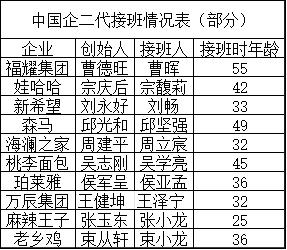
Core Viewpoint - The recent announcement of the succession at Fuyao Glass, with 55-year-old Cao Hui taking over as chairman from his father, Cao Dewang, highlights the ongoing generational transition in Chinese family businesses, raising questions about the ability of the second generation to lead effectively [1][2]. Group 1: Succession Trends in Chinese Family Businesses - A significant wave of succession is occurring in Chinese family businesses, with over 80% of private enterprises being family-owned and many reaching critical transition points [2][4]. - The All-China Federation of Industry and Commerce predicts that over 3 million private enterprises will face succession challenges in the coming years, with the rise of the 90s generation as successors [2][4]. - The average founding generation of China's top 100 family businesses was born between 1950 and 1960, indicating a pressing need for succession planning [2][4]. Group 2: Challenges and Strategies in Succession - Founders often prefer to pass control to their children due to deep-rooted cultural values and a desire to maintain family legacy, as well as concerns about external management [4][5]. - The lack of a well-established pool of professional managers in China leads to a preference for family members, as founders worry about the potential risks of hiring external managers [4][5]. - Many family businesses operate under a "personal rule" rather than a structured governance model, complicating the transition to professional management [5]. Group 3: Case Studies of Successful Succession - Cao Hui's journey within Fuyao Glass involved extensive hands-on experience, including six years in the workshop and six years in sales, before becoming the general manager in 2006 [9][10]. - Liu Yonghao's daughter, Liu Chang, and Zong Qinghou's daughter, Zong Fuli, also underwent rigorous training outside their family businesses before taking on leadership roles, demonstrating a trend of preparing successors through real-world experience [10][12]. - The success rate of family businesses transitioning to the second generation is only about 30%, highlighting the challenges faced by successors in maintaining competitiveness and managing internal dynamics [12][13]. Group 4: Importance of Early Planning and Trust - Only about 16% of family businesses have a clear succession plan, with less than 3% implementing it effectively, indicating a significant gap in preparedness [14]. - Founders are often reluctant to relinquish control, leading to rushed transitions that can pose risks to the business [14]. - Establishing clear ownership structures and governance frameworks is crucial to prevent disputes and ensure smooth transitions [16][17].

2025胡润榜:立讯精密王来胜父女身家845亿,增幅34%排名升1位
Xin Lang Zheng Quan· 2025-10-29 10:41
Core Insights - The 2025 Hurun Rich List was officially released, with Wang Laisheng and Wang Yayuan from Luxshare Precision ranking 56th with a wealth of 84.5 billion yuan, an increase of 21.5 billion yuan or 34% from 63 billion yuan in 2024 [1][2] - Luxshare Precision specializes in precision intelligent manufacturing, primarily serving leading global brands in sectors such as consumer electronics, automotive, communication, industrial, and medical [1] Company Performance - Luxshare Precision reported a revenue of 124.5 billion yuan for the first half of 2025, reflecting a year-on-year growth of 20.18%, and a net profit of 6.644 billion yuan, up 23.13% year-on-year [2] - The company continues to face challenges related to over-reliance on a single client, indicating that its diversification and globalization efforts need further validation in the market [2] IPO and Future Prospects - Luxshare Precision is preparing for an IPO in Hong Kong, with expected fundraising exceeding 1 billion USD, aimed at supporting its global strategic expansion [2] - This IPO is anticipated to enhance the company's financing channels and provide new momentum for its overseas business development, which will support the long-term growth of the wealth of Wang Laisheng and Wang Yayuan [2]
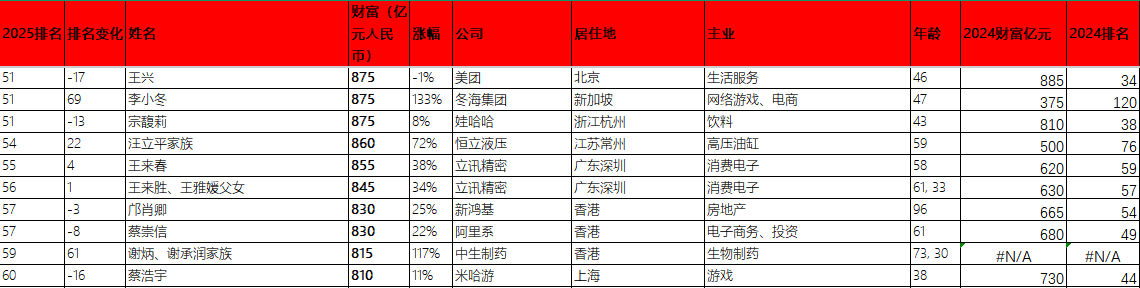
2025胡润榜:96岁邝肖卿身家830亿增25%,排名降至57位
Xin Lang Cai Jing· 2025-10-29 10:41
Core Insights - The 2025 Hurun Rich List was released, highlighting that Kwan Siu Ching of Sun Hung Kai Properties has a wealth of 83 billion yuan, an increase of 16.5 billion yuan or 25% from 2024 [1] - Despite a slight drop in ranking from 54th to 57th, Kwan Siu Ching remains the wealthiest woman in China with a net worth of 72 billion HKD [1] - Sun Hung Kai Properties has a substantial land reserve exceeding 10 million square meters, which has contributed to Kwan Siu Ching's wealth growth amid a declining real estate market in China [1] Company Overview - Sun Hung Kai Properties is primarily engaged in real estate, and its business model has allowed it to maintain asset value and achieve growth despite industry challenges [1] - The company has built a large property portfolio through decades of acquisitions in both Hong Kong and mainland China [1] - The brand's strategy of "building homes with heart" has been a key factor in its operational stability and asset appreciation [1] Industry Context - The real estate sector in China continues to face downturns, with notable figures like Wang Jianlin of Wanda and Yang Huiyan of Country Garden experiencing wealth declines [1] - The overall market conditions have been challenging, with some prominent real estate tycoons facing legal issues, contrasting with Sun Hung Kai's performance [1]

身家暴涨235亿!王来春以855亿登胡润榜,排名跃升4位
Xin Lang Zheng Quan· 2025-10-29 10:41
Core Insights - The 2025 Hurun Rich List was released, featuring Wang Laichun of Luxshare Precision with a wealth of 85.5 billion yuan, an increase of 23.5 billion yuan or 38% from 2024 [1][2] - Wang Laichun's entrepreneurial journey exemplifies the transformation of China's manufacturing industry from OEM to independent innovation [1][2] Company Overview - Luxshare Precision was officially established in 2004, and under Wang Laichun's leadership, the company has experienced rapid growth, listing on the Shenzhen Stock Exchange in 2010 with a wealth of 2.3 billion yuan at that time [2] - The company strategically entered the Apple supply chain in 2011 by acquiring Kunshan Lian Tao Electronics and subsequently secured the AirPods OEM qualification, becoming a core supplier in the global consumer electronics sector [2] - Luxshare has defined its strategic focus on three main areas: consumer electronics, automotive electronics, and communication technology [2] Financial Performance - For the reporting period, Luxshare achieved a revenue of 124.5 billion yuan, representing a year-on-year growth of 20.18% [2] - The net profit attributable to shareholders was 6.644 billion yuan, up 23.13% year-on-year, while the net profit after deducting non-recurring items was 5.599 billion yuan, reflecting a growth of 12.90% [2] - The growth in performance is attributed to the continuous expansion of business segments in consumer electronics, communication, and mobile network equipment [2]