
平安银行

Search documents
银行利润,“省”出来
Shang Hai Zheng Quan Bao· 2025-09-04 19:12
Core Insights - The banking sector is focusing on cost reduction and efficiency improvement, with many banks relying on meticulous cost management to enhance profits [3][4] - A significant number of banks have reported a decrease in their cost-to-income ratios, indicating successful cost control measures [4][5] - Future improvements in cost reduction and efficiency will require a comprehensive approach involving business structure adjustments, human resource optimization, and digital transformation [3][7] Cost Reduction Strategies - Many banks have achieved profit stabilization by lowering deposit interest rates and reducing labor costs, leading to a dual reduction in costs [4][5] - Among 42 A-share listed banks, 26 reported a year-on-year decrease in cost-to-income ratios, with notable reductions from Xi'an Bank and Postal Savings Bank [4] - Interest expenses have decreased for 40 banks, with 33 banks experiencing declines exceeding 5%, and the highest reduction in interest expenses exceeding 47 billion yuan [4][5] Operational Efficiency - Banks are enhancing deposit structure management to drive down interest expenses, with Zhejiang Commercial Bank reporting a 10.95% decrease in interest expenses [5] - Labor cost control is a key focus, with banks reducing employee numbers and salaries to improve efficiency [5][6] - For example, Shanghai Pudong Development Bank reduced its operational and management expenses by 7.75 million yuan, while also decreasing its workforce [5][6] Quality of Efficiency Improvement - Industry experts emphasize that true cost reduction and efficiency improvement should not merely involve cutting budgets but should focus on restructuring business models and optimizing human resources [7] - Banks are encouraged to prioritize low-capital, low-cyclical business segments to enhance profitability [7] - Embracing digital transformation is seen as essential for releasing efficiency and improving operational processes [7]



从“中介服务商”向“战略价值伙伴”转型 深圳证监局引导辖区券商浇筑科创高地
Zheng Quan Shi Bao· 2025-09-04 18:55
Core Insights - Technological innovation is identified as the core engine driving high-quality development, with a focus on forming new productive forces as a strategic support for building a modern industrial system [1] - Shenzhen securities firms are transitioning from "intermediary service providers" to "strategic value partners," placing technological innovation at the core of their corporate strategies [1] Group 1: Support for Technology Enterprises - Over the past three years, Shenzhen securities firms have successfully assisted 190 companies in listing on the Shanghai and Shenzhen stock exchanges, raising over 240 billion yuan [1] - Since the implementation of the registration system reform, Shenzhen securities firms have helped 193 companies list on the Sci-Tech Innovation Board and 162 on the Growth Enterprise Market, covering key strategic sectors such as information technology, biomedicine, and green energy [2] - Notable examples include the successful IPO of Yingshi Innovation, which raised 1.938 billion yuan, and the listing of Dingjia Precision, a national-level specialized "little giant" in consumer electronics [2] Group 2: Mergers and Acquisitions - Shenzhen Securities Regulatory Bureau has organized 15 events to promote understanding of merger and acquisition policies, encouraging firms to focus on key industrial chain enhancements [3] - Huatai United Securities has successfully executed significant merger cases, including the acquisition of Nexperia Holding B.V. by Wentai Technology [3] Group 3: Bond Financing - Shenzhen securities firms have responded quickly to the demand for "technology bonds," with six firms issuing a total of 16 billion yuan in technology innovation bonds [4] - In the first half of the year, CITIC Securities assisted over 40 companies in issuing technology innovation bonds, raising more than 70 billion yuan [5] Group 4: Comprehensive Financial Services - Since 2024, Shenzhen Securities Regulatory Bureau has conducted 58 activities to promote policy advocacy and investment matching, encouraging firms to establish specialized service teams [6] - CITIC Securities helped ZTE Corporation issue 3.584 billion yuan in H-share convertible bonds, while Huatai United Securities supported Demingli in a 972 million yuan private placement [6] Group 5: Future Directions - The Shenzhen Securities Regulatory Bureau emphasizes the importance of regulatory guidance to support national strategies and technological innovation, exploring new financing models such as technology REITs and ESG investments [7]
银行观察 | 四大维度打造手机银行服务新生态
Zheng Quan Shi Bao· 2025-09-04 18:47
Core Insights - Mobile banking has evolved from a single financial tool to a comprehensive service platform, becoming a key entry point for customer acquisition in the digital transformation of banks [1][2][4] - The competitive landscape of mobile banking is shifting towards an ecosystem approach, emphasizing the integration of financial and non-financial services [3][4] Group 1: User Growth and Market Dynamics - As of June 2025, Industrial and Commercial Bank of China (ICBC) leads the industry with 600 million personal mobile banking customers, while other major banks maintain user bases above 300 million [1] - The growth of mobile banking users is particularly strong among joint-stock banks, with China Merchants Bank reaching 205 million cumulative users and 82.67 million monthly active users by June 2025 [1] Group 2: Transformation of Corporate Mobile Banking - Corporate mobile banking is transitioning from "financial services" to a "comprehensive management" platform, with ICBC and China Bank enhancing their offerings to include cross-border financial services and integrated management tools [2] - China Merchants Bank's corporate app provides a one-stop mobile service for businesses, including fund transfers, investment management, and online financing for SMEs [2] Group 3: Technological Integration and AI - The integration of AI technology is becoming central to mobile banking, with banks like China Merchants Bank and Bank of Communications developing frameworks to enhance personalized services and operational efficiency [2] - AI is evolving from application in specific scenarios to deep integration across all processes, positioning itself as a core engine for personalized banking services [2] Group 4: Open Banking and Ecosystem Development - The evolution of mobile banking is characterized by a shift from tools to platforms and ecosystems, with banks focusing on open capabilities to integrate financial services into everyday life [3] - Banks are encouraged to collaborate with governments, enterprises, and third-party platforms to create a "financial + non-financial" ecosystem [3] Group 5: Risk Management and Security - Digital risk management is essential for the stable operation of mobile banking, with banks employing big data and AI to build a comprehensive risk control system [4] - The focus is on creating precise customer profiles, real-time monitoring, and dynamic risk alerts to ensure user fund safety and financial system stability [4] Group 6: Future Outlook - Mobile banking is set to become the primary touchpoint for customer service, evolving into an "ecological entry point" that offers smarter, more convenient, and safer comprehensive services [4]
15家上市银行上半年信用卡贷款余额减少1961亿元
Zheng Quan Ri Bao· 2025-09-04 16:19
Core Viewpoint - The credit card business of several listed banks in China is experiencing a contraction in loan balances and transaction volumes, with some banks facing rising non-performing loan balances and rates [1][4]. Group 1: Credit Card Loan Balances - The total credit card loan balance of 15 listed banks reached 7.56 trillion yuan, a decrease of 196.1 billion yuan or 2.52% compared to the beginning of the year [2]. - Among these banks, 11 reported varying degrees of contraction in their credit card loan balances, with China Bank showing the most significant reduction of 13.88% [2]. - Only four banks, including Industrial and Commercial Bank of China and Agricultural Bank of China, managed to achieve growth in their loan balances [2]. Group 2: Credit Card Transaction Volumes - The total credit card transaction amount for 12 banks was 11.47 trillion yuan, reflecting a year-on-year decline of 11.05% [2]. - Notably, China Bank and China Everbright Bank experienced transaction declines exceeding 18%, while several other banks saw reductions around 5% [2]. - Seven banks reported transaction amounts below 1 trillion yuan, with China Merchants Bank being the only bank exceeding 2 trillion yuan in transactions [2]. Group 3: Factors Influencing Contraction - The contraction in credit card loan balances and transaction volumes is attributed to multiple factors, including banks tightening credit for high-risk customers and shifting resources to corporate lending [3]. - Sluggish consumer demand and the adjustment of the industry ecosystem, including the rise of internet credit, have also contributed to the decline [3]. - The reduction in credit card benefits has led to a loss of "sheep wool party" customers, further decreasing business scale and activity [3]. Group 4: Loan Quality Pressure - Eleven banks reported a total non-performing loan balance of 162.69 billion yuan, an increase of 3.75% since the beginning of the year [4]. - Notably, banks like China Merchants Bank and Industrial and Commercial Bank of China saw significant increases in their non-performing loan balances, at 25.73% and 10.01% respectively [4]. - The rise in non-performing loans is linked to weakened repayment capabilities among small business owners and the spillover risks from the real estate sector [4]. Group 5: Industry Transformation - The credit card market is transitioning into a phase focused on customer retention and value extraction rather than mere expansion [5]. - The industry is expected to face a critical transformation period by mid-2025, with a focus on digital transformation and refined operations [5]. - Banks are shifting their strategies from acquiring new customers to enhancing the value of existing customers, emphasizing product innovation and quality [6]. Group 6: Future Directions - The future direction for credit card businesses includes refined risk management, focusing on customer lifecycle value, and creating differentiated ecosystems [6]. - There is a growing trend towards integrating retail services to enhance comprehensive financial service capabilities for high-end customers [6]. - The emphasis will be on managing high-risk customer segments dynamically and reducing reliance on interest income by embedding credit cards into consumer scenarios [6].
7家上市银行私行管理资产余额均超万亿元
Zheng Quan Ri Bao· 2025-09-04 16:18
Core Insights - The private banking sector is identified as a key area for value extraction within retail banking, reflecting the strength of banks' wealth management capabilities [1] - As of mid-2023, most banks reported growth in both the number of private banking clients and assets under management (AUM), indicating a continuous expansion of the high-net-worth wealth management market [1][2] Client Growth - Among the 13 listed banks that disclosed private banking client data, Agricultural Bank, China Bank, and Construction Bank lead with over 200,000 clients each, with respective figures of 279,000, 265,500, and 216,900 [2] - Construction Bank saw a 14.69% increase in private banking clients compared to the end of 2022, while China Bank surpassed the 200,000 client mark [2] - Among national joint-stock banks, China Merchants Bank leads with 182,700 clients, followed by Ping An Bank and CITIC Bank, both exceeding 90,000 clients [2] AUM Performance - Of the 13 banks analyzed, 11 disclosed AUM data, with Agricultural Bank, China Bank, and Construction Bank each exceeding 3 trillion yuan in AUM, at 3.5 trillion, 3.4 trillion, and 3.18 trillion yuan respectively [3] - Traffic Bank's AUM reached 1.39 trillion yuan, reflecting a 7.20% growth since the end of 2022 [3] - Among national joint-stock banks, Ping An Bank, CITIC Bank, and Industrial Bank are part of the "trillion yuan club," with AUM figures of 1.97 trillion, 1.28 trillion, and 1.05 trillion yuan respectively [3] Service Optimization - Private banking has become a significant profit growth point for banks, especially as traditional retail banking growth slows [4] - The sector is evolving from a single financial advisory model to a comprehensive service ecosystem, incorporating diverse products such as family trusts and cross-border asset allocation [4] - Major banks are enhancing their private banking services through product optimization and resource integration, aiming to build a robust service ecosystem [4] Future Directions - The future of private banking is expected to focus on three main areas: deepening digitalization, creating service ecosystems, and expanding global investment options [6] - Digital transformation will leverage technologies like AI and blockchain to enhance client service processes and risk management [6] - The integration of external resources such as legal and tax services will be crucial in developing a comprehensive service framework, particularly for family office and legacy planning services [6]



24家银行上半年人均月薪超3万元
第一财经· 2025-09-04 16:10
Core Viewpoint - The banking sector in A-shares has regained its position as the largest sector with a market value of 11.31 trillion yuan, surpassing the electronics sector, and the salary situation of banking employees has become a focal point as 42 banks disclose their salary data for the first half of 2025 [2][3]. Salary Structure - The average monthly salary in the banking industry for the first half of 2025 is 30,200 yuan, a slight increase of 1,300 yuan year-on-year, reversing the trend of a 5,300 yuan decrease in the same period last year [5][6]. - The top tier of banks, including joint-stock banks and strong city commercial banks in eastern regions, have an average monthly salary exceeding 45,000 yuan, with specific banks like China Merchants Bank and Nanjing Bank reporting 50,500 yuan and 48,185 yuan respectively [5][6]. - The second tier consists of state-owned banks with average monthly salaries ranging from 25,000 to 30,000 yuan, while the third tier includes some rural and city commercial banks with salaries below 25,000 yuan [7]. Management Salary Trends - A notable trend is the decline in executive salaries across the banking sector, with 33 out of 42 A-share listed banks reporting a decrease in management compensation, with the highest drop reaching 82.4% [9][10]. - For instance, Zhengzhou Bank's key management salary total fell from 10,388 million yuan to 5,957 million yuan year-on-year [9]. - The emphasis on value creation and the adjustment of salary structures to favor grassroots employees are becoming key themes in many banks' compensation reforms [10][11]. Salary Reform Mechanisms - The implementation of a reverse salary reclamation mechanism is gaining traction, with banks establishing systems to withhold or reclaim performance-related pay in cases of misconduct or excessive risk exposure [11]. - For example, China Merchants Bank reported reclaiming over 100 million yuan in performance pay over the past two years due to such mechanisms [11]. - The overall trend indicates a shift towards aligning total compensation with bank performance, suggesting that if revenue and profits decline, salaries may also be affected [11][12].

申万菱信红利量化选股股票A:2025年上半年利润51.27万元 净值增长率5.02%
Sou Hu Cai Jing· 2025-09-04 15:41
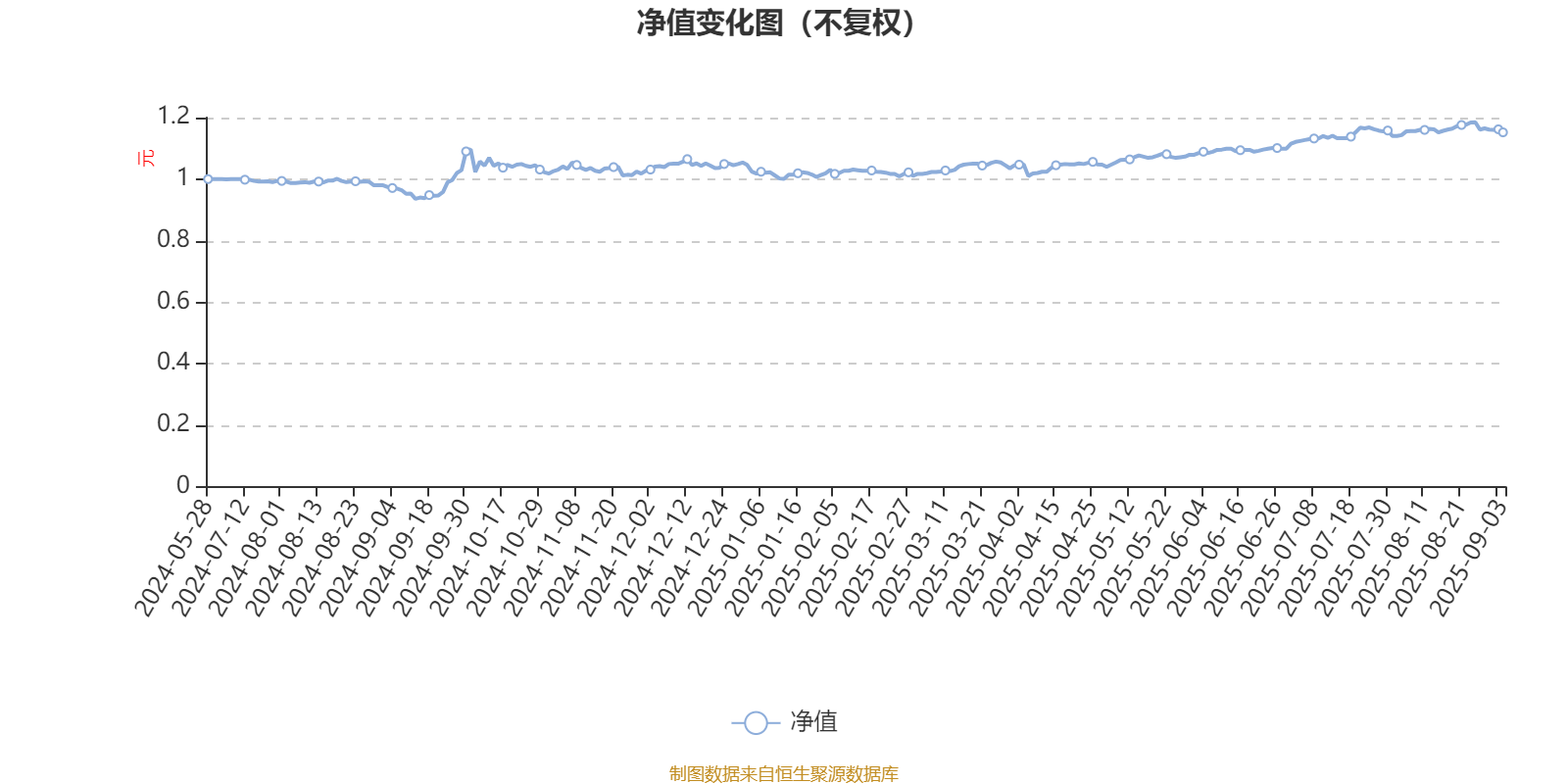
Core Viewpoint - The AI Fund Shenwan Lingshin Dividend Quantitative Stock A (017292) reported a profit of 51,270 yuan for the first half of 2025, with a net value growth rate of 5.02% and a fund size of 12.5744 million yuan as of the end of June 2025 [3]. Fund Performance - As of September 3, 2025, the fund's unit net value was 1.152 yuan, with a three-month growth rate of 6.22%, a six-month growth rate of 13.28%, and a one-year growth rate of 18.34%, ranking 92/110, 76/110, and 100/110 among comparable funds respectively [5]. Valuation Metrics - As of June 30, 2025, the fund's weighted price-to-earnings ratio (TTM) was approximately 10.62 times, compared to the industry average of 28.84 times. The weighted price-to-book ratio (LF) was about 0.92 times, while the industry average was 2.19 times. The weighted price-to-sales ratio (TTM) was around 1.17 times, against an industry average of 1.95 times, indicating that the fund's valuations are lower than the industry average [10]. Growth Metrics - For the first half of 2025, the weighted revenue growth rate (TTM) of the stocks held by the fund was -0.01%, with a weighted net profit growth rate (TTM) of 0% and a weighted annualized return on equity of 0.09% [18]. Fund Composition and Holdings - As of June 30, 2025, the fund had 211 holders, with a total of 11.4442 million shares held. Institutional investors accounted for 46.64% of the holdings, while individual investors made up 53.36% [34]. The top ten holdings included major banks and companies such as Industrial and Commercial Bank of China, Postal Savings Bank, and China Petroleum [39]. Fund Management Insights - The fund management indicated that the evolution of international trade patterns and changes in the domestic economy are key variables to monitor for the second half of 2025. They emphasized the continued value of dividend assets due to China's development stage and interest rate environment, and the fund will focus on dividend-themed stocks using a multi-factor model for stock selection [3].
电子版 | 《山西广播电视报》2025年第36期
Sou Hu Cai Jing· 2025-09-04 15:21
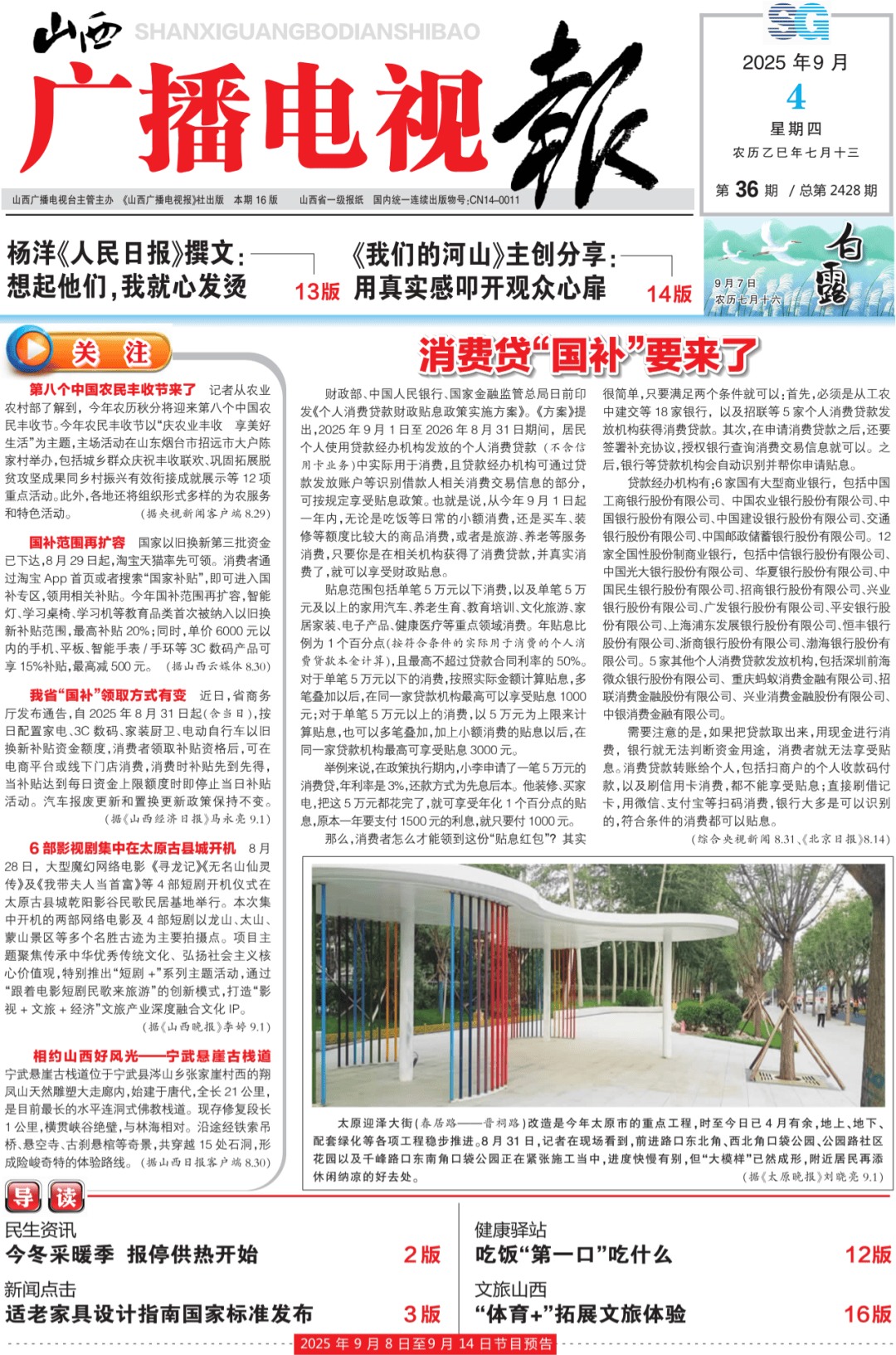
Group 1 - The article discusses the introduction of a new consumer loan subsidy policy, which includes interest subsidies for personal loans used in key consumption areas such as home decoration, education, and healthcare [7][8] - The subsidy rate is set at 1% per year, with a maximum limit of 50% of the loan contract interest rate, allowing for a maximum subsidy of 1,000 yuan for loans under 50,000 yuan and 3,000 yuan for loans above that amount [7] - The policy aims to stimulate consumer spending and support various sectors, including automotive, healthcare, and education [7][9] Group 2 - The article highlights the expansion of the "national subsidy" program, which now includes additional categories such as educational products and digital devices, with subsidies reaching up to 20% [9] - The implementation of the subsidy program is expected to enhance consumer confidence and drive sales in the affected sectors [9][10] - The article also mentions the involvement of major banks and financial institutions in facilitating these loans, indicating a broad support network for the initiative [8] Group 3 - The article outlines the upcoming "Public Low-Carbon Travel Month" initiative in Taiyuan, aimed at promoting green transportation and encouraging the use of public transport [19] - The initiative includes various activities such as issuing discount cards for students and seniors, and promoting cycling and walking as alternatives to driving [19] - This initiative aligns with broader environmental goals and reflects a growing emphasis on sustainable urban development [19] Group 4 - The article reports on the establishment of a new mixed fuel station in Shanxi, which is designed to serve both gasoline and LNG vehicles, enhancing the infrastructure for alternative fuel sources [47] - This development is part of a larger trend towards diversifying energy sources in the transportation sector, catering to the increasing number of LNG vehicles on the road [47] - The station is strategically located on a major highway, indicating its importance for long-distance travel and logistics [47]
“把脉”A股42家上市银行中期资产质量:对公贷款不良率持续向好,零售贷款仍处风险暴露期
Mei Ri Jing Ji Xin Wen· 2025-09-04 14:35
Group 1: Overall Asset Quality - As of August 31, 2023, the asset quality of 42 listed banks in A-shares shows a stable improvement, with some banks experiencing a slight increase in non-performing loan (NPL) ratios compared to the end of the previous year [1] - The overall NPL ratio for commercial banks was 1.49% at the end of Q2 2023, improving by 0.02 percentage points from the end of Q1 [3] - The provision coverage ratio for state-owned banks and rural commercial banks increased to 249.16% and 161.87%, respectively, while the ratios for joint-stock banks and city commercial banks decreased [4] Group 2: Non-Performing Loan Trends - The NPL ratio for corporate loans is improving, while the NPL ratio for retail loans is on the rise, indicating a structural change in asset quality [5][6] - For example, Industrial and Commercial Bank of China (ICBC) reported a decrease in corporate loan NPL ratio from 1.58% to 1.47%, while the personal loan NPL ratio increased from 1.15% to 1.35% [5] - The rise in retail loan NPLs is attributed to factors such as market conditions, increased flexible employment, and changes in industry environments affecting borrower income [6] Group 3: Real Estate Loan Performance - The real estate sector remains a significant source of NPLs, with some banks reporting an increase in real estate loan NPL ratios, while others have seen improvements [7][8] - For instance, Qingnong Commercial Bank's real estate NPL ratio rose to 21.32%, an increase of 14.15 percentage points from the end of the previous year [7] - The overall decline in real estate sales and the high leverage of real estate companies are fundamental reasons for the rising NPL ratios in this sector [8]






上半年银行新增15万高净值客户,“科学家”正在成为新宠?
Di Yi Cai Jing· 2025-09-04 13:04
Group 1 - The high-net-worth client segment is a focal point for retail banking, with significant competition among commercial banks to capture this valuable market [1][4] - As of June 2025, 15 banks reported private banking data, with a total client base exceeding 1.63 million, marking a growth of nearly 150,000 clients or over 10% since the beginning of the year [1] - The four major state-owned banks have crossed the 3 trillion yuan mark in assets under management (AUM), with Industrial Bank entering the "trillion club" for the first time [1][2] Group 2 - The four major state-owned banks collectively have 864,000 private banking clients, with Agricultural Bank leading in AUM at 3.5 trillion yuan, and a client base of over 279,000 [2] - China Construction Bank reported a remarkable AUM growth of 14.39% to 3.18 trillion yuan, with a client increase of 34,000, marking a 14.69% rise [2] - Postal Savings Bank, despite not disclosing AUM, saw a client growth of over 21%, reaching 41,400 clients, indicating a strong potential for future AUM increases [2] Group 3 - Joint-stock banks are experiencing a stark contrast in performance, with China Merchants Bank leading in client growth among joint-stock banks, while Ping An Bank reported a slight decline in AUM [3] - The AUM for CITIC Bank and Industrial Bank grew by 9.33% and 9.59%, respectively, indicating steady growth in the joint-stock sector [3] - Regional banks like Ningbo Bank and Beijing Bank demonstrated strong growth, with AUM increases of 17.62% and 17.06%, respectively [3] Group 4 - The private banking sector in China is characterized by a concentration of leading banks and differentiated competition, with smaller banks adopting unique strategies to capture market share [4] - The shift in client demographics is evident, with a growing number of new high-net-worth clients entering the market, while the growth of ultra-high-net-worth clients is slowing [5][6] Group 5 - The focus on new client segments, such as scientists and tech entrepreneurs, is reshaping the private banking landscape, with banks redefining their target client profiles [7] - Private banking is becoming a key driver for retail banking transformation, providing stability and high value-added services amid traditional retail banking challenges [7][8] - The demand for non-financial services among private banking clients is creating new opportunities for banks to enhance customer engagement and service offerings [8]