招商银行

Search documents
今日正式实施!揭秘新一代数字人民币计量框架
财联社· 2026-01-01 01:32
近日,中国人民银行出台《关于进一步加强数字人民币管理服务体系和相关金融基础设施建设的行动方案》。 根据行动方案,新一代数字人民币计量框架、管理体系、运行机制和生态体系将于2026年1月1日正式启动实施。 对此,财联社记者采访多 位专家,从数字人民币到底有何变化,对商业银行及个人投资者有何影响,进行多维度解读。 那么,新一代数字人民币计量框架对商业银行有何实质性影响? 中国人民银行党委委员、副行长陆磊在近日的署名文章中也提到,要"建立科学合理的权责对称关系是数字现金机制设计中不容回避的问 题。" "新"在哪里? "首先,数字人民币的负债主体有了变化。"一位专家对财联社记者表示, 此前,数字人民币是中国人民银行发行的法定数字货币,是数字 现金,即现金的数字形式。 "这意味着,此前,数字人民币是中央银行对公众的负债。"专家指出,"新一代数字人民币计量框架中,数字人民币负债主体有了变化,不 再是中央银行对公众的负债,而成为商业银行的负债。" "这就标志着,数字人民币由现金型1.0版,进入了存款货币型数字人民币2.0版。"另一位行业专家对财联社记者表示,"也就是说,现阶 段,从货币角度,数字人民币的定位,从流通中现金转 ...


智通港股通持股解析|1月1日




智通财经网· 2026-01-01 00:35
Core Insights - The top three companies by stockholding ratio in the Hong Kong Stock Connect are China Telecom (71.90%), GCL-Poly Energy (69.96%), and Da Zhong Public Utilities (68.75%) [1][2] - The companies with the largest increase in stockholding over the last five trading days include SMIC (+1.092 billion), China Merchants Bank (+1.052 billion), and Hong Kong Exchanges and Clearing (+790 million) [1][2] - The companies with the largest decrease in stockholding over the last five trading days include China Mobile (-3.216 billion), Tencent Holdings (-1.107 billion), and the Tracker Fund of Hong Kong (-465 million) [1][2] Stockholding Ratios - China Telecom (00728) holds 99.79 million shares with a stockholding ratio of 71.90% [2] - GCL-Poly Energy (01330) holds 28.3 million shares with a stockholding ratio of 69.96% [2] - Da Zhong Public Utilities (01635) holds 36.7 million shares with a stockholding ratio of 68.75% [2] - Other notable companies in the top 20 include China Shenhua (66.39%) and China Merchants Energy (64.43%) [2] Recent Trading Activity - The top three companies with increased holdings in the last five trading days are: - SMIC (00981): +1.092 billion, +15.28 million shares [2][3] - China Merchants Bank (03968): +1.052 billion, +19.92 million shares [2][3] - Hong Kong Exchanges and Clearing (00388): +790 million, +1.93 million shares [2][3] - The top three companies with decreased holdings in the last five trading days are: - China Mobile (00941): -3.216 billion, -39.36 million shares [2][3] - Tencent Holdings (00700): -1.107 billion, -1.84 million shares [2][3] - Tracker Fund of Hong Kong (02800): -465 million, -18.01 million shares [2][3]
银行“开门红”静悄悄:利率战熄火,指标考核硝烟四起
Di Yi Cai Jing· 2025-12-31 23:30
Group 1 - The traditional "opening red" phenomenon in the banking sector is fading, with a significant reduction in high-interest deposits and financial products typically seen at the beginning of the year [1][2] - Loan rates have increased from a historical low of 2.2% to around 2.35%, indicating a shift in the lending landscape [2][3] - Major banks in Guangdong are now offering similar products with rates not lower than 2.35%, with some banks like China Construction Bank offering rates as high as 2.65% [3][4] Group 2 - Despite the absence of traditional high-interest products, the pressure on bank employees to meet performance indicators remains high, with a shift from acquiring deposits to fulfilling loan targets [5][6] - Employees are resorting to unconventional methods, such as subsidizing customer purchases or collaborating with loan intermediaries to meet their sales targets [6][7] - The design of performance metrics has become increasingly detailed, with specific assessments for various tasks, indicating that the competitive environment within banks is intensifying [7][8]
道生天合材料科技(上海)股份有限公司 关于部分募投项目结项暨注销部分募集资金专项账户公告
Zhong Guo Zheng Quan Bao - Zhong Zheng Wang· 2025-12-31 20:27
Fundraising Overview - The company has been approved to publicly issue 131,880,000 shares at a price of RMB 5.98 per share, raising a total of RMB 788,642,400, with a net amount of RMB 686,950,112.60 after deducting issuance costs [1][2] Fund Allocation Adjustments - Due to the actual net amount raised being lower than the planned investment amounts disclosed in the prospectus, the company adjusted the investment amounts for certain projects during a board meeting on October 29, 2025 [2] Fund Management - As of the announcement date, the company has established a special account for the raised funds and has signed a tripartite supervision agreement with the sponsor and the bank [1][3] Account Closure and Surplus Funds - The special account for the project "Repayment of Bank Loans" has been closed, with a total surplus of RMB 6,656.34, which includes RMB 267.77 of surplus funds and RMB 6,388.57 of interest income [2][5] Project Completion and Surplus Reasons - The project "Repayment of Bank Loans" has been completed, and the total surplus funds used for other projects were RMB 8,739.68, which is below the threshold for requiring further board approval [4][6] Compliance with Regulations - The company has complied with relevant regulations regarding the use of surplus funds, allowing for the transfer of these funds to other investment projects without the need for additional board review [6]
银行:银行2026年展望:稳中求进
2025-12-31 16:02
Summary of the Conference Call Transcript Industry Overview - The banking sector is entering a phase of high-quality development, with a focus on absolute and relative returns from bank stocks, driven by high dividend yields and asset quality [3][4][20]. Key Points Financial Performance Projections - Expected revenue growth for listed banks in 2026 and 2027 is +2.5% and +3.6% respectively, with net profit growth of +1.9% and +2.6% [4][20]. - Revenue and profit growth are anticipated to improve due to: 1. Narrowing net interest margin pressure 2. Quality-focused credit issuance amid weak demand [4][20]. 3. Stabilization of fee income growth after several years of fee reductions [4][20]. 4. Stable or improving net non-performing loan generation rates [4][11]. 5. Accelerated supply-side reforms leading to a reduction in the number of bank licenses, improving competition and operational landscape [4][11]. Customer Demand and Market Dynamics - The low-interest-rate environment has shifted customer demand, with government and state-owned enterprises becoming significant contributors to leverage, affecting the structure of new social financing [5][10]. - Regulatory policies are influencing the development of inclusive finance, focusing on risk compensation rather than merely increasing customer numbers [5][10]. Risk Factors - Risks associated with real estate developers and retail sectors are highlighted, with potential for greater-than-expected exposure [6][11]. Profitability and Valuation Adjustments - Adjustments to profitability forecasts for 2025 and 2026 have been made, with a focus on net interest income recovery and fee income growth [20][21]. - The expected net interest margin for 2026 is projected to be approximately 1.34%, a decrease of 6 basis points from 2025 [21][22]. - Fee income is expected to grow by 3.6% and 4.9% in 2026 and 2027 respectively, indicating a positive trend in non-interest income [21][22]. Asset Quality and Credit Costs - The net non-performing loan generation rate is expected to stabilize or slightly decline, with structural characteristics of retail and corporate lending continuing [11][21]. - Credit costs are projected to remain stable at around 0.58% for 2026 and 2027, reflecting the balance between corporate and household debt servicing capabilities [21][22]. Investment Recommendations - The report suggests a continued positive outlook for bank stocks, emphasizing the importance of dividend yield and asset quality in investment decisions [3][4][20]. Additional Insights - The banking sector is undergoing a transformation towards high-quality development, with a shift in focus from scale to quality, driven by macroeconomic pressures and regulatory changes [12][20]. - The reduction in the number of banking licenses over the past five years indicates successful risk management efforts within the sector [11][12]. - The report emphasizes the need for banks to adapt their strategies to maintain competitiveness in a changing regulatory and economic environment [12][20].



北水成交净买入34.49亿 北水全年净买入港股逾1.4万亿港元 创历史纪录新高
Zhi Tong Cai Jing· 2025-12-31 14:22
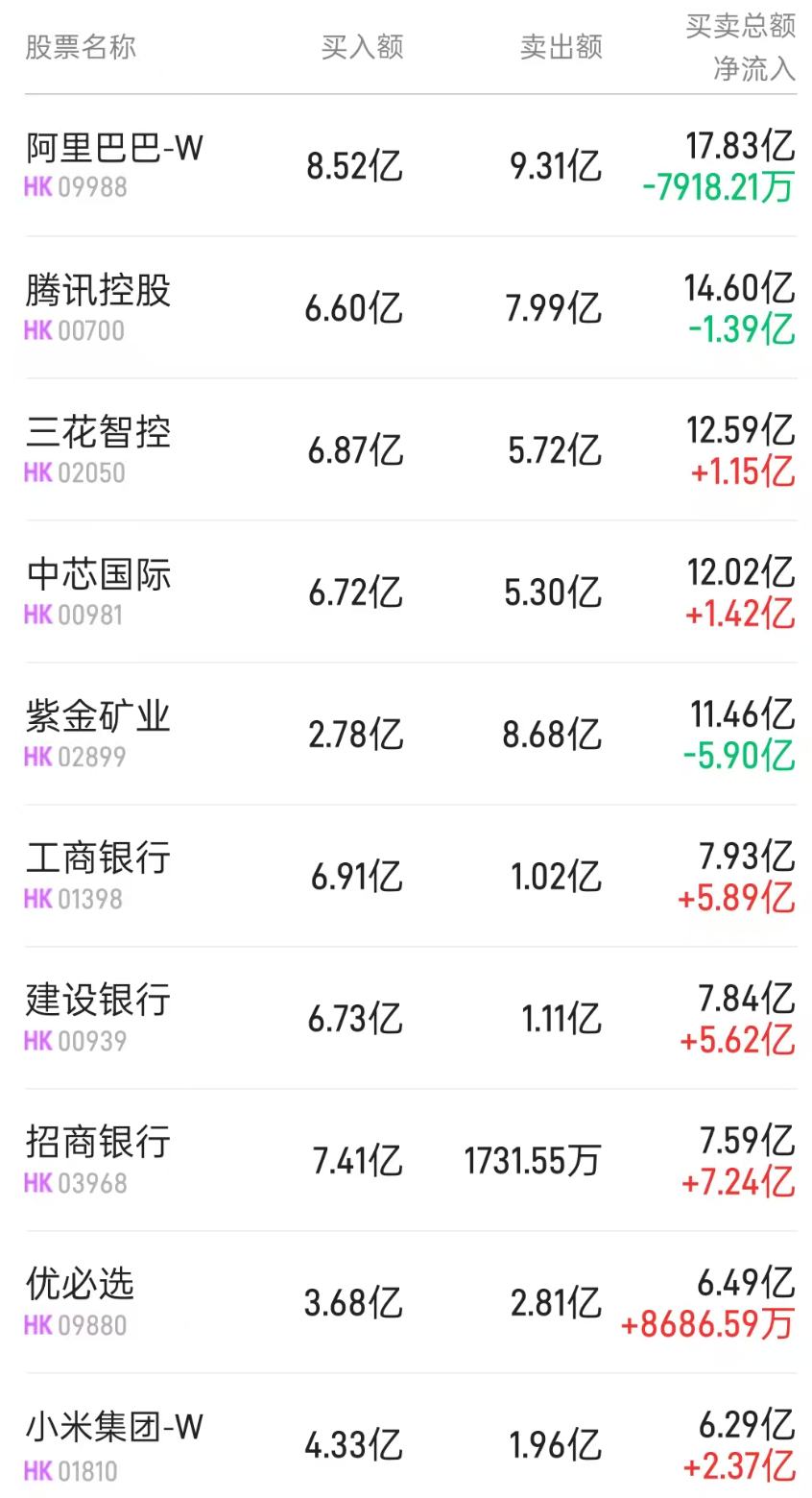
Group 1: Market Overview - On December 31, the Hong Kong stock market saw a net inflow of 34.49 billion HKD from northbound funds, with 30.97 billion HKD from the Shanghai Stock Connect and 3.51 billion HKD from the Shenzhen Stock Connect. This marks a record high net inflow of 1.41 trillion HKD for the year, significantly up from approximately 807.9 billion HKD in 2024 [2]. Group 2: Key Stocks - The most net bought stocks by northbound funds included China Merchants Bank (招商银行) with 7.24 billion HKD, Industrial and Commercial Bank of China (工商银行) with 5.88 billion HKD, and China Construction Bank (建设银行) with 5.61 billion HKD [6]. - The most net sold stocks were Zijin Mining (紫金矿业) with a net outflow of 6.82 billion HKD and Tencent (腾讯) with a net outflow of 6.46 billion HKD [7]. Group 3: Sector Performance - The banking sector is expected to benefit from a stable macro-financial environment, with projections indicating that bank interest margins may have bottomed out and risks in the real sector are easing. This is anticipated to lead to income and profit recovery in the banking industry [6]. - Semiconductor stocks, particularly SMIC (中芯国际), received significant net buying, with 3.91 billion HKD, driven by price increases in the 8-inch BCD process platform by approximately 10% [6]. Group 4: Specific Company Insights - Jiangxi Copper (江西铜业) saw a net inflow of 1.58 billion HKD, while Zijin Mining faced a net outflow of 6.82 billion HKD. The National Development and Reform Commission emphasized the need for optimizing the management of the copper smelting industry, which may impact future production levels [7]. - Xiaomi Group (小米集团) received a net inflow of 2.37 billion HKD, supported by government policies promoting consumer electronics [7].


银行业十五五展望系列专题(上篇):回眸十四五,监管引导和主动求变下的银行经营理念重构
Shenwan Hongyuan Securities· 2025-12-31 14:14
Investment Rating - The report indicates a positive outlook for the banking industry, suggesting a return to a price-to-book (PB) ratio of 1x during the "15th Five-Year Plan" period, focusing on stable profitability and high-quality development [3][4]. Core Insights - The banking sector is transitioning from a focus on scale to quality, with an emphasis on risk management and structural optimization. The "15th Five-Year Plan" includes the goal of building a strong financial nation, highlighting the importance of high-quality development [3][16]. - The report identifies key changes in the banking industry during the "14th Five-Year Plan," including a shift in credit structure, a focus on profitability, and the need for banks to balance risk and efficiency [2][4]. - Regulatory support is expected to stabilize net interest margins, which have reached record lows, with a projected recovery in the coming years [5][19]. Summary by Sections 1. From Quantity to Quality - The banking industry has evolved through three five-year plans, with a shift from rapid expansion to a focus on quality and risk management. The current phase emphasizes high-quality development and financial support for key sectors [2][10]. 2. Developments During the "14th Five-Year Plan" 2.1 ROE: Resilience of State-Owned Banks and Advantages of City Commercial Banks - The return on equity (ROE) for listed banks has remained around 10%, with city commercial banks showing a slight advantage due to higher leverage and better provisioning [19][20]. 2.2 Credit: Moving Away from Scale to Balance Capital and Efficiency - Banks are prioritizing structural transformation over sheer volume, focusing on supporting key sectors and optimizing credit distribution [4][12]. 2.3 Interest Margin: Recovery from Continuous Decline - The report anticipates a stabilization of net interest margins, which have been under pressure, with regulatory measures aimed at supporting banks [5][19]. 2.4 Risk: Provisioning to Support Stability - The banking sector is expected to manage risks more effectively, with a focus on maintaining adequate provisions to support profitability during challenging economic conditions [4][19]. 2.5 Financial Markets: An Alternative Revenue Stream - The report highlights the increasing importance of financial market activities as a means to smooth revenue amid declining interest income, with banks diversifying their investment strategies [4][19]. 3. Investment Analysis Opinion - The report suggests a dual strategy of focusing on leading banks and undervalued city commercial banks, anticipating a recovery in valuations for state-owned banks that have been lagging [3][4].


前瞻2026 | 银行“开门红”静悄悄:利率战熄火,指标考核硝烟四起
Di Yi Cai Jing· 2025-12-31 13:45
Core Viewpoint - The pressure on grassroots bank employees is becoming more complex and hidden, as traditional high-interest deposit products are in short supply, and the focus has shifted to loan and intermediary business metrics [1][4]. Group 1: Changes in Banking Practices - The concept of "opening red" is fading, with banks no longer aggressively releasing special credit quotas at the beginning of the year as they did from 2010 to 2020 [1][4]. - High-interest deposits and financial products that previously stimulated the market are largely absent this year, with loan rates increasing from a historical low of 2.2% to around 2.35% [2][3]. - The People's Bank of China reports that the current one-year Loan Prime Rate (LPR) is 3%, indicating that some banks are offering loans below this benchmark [3]. Group 2: Pressure on Bank Employees - Despite the absence of traditional high-interest products, the pressure on bank employees to meet performance metrics has not decreased, with new marketing initiatives emerging to cope with the challenges [4][5]. - Employees are increasingly resorting to unconventional methods to meet loan targets, such as subsidizing customer purchases or collaborating with loan intermediaries to package client qualifications [5][6]. - The design of performance metrics has become more detailed, with specific assessment points for various tasks, indicating that the competition within the banking sector remains intense [7].
“每天要加十几个,完不成扣钱或加班”!银行员工为企业微信考核伤脑筋,有人去电商买量,还有同行发帖求“互加”
Mei Ri Jing Ji Xin Wen· 2025-12-31 13:40
Core Viewpoint - Banks are increasingly implementing performance assessments based on the addition of clients on enterprise WeChat, reflecting the pressure on retail banking amid declining revenues and profits in the sector [1][17]. Group 1: Performance Assessment and Pressure - Many banks have set specific targets for adding clients on enterprise WeChat, with some requiring customer managers to add up to 100 clients per month, leading to significant pressure on employees [4][6]. - Employees are sharing their enterprise WeChat QR codes on social media to meet these targets, often incentivized by monetary rewards or penalties for failing to meet the requirements [2][5]. - The assessment mechanisms include strict monitoring and penalties, such as deductions from salaries for not meeting the required number of added clients [6][9]. Group 2: Rationale Behind Enterprise WeChat Adoption - The push for enterprise WeChat is partly to prevent "client privatization," ensuring that client relationships remain with the bank rather than individual employees [9][10]. - Banks view enterprise WeChat as a tool for unified client management, allowing for better data collection and analysis of customer behavior and preferences [9][10]. - The financial industry is facing rising customer acquisition costs, making effective client engagement through platforms like enterprise WeChat increasingly important [10][17]. Group 3: Challenges and Misconceptions - There are significant challenges in the implementation of enterprise WeChat, including the perception that the current assessment system is flawed and does not effectively utilize the platform's potential [13][16]. - Many employees express concerns about the quality of interactions with clients, often resorting to generic content that fails to engage customers meaningfully [15][16]. - The focus on quantitative metrics, such as the number of added clients, often overshadows the need for qualitative interactions that drive actual business results [16][17]. Group 4: Retail Banking Performance - Retail banking is experiencing a downturn, with many banks reporting declines in retail revenue and profits compared to the previous year [17][18]. - Specific banks, such as Ping An Bank and Zhejiang Commercial Bank, have seen significant drops in retail revenue, with some experiencing double-digit declines [18]. - Despite some banks reporting growth in retail profits, this is often due to low comparative bases from the previous year, indicating underlying challenges in the retail banking sector [19][20]. Group 5: Success Stories and Future Outlook - Some banks have successfully leveraged enterprise WeChat to enhance customer engagement, with notable increases in client activity and retention rates [20][21]. - For instance, the Industrial and Commercial Bank of China reported significant growth in the number of clients added through enterprise WeChat, leading to improved customer engagement metrics [20][22]. - The ongoing digital transformation in banking emphasizes the need for effective use of platforms like enterprise WeChat to drive profitability and customer satisfaction [10][17].


银行员工为企业微信考核伤脑筋,有人去电商买量,还有同行发帖求“互加”
Mei Ri Jing Ji Xin Wen· 2025-12-31 13:36
Core Viewpoint - Banks are increasingly focusing on the assessment of adding clients via enterprise WeChat as a key performance indicator (KPI) amid challenges in retail banking, leading to a surge in social media posts where employees seek mutual additions to meet their targets [1][22]. Group 1: KPI and Assessment Mechanisms - Many banks have set specific targets for adding enterprise WeChat contacts, with requirements such as 50 contacts per month for some employees, and penalties for not meeting these targets [5][8]. - The assessment includes financial penalties, such as a deduction of 300 yuan for failing to meet monthly targets, and some banks have implemented a ranking system with monetary rewards for top performers [8][12]. - The pressure to meet these KPIs has led to a culture of mutual assistance among bank employees, with many posting their WeChat QR codes on social media to gain more contacts [2][3]. Group 2: Challenges and Pain Points - Employees express frustration over the pressure to add contacts, often feeling compelled to work overtime to meet their targets [17]. - The current assessment system is criticized for focusing solely on frontline employees, neglecting the role of middle management in effectively utilizing enterprise WeChat [18][20]. - There is a concern that the quality of interactions is suffering, as many employees are merely adding contacts to fulfill their quotas rather than engaging meaningfully with clients [19]. Group 3: Industry Context and Performance - The retail banking sector is experiencing significant pressure, with many banks reporting declines in retail revenue and profits compared to the previous year [22][24]. - For instance, several banks, including Postal Savings Bank and Agricultural Bank, have seen retail revenue drop by over 6% year-on-year [23]. - In response to these challenges, banks are leveraging enterprise WeChat as a tool for deeper customer engagement, aiming to enhance client interaction and operational efficiency [25][26].