
牧原股份

Search documents
营收近80亿,东晓生物获批登陆新三板!以合成生物和发酵技术深耕多元产品领域
合成生物学与绿色生物制造· 2025-10-21 10:09
Core Viewpoint - The article highlights the progress of Dongxiao Biotechnology Co., Ltd. in the synthetic biology manufacturing sector, focusing on its diverse corn deep processing capabilities and its upcoming listing on the New Third Board [2][4]. Group 1: Company Overview - Dongxiao Biotechnology specializes in synthetic biology manufacturing and fermentation technology, primarily engaged in the deep processing of corn to produce animal nutrition products, solid beverages, food additives, organic acids, and health sweeteners [2][4]. - The company has an annual corn deep processing capacity of 1.6 million tons, producing various products such as L-lysine hydrochloride, erythritol, and glucose [4]. Group 2: Market Position and Innovation - Dongxiao is positioned as a leader in the corn deep processing industry, transforming traditional agricultural raw materials into high-value products through technological innovation [4]. - The company utilizes renewable resources like corn and green energy sources such as wind and solar power to achieve sustainable product transformation across multiple sectors, including food, pharmaceuticals, and personal care [4]. Group 3: Financial Performance - For the fiscal years 2023 and 2024, Dongxiao's projected revenues are 7.993 billion yuan and 7.840 billion yuan, respectively, with main business revenues contributing significantly at 7.845 billion yuan and 7.630 billion yuan, accounting for 98.15% and 97.33% of total revenues [5]. - The net profits for the same periods are expected to be 298 million yuan and 578 million yuan, with a slight decline in revenue attributed to lower procurement prices for corn and energy [5]. - The overall gross profit margin is projected to improve to 10.33% and 13.91%, driven by reduced raw material costs despite limited price declines in the market [5].


养殖业板块10月21日涨0.28%,天邦食品领涨,主力资金净流出4444.89万元
Zheng Xing Xing Ye Ri Bao· 2025-10-21 08:22
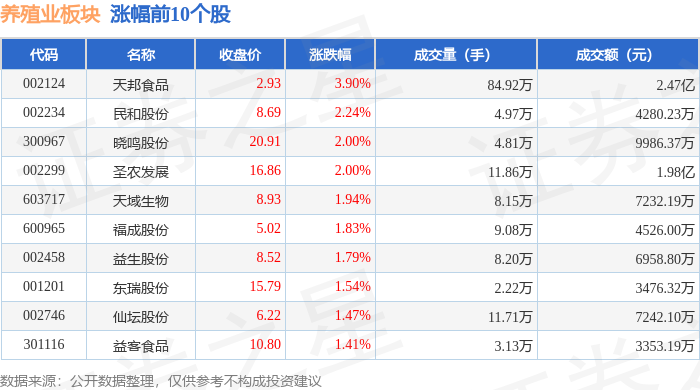
Market Overview - The aquaculture sector increased by 0.28% on October 21, with Tianbang Food leading the gains [1] - The Shanghai Composite Index closed at 3916.33, up 1.36%, while the Shenzhen Component Index closed at 13077.32, up 2.06% [1] Stock Performance - Tianbang Food (002124) closed at 2.93, up 3.90% with a trading volume of 849,200 shares and a transaction value of 247 million [1] - Minhe Livestock (002234) closed at 69.8, up 2.24% with a trading volume of 49,700 shares and a transaction value of 42.8 million [1] - Xiaoming Co. (300967) closed at 20.91, up 2.00% with a trading volume of 48,100 shares and a transaction value of 99.9 million [1] - Shengnong Development (002299) closed at 16.86, up 2.00% with a trading volume of 118,600 shares and a transaction value of 28.67 million [1] - Tianyu Bio (603717) closed at 8.93, up 1.94% with a trading volume of 81,500 shares and a transaction value of 72.32 million [1] Capital Flow - The aquaculture sector experienced a net outflow of 44.44 million from institutional investors and 35.77 million from retail investors, while retail investors saw a net inflow of 80.22 million [2] - The capital flow for individual stocks shows Shengnong Development (002299) with a net inflow of 22.98 million from institutional investors [3] - Institutional investors also showed a net inflow of 18.73 million for Zhengbang Technology (002157) [3] - Tianbang Food (002124) had a net inflow of 16.94 million from institutional investors [3]




农林牧渔行业报告(2025.10.13-2025.10.19):猪价止跌,9月产能去化
China Post Securities· 2025-10-21 06:44
Investment Rating - The industry investment rating is "Outperform the Market" and is maintained [2] Core Views - The agricultural sector experienced a downward adjustment, with the Agricultural, Forestry, Animal Husbandry, and Fishery (Shenwan) index declining by 2.20%, ranking 13th among 31 primary industries [4][13] - National pig prices showed a slight rebound after a decline, with the average price rising to 11.03 CNY/kg as of October 19, indicating a potential bottoming out [5][18] - The "anti-involution" policies have been intensified since May, which is expected to accelerate capacity reduction in the pig industry and lead to a price increase in the second half of next year [6][20] Summary by Sections Market Review - The agricultural sector followed the overall market trend and declined, with the Shanghai Composite Index and CSI 300 dropping by 1.47% and 2.22%, respectively [13][14] Livestock Industry Chain Tracking Pigs: Price Stabilization and Capacity Reduction - The national average pig price fell to a low of 10.87 CNY/kg before rebounding to 11.03 CNY/kg [5][18] - The average loss for self-bred pigs was approximately 254 CNY per head, while for purchased piglets, it was about 375 CNY [19] - The breeding stock saw a reduction in September, with a decrease of 0.07% in the number of breeding sows [19] Broilers: Profit Squeeze - As of October 19, the price of broiler chicks was 3.5 CNY per chick, with an average profit of 0.4 CNY per chick, while the price of broiler chickens was 3.37 CNY per jin, resulting in a loss of 2.2 CNY per chick [31] - The number of grandparent stock updated in the first three quarters of 2025 was 803,300 sets, a decrease of 9.86 million sets or 19.01% compared to the same period in 2024 [31][32] Planting Industry Chain Tracking - Sugar prices continued to decline, with white sugar priced at 5,780 CNY/ton, down 55 CNY/ton [35] - The price of corn was 2,216 CNY/ton, showing a slight decrease [36]
世界猪业博览会开幕!农牧渔ETF(159275)上涨0.7%!机构:养殖业产能出清或推动景气反转
Xin Lang Ji Jin· 2025-10-21 05:18
Group 1 - The agricultural and livestock ETF (159275) showed a stable performance with a price increase of 0.81% and a trading volume of 3.45 million yuan, bringing the fund's total size to 206 million yuan [1] - Among the constituent stocks, Zhongxing Junye reached the daily limit, while Chenguang Biotech and Zhuangzidao followed with increases of 3.07% and 2.89% respectively [1] - The 14th World Pig Industry Expo opened in Changsha, covering an area of 100,000 square meters and attracting over 800 global enterprises, focusing on technology exchange and innovation in the pig farming industry [1] Group 2 - Guohai Securities indicated that the pig farming industry is entering a regulatory phase, with measures to reduce production capacity affecting pig prices, which are under downward pressure in the short term [2] - The poultry sector is expected to improve, with the import ratio of white feather chicken breeding stock decreasing to 41%, despite low prices [2] - The pet economy is rapidly developing, with domestic brands rising and improving industry profitability [2]
猪价“跌跌不休”,生猪养殖业陷入全面亏损,畜牧养殖ETF(516670)近7个交易日获资金连续净流入近1.5亿元
2 1 Shi Ji Jing Ji Bao Dao· 2025-10-21 03:11
Core Viewpoint - The rapid decline in pig prices has led to significant losses in the pig farming industry, with many farmers facing financial distress as prices fall below production costs [1][2]. Group 1: Price Trends - The average purchase price for live pigs from designated slaughterhouses was 13.45 yuan/kg, a decrease of 3.0% week-on-week and 29.2% year-on-year [1]. - The average ex-factory price for pork was 17.58 yuan/kg, down 2.7% week-on-week and 28.5% year-on-year [1]. - On October 20, the price for live pigs (external three yuan) was 11.18 yuan/kg, a year-on-year decrease of 35.41%, falling below the cost line of 13-14 yuan/kg for most farming entities [1]. Group 2: Industry Impact - The continuous drop in pig prices has resulted in comprehensive losses for the pig farming industry, with major companies like Muyuan Foods reporting a September average selling price of 12.88 yuan/kg, down 30.94% year-on-year, and a sales revenue of 9.066 billion yuan, down 22.46% year-on-year [1]. - Small and medium-sized farmers are increasingly at risk of financial collapse, with losses per pig reaching over 50 yuan for self-bred pigs and approximately 150 yuan for those purchasing piglets for fattening [1]. Group 3: Market Dynamics - Analysts from Guojin Securities noted that the rapid decline in pig prices has created a negative sentiment, although there has been a slight rebound due to secondary fattening [2]. - The average weight of pigs at market release remains high at 128.25 kg, indicating that inventory levels have not significantly decreased despite falling prices [2]. - The supply of live pigs is expected to increase in the coming months, with limited seasonal accumulation space, suggesting further potential price declines [2]. Group 4: Investment Opportunities - There is a focus on the potential for capacity reduction in the industry, which may create low-entry opportunities for leading pig farming companies as the market adjusts [2]. - Recent data indicates a net inflow of over 16.38 million yuan into the livestock farming ETF (516670), with a total net inflow of nearly 150 million yuan over the past seven trading days [2]. Group 5: ETF Overview - The livestock farming ETF (516670) closely tracks the China Securities Livestock Farming Index, covering approximately 60% of the weight of stocks related to pig farming, including major companies like Muyuan Foods and Wens Foodstuffs [3]. - The ETF also encompasses upstream and downstream sectors such as vaccines and feed, as well as poultry and aquaculture [3]. - The management fee for the ETF is 0.2% per year, which is lower than the typical 0.5% for similar index products [3].
畜牧ETF(159867)连续5日净申购,“猪价+疫情+调控”三重因素加速生猪产能去化
Xin Lang Cai Jing· 2025-10-21 02:53
Core Viewpoint - The livestock sector is experiencing a surge due to three main factors: low pig prices, African swine fever (ASF) outbreaks, and regulatory policies aimed at capacity reduction. Group 1: Low Pig Prices - The core pressure for capacity reduction is the low pig prices, with the average cost of production around 13 yuan/kg, leading to losses of approximately 250–300 yuan per fattening pig since September 15 [1] - As of late October, the national average pig price is about 11 yuan/kg, marking the lowest point in six years for the same period [1] - The collapse of the piglet market is evident, with prices for 6–7 kg piglets plummeting from 450–500 yuan/head in the first half of the year to 150 yuan/head, resulting in a situation of "having a price but no market" [1] - High asset-liability ratios among listed pig companies could accelerate capacity reduction if low prices persist for 3–4 months, potentially leading to continuous losses [1] Group 2: African Swine Fever (ASF) Outbreaks - The winter season (October to January) poses significant challenges for ASF control, as the virus thrives in colder conditions [2] - Current risks include unusually high antibody positivity rates, worsening weather conditions that facilitate virus spread, and lax biosecurity measures by farmers due to low pig prices [2] Group 3: Regulatory Policies - A series of policies have been introduced to actively regulate production capacity, including a directive for the top 25 enterprises to reduce breeding sows by 1 million by January 2026 [3] - Additional measures include controlling the weight of pigs at around 120 kg to combat secondary fattening and a projected 10% reduction in output for major companies by 2026, which is expected to decrease national output by 5% [3] - Supporting measures involve strict environmental controls, tightening of credit, and reduction of subsidies [4] - The policy goal is to accelerate capacity reduction through administrative means to stabilize the positive impact of pork prices on the Consumer Price Index (CPI) [5] Group 4: Market Performance - As of October 21, 2025, the CSI Livestock Breeding Index (930707) rose by 0.55%, with notable increases in stocks such as Haida Group (1.81%) and Luoniushan (1.63%) [5] - The Livestock ETF (159867) increased by 0.46%, reflecting the overall performance of listed companies involved in livestock breeding, feed, and pharmaceuticals [5] - The top ten weighted stocks in the CSI Livestock Breeding Index account for 66.06% of the index, indicating a concentrated market [5]
晨会纪要:2025年第177期-20251021
Guohai Securities· 2025-10-21 02:07
Group 1: Pig Industry - The pig industry is undergoing a period of regulatory control, with measures aimed at reducing production capacity to stabilize prices. Short-term pressures on prices are expected due to increased market supply, but the overall regulatory approach is likely to be moderate, focusing on sustainable price recovery [3][4] - The recommendation is to focus on leading companies such as Muyuan Foods and Wens Foodstuffs, while also considering opportunities in lower-cost producers like Dekang Agriculture and Shennong Group [3] Group 2: Poultry Industry - The poultry sector is expected to see improvements in its fundamentals, with significant updates in breeding stock. In September 2025, 136,800 sets of grandparent stock were updated, contributing to a total of 803,300 sets for the year [4] - The recommendation includes companies like San Nong Development and Lihua Stock, as the market dynamics are anticipated to shift positively [4] Group 3: Animal Health - The competitive landscape in the animal health sector is expected to improve, supported by government initiatives to optimize the veterinary drug industry and encourage innovation among leading firms [5] - The clinical trials for African swine fever vaccines are progressing, with companies like BioFeng and Zhongmu Bio receiving clinical approval, which could enhance market prospects for these vaccines [5] Group 4: Planting Industry - The pig-to-grain price ratio is continuing to decline, which may benefit companies that have invested early in genetically modified seed development. Companies like Suqian Agricultural Development and Longping High-Tech are recommended [6] Group 5: Feed Industry - The feed industry is experiencing price fluctuations, but there is an expectation of increased market concentration. Hai Da Group is recommended, with a focus on He Feng Stock as a potential opportunity [7] Group 6: Pet Industry - The pet economy is thriving, with domestic brands gaining significant market share. The profitability of the industry is improving, and companies like Guibao Pet and Zhongchong Stock are recommended for investment [8] Group 7: Automotive Industry - In September 2025, wholesale automotive sales increased by 14.9% year-on-year, with significant growth in new energy vehicles, which accounted for 46.1% of total new car sales [9][10] - The launch of new models like the Leap D19 and Wei Brand's Gaoshan 7 is expected to enhance market competitiveness, with the latter achieving a sales price of 285,800 yuan [10][11] - The automotive sector is recommended for investment, particularly in companies that are positioned for high-end and intelligent vehicle development, such as Li Auto and BYD [12] Group 8: Beauty and Healthcare - Meili Tianyuan's acquisition of Siyuanli for 1.25 billion yuan is set to strengthen its position in the high-end beauty market, with the deal structured as 67% cash and 33% stock [14][15] - The acquisition is expected to enhance revenue and profit scales, with projected revenues of 3 billion yuan in 2025, growing to 5.2 billion yuan by 2027 [16]
牧原股份10月20日获融资买入1.71亿元,融资余额48.60亿元
Xin Lang Cai Jing· 2025-10-21 01:34
融券方面,牧原股份10月20日融券偿还1.65万股,融券卖出2.29万股,按当日收盘价计算,卖出金额 113.31万元;融券余量33.64万股,融券余额1664.58万元,超过近一年80%分位水平,处于高位。 分红方面,牧原股份A股上市后累计派现265.76亿元。近三年,累计派现165.94亿元。 机构持仓方面,截止2025年6月30日,牧原股份十大流通股东中,香港中央结算有限公司位居第三大流 通股东,持股1.49亿股,相比上期增加2047.15万股。华泰柏瑞沪深300ETF(510300)位居第七大流通 股东,持股4865.74万股,相比上期增加398.32万股。易方达沪深300ETF(510310)位居第九大流通股 东,持股3468.03万股,相比上期增加345.23万股。华夏沪深300ETF(510330)位居第十大流通股东, 持股2543.26万股,为新进股东。汇添富中证主要消费ETF(159928)退出十大流通股东之列。 资料显示,牧原食品股份有限公司位于河南省南阳市卧龙区龙升工业园区,香港铜锣湾希慎道33号利园1 期19楼1920室,成立日期2000年7月13日,上市日期2014年1月28日,公司 ...
猪价跌跌不休!“保险+期货”为养殖户捂紧钱袋子
Zheng Quan Shi Bao· 2025-10-21 00:46
Core Insights - After the National Day and Mid-Autumn Festival holiday, the price of live pigs has accelerated its decline, with recent futures contracts falling below 12,000 yuan/ton [1] - Despite multiple state interventions in frozen pork storage, the market's recovery effect has been limited, leading to a situation where prices continue to drop even during the traditional peak consumption season [1] - The "insurance + futures" project, driven by futures, insurance, and local government, is providing significant support to small and medium-sized pig farmers [2] Group 1 - The state has initiated the storage of 15,000 tons of frozen pork on October 10, marking the latest action in a series of five storage initiatives in August and September [1] - On October 9, the first trading day after the holiday, the main futures contract for live pigs closed at 11,595 yuan/ton, with a single-day decline of 6.15% [1] - The price of the futures contract dropped to as low as 11,020 yuan/ton on October 17, indicating ongoing price pressure in the market [1] Group 2 - The "insurance + futures" project in the city of Luohe serves as a benchmark for the Dalian Commodity Exchange's "Farmer Income Protection Plan," highlighting its importance in managing price risks for pig farmers [2] - The project has successfully compensated farmers, such as the Zhichun Breeding Farm, which received over 180,000 yuan in compensation due to price declines, achieving a compensation rate of nearly 364% [2] - Since 2021, listed pig companies have shown increasing enthusiasm for engaging in commodity futures hedging, with several companies, including Haida Group and Muyuan Foods, announcing their participation in such activities [3]
回望“十四五”| 数说“十四五” ESG笔墨绘就企业发展新底色
Zhong Guo Zheng Quan Bao· 2025-10-21 00:27
Group 1: ESG Reporting and Development - The disclosure rate of ESG reports among A-share listed companies has increased significantly, with 2,521 companies publishing reports for the 2024 fiscal year, representing 46.83% of all listed companies, marking a 71% increase from 2021 [2] - The quality of ESG development has improved, with 342 companies in the Shanghai Stock Exchange included in MSCI ESG ratings, and 100 companies receiving upgrades in their ratings [2] - ESG has evolved from a conceptual framework to a key dimension for measuring corporate competitiveness, aligning with national development goals for green growth and harmony with nature [2][4] Group 2: Green Energy and Low-Carbon Initiatives - The share of renewable energy in power generation capacity has risen from 40% to approximately 60% during the "14th Five-Year Plan" period, with nearly 60% of new power generation coming from non-fossil energy sources [6] - A zero-carbon intelligent manufacturing base in Jiangsu has been established, generating over 600 million kWh of clean electricity annually and achieving net-zero emissions [5] - Significant reductions in energy consumption per unit of GDP have been achieved, with an 11.6% decrease over four years, equating to a reduction of 1.1 billion tons of CO2 emissions [6] Group 3: Corporate Social Responsibility and Community Engagement - A majority of listed companies are actively engaging in community services and educational support, with 67.16% involved in community service and 66.67% providing educational assistance [8] - The third industry has seen an increase in employment capacity, with 35.866 million people employed by the end of 2024, marking a 1.1 percentage point increase in its share of total employment [8] - Significant progress has been made in housing projects, with over 240,000 urban old residential areas renovated, benefiting over 40 million households [9] Group 4: Agricultural and Rural Development - Companies are integrating ESG practices with rural revitalization strategies, with over 6,000 enterprises supporting poverty alleviation efforts [12] - The contribution rate of agricultural technology has reached 63.2%, with over 75% of crop farming being mechanized by the end of 2024 [12] - Initiatives like the "MAP modern agricultural assistance model" have helped increase agricultural output and income for farmers [12]