中金公司

Search documents
出海2035:接下来是最有希望的十年,可能也是最难的十年 || 大视野
Sou Hu Cai Jing· 2026-02-16 00:45
Core Insights - The article emphasizes the importance of understanding the impact of national security and geopolitical factors on Chinese companies' overseas expansion, which may exceed the companies' capabilities to address [3][4][10]. Group 1: Future Predictions for Chinese Companies Going Abroad - Chinese companies are expected to succeed in localizing products and services, creating consumer welfare in host countries, and some have already reached the stage of creating globally competitive products [5]. - Compliance with local laws and regulations, as well as building good relationships with stakeholders, will also lead to positive outcomes for Chinese companies [5][6]. - The article highlights the need for deep localization and community engagement, as demonstrated by Zijin Mining's proactive approach in Serbia and China Minmetals' efforts in Peru [6][9]. Group 2: Challenges from Geopolitical Factors - Geopolitical issues and national security concerns pose significant challenges for Chinese companies, especially in sensitive markets, which could threaten their operational existence [10][11]. - Companies may seek assistance from government institutions and industry associations when facing geopolitical pressures, but it is difficult for a single company to withstand national and international pressures alone [11][12]. Group 3: Structural Changes in International Business Environment - The article discusses the structural changes in the international business environment, where national security and geopolitical factors have become a standard consideration for many countries, leading to increased intervention in markets [28][29]. - The U.S. and EU have adopted policies that prioritize economic security, viewing China as a significant threat, which has resulted in a shift towards protectionism and increased regulatory scrutiny [29][30][31]. Group 4: Recommendations for Chinese Companies - Companies are advised to enhance their awareness of controllability, especially in mergers and acquisitions, and to consider alternative strategies such as technology or service collaborations to mitigate risks [40][41]. - There is a strong emphasis on compliance with local laws and understanding local cultures to avoid conflicts and ensure sustainable operations [42][43]. - A dynamic balance between exports and overseas expansion is crucial, leveraging China's advantages while responding to global changes [43][44]. Group 5: National-Level Strategies - The article suggests that the government should integrate overseas expansion into national development strategies, fostering communication with companies to create a comprehensive roadmap for internationalization [45]. - It is essential to recognize the disruptive impact of national security and geopolitical factors and to deploy systematic support measures for companies venturing abroad [46].


存款搬家加速?1月非银存款同比多增2.56万亿,最新解读来了
Xin Lang Cai Jing· 2026-02-15 23:33
Core Viewpoint - The recent data from the central bank indicates a significant shift in household deposits towards non-bank financial institutions, reflecting an acceleration in the trend of residents moving their savings from traditional deposits to asset management products [1][4][12]. Group 1: Financial Data Overview - In January, household deposits increased by 2.13 trillion yuan, non-financial corporate deposits rose by 2.61 trillion yuan, and deposits in non-bank financial institutions grew by 1.45 trillion yuan [1][8]. - The total balance of broad money (M2) reached 347.19 trillion yuan, with a year-on-year growth of 9%, while narrow money (M1) stood at 117.97 trillion yuan, growing by 4.9% [8][9]. - Compared to the same period in 2025, non-bank deposits increased by 2.56 trillion yuan year-on-year, while household deposits decreased by 3.39 trillion yuan [1][9]. Group 2: Analysis of Deposit Trends - Analysts from various brokerages agree that the data indicates an acceleration in the migration of household deposits, with the growth rate of household deposits declining sharply [3][10]. - The difference between the growth rates of household deposits and M2 has turned negative for the first time in 7.5 years, indicating a significant shift [10][11]. - The increase in non-bank deposits is attributed to both a low base effect from previous self-regulation in interbank deposit pricing and a potential shift of household savings towards the stock market [2][9]. Group 3: Wealth Migration to Asset Management Products - There is a growing discussion regarding the reallocation of deposits as a large volume of fixed-term deposits is set to mature, estimated to be between 30 trillion and 70 trillion yuan by 2026 [4][12]. - By the end of 2025, deposits in non-bank financial institutions are projected to reach 34.6 trillion yuan, marking a 22.8% year-on-year increase, the highest in a decade [12]. - The balance of asset management products sourced from households and enterprises is expected to grow to 56.3 trillion yuan by the end of 2025, reflecting a 9.7% increase [12]. Group 4: Market Implications - Despite the migration of deposits, analysts caution that this does not necessarily imply a significant influx of capital into the equity market, as much of the funds may flow into low-risk assets rather than riskier investments [5][13]. - The expected path of fund flow is projected to be from household deposits to non-bank deposits, then to financial products, and finally into the bond and stock markets [6][13]. - Analysts suggest that the liquidity in the equity market will depend on various macroeconomic indicators, and the sentiment may shift as the high point of deposit maturity pressure approaches in early 2026 [13][14].
存款搬家加速?1月非银存款同比多增2.56万亿,最新解读来了
券商中国· 2026-02-15 23:31
Core Viewpoint - The recent financial statistics from the central bank indicate a significant shift in household deposits towards non-bank financial institutions, reflecting a broader trend of wealth migration from traditional savings to asset management products [2][6][7]. Group 1: Financial Data Overview - In January, household deposits increased by 2.13 trillion yuan, while non-financial corporate deposits rose by 2.61 trillion yuan, and deposits from non-bank financial institutions grew by 1.45 trillion yuan [1][3]. - The total balance of broad money (M2) reached 347.19 trillion yuan, with a year-on-year growth of 9%, while narrow money (M1) stood at 117.97 trillion yuan, growing by 4.9% [3][4]. Group 2: Deposit Migration Trends - Compared to the same period in 2025, non-bank deposits increased by 2.56 trillion yuan, while household deposits decreased by 3.39 trillion yuan, indicating a clear trend of "deposit migration" [2][4]. - Analysts noted that the decline in household deposits and the increase in non-bank deposits are influenced by factors such as the timing of the Spring Festival and a shift in investment preferences towards the stock market [4][5]. Group 3: Asset Management Product Migration - The discussion around the "massive maturity of deposits" has led to speculation about where these funds will be reallocated, with estimates suggesting that between 3 trillion to 7 trillion yuan of household time deposits will mature in 2026 [6][7]. - By the end of 2025, the balance of deposits in non-bank financial institutions is projected to reach 34.6 trillion yuan, marking a 22.8% year-on-year increase, which reflects the ongoing trend of deposit migration [6][7]. Group 4: Market Implications - Analysts express caution regarding the potential impact of deposit migration on the equity market, suggesting that the primary destination for matured deposits may be low-risk assets rather than high-risk equities [7][8]. - The outlook for 2026 indicates that if household investment remains stable, funds may flow from household deposits to non-bank deposits, and subsequently into financial products like funds and insurance, before reaching the bond and stock markets [7][8].

1月“存款搬家”现象,背后发生了什么?
Xin Lang Cai Jing· 2026-02-15 19:04
智通财经记者 陈月石 今年1月,人民币存款同比大幅多增,居民存款则同比少增,非银存款同比多增,"存款搬家"现象在1月 持续。 中国人民银行公布的1月金融数据显示,1月人民币存款增加8.09万亿元。其中,住户存款增加2.13万亿 元,非金融企业存款增加2.61万亿元,财政性存款增加1.55万亿元,非银行业金融机构存款增加1.45万 亿元。 浙商证券指出,1月人民币存款同比多增3.8万亿,存款开门红增长势头较好;其中,非银存款新增1.5万 亿,同比多增2.6万亿,主因年初权益市场牛市行情;居民存款新增2.1万亿,同比少增3.4万亿,存款搬 家现象持续。 本 期 编 辑 邢潭 中金公司在报告中指出,1月居民存款增加2.13万亿元,同比少增3.39万亿元,非银存款增加1.45万亿 元,同比多增2.56万亿元,低利率下居民投资更偏向理财产品;1月企业存款增加2.61万亿元,同比多增 2.82万亿元,企业结汇规模较高支撑企业存款增长。1月M1同比增速从去年12月的3.8%升至4.9%,企业 结汇叠加春节偏晚影响,M1同比增速有所回升;1月M2同比增速从去年12月的8.5%升至9.0%,受企业 结汇和非银存款支撑,广义货币 ...
美高梅中国Q4业绩超预期,机构看好高端市场复苏
Jing Ji Guan Cha Wang· 2026-02-15 16:45
Core Insights - MGM China reported a strong performance in Q4 2025, with net revenue reaching HKD 9.617 billion, a year-on-year increase of 21%, recovering to 169% of the same period in 2019 [1] - Adjusted EBITDA for MGM China was HKD 2.753 billion, up 29% year-on-year, recovering to 177% of the same period in 2019, primarily driven by the recovery of high-end business [1] - MGM International noted that the licensing and brand fee share charged to MGM China doubled, attributed to an increase in market share for MGM China [1] Institutional Views - Macquarie Securities adjusted MGM China's target price to HKD 21.6 on February 9, maintaining an "Outperform" rating based on Q4 performance and room upgrade plans [2] - CICC maintained an "Outperform" rating with a target price of HKD 16.10, but cautioned that new brand agreements could impact net profit by approximately 14% [2] - JPMorgan included MGM China as a top pick in Hong Kong stocks on February 12, optimistic about the recovery in the high-end market [2] Stock Performance - MGM China's stock experienced significant volatility, rising 4.11% to HKD 13.68 on February 9, but closing at HKD 13.58 on February 13, narrowing the cumulative gain to 3.35% with declining trading volume [3] - MGM International's stock fell 8.94% during the same period, with a single-day drop of 5.97% on February 12, influenced by market sentiment and technical adjustments [3] - The Hong Kong gaming sector saw a slight decline of 0.12%, while the U.S. gaming sector increased by 0.87% [3] Recent Events - MGM launched a National Art Fund project exhibition in Macau on February 5, aimed at enhancing brand cultural image, though the event had limited direct impact on stock prices [4]

春节期间,券商电话会近300场
财联社· 2026-02-15 15:43
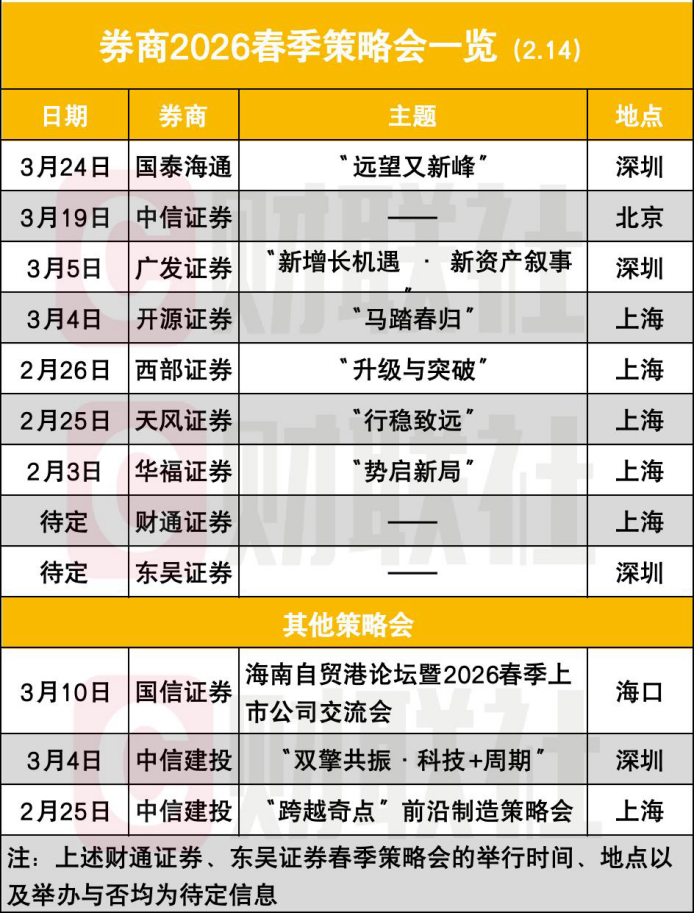
Core Viewpoint - The brokerage industry is intensifying competition in research services during the Spring Festival, with a significant number of phone conferences and strategy meetings being held to capture market share and enhance performance amidst declining research income [1][11][12]. Group 1: Phone Conferences - From February 16 to 23, a total of 292 phone conferences will be held by brokerage research teams, averaging over 32 per day, including 7 on New Year's Eve and 10 on the first day of the New Year [1]. - A total of 176 sell-side roadshow meetings are scheduled, with 108 occurring during the Spring Festival period [3]. - Notably, West Securities will host a series of phone conferences covering various topics, including a special session on AI products and industries on February 16 [5]. Group 2: Spring Strategy Meetings - Seven brokerages have confirmed their Spring Strategy Meetings, with themes reflecting optimism about the capital market, such as "New Growth Opportunities" and "Upgrades and Breakthroughs" [12][14][15]. - The meetings are scheduled to take place in various locations, with a concentration in Shanghai and Shenzhen, indicating a strategic focus on key financial hubs [13]. - The themes of the strategy meetings are generally positive, suggesting a favorable outlook for the upcoming market conditions [14][15]. Group 3: Competitive Landscape - The competition for research market share is intensifying, particularly among mid-sized brokerages, as they seek to enhance their research capabilities and client resources [11]. - The ongoing fee reduction reforms in public funds are impacting brokerage research income, with a reported 33.98% year-on-year decline in commission income for the first half of 2025 [11]. - The industry is expected to see increased concentration as some smaller firms exit the market, while larger firms maintain strategic investments in research services [11].


券商一年少近8000人,公募却九次刷新纪录:金融人正“用脚投票”
Xin Lang Cai Jing· 2026-02-15 14:47
Core Viewpoint - The financial industry is experiencing a significant migration trend, with professionals moving from brokerage firms to public funds, indicating a shift in resource allocation within the wealth management sector [3][17][24]. Group 1: Migration Trends - A notable number of brokerage employees have changed their careers to join public funds, exemplified by individuals like Zhao Binghao moving from CITIC Securities to Huazhang Fund [3][17]. - As of the end of 2025, the number of employees in securities companies is projected to decrease to 327,800, reflecting a net loss of nearly 8,000 in one year, while public fund assets are expected to reach 37.71 trillion yuan, marking an increase of nearly 5 trillion yuan [5][19]. Group 2: Reasons for Migration - The decline in commission rates and shrinking investment banking projects have led to reduced income for brokerage employees, making the once lucrative positions less attractive [7][20]. - In contrast, public funds are experiencing rapid growth, with a significant demand for investment research talent, as evidenced by the average management scale per employee exceeding 1.1 billion yuan [20][25]. Group 3: Characteristics of Migrating Professionals - Two main groups are migrating: experienced professionals returning to their roots in public funds and investment managers transferring their product management rights as part of a business transition [9][22]. - The migration is not merely a job change but reflects a strategic realignment in response to market demands and opportunities [24][26]. Group 4: Industry Dynamics - The surge in public fund assets is driven by a shift in consumer investment preferences, as traditional wealth management products face challenges, leading to increased inflows into public funds [11][25]. - The current trend signifies a structural transformation in China's wealth management industry, moving from a focus on brokerage services to a greater emphasis on product management and research capabilities [14][26].


除夕不看春晚开电话会!春节期间电话会近300场
Feng Huang Wang· 2026-02-15 14:04
Core Insights - The sell-side research sector is intensifying efforts to boost performance during the Chinese New Year, with a significant number of conference calls scheduled, including 292 calls from February 16 to 23, averaging over 32 calls per day [1][2] - The spring strategy meetings are also being held earlier and more densely than in previous years, with seven brokerages confirmed to host events, indicating a competitive landscape for research market share [2][11] Conference Calls and Meetings - A total of 176 sell-side roadshow meetings are planned, with 108 occurring during the Chinese New Year holiday from February 15 to 23, involving over 13 brokerages [3][4] - Notable brokerages participating include Pacific Securities, Guotai Junan, and CITIC Securities, with a focus on various industries such as food and beverage, real estate, and technology [3][7] Spring Strategy Meetings - The spring strategy meetings are characterized by early initiation and dense scheduling, with the first meeting held by Huafu Securities on February 3, 2026 [11][12] - The themes of these meetings reflect a positive outlook for the capital market, with keywords like "new," "breakthrough," and "upgrade" being prevalent [12][13] - Brokerages are also expanding their geographical reach, with events planned in locations beyond traditional financial hubs, indicating a shift in focus towards emerging economic regions [12] Competitive Landscape - The competition among brokerages for research market share is intensifying, driven by pressures on research income due to ongoing reforms in public fund fees [10][11] - Medium-sized brokerages are particularly focused on enhancing their research capabilities to capture market share, while larger firms maintain strategic investments in research to support both external and internal functions [10]



再融资新规红利释放,投行谁将受益?
Xin Lang Cai Jing· 2026-02-15 05:57
Core Viewpoint - The introduction of new refinancing regulations by the Shanghai, Shenzhen, and Beijing stock exchanges is seen as a positive development for the investment banking sector, providing opportunities for both large and small brokerage firms to adapt and capitalize on the changes [1][2][8]. Group 1: Market Response and Opportunities - The new refinancing regulations are expected to enhance the efficiency of refinancing processes, addressing previous concerns raised by market participants [2][10]. - In the first week following the announcement of the new regulations (February 10-12), at least 10 listed companies in the three exchanges issued new refinancing proposals, indicating a quick market response [2][11]. - The refinancing market in January saw a significant increase, with a total of 130 billion yuan raised, marking a 56% year-on-year growth and a 234% month-on-month increase [3][11]. Group 2: Impact on Brokerage Firms - Analysts believe that leading brokerage firms with strong pricing and underwriting capabilities will benefit the most from the new regulations, while smaller firms will need to find differentiated strategies to compete [4][12]. - The top five brokerage firms accounted for 54% of the underwriting volume in 2025, with CITIC Securities leading by underwriting 36 companies [4][12]. - Smaller brokerage firms are focusing on the Beijing Stock Exchange's refinancing market, which is seen as a key area for growth due to the concentration of small and medium-sized enterprises [5][13][14]. Group 3: Challenges and Requirements - The new regulations emphasize "supporting the strong and limiting the weak," which raises the bar for brokerage firms in terms of their capabilities, particularly in pricing for unprofitable technology companies [7][16]. - There is a limited number of firms with experience in pricing for unprofitable companies, highlighting a potential challenge for many in the industry [7][16]. - The ability to effectively integrate technology and finance is becoming increasingly important, requiring firms to enhance their understanding of industries and technologies [7][16].

再融资新规红利释放,投行谁将受益?
券商中国· 2026-02-15 05:56
Core Viewpoint - The introduction of new refinancing regulations by the Shanghai, Shenzhen, and Beijing stock exchanges is expected to improve the investment banking business, creating opportunities for both large and small brokerages [1][2]. Group 1: Policy Changes and Market Reactions - The new refinancing regulations aim to enhance the efficiency of refinancing approvals, responding to market demands and facilitating the rapid development of new economies [2]. - The first week following the policy announcement saw at least 10 listed companies in the three exchanges release new refinancing plans, indicating a positive market response [2][3]. - The refinancing market had already shown significant growth prior to the new regulations, with A-share refinancing in January reaching 130 billion, a year-on-year increase of 56% and a month-on-month increase of 234% [3]. Group 2: Impact on Investment Banking Landscape - The new regulations are expected to benefit leading brokerages with strong pricing and underwriting capabilities, while smaller firms may need to find differentiated development paths [4][5]. - The top five brokerages accounted for 54% of the underwriting cases in 2025, indicating a concentration of market power among leading firms [5]. - Smaller brokerages are focusing on the Beijing Stock Exchange's refinancing market, which presents opportunities for growth due to the concentration of small and medium enterprises [6][5]. Group 3: Challenges and Requirements for Brokerages - The new refinancing rules emphasize "supporting the strong and limiting the weak," raising the capability requirements for investment banks [7]. - There is a limited number of brokerages experienced in pricing for unprofitable companies, highlighting a gap in expertise that needs to be addressed [8]. - The ability to integrate industry knowledge and resources is becoming increasingly important for brokerages, especially in the context of financing technology innovation [8].