华熙生物

Search documents
化妆品医美行业周报20260125:化妆品12月社零高增,Q4需求端景气度明显提升-20260125
Shenwan Hongyuan Securities· 2026-01-25 14:44
Investment Rating - The report maintains a "Positive" outlook on the cosmetics and medical beauty industry, indicating strong performance compared to the market [2]. Core Insights - The cosmetics and medical beauty sector has outperformed the market recently, with the Shenwan Beauty Care Index rising by 2.0% from January 16 to January 23, 2026, surpassing the Shenwan A Index by 0.8 percentage points [4][5]. - December 2025 saw a significant increase in social retail sales for cosmetics, reaching 38 billion yuan, with a growth rate of 8.8%, indicating robust demand even in the off-season. The overall growth rate for Q4 was 9.9%, significantly higher than the annual growth of 5.1% for 2025, driven by promotional events like Double 11 [10][17]. - The report anticipates continued high consumer demand in Q1 2026, supported by new product launches and regulatory approvals in the medical beauty sector [10]. Summary by Sections Industry Performance - The cosmetics and medical beauty sector has shown strong performance, with the Shenwan Cosmetics Index increasing by 2.6% and the Shenwan Personal Care Index rising by 4.2%, both outperforming the Shenwan A Index [4][5]. Key Company Reviews - Lin Qingxuan (2657HK) is highlighted as a benchmark in the high-end domestic skincare market, with revenue projected to grow from 690 million yuan in 2022 to 1.21 billion yuan in 2024, representing a CAGR of 32.7%. The company is expected to turn a profit of 187 million yuan in 2024, a 120% increase year-on-year [11][12]. - Langzi Co., Ltd. (002612.SZ) forecasts a net profit of 900 million to 1.05 billion yuan for 2025, reflecting a year-on-year growth of 245.25% to 302.80% [4]. - Qingsong Co., Ltd. (300132.SZ) anticipates a net profit of 130 million to 165 million yuan for 2025, with a growth rate of 137.73% to 201.74% [4]. Market Trends - The report notes that the high-end skincare market is expanding, with the market size expected to reach 218.5 billion yuan by 2029. The concept of "oil-based skincare" is becoming mainstream, driving growth in the facial oil segment, which is projected to grow at a CAGR of 42.8% from 2019 to 2024 [12][14]. - E-commerce channels are increasingly important, with Lin Qingxuan achieving a 65.4% online revenue share in H1 2025, leveraging platforms like Douyin and Tmall for growth [13]. Sales Data - In December 2025, the total retail sales of cosmetics reached 38 billion yuan, with a year-on-year growth of 8.8%. The overall retail sales for cosmetics in 2025 were 465.3 billion yuan, reflecting a 5.1% increase [17][21].


医疗美容板块1月23日涨1.5%,华熙生物领涨,主力资金净流出583.13万元
Zheng Xing Xing Ye Ri Bao· 2026-01-23 09:07
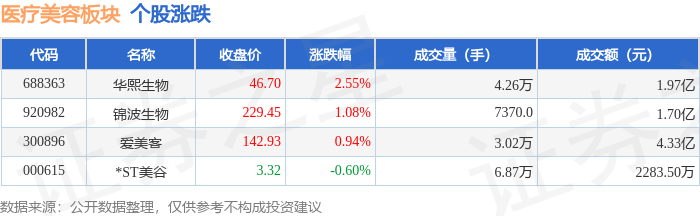
Group 1 - The medical beauty sector increased by 1.5% on January 23, with Huaxi Biological leading the gains [1] - The Shanghai Composite Index closed at 4136.16, up 0.33%, while the Shenzhen Component Index closed at 14439.66, up 0.79% [1] - The trading volume and turnover for key stocks in the medical beauty sector were as follows: Huaxi Biological at 42,600 shares and 1.971 billion yuan, Jinbo Biological at 7,370 shares and 170 million yuan, Aimeike at 30,200 shares and 433 million yuan, and *ST Meigu at 68,700 shares and 22.835 million yuan [1] Group 2 - The net capital flow in the medical beauty sector showed a net outflow of 5.8313 million yuan from main funds and 35.3444 million yuan from speculative funds, while retail investors had a net inflow of 41.1758 million yuan [1] - Specific net capital flows for key stocks included: Jinbo Biological with a net inflow of 7.7778 million yuan from main funds, Huaxi Biological with a net inflow of 4.8639 million yuan, *ST Meigu with a net outflow of 5.0191 million yuan, and Aimeike with a net outflow of 5.6761 million yuan [2]

“港股国货个护第一股”!半亩花田赴港IPO,76%高增长背后收入砸营销
Sou Hu Cai Jing· 2026-01-23 08:31
Core Viewpoint - The company, 半亩花田, is preparing for an IPO in Hong Kong, aiming to become the leading domestic personal care brand in the market, with a strong revenue growth of 76.7% in the first nine months of 2025, driven largely by high marketing expenditures [4][6][7]. Financial Performance - The company's revenue for 2023 and 2024 is projected to be 1.199 billion RMB and 1.499 billion RMB, respectively, with a growth rate of 25.05% [6][7]. - In the first nine months of 2025, revenue reached 1.895 billion RMB, marking a year-on-year increase of 76.7% [6][7]. - Adjusted net profit (non-IFRS) is expected to grow from 23.71 million RMB in 2023 to 82.83 million RMB in 2024, and further to 148 million RMB in the first nine months of 2025, reflecting a growth of 197.41% [8]. Marketing and Sales Strategy - The company allocates a significant portion of its revenue to marketing, with expenses reaching 637 million RMB in 2023, 677 million RMB in 2024, and 896 million RMB in the first nine months of 2025, accounting for 53.2%, 45.2%, and 47.3% of total revenue, respectively [10][11]. - The marketing strategy includes collaborations with KOLs and celebrities, which has proven effective in driving sales, with monthly marketing expenses nearing 1 billion RMB in 2025 [16][17]. Product and Market Position - 半亩花田 is recognized as the leading domestic brand in body care products, with a strong market presence in body lotion, body scrub, and facial cleansing mousse [7][21]. - The company’s product pricing strategy remains competitive, with average prices around 20 RMB, while maintaining a gross margin above 60% [15][21]. Challenges and Risks - The company faces challenges due to a high dependency on online sales channels, which accounted for 85.7% of total revenue in 2023, making it sensitive to changes in platform policies and rising customer acquisition costs [20][21]. - R&D investment is notably low, with expenses constituting only 2.39% to 1.49% of total revenue from 2023 to 2025, raising concerns about the company's technological competitiveness [11][22]. Future Outlook - The company plans to use the funds raised from the IPO to expand sales channels, increase R&D investment, build a global talent team, and enhance digital and intelligent upgrades [28]. - The competitive landscape in the personal care market is intensifying, with both international giants and emerging domestic brands posing significant challenges [21][22].
一把刀与一辆奔驰:百年老号的“冰火两重天”
投中网· 2026-01-23 07:26
Core Viewpoint - The article discusses the crisis faced by the century-old brand "Zhang Xiaoqin," highlighting the stark contrast between the brand's operational success and the financial troubles of its parent company, Fuchun Holdings, which is burdened with over 5 billion yuan in debt [4][6]. Group 1: Brand Crisis and Debt Issues - The auction of a ten-year-old Mercedes-Benz belonging to Zhang Xiaoqin Group reflects the brand's current struggles, as the vehicle's price dropped from 600,000 yuan to 384,000 yuan without attracting buyers [4]. - Zhang Xiaoqin Co., as a listed entity, reported revenue and profit growth for the first three quarters of 2025, indicating that the core business is not failing; rather, the issues stem from the parent company's debt crisis [6][9]. - Fuchun Holdings' aggressive expansion into high-leverage sectors like real estate and finance has led to a complex web of cross-shareholding and guarantees, dragging Zhang Xiaoqin Group into a debt quagmire [8][9]. Group 2: Impact of Diversification - The brand's core foundation is being eroded due to resource misallocation, as the parent company's focus has shifted away from the traditional knife and scissors business to real estate and capital operations [9][10]. - Negative publicity surrounding the parent company's debt issues has tarnished the brand's reputation, leading to consumer doubts about product quality and stability [10]. - The judicial freezing and pledging of 28.23% of the listed company's shares owned by Zhang Xiaoqin Group highlight the financial strain and the potential loss of control over the brand [10]. Group 3: Lessons from Other Brands - The article draws parallels with other brands that have faced similar crises due to blind diversification, such as Renhe Pharmaceutical and Two-Sided Needle, which diluted their core business and brand value [12][13]. - Successful recovery strategies often involve a painful return to core competencies, as demonstrated by Bosideng's focus on down jackets after diversifying unsuccessfully [15][20]. - The case of GAP in China illustrates the effectiveness of deep localization and strategic restructuring in revitalizing a struggling brand [18]. Group 4: Strategic Insights - Brands must respect their core business and focus on deepening their unique value proposition rather than pursuing broad diversification [20][21]. - Successful diversification should stem from natural extensions of core capabilities rather than arbitrary cross-industry ventures [21]. - The article emphasizes the importance of maintaining brand independence and security in capital partnerships to avoid becoming collateral damage in financial games [21].

申万宏源研究晨会报告-20260123
Shenwan Hongyuan Securities· 2026-01-23 01:10
Group 1: Gold Market Analysis - The bull market for gold is not over, with macro factors remaining optimistic and short-term fluctuations driven by geopolitical events [3][11][13] - Key macro pricing factors for gold have not changed, indicating a sustained upward potential in the medium to long term [3][13] - Micro indicators show that while gold price deviations are high, the RSI is healthy, and ETF inflows continue to rise, suggesting no clear direction for gold prices [3][13] Group 2: Semiconductor Industry Insights - TSMC's revenue for December 2025 is projected to grow by 20.4% year-on-year, driven by high-margin advanced processes and strong demand from AI/HPC sectors [4][12] - The advanced process capacity is fully loaded, with HPC accounting for 55% of revenue and 3nm technology representing 28% of wafer revenue [4][12] - TSMC's guidance for Q1 2026 indicates revenue between $34.6 billion and $35.8 billion, with a gross margin of 63%-65%, reflecting strong demand visibility in AI [4][14] Group 3: Beauty Industry Trends - The South Korean beauty market has undergone several growth and decline phases, with the current phase focusing on global market expansion and reducing reliance on China [18][20] - New brands like APR and Silicon2 are outperforming traditional giants, indicating a shift in market dynamics and consumer preferences [20] - The report highlights the importance of innovation in product formulation and packaging, with South Korean brands leading in areas like cushion packaging and functional skincare products [20]
从韩国美妆发展看如何重建新增长动能:品牌格局重塑,全球战略扩张
Shenwan Hongyuan Securities· 2026-01-22 11:06
业 研 究 / 行 业 点 相关研究 行 业 及 产 业 美容护理 2026 年 01 月 22 日 证 券 研 究 报 告 证券分析师 王立平 A0230511040052 wanglp@swsresearch.com 聂霜 A0230524120002 nieshuang@swsresearch.com 联系人 聂霜 A0230524120002 nieshuang@swsresearch.com 品牌格局重塑,全球战略扩张 看好 ——从韩国美妆发展看如何重建新增长动能 本期投资提示: 请务必仔细阅读正文之后的各项信息披露与声明 本研究报告仅通过邮件提供给 中庚基金 使用。1 ⚫ 韩国美妆市场相对成熟,进行国际化探索早,并随着自身国家综合实力、本土需求与国 际市场需求的变化,发展经历数次沉浮,其展现的发展路径值得国货公司参考借鉴。我 们通过对韩国美妆市场的研究,探索韩国美妆在不同的发展阶段,崛起的美妆集团组织 架构的特点,如何在需求端快速变化的产品领域加速推新,在新成分、新剂型等领域如 何走在全球市场前端,以及拥抱全球市场背后所需要的能力。 ⚫ 韩国美妆四大成长与衰退阶段,把握低谷紧抓转型,再临高峰。韩国 ...
医疗美容板块1月22日跌1.35%,锦波生物领跌,主力资金净流出6630.89万元
Zheng Xing Xing Ye Ri Bao· 2026-01-22 09:01
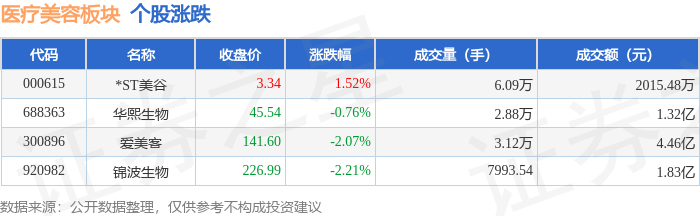
Core Viewpoint - The medical beauty sector experienced a decline of 1.35% on January 22, with Jinbo Biological leading the drop, while the overall market indices showed slight increases [1]. Group 1: Market Performance - The Shanghai Composite Index closed at 4122.58, up 0.14% - The Shenzhen Component Index closed at 14327.05, up 0.5% [1]. Group 2: Individual Stock Performance - ST Meigu closed at 3.34, with an increase of 1.52% and a trading volume of 60,900 shares, totaling a transaction value of 20.15 million yuan - Huaxi Biological closed at 45.54, down 0.76% with a trading volume of 28,800 shares, totaling a transaction value of 13.2 million yuan - Aimeike closed at 141.60, down 2.07% with a trading volume of 31,200 shares, totaling a transaction value of 44.6 million yuan - Jinbo Biological closed at 226.99, down 2.21% with a trading volume of 7,993.54 shares, totaling a transaction value of 183 million yuan [1]. Group 3: Capital Flow Analysis - The medical beauty sector saw a net outflow of 66.31 million yuan from main funds, while retail investors contributed a net inflow of 45.07 million yuan - The detailed capital flow for individual stocks shows: - ST Meigu: Main funds net inflow of 1.81 million yuan, retail net outflow of 759,000 yuan - Huaxi Biological: Main funds net outflow of 24.14 million yuan, retail net inflow of 8.44 million yuan - Jinbo Biological: Main funds net outflow of 35.10 million yuan, retail net inflow of 313,600 yuan - Aimeike: Main funds net outflow of 43.98 million yuan, retail net inflow of 37.39 million yuan [2].
减持潮下的“瘦身”自救 华熙生物何时能重拾荣光?
Xin Lang Cai Jing· 2026-01-22 08:34
Group 1 - The core issue facing Huaxi Biological is a dual challenge of capital and performance, with frequent shareholder sell-offs, declining performance, and significant market value reduction [1][6] - The second-largest shareholder, Guoshou Chengda, has reduced its stake from 7.15% to 4.01% since October 2024, cashing out approximately 769 million yuan through two large-scale sell-offs, signaling a strong capital exit and reflecting cautious sentiment from institutional investors [2][7][8] - The company's market value has shrunk to about 22.2 billion yuan, far from its peak of over 100 billion yuan, indicating a loss of market confidence [8] Group 2 - Huaxi Biological's revenue and net profit have entered a downward trend, with a reported revenue decline of 11.61% and a net profit drop of 70.59% in 2024, followed by an 18.36% revenue decline and a 30.29% net profit decrease in the first three quarters of 2025 [3][9] - The company has initiated a series of business contraction actions, including the closure of several sub-brands and focusing resources on core brands like "Runbaiyan" and "Kuaidi," which highlights the challenges faced in previous diversification efforts [3][9] - Despite some recovery in net profit in the second and third quarters of 2025 due to cost-cutting measures, the overall revenue scale continues to shrink, indicating ongoing struggles [3][9] Group 3 - The return of founder Zhao Yan has led to initial success in cost control, achieving a temporary halt in losses, but the company has yet to demonstrate sustainable revenue generation capabilities [4][10] - Huaxi Biological is advancing research projects in synthetic biology, including injectable recombinant collagen and VAHA, which are in trial production stages, potentially opening a new growth avenue if these products can achieve market competitiveness [4][10] - The transition from research and development to market success involves overcoming multiple technical, market, and cost barriers, which remains a significant challenge for the company [4][10] Conclusion - The difficulties faced by Huaxi Biological reflect typical challenges for high-growth companies entering an adjustment phase, including a retreat of capital enthusiasm, a shift in growth models, and a gap between old and new business lines [5][11] - While the company has taken critical steps towards focusing its operations, moving from cost-cutting to revenue generation and achieving breakthroughs in core brand competitiveness and commercialization of R&D results remains essential for future recovery [5][11]
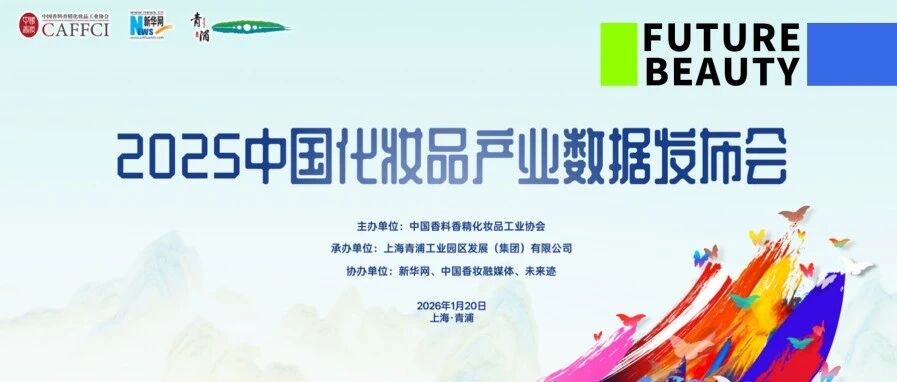
化妆品交易额破1.1万亿元,线上销量占比接近2/3
Sou Hu Cai Jing· 2026-01-21 19:18
Core Insights - The Chinese cosmetics industry is projected to reach a total transaction value of 1.104245 trillion yuan by 2025, marking a year-on-year growth of 2.83%, and maintaining its position as the world's largest cosmetics consumer market [1][6]. Market Overview - The market is undergoing a significant transformation, with resources concentrating on leading brands and technology-driven companies, while weaker brands are being eliminated [3][9]. - The market share of domestic brands has increased for four consecutive years, reaching 57.37% by 2025, indicating a shift towards a "domestic brand-led" market [3][6]. Brand Dynamics - The number of brands with sales exceeding 100 million yuan is expected to rise from 746 in 2023 to 839 in 2025, reflecting an improvement in brand quality [6]. - The top 1000 online brands are increasingly dominated by domestic brands, which are now competing effectively against traditional powerhouses from France, the USA, Japan, and South Korea [3][6]. Market Structure Changes - The industry is experiencing a significant shakeout, with an estimated 27,000 brands expected to be eliminated by 2025, and only about 26% of lower-tier brands projected to achieve growth [9][12]. - The market is shifting from quantity-based competition to quality-based competition, focusing on brand value, technological innovation, and user experience [9][12]. Consumer Behavior - Consumer preferences are evolving towards high-cost performance products priced below 300 yuan and high-end products above 1000 yuan, while the mid-range market is being squeezed [13]. - The new consumer consensus emphasizes rational and refined purchasing decisions, focusing on ingredients, efficacy, cultural identity, and emotional value [13]. Regulatory Environment - New regulations are being introduced to create a fair competitive environment for both online and offline channels, with offline spaces being redefined as comprehensive areas for brand experience and social interaction [14]. - The regulatory framework is shifting from strict control to promoting development, with a focus on innovation incentives and reducing entry barriers for new products [14]. Technological Innovation - The integration of artificial intelligence is expected to reshape the industry significantly between 2026 and 2030, enhancing research and development, personalized content production, and supply chain efficiency [17]. - Companies are increasingly investing in R&D, with the average R&D expense ratio rising from 2.36% to 3.24% over five years, highlighting a trend towards innovation-driven growth [14][17]. Future Outlook - The industry aims to transition from being a "cosmetics manufacturing power" to a "cosmetics strong power," focusing on intelligent, green, and integrated development [16][18]. - The market is expected to expand towards the "silver economy" and international markets, with domestic brands enhancing their global presence [16][15].
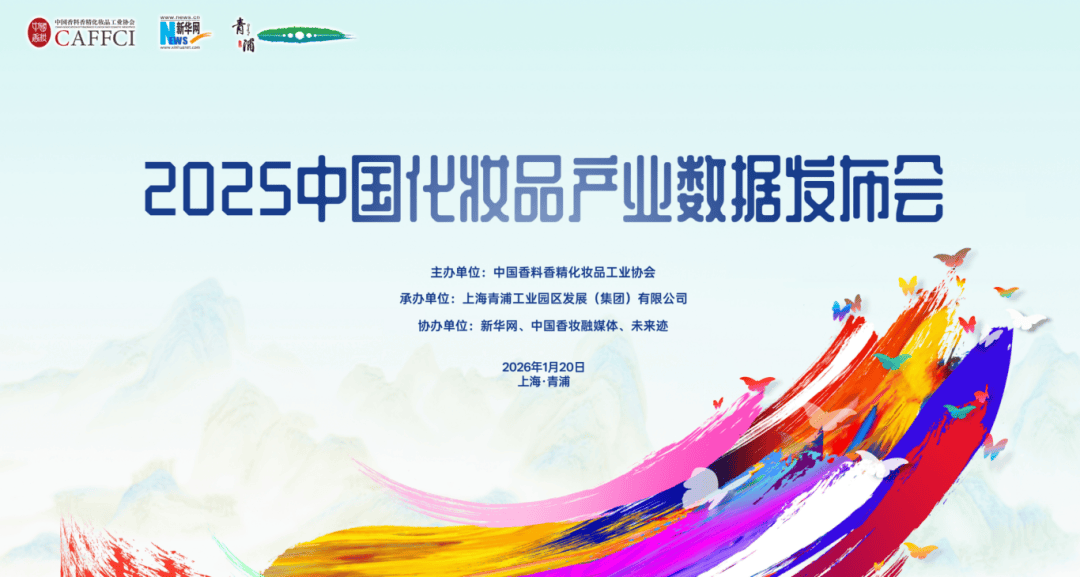
1.1万亿之上的竞逐:从“水涨船高”到“结构分化”
FBeauty未来迹· 2026-01-21 14:25
Core Insights - The Chinese cosmetics market has surpassed 1.1 trillion yuan, maintaining its position as the largest cosmetics consumer market globally [2][3] - The market share of domestic cosmetics has increased to 57.37%, solidifying its leading position [3][25] - Approximately 27,000 brands were eliminated in the past year, while over 60% of the top 500 brands achieved positive growth, indicating a shift from a broad growth phase to a deep transformation focused on structural optimization [3][19] Market Size and Growth - In 2025, the total transaction value of the Chinese cosmetics market is projected to be 1,104.25 billion yuan, with a year-on-year growth of 2.83%, indicating a stable development phase [8] - The growth rates for the years 2023, 2024, and 2025 are 3.61%, 2.80%, and 2.83% respectively, reflecting a new normal of single-digit growth [8] - The retail sales of cosmetics in 2025 are expected to reach 465.3 billion yuan, with a growth rate of 5.1%, outpacing the overall retail sales growth [11] Market Dynamics - The data from the China Cosmetics Association and the National Bureau of Statistics complement each other, presenting a comprehensive view of the market landscape [14] - The divergence in data is attributed to different statistical scopes, with the National Bureau focusing on larger enterprises while the Association includes a broader range of market players [14] - The market is experiencing a significant internal structural change, with resources concentrating on larger, compliant, and research-capable enterprises, while smaller firms face increasing survival pressures [15] Brand Performance - Over 60% of the top 500 brands achieved positive growth, while the number of brands with over 100 million yuan in sales increased from 746 in 2023 to 839 in 2025 [16] - The elimination of approximately 27,000 brands in 2025 signifies the end of competition based on traffic and homogenized products, marking an acceleration of the survival of the fittest [19] Channel Competition - Online channel transaction value grew by 4.45% in 2025, while offline channels remained stable, indicating the end of reliance on a single growth channel [22] - The shift towards comprehensive channel operations is becoming the new foundation for brand development [22] Rise of Domestic Brands - Domestic brands' market share has risen to 57.37%, marking a fundamental shift in market dynamics [25] - Successful domestic brands focus on niche markets, technological barriers, and unique brand cultures rather than just price competitiveness [28] - The victory of domestic brands reflects a new development model that emphasizes long-term value and systemic capabilities [31] Regulatory and Competitive Landscape - The modernization of the regulatory system during the 14th Five-Year Plan has clarified the direction for high-quality development [34] - The shift from marketing wars to technology and brand wars is reshaping competitive dynamics within the industry [35] - Continuous investment in R&D is evident, with the average R&D expense ratio for Chinese cosmetics companies increasing from 2.36% in 2020 to 3.24% in 2025 [35] Consumer Behavior and Market Trends - The market is witnessing a dual pursuit among consumers for both high-value basic products under 300 yuan and luxury products over 1,000 yuan, while mid-range products are declining [38] - Brands must clearly position their value propositions to succeed in this evolving market landscape [38] Global Market Expansion - Expanding into global markets is becoming essential for leading brands, with some achieving significant breakthroughs in mature markets [39] - The dual drivers of strong policy and active market dynamics are propelling the Chinese cosmetics industry towards a new era of high-quality development [40]