
新安股份

Search documents
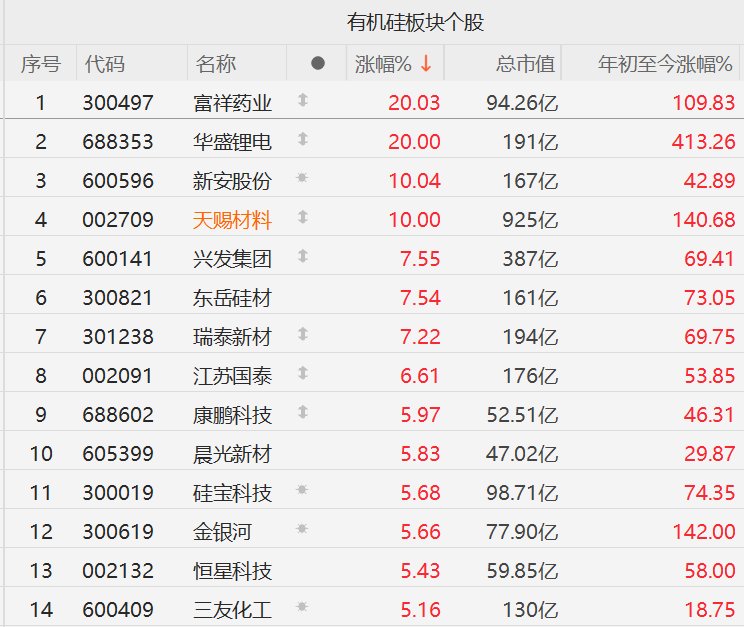
A股有机硅概念股集体走强,新安股份、天赐材料等涨停
Ge Long Hui A P P· 2025-11-13 02:21
Core Viewpoint - The A-share market has seen a significant rally in the silicon-based materials sector, with multiple stocks reaching their daily price limits, indicating strong investor interest and potential growth in this industry [1]. Group 1: Stock Performance - Fujian Pharmaceutical (富祥药业) and Huasheng Lithium Battery (华盛锂电) both hit the 20% daily limit up, showcasing exceptional performance [1]. - New安股份 (New安股份) and Tianqi Materials (天赐材料) achieved a 10% increase, reflecting robust market sentiment [1]. - Other notable performers include Xingfa Group (兴发集团) and Dongyue Silicon Materials (东岳硅材), both rising over 7%, while Jiangsu Guotai (江苏国泰) increased by over 6% [1]. Group 2: Market Capitalization and Year-to-Date Performance - Fujian Pharmaceutical has a market capitalization of 9.426 billion, with a year-to-date increase of 109.83% [2]. - Huasheng Lithium Battery has a market cap of 19.1 billion and a remarkable year-to-date increase of 413.26% [2]. - New安股份 has a market cap of 16.7 billion and a year-to-date increase of 42.89% [2]. - Tianqi Materials boasts a market cap of 92.5 billion with a year-to-date increase of 140.68% [2]. - Xingfa Group has a market cap of 38.7 billion and a year-to-date increase of 69.41% [2]. - Dongyue Silicon Materials has a market cap of 16.1 billion and a year-to-date increase of 73.05% [2]. - Jiangsu Guotai has a market cap of 17.6 billion and a year-to-date increase of 53.85% [2].





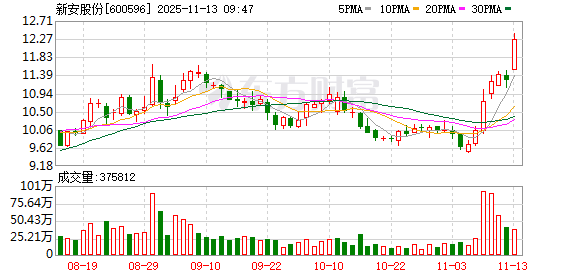
新安股份盘中涨停
Mei Ri Jing Ji Xin Wen· 2025-11-13 01:46
(文章来源:每日经济新闻) 每经AI快讯,新安股份盘中涨停,涨幅10.04%,成交额超1亿元。 ...
有机硅概念走强,富祥药业涨停
Mei Ri Jing Ji Xin Wen· 2025-11-13 01:37
Group 1 - The organic silicon concept has strengthened, with Fu Xiang Pharmaceutical reaching the daily limit increase [1] - Companies such as Huasheng Lithium Battery, Ruitai New Materials, Dongyue Silicon Materials, and Xin'an Shares have also seen significant gains [1]
对话有机硅,反内卷与新需求如何共振?
2025-11-12 02:18
Summary of Silicon Industry Conference Call Industry Overview - The silicon industry is experiencing a significant increase in production capacity, with mono-silicon capacity expected to reach 6.8 million tons by early 2025, a nearly 25% increase from 5.4 million tons at the beginning of 2024 [1][2] - Domestic demand has not kept pace with this increase in capacity, leading to an imbalance in supply and demand, resulting in continuous price declines below the full cost line for companies [1][2] Key Points and Arguments - **Price and Production Management**: - DMC prices are currently around 11,000-11,500 RMB/ton, with expectations to rise above 12,000 RMB/ton following upcoming meetings [5] - Companies are considering rotational production cuts to maintain operational rates between 60%-70% to meet domestic and export demand [5][6] - **Anti-Dumping Measures**: - Short-term anti-dumping measures are primarily driven by voluntary actions from companies, with potential for future guidance from associations or national bodies, similar to the multi-crystalline silicon industry [6] - The industry is facing significant price pressure, with profits currently at 100-200 RMB/ton, necessitating close monitoring of policy changes and market dynamics [6][12] - **Market Sentiment**: - Recent stock performance of companies like Hesheng, Dongyue, and Xin'an has shown an upward trend, reflecting market optimism regarding anti-dumping measures and potential improvements in supply-demand dynamics [7] Emerging Applications - **New Energy Vehicles (NEVs) and Robotics**: - NEVs and robotics are identified as key growth areas for silicon applications, with demand growth rates projected at 5%-6% annually [8] - In NEVs, silicon is used in battery encapsulation adhesives and other components, with demand per vehicle increasing significantly [17] - **Real Estate Market Impact**: - The real estate sector, despite recent contractions, still accounts for 40%-50% of silicon demand, with expectations of gradual recovery and annual growth of 4%-5% in the coming years [9] - **Electronics and Electrical Sector**: - The electronics sector is expected to see a slight increase in silicon consumption, currently accounting for 23%-24% of total demand, driven by government subsidies [10] - **Photovoltaic Industry**: - Although domestic photovoltaic demand has decreased, global demand is rising, particularly in overseas markets, which is expected to offset domestic declines [11] Supply Chain Challenges - The industry faces challenges with excess supply due to new capacity not matching consumption, leading to inventory build-up [12][15] - Without anti-dumping or production limitation measures, the risk of price competition remains high, potentially lasting until 2026 [12] Future Capacity and Market Dynamics - Planned new capacity additions of 400,000 tons in 2025, with further expansions anticipated in subsequent years, could impact market dynamics if new entrants disrupt current agreements [14] - The exit of overseas chemical plants presents opportunities for Chinese companies, but quality improvements are necessary for full market replacement [18] Global Trade and Demand Trends - Global trade flows are expected to balance over time, with Chinese companies gradually closing quality gaps through technological advancements [19] - The overall outlook for the silicon industry remains cautiously optimistic, with potential for growth driven by both domestic recovery and international demand [15][16]
磷化工供需情况及化工核心涨价品种弹性测算
2025-11-11 01:01
Summary of Conference Call Records Industry Overview - The chemical sector is experiencing increased investment attractiveness due to expectations of PPI turning positive, improvements in macro indicators, and appealing valuations. The current PB index is approximately 2.2 times, which is at the 47th percentile over the past decade, indicating investment value [1][2][6]. Key Points on Phosphate and Lithium Iron Phosphate - Significant growth in demand for phosphate rock and lithium iron phosphate is noted, with lithium iron phosphate prices rising, which in turn boosts upstream phosphate demand. It is expected that in 2026, lithium iron phosphate will account for about 10% of total phosphate demand, supporting supply-demand balance [1][3][10]. - The overall phosphate demand is projected to be around 130 million tons in 2026, with lithium iron phosphate contributing approximately 14 million tons [3][7]. - The phosphate market is driven by the demand from both traditional fertilizers and the new energy sector, with the latter's share increasing. By 2026 and 2027, new demand is expected to add over 3 million tons of phosphate rock annually [1][10]. Performance of Specific Companies - Companies like Yuntianhua are highlighted as high-dividend assets benefiting from the rising prices of lithium iron phosphate. Other companies such as Chuanfa and Annada also possess significant production capacities, providing them with elasticity in the market [1][4][8]. - Companies like Luxi and Hualu Hengsheng are noted for their strong market positions, with Luxi showing significant performance due to its diverse product range and elasticity during price increases [8]. Market Dynamics in Other Chemical Segments - The caprolactam sector has shown good performance, with a recent agreement to reduce production by 20% and increase prices by 100 yuan per ton, benefiting companies like Luxi [5]. - Other segments such as PTA bottles, polyester filament, DMT, and sucralose are also worth monitoring due to their potential for price increases amid a deepening anti-involution trend [5]. Supply and Demand Forecasts - The supply-demand balance for phosphate rock is expected to remain tight due to limited new production capacity and increasing demand from the new energy sector. The average market price is currently stable at around 1,000 yuan per ton, with expectations for prices to remain high in the coming years [10][12]. - The lithium iron phosphate market is projected to maintain a compound annual growth rate of around 30% from 2025 to 2027, driven by the rapid growth in demand for electric vehicle and energy storage batteries [11]. Organic Silicon Market Outlook - The organic silicon market is anticipated to see changes in demand structure, with a shift towards photovoltaic and new energy vehicle applications. However, growth rates may slow due to high penetration rates in the new energy vehicle sector [18]. - The current capacity utilization rate in the organic silicon industry is below 70%, indicating potential for adjustment. The industry is planning to implement production cuts to control supply, which may support price increases [19][21]. Conclusion - The chemical sector, particularly in phosphate and lithium iron phosphate, presents significant investment opportunities due to strong demand growth and favorable market conditions. Companies with robust production capacities and strategic positioning are likely to benefit from these trends. The organic silicon market also shows potential for recovery, contingent on effective supply management and cost stabilization.
有机硅板块走强 东岳硅材涨超10%
Shang Hai Zheng Quan Bao· 2025-11-10 10:48
Group 1 - The organic silicon sector showed strong performance on November 10, with notable increases in stock prices [1] - Dongyue Silicon Materials rose over 10%, while Hoshine Silicon Industry increased by more than 8% [1] - Other companies such as Silbond Technology, Runhe Materials, and Xin'an Chemical also experienced gains [1]


农化制品板块11月10日涨1.71%,澄星股份领涨,主力资金净流出11.92亿元
Zheng Xing Xing Ye Ri Bao· 2025-11-10 08:42
Group 1 - The agricultural chemical sector increased by 1.71% on November 10, with Chengxing Co., Ltd. leading the gains [1] - The Shanghai Composite Index closed at 4018.6, up 0.53%, while the Shenzhen Component Index closed at 13427.61, up 0.18% [1] - Chengxing Co., Ltd. saw a closing price of 13.13, with a rise of 9.97% and a trading volume of 962,900 shares, amounting to a transaction value of 1.257 billion yuan [1] Group 2 - The agricultural chemical sector experienced a net outflow of 1.192 billion yuan from major funds, while retail investors saw a net inflow of 1.64 billion yuan [2] - The top gainers in the agricultural chemical sector included Hualu Hengsheng, with a closing price of 28.61 and a rise of 7.68%, and Lu Hua Technology, with a closing price of 3.54 and a rise of 7.27% [1] - The sector's overall trading activity reflected significant participation from retail investors, contrasting with the outflow from institutional and speculative funds [2]


新安股份(600596):草甘膦略有回暖,静待景气延续修复
Changjiang Securities· 2025-11-09 23:30
Investment Rating - The investment rating for the company is "Buy" and is maintained [8]. Core Views - The company reported a slight recovery in glyphosate prices, with expectations for continued improvement in the industry [10]. - For the first three quarters of 2025, the company achieved a revenue of 11.7 billion yuan, a year-on-year decrease of 1.1%, and a net profit attributable to shareholders of 70 million yuan, down 46.2% year-on-year [5][10]. - The third quarter alone saw a revenue of 3.64 billion yuan, representing a year-on-year increase of 9.0% but a quarter-on-quarter decrease of 17.9% [5][10]. Summary by Sections Financial Performance - The company’s Q1-Q3 2025 revenue was 11.7 billion yuan, with a net profit of 70 million yuan and a non-recurring net profit of -40 million yuan [5][10]. - In Q3 2025, the revenue was 3.64 billion yuan, with a net profit of 2 million yuan, reflecting a year-on-year decline of 60.3% and a quarter-on-quarter decline of 93.6% [5][10]. Product Performance - The main products, including glyphosate, organic silicon, and industrial silicon, are still experiencing low demand, with prices having significantly dropped since the high cycle in 2021-2022 [10]. - The average sales prices for key products in Q3 2025 were as follows: glyphosate at 31,272 yuan/ton (+16.2% QoQ, -34.9% YoY), organic silicon at 11,061 yuan/ton (-2.0% QoQ, -14.1% YoY), and industrial silicon at 8,649 yuan/ton (-10.0% QoQ, -12.8% YoY) [10]. Market Outlook - Glyphosate prices have shown signs of recovery due to overseas demand and domestic supply disruptions, with prices rising from 23,498 yuan/ton in early June to a peak of 27,504 yuan/ton by September 19, marking a 17.0% increase [10]. - The company is well-positioned in the organic silicon market, with a total production capacity exceeding 200,000 tons/year and a focus on high-margin products [10]. - The outlook for glyphosate and organic silicon is optimistic, with expectations for continued price recovery and limited new production capacity in the domestic market [10]. Profit Forecast - The projected net profits for the company from 2025 to 2027 are 160 million yuan, 630 million yuan, and 970 million yuan, respectively, indicating significant growth potential [10].
工业硅-多晶硅周报:工业硅:西南逐步减产,但上行驱动仍不足多晶硅:供需双弱,维持弱势震荡格局-20251109
Guo Lian Qi Huo· 2025-11-09 13:09
1. Report Industry Investment Rating No relevant content provided. 2. Core Views of the Report Industrial Silicon - This week, the spot price of industrial silicon remained largely stable with minor fluctuations, while the futures price oscillated downward. The downstream demand decreased slightly, and the procurement sentiment was poor. The overall supply - demand was relatively loose, but there were also some bullish factors such as cost increases and production cuts in the southwest [6]. - The recommended strategy is to maintain a short position when the price rises, with an upper pressure level of 9,500 yuan/ton [7]. Polysilicon - The spot price of polysilicon was largely stable with minor fluctuations, and the market atmosphere was sluggish. The futures price oscillated strongly due to expectations of production reduction and the establishment of a storage platform. In the short - term, the price is expected to oscillate weakly [12]. - The recommended strategy is to hold the previous short position, with an oscillation range of 48,000 - 52,000 yuan [13]. 3. Summary by Directory 3.1 Weekly Core Points and Strategies Industrial Silicon - **Market Situation**: The spot price decreased slightly, and the futures price oscillated downward. The southwest region gradually reduced production, and the downstream demand was weak [6]. - **Logic Analysis**: - **Bearish Logic**: High supply in October, high inventory, and limited demand growth in the fourth quarter [6]. - **Bullish Logic**: Cost increase, production cuts in Xinjiang and the southwest, and expectations of the dry season in the southwest [6]. - **Recommended Strategy**: Short positions can be established when the price rises, with an upper pressure level of 9,500 yuan/ton [7]. Polysilicon - **Market Situation**: The spot price was stable with minor fluctuations, and the futures price oscillated strongly. The market was in a state of "strong expectation" and "weak reality" [12]. - **Logic Analysis**: - **Bearish Logic**: High inventory, loose supply, weak downstream transactions, and poor fundamentals [12]. - **Bullish Logic**: Rising component tender prices, policy support, and industrial linkage effects [13]. - **Recommended Strategy**: Hold the previous short position, with an oscillation range of 48,000 - 52,000 yuan [13]. 3.2 Industrial Silicon Data Review Price Data - **Futures**: The closing price of the main contract Si2601 was 9,220 yuan/ton, up 1.32% from last week. The trading volume increased by 29.79%, and the open interest increased by 17.38% [27]. - **Spot**: The prices of Tongyang 5530 and Tongyang 4210 in the East China market remained unchanged from last week [27]. - **Basis and Spread**: The basis of Si2601 (East China 553) decreased by 52.17%, and the basis of Si2601 (East China 421) decreased by 25% [27]. Supply and Demand Data - **Supply**: The overall industrial silicon production decreased by 7.85% this week, and the opening rate decreased to 34.30%. The southwest region saw a significant decline in production, while the northwest region also had a slight decrease [28][58]. - **Demand**: The demand from downstream industries such as polysilicon, organic silicon, and aluminum alloy was weak. The production of polysilicon decreased by 5.05%, and the production of organic silicon increased by 5.22% [28]. - **Inventory**: The social inventory increased to 554,800 tons, up 4.8% from last week, while the futures inventory decreased by 505 tons [28][80]. Cost and Profit Data - **Cost**: The production cost increased mainly due to the rising price of petroleum coke and electricity in the southwest region [78]. - **Profit**: The profit decreased slightly this week, and it is expected to continue to decline next week [78]. 3.3 Polysilicon Data Review Price Data - **Spot**: The price of P - type polysilicon remained unchanged at 44,000 yuan/ton, and the price of N - type polysilicon decreased by 1.54% to 51,000 yuan/ton [119]. - **Futures**: The futures price oscillated strongly due to expectations of production reduction and the establishment of a storage platform [12]. Supply and Demand Data - **Supply**: In November, the polysilicon production is expected to decrease, with a north - south difference in production changes. The overall supply is still at a high level, and the inventory continued to rise [126]. - **Demand**: The downstream demand was weak. The production of silicon wafers, battery cells, and components decreased, and the procurement sentiment was poor [119][126]. Cost and Profit Data - **Cost**: The average production cost decreased to 41,553 yuan/ton, a decrease of 0.2% [132]. - **Profit**: The gross profit and gross margin increased slightly, but the overall profit level was still low [132].
枯水期减产兑现,平台公司再度不及预期
Dong Zheng Qi Huo· 2025-11-09 10:42
Report Industry Investment Rating - Industrial silicon: Volatile; Polysilicon: Volatile [1] Core Viewpoints - Industrial silicon prices may have a clearer lower limit, and it is recommended to buy on dips and take profits at high levels. Polysilicon has entered a critical point of policy - fundamental game, and it is advisable to consider short - selling on rallies [3][14][15] Summary by Directory 1. Industrial Silicon/Polysilicon Industry Chain Prices - Industrial silicon Si2601 contract rose 120 yuan/ton to 9220 yuan/ton week - on - week. SMM spot East China oxygen - blown 553 remained flat at 9450 yuan/ton, and Xinjiang 99 rose 50 yuan/ton to 8850 yuan/ton. Polysilicon PS2601 contract fell 3195 yuan/ton to 53215 yuan/ton. The average transaction price of polysilicon N - type re -投料 was flat at 53200 yuan/ton [8][9] 2. Dry Season Production Cuts Materialize, Platform Companies Fall Short of Expectations Again - **Industrial silicon**: Futures main contract fluctuated strongly. Yunnan's开工 decreased by 22 units to 21, Sichuan's by 23 units to 22, while Inner Mongolia and Ningxia each added 1 unit. Southwest furnaces may further limit production in mid - to - late November, with the start - up furnaces in Southwest expected to drop to about 20 by the end of November. Northern production is stable. SMM industrial silicon social inventory decreased by 0.6 million tons week - on - week, and sample factory inventory increased by 0.39 million tons. After updating the balance sheet, a slight inventory build - up in November and a 1 - million - ton inventory reduction in December are expected [10] - **Organic silicon**: Prices fluctuated. Jiangxi Xinghuo's 200,000 - ton plant is expected to resume production on the 31st, Tangshan Sanyou's Phase III plant shut down, Hubei Xingrui's plant is operating at 70% capacity, Xin'an Chemical's plant is under maintenance, Shandong Dongyue's Phase III plant shut down, and Yunnan Energy Investment's plant is expected to resume production on the 4th. The overall enterprise start - up rate was 72.41%, weekly output was 47,900 tons (up 5.51% week - on - week), and inventory was 43,500 tons (down 1.36% week - on - week). Prices are expected to fluctuate [10][11] - **Polysilicon**: Futures main contract dropped significantly. Spot prices are under pressure. Leading first - tier manufacturers' dense re -投料 prices are above 51 - 53 yuan/kg, second - and third - tier manufacturers' prices are 47 - 50 yuan/kg, and low - quality supplies' prices are weakening. Granular material prices are 50 - 51 yuan/kg. November's production is expected to drop to 115,000 tons. As of November 6th, factory inventory was 259,000 tons (down 0.2 million tons week - on - week). In November, it enters the critical point of policy - fundamental game, and the fundamentals are more severe than in October. If platform companies underperform again, spot prices may fall [11] - **Silicon wafers**: Prices declined. M10 wafers' mainstream price is 1.35 yuan/piece, with some dropping to 1.33 yuan/piece; G12R wafers' mainstream price is 1.35 yuan/piece, with low - price transactions at 1.30 - 1.33 yuan/piece; G12 wafers' mainstream price dropped to 1.65 - 1.68 yuan/piece. November's production is expected to be 57.66GW, a decrease of 2.99GW from October. As of November 6th, inventory was 17.52GW (down 1.41GW week - on - week). The supply - demand and inventory situation in the silicon wafer segment is controllable, but it is under pressure due to the battery segment [12] - **Battery cells**: Prices continued to fall. Indian demand shifted to Southeast Asian production bases, and M10 battery cells' mainstream price dropped to 0.305 yuan/watt. Domestic demand also declined, and G21R and G12 battery cells' mainstream prices dropped to 0.28 and 0.30 yuan/watt. As of November 3rd, export factory inventory was 3.85GW (down 2.17GW week - on - week). November's production is expected to be 57.4GW. With weakening domestic and foreign demand, prices may decline further [12] - **Components**: Prices were basically stable. Centralized components mainly executed previous orders, with mainstream delivery prices at 0.64 - 0.70 yuan/watt; distributed project large - customer delivery prices were 0.66 - 0.70 yuan/watt. Some centralized procurement projects had demand for high - power components above 700W, and leading component manufacturers raised quotes for such components by 0.04 - 0.06 yuan/watt to 0.72 - 0.75 yuan/watt. Demand declined significantly, and some enterprises reported orders falling short of expectations. November's domestic production is expected to be 44.4GW (down 1GW month - on - month). There are concerns about a significant drop in December's production. As of November 3rd, finished - product inventory was 31.2GW (down 0.6GW week - on - week). Component enterprises are responding to the guiding prices, but actual transaction prices need attention [13] 3. Investment Recommendations - **Industrial silicon**: After previous hedging, short - term price drops are unlikely to cause production cuts. Prices need to break through 10,000 yuan/ton to bring significant supply increases. It is recommended to buy on dips and take profits at high levels [14] - **Polysilicon**: It has entered the critical point of policy - fundamental game, and the fundamentals are more severe. If platform companies underperform again, spot prices may fall. It is advisable to consider short - selling on rallies [15] 4. Hot News Compilation - In September 2025, the national photovoltaic power generation utilization rate was 95%, and the January - September utilization rate was also 95% [16] - A Chinese company invested $85 million to build a factory in Angola to process quartz ore into metallic silicon, with a monthly production capacity of 1,000 tons per electric furnace. The project has provided jobs for 500 Angolan and 50 Chinese employees [16] - On November 5th, the environmental impact assessment of a 6.2GW TOPCon solar cell technical renovation project in Jiangsu was publicized, with a total investment of 22 million yuan [17] 5. Industry Chain High - Frequency Data Tracking - **Industrial silicon**: Includes data on spot prices, weekly production in different regions, social inventory, and sample factory inventory [19][22][27] - **Organic silicon**: Covers data on DMC spot prices, weekly profit, factory inventory, and weekly production [29][30] - **Polysilicon**: Involves data on spot prices, weekly gross profit, factory weekly inventory, and enterprise weekly production [33][37] - **Silicon wafers**: Contains data on spot prices, profit calculation, factory weekly inventory, and enterprise weekly production [39][43] - **Battery cells**: Has data on spot prices, profit calculation, export factory weekly inventory, and enterprise monthly production [44][50] - **Components**: Includes data on spot prices, profit calculation, finished - product inventory, and enterprise monthly production [52][57]