京东方

Search documents
一村资本于彤:这轮并购潮的八大机会
投资界· 2025-09-05 07:02
Core Viewpoint - The article discusses the current trends and opportunities in China's M&A market, emphasizing the importance of strategic acquisitions and the evolving role of private equity and venture capital in this landscape [5][10]. Group 1: M&A Market Trends - The M&A market in China is experiencing a surge in activity, driven by the need for industry consolidation and transformation amid a complex macroeconomic environment [5][9]. - The "Six Guidelines for M&A" released on September 24, 2022, aims to optimize the M&A restructuring mechanism and promote industrial upgrades [10][11]. - Technology companies are expected to become the focal point of M&A activities by 2025, marking a shift from previous trends that favored internet and consumer sectors [10][11]. Group 2: Key Strategies in M&A - The current M&A landscape is characterized by a buyer's market, where listed companies have greater bargaining power in transactions [11][12]. - Cross-border M&A is seen as a strategic opportunity, supported by legal and policy changes, as well as shifts in the global economic environment [12][14]. - Innovative payment methods for M&A transactions are emerging, such as convertible bond funds and installment payments, to alleviate financial pressures on buyers [12][14]. Group 3: Characteristics of Chinese-style M&A - Chinese-style M&A is distinct due to the significant role of listed companies in the industrial chain, which contrasts with the U.S. market where listed companies are less dominant [17][18]. - The funding attributes of M&A funds in China are heavily influenced by local government allocations, which is a unique aspect of the Chinese market [17][18]. - The integration strategies in Chinese M&A require flexibility and adaptability to the unique characteristics of each case, emphasizing the importance of cultural integration and post-investment support [18][19]. Group 4: Case Studies and Strategies - One Village Capital has established a dedicated M&A investment department, focusing on both listed and non-listed companies, and has successfully executed various acquisition strategies since 2015 [19][20]. - For listed companies, strategies include consolidating fragmented markets and becoming significant shareholders to assist in subsequent acquisitions [21][22]. - For non-listed companies, the focus is on controlling stakes and ensuring future cash flows, with successful examples including the acquisition of a major Italian oncology research firm [25][26].


涨超3.4%,消费电子ETF(561600)近1周成交额同类第1
Sou Hu Cai Jing· 2025-09-05 06:57
Group 1 - The China Securities Consumer Electronics Theme Index (931494) has seen a strong increase of 3.97% as of September 5, 2025, with notable gains in constituent stocks such as Xinwangda (300207) up 15.96%, Dongshan Precision (002384) up 10.00%, and Ansheng Technology (300073) up 9.49% [3] - The Consumer Electronics ETF (561600) rose by 3.48%, with the latest price reported at 1.1 yuan, and has accumulated a 6.63% increase over the past two weeks as of September 4, 2025 [3] - The trading volume for the Consumer Electronics ETF reached 49.42 million yuan with a turnover rate of 9.29%, and the average daily trading volume over the past week was 108 million yuan, ranking first among comparable funds [3] Group 2 - As of August 29, 2025, the top ten weighted stocks in the China Securities Consumer Electronics Theme Index accounted for 54.8% of the index, including companies like Cambricon (688256), Luxshare Precision (002475), and SMIC (688981) [4] - The top ten stocks by weight include Luxshare Precision (8.06%), BOE Technology Group (6.71%), and Cambricon (5.79%), among others, indicating a concentration of investment in these key players [6]
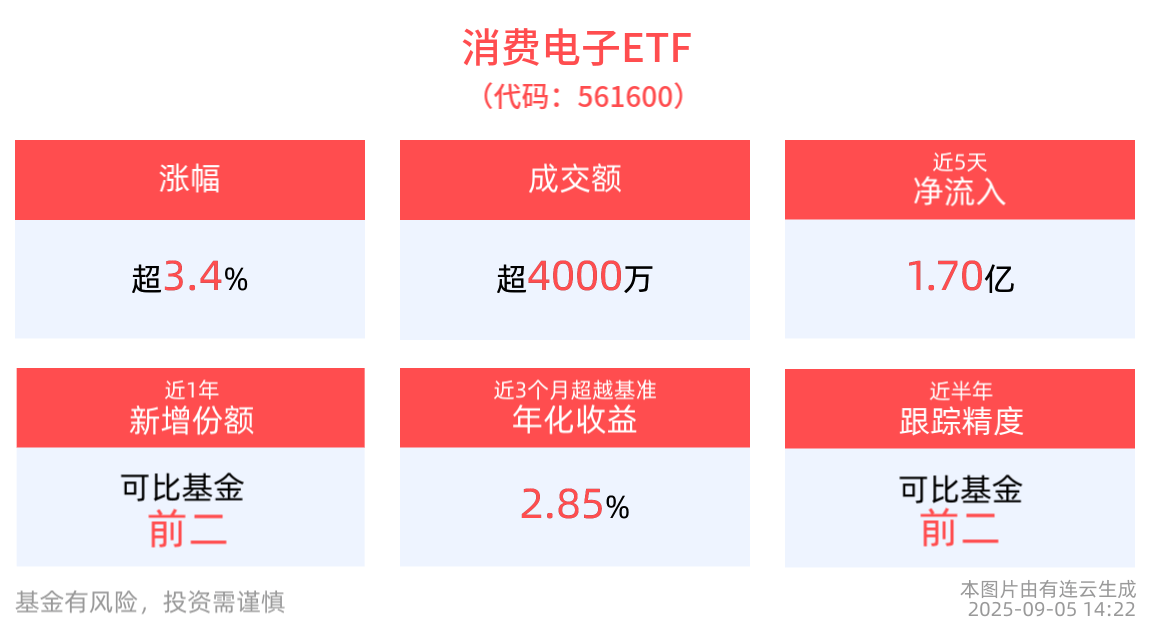
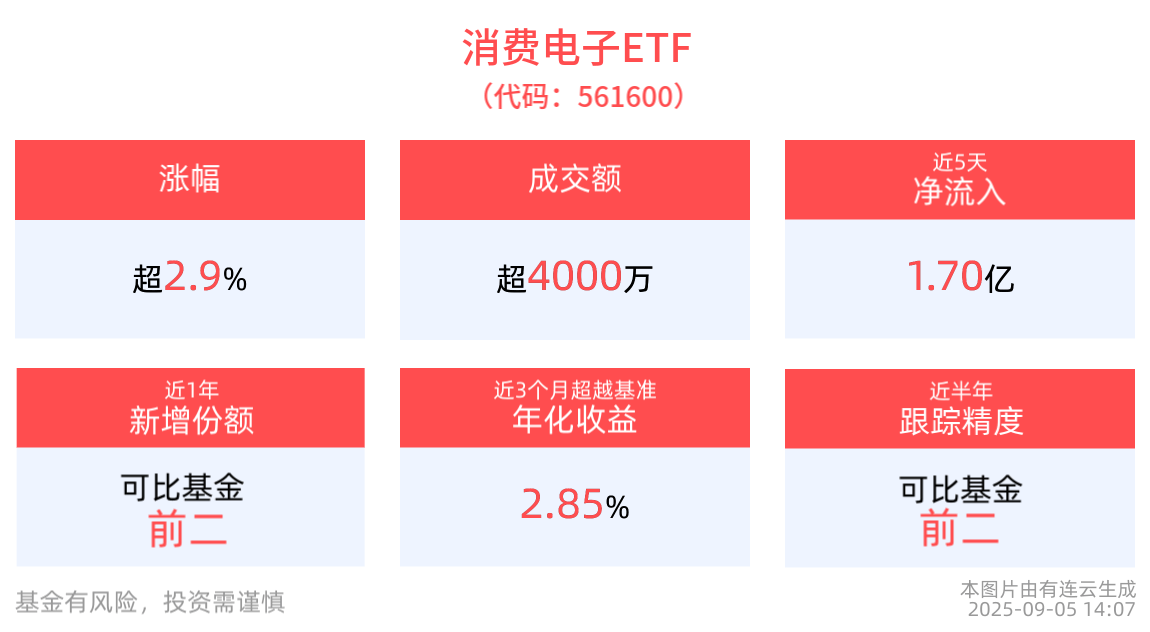
涨超2.9%,消费电子ETF(561600)近5个交易日净流入1.70亿元
Sou Hu Cai Jing· 2025-09-05 06:28
Group 1 - The China Securities Consumer Electronics Theme Index (931494) has seen a strong increase of 3.36% as of September 5, 2025, with notable gains in constituent stocks such as Xinwangda (300207) up 13.87%, Dongshan Precision (002384) up 10.00%, and Yiwei Lithium Energy (300014) up 9.64% [3] - The Consumer Electronics ETF (561600) has risen by 2.92%, with the latest price reported at 1.09 yuan, and has accumulated a 6.63% increase over the past two weeks as of September 4, 2025 [3] - The trading volume for the Consumer Electronics ETF reached 45.49 million yuan with a turnover rate of 8.57% during the session, and the average daily trading volume over the past week was 108 million yuan, ranking first among comparable funds [3] Group 2 - As of August 29, 2025, the top ten weighted stocks in the China Securities Consumer Electronics Theme Index accounted for 54.8% of the index, including companies like Cambricon (688256), Luxshare Precision (002475), and SMIC (688981) [4] - The top ten stocks by weight include Luxshare Precision (8.06%), BOE Technology Group (6.71%), and Cambricon (5.79%), among others, indicating a concentration of investment in these key players [6]




活力中国调研行 | 低碳赋能 造就新韵重庆新动能
Zhong Guo Qing Nian Bao· 2025-09-05 05:13
Core Viewpoint - Chongqing's low-carbon development is seen as a new engine for high-quality economic growth, with significant achievements in energy consumption reduction and economic growth rates [1][4]. Group 1: Low-Carbon Initiatives - Chongqing's energy consumption growth rate is 2.4% annually, supporting an economic growth rate of 5.6%, with GDP energy consumption dropping to 0.310 tons of standard coal per ten thousand yuan, outperforming the national average by approximately 30% [1]. - The Chongqing Conch Cement plant utilizes urban waste for energy generation, achieving a zero-emission goal through resource recovery and full utilization of residual ash as cement raw material [1][4]. - The waste incineration project at Chongqing Conch Cement has processed over 570,000 tons of municipal waste since its operation, significantly reducing landfill usage and environmental risks [5][6]. Group 2: Environmental Impact and Achievements - The Chongqing Conch Cement plant has achieved a reduction of 11,500 tons of CO2 emissions annually and over 90% reduction in methane emissions, with dioxin concentrations far below national standards [6]. - The plant has been recognized as a national-level green factory and a model for ecological protection along the Yangtze River Economic Belt [6]. - The waste management system in Chongqing has reached a 100% harmless treatment rate, with a goal of zero landfill by 2025 [4][5]. Group 3: Industry Cluster and Technological Innovation - The Dadu River area hosts several national-level green factories, including Chongqing International Composite Materials Co., which has achieved top-tier emissions standards in its glass fiber production [7][8]. - The Chongqing Smart Industry Park has transformed into a near-zero carbon park, focusing on smart economy and green manufacturing, with significant reductions in carbon emissions and waste [11][12]. - The introduction of low-carbon technologies in various sectors, such as the production of microbial protein and hydrogen fuel cells, showcases the region's commitment to sustainable development [12][13][14].

拆解华为新三折叠机核心供应商,前期备货量40-60万台
Ge Long Hui· 2025-09-05 03:36
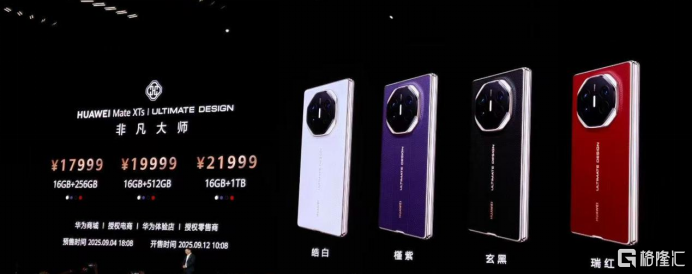
Group 1 - Huawei officially launched the new Mate XTs foldable phone on September 4, with a starting price of 17,999 yuan, which is a reduction of 2,000 yuan compared to the previous generation, indicating a shift from "high-end trial" to "mainstream" foldable devices [1][3] - Huawei remains the only brand in the industry to achieve mass production and iteration of the tri-folding phone since the release of the world's first commercial tri-folding phone last year, with key technologies in hinge systems, screens, and structural components [3][8] - The new Mate XTs features a new Tian Gong hinge system that reduces the thickness of the outer folding axis by 23% and the inner folding axis by 16%, with the hinge value remaining around 1,000 yuan [8][9] Group 2 - The phone's structural components include a lightweight metal frame design and the introduction of eSIM functionality, eliminating the need for a physical SIM card slot, with a thickness of only 3.6mm when unfolded, making it thinner than Samsung's Galaxy Z Fold 7 by 15% [8][9] - The display of the Mate XTs is the largest foldable screen in the industry, utilizing 30μm ultra-thin UTG glass, which enhances impact resistance by 30% through a non-Newtonian fluid material that hardens upon impact [8][9] - Following the pre-sale launch, the Mate XTs sold out in less than half an hour, indicating strong market demand, with initial stock estimates ranging from 400,000 to 600,000 units [9][11] Group 3 - According to IDC data, the foldable phone market in China is expected to reach 4.98 million units in the first half of 2025, with a year-on-year growth of 12.6%, and Huawei's shipment volume reached 3.74 million units, capturing 75% of the market share [11]
再过几年,日本人或许只能购买中国电视机了
创业邦· 2025-09-05 03:18
Core Viewpoint - The article discusses the decline of Japanese television manufacturing and the rise of Chinese brands, highlighting the shift in global manufacturing dynamics and the competitive advantages of Chinese companies over their Japanese counterparts [5][8]. Group 1: Historical Context of Japanese Television Industry - The Japanese television industry experienced a golden era, dominating the global market with brands like Sony and Panasonic, which accounted for over 40% of global TV shipments in 1990 [10][12]. - Japan's manufacturing prowess was built on technological advancements and brand reputation, with significant market shares in the high-end segment during the 1980s and 1990s [14][15]. - The shift towards liquid crystal technology in the early 2000s marked a turning point, as Japanese companies failed to adapt, leading to significant losses and market share decline [16][17]. Group 2: Decline of Japanese Brands - By 2024, Japanese brands' global TV shipment share is projected to drop to 9%, down from 28% in 2010, with Panasonic's domestic market share falling from 16.8% in 2018 to 8.8% in 2024 [21][23]. - The inability to pivot from traditional technologies and the slow decision-making processes contributed to the decline of Japanese manufacturers [18][30]. - Japanese companies are now struggling to compete in high-end markets, with many having exited the consumer TV market altogether [17][34]. Group 3: Rise of Chinese Television Brands - Chinese brands have captured nearly 50% of the Japanese TV market by 2024, with Hisense leading at 25.4% market share, marking a significant shift in consumer preferences [23][25]. - Chinese companies like TCL and Xiaomi have also gained substantial market shares, leveraging technology and localization strategies to appeal to Japanese consumers [20][26]. - The global shipment share of Chinese TV brands reached 30.2% in 2024, surpassing that of South Korean competitors for the first time [21][22]. Group 4: Competitive Advantages of Chinese Brands - Chinese manufacturers have developed a complete television industry chain, enabling rapid response to market changes and cost reductions [28][30]. - Innovations such as Hisense's self-developed chips and TCL's advanced display technologies have allowed Chinese brands to outperform traditional Japanese offerings in quality [25][37]. - The ability to quickly adapt to consumer demands, such as energy efficiency standards, has given Chinese brands a competitive edge over their Japanese counterparts [30][38]. Group 5: Broader Implications for Manufacturing - The decline of Japanese manufacturing is indicative of broader trends, where efficiency, innovation speed, and market responsiveness are critical for success in global competition [38]. - The article suggests that without breaking free from path dependency and improving decision-making speed, Japanese companies may continue to lose competitiveness across various industries [39].



涨超1.6%,消费电子ETF(561600)近5个交易日净流入1.70亿元
Xin Lang Cai Jing· 2025-09-05 03:17
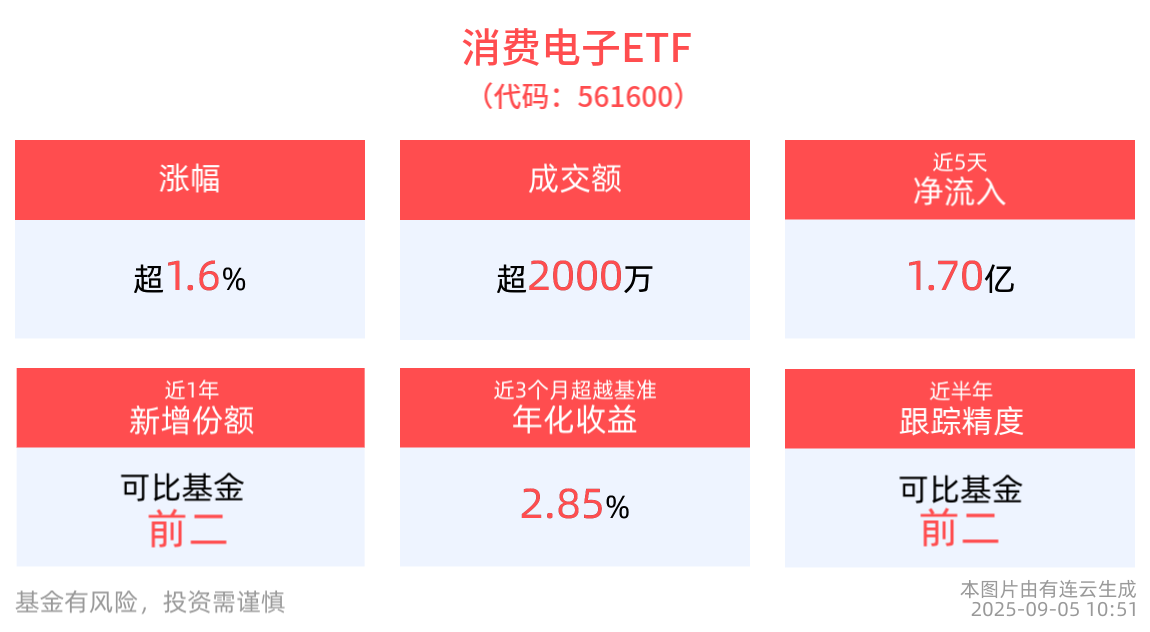
Core Insights - The China Securities Consumer Electronics Theme Index (931494) has shown a strong increase of 2.02% as of September 5, 2025, with notable gains in constituent stocks such as Xinwangda (300207) up 10.43% and Yiwei Lithium Energy (300014) up 8.80% [3] - The Consumer Electronics ETF (561600) has also risen by 1.60%, with a recent price of 1.08 yuan, and has accumulated a 6.63% increase over the past two weeks [3] - The ETF has a turnover rate of 5.47% during the trading session, with a transaction volume of 28.88 million yuan, and an average daily transaction of 108 million yuan over the past week, ranking first among comparable funds [3] Index Composition - As of August 29, 2025, the top ten weighted stocks in the China Securities Consumer Electronics Theme Index account for 54.8% of the index, including companies like Cambricon (688256) and Luxshare Precision (002475) [4] - The top ten stocks by weight are: - Cambricon (688256) - 5.79% - Luxshare Precision (002475) - 8.06% - SMIC (688981) - 3.89% - Industrial Fulian (601138) - 3.89% - BOE Technology Group (000725) - 6.71% - Lattice Semiconductor (688008) - 4.31% - OmniVision Technologies (603501) - 4.99% - Zhaoyi Innovation (603986) - 3.84% - GoerTek (002241) - 2.61% - Yiwei Lithium Energy (300014) - 2.57% [6]
再过几年,日本人或许只能购买中国电视机了
Hu Xiu· 2025-09-05 02:39
Core Viewpoint - The article discusses the significant shift in the global television market, highlighting the decline of Japanese brands and the rise of Chinese brands, particularly in Japan, where Chinese brands now hold nearly half of the market share [3][18][24]. Industry Overview - Japanese television brands, once dominant in the global market, have seen their global shipment share drop from 28% in 2010 to an estimated 9% in 2024 [15]. - The decline of Japanese brands is attributed to their slow adaptation to technological changes, particularly the shift to LCD technology, while competitors like Samsung and LG quickly embraced new technologies [14][12]. Market Dynamics - In 2024, Chinese television brands accounted for 30.2% of global shipments, surpassing Korean brands for the first time [20][22]. - Chinese brands, including Hisense, TCL, and Xiaomi, collectively hold a 31.3% market share, exceeding the combined total of Samsung and LG [20][22]. Competitive Strategies - Chinese brands have successfully penetrated the Japanese market by leveraging technology and localization strategies, such as optimizing products for local preferences and providing localized customer service [25][28]. - Hisense's self-developed X chip and TCL's ADS Pro technology have allowed them to meet specific Japanese consumer needs, enhancing their competitive edge [27][31]. Challenges and Opportunities - Japanese manufacturers face challenges due to their "path dependence" and slow decision-making processes, which hinder their ability to innovate and respond to market changes [16][39]. - The article suggests that for Japanese companies to regain competitiveness, they must break free from traditional practices and improve their decision-making speed [49]. Future Outlook - The shift in market dynamics indicates a broader trend of global manufacturing power moving towards China, driven by integrated supply chains and rapid innovation capabilities [50]. - The article concludes that the future of the television industry will depend on the ability of companies to adapt to changing market demands and technological advancements [48].
华为三折叠屏手机发布,消费电子ETF(561600)盘中上涨
Xin Lang Cai Jing· 2025-09-05 02:29
Group 1 - Huawei launched the Mate XTs foldable smartphone, featuring the Kirin 9020 chip and HarmonyOS 5.0, starting at a price of 17,999 yuan [1] - This marks the first public display of Huawei's Kirin chip in four years [1] - As of September 5, 2025, the CSI Consumer Electronics Theme Index (931494) rose by 0.17%, with notable increases in component stocks such as Yiwei Lithium Energy (300014) up 6.83% and Xinwanda (300207) up 5.65% [1] Group 2 - As of August 29, 2025, the top ten weighted stocks in the CSI Consumer Electronics Theme Index accounted for 54.8% of the index, including companies like Cambricon (688256) and Luxshare Precision (002475) [2] - The Consumer Electronics ETF (561600) closely tracks the CSI Consumer Electronics Theme Index, which includes 50 listed companies involved in component production and consumer electronics [1][2]
华宝ESG责任投资混合A:2025年上半年利润127.8万元 净值增长率1.93%
Sou Hu Cai Jing· 2025-09-05 02:25
Group 1 - The AI fund Huabao ESG Responsibility Investment Mixed A (018118) reported a profit of 1.278 million yuan for the first half of 2025, with a weighted average profit per fund share of 0.0189 yuan [2] - The fund's net value growth rate for the reporting period was 1.93%, and as of the end of the first half, the fund size was 59.7432 million yuan [2][30] - The fund manager noted that the potash fertilizer industry exhibits a quasi-monopolistic characteristic globally, with prices significantly above production costs, allowing companies in this sector to achieve returns exceeding the average social return rate [2] Group 2 - As of September 3, 2025, the fund's one-year cumulative net value growth rate was 32.76%, ranking 401 out of 601 comparable funds [5] - The fund's weighted average price-to-earnings ratio (TTM) was approximately 16.95 times, significantly lower than the industry average of 25.34 times [10] - The weighted average revenue growth rate (TTM) for the stocks held by the fund was 0.04%, and the weighted average net profit growth rate (TTM) was 0.03% for the first half of 2025 [16] Group 3 - The fund's top ten holdings included companies such as Fenzhong Media, Yalake Co., and Ningde Times, with a high concentration level exceeding 60% for nearly two years [38] - The fund's stock position averaged 87.81% since inception, with a peak of 92.93% at the end of the first quarter of 2025 [29] - The fund's recent six-month turnover rate was approximately 56.55%, consistently below the industry average [36]