谷歌

Search documents
AI算力下半场,具备预期差的方向梳理
Ge Long Hui A P P· 2025-09-12 00:18
Core Insights - The rise of ASIC chip manufacturers, exemplified by Broadcom, is reshaping the technology investment landscape, with ASICs transitioning from a supporting role to a leading position in the market [1] Market Overview - The global ASIC chip market is projected to reach approximately $12 billion in 2024, with expectations to exceed $30 billion by 2027, reflecting a compound annual growth rate (CAGR) of 34% from 2024 to 2027 [1] Company Performance - Broadcom reported a 63% year-over-year increase in AI chip revenue in Q3, driven by a significant $10 billion custom AI chip (XPU) order from a fourth major client [3] - The demand for ASICs is being fueled by cloud service providers (CSPs) favoring ASICs over traditional GPUs due to performance and cost advantages [3] Technological Advancements - ASICs are designed for specific tasks, offering superior efficiency compared to general-purpose GPUs, which are likened to multi-functional tools [4] - Recent innovations have reduced the design cycle for ASICs from 18-24 months to 6-12 months, cutting costs by over 60% [4] Competitive Landscape - Major players in the ASIC design space include IDM giants like Broadcom, cloud companies like Amazon and Google, and specialized design firms such as Cambricon and Rockchip [6] - Broadcom holds a 60% market share in data center interconnect scenarios with its XPU products [6] Manufacturing and Supply Chain - Domestic manufacturers are leveraging advanced manufacturing and packaging technologies to meet ASIC production demands, with companies like SMIC and Changdian Technology playing key roles [7] Supporting Industries - The high power consumption of ASICs has led to increased demand for cooling solutions and optical interconnects, with companies like Invec and Taicheng providing innovative products [8] Investment Opportunities - Investors are advised to focus on companies with visible long-term orders, strong technological barriers, and flexible supply chains in the ASIC ecosystem [9] - The shift towards ASICs represents a significant investment opportunity as the technology landscape evolves, similar to the transition from feature phones to smartphones [9]


甲骨文市值逼近万亿美元,AI大订单是主要原因
2 1 Shi Ji Jing Ji Bao Dao· 2025-09-11 14:52
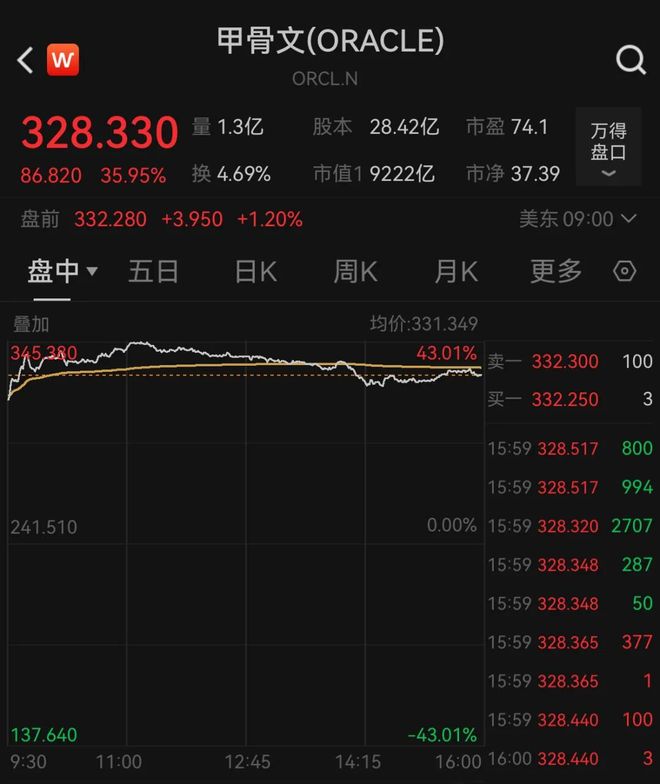
Core Viewpoint - Oracle's stock price surged significantly due to its latest financial report and substantial AI contracts, with a notable increase in its Remaining Performance Obligations (RPO) [1][3][6] Financial Performance - For Q1 of fiscal year 2026, Oracle reported total revenue of $14.9 billion, a year-over-year increase of 12% [6] - Cloud revenue grew by 28% to $7.2 billion, with IaaS revenue increasing by 55% to $3.3 billion and SaaS revenue rising by 11% to $3.8 billion [6][10] - RPO surged to $455 billion, exceeding market expectations of $178 billion, driven by demand for AI computing power and multi-cloud services [3][6] AI Contracts and Market Impact - Oracle signed four contracts worth billions with three major clients, contributing to the RPO increase and indicating strong future revenue potential [4][6] - A reported $300 billion, five-year computing power procurement agreement with OpenAI may explain the RPO surge and market revaluation of Oracle's stock [7][8] Competitive Positioning - Oracle's multi-cloud strategy has led to a 1529% year-over-year increase in multi-cloud database revenue, expanding its market presence [8][10] - The company is actively collaborating with major cloud providers like Google, Microsoft, and Amazon to enhance its service offerings and customer reach [11][12] Future Outlook - Oracle anticipates Q2 fiscal year 2026 total revenue growth of 12% to 14%, with cloud business expected to grow by 32% to 36% [6][10] - The company is focused on converting RPO into actual revenue, contingent on its ability to fulfill contracts and secure necessary AI chip supplies [10] Market Reaction - Following Oracle's stock surge, related AI hardware stocks in the Chinese market also experienced significant gains, indicating a broader market enthusiasm for AI investments [14]
甲骨文“爷爷级”创始人All in AI,冲顶全球首富
Di Yi Cai Jing· 2025-09-11 14:08
甲骨文近几个月来疯狂斩获一系列巨额订单。 《彭博亿万富豪指数》(Bloomberg Billionaires Index)数据显示,在蝉联"全球首富"头衔近300天后,特斯拉公司首席执行官马斯克 (Elon Musk)交出了位置。 随着云业务需求激增刺激营收前景,甲骨文公司股价盘中暴涨超42%,该公司联合创始人埃里森(Larry Ellison)首次登顶。截至美股周三收盘,甲骨文股价飙升36%,创下自1992年以来的最大单日百分比涨幅,单日市值暴增2440亿美元。 彭博数据显示,截至周二马斯克仍以3840亿美元的总身家位居榜首,埃里森则以2950亿美元紧随其后。然而在当日收盘后,这家云计算巨 头上调了销售额预期,并宣布新增多个大型客户,其股价随即大幅飙升。 史诗级暴涨 周三早盘,甲骨文股价涨幅接近40%,这使其载入史册,因为从未有如此规模的公司出现过这样的单日涨幅。根据道琼斯市场数据(Dow Jones Market Data),甲骨文成为首家市值至少达到5000亿美元,且实现单日股价涨幅超25%的公司。 这一幕让人想起2023年5月的英伟达公司。当时这家芯片制造商公布季度营收预期为110亿美元,较市场普遍预 ...

AI算力下半场,具备预期差的方向
Ge Long Hui· 2025-09-11 13:53
Core Insights - The rise of ASIC chip manufacturers, exemplified by Broadcom, is reshaping the technology investment landscape, with ASICs transitioning from a supporting role to a leading position in the market [1][3][10] Market Overview - The global ASIC chip market is projected to reach approximately $12 billion in 2024, with expectations to exceed $30 billion by 2027, reflecting a compound annual growth rate (CAGR) of 34% from 2024 to 2027 [1] - Major cloud service providers (CSPs) are increasingly favoring ASICs over traditional GPUs due to their efficiency and cost-effectiveness in AI applications [3][4] Technological Advancements - ASICs are designed for specific tasks, offering superior performance compared to GPUs, which are more generalized [3] - Innovations such as IP core reuse and cloud design platforms have significantly reduced ASIC development cycles from 18-24 months to 6-12 months, cutting costs by over 60% [4] Competitive Landscape - Broadcom's XPU product has captured a 60% market share in data center interconnect scenarios, with a 63% year-over-year increase in AI chip revenue [6] - Major players like Amazon and Google are not only consumers but also producers of ASICs, with self-developed ASICs expected to account for 25% of their computing power procurement by 2024 [6] Manufacturing and Supply Chain - Domestic manufacturers are advancing in ASIC production, with companies like SMIC and Changdian Technology enhancing manufacturing capabilities [7] - The high power consumption of ASICs has led to increased demand for cooling solutions and optical interconnects, creating new market opportunities [8] Investment Considerations - Investors are advised to focus on companies with visible long-term orders, strong technological barriers, and flexible supply chains in cooling and optical interconnects [9][10] - The transition from general-purpose computing to specialized ASICs is likened to the shift from feature phones to smartphones, indicating a significant investment opportunity in this evolving sector [10]

甲骨文AI“超级订单”催热市场,A股算力概念走强
2 1 Shi Ji Jing Ji Bao Dao· 2025-09-11 12:37
Core Insights - Oracle's stock price surged significantly due to its latest financial report and substantial AI contracts, with a closing price of $328.33 per share on September 10, marking a 36% increase and nearing a market valuation of $1 trillion [1][2] - The company's Remaining Performance Obligations (RPO) skyrocketed to $455 billion, far exceeding market expectations of $178 billion, indicating strong future revenue potential driven by AI demand [1][2][3] Financial Performance - For Q1 of fiscal year 2026, Oracle reported total revenue of $14.9 billion, a 12% year-over-year increase, with cloud revenue growing by 28% to $7.2 billion [2] - The RPO increased by 359% to $455 billion, primarily due to AI computing power and multi-cloud demand, with expectations to exceed $500 billion in the coming months [2][3] AI Contracts and Market Position - Oracle signed significant contracts with three major clients, totaling over $31.7 billion in new contracts within a single quarter, which has led to a reassessment of its future earnings potential [3][4] - The company is actively expanding its multi-cloud database services, with a 1529% year-over-year increase in revenue from partnerships with major cloud providers [3][4] Competitive Landscape - Despite rapid growth, Oracle still faces stiff competition in the global cloud infrastructure market, dominated by Amazon, Microsoft, and Google, which collectively hold 65% of the market share [4][6] - Oracle's strategy focuses on leveraging AI infrastructure and building data centers to secure market space, while also forming partnerships with other cloud giants to enhance its service offerings [4][7] Future Outlook - Oracle's cloud infrastructure (OCI) is designed to meet high-performance computing needs, particularly for AI workloads, and has become essential for major clients like Meta and OpenAI [6][7] - The company is also pursuing collaborations to expand its data center footprint across the U.S., ensuring a stable supply of high-end AI chips through partnerships with NVIDIA [6][7] Market Reaction - Following Oracle's stock surge, related AI computing hardware stocks in the Chinese market also experienced significant gains, indicating a broader market impact from Oracle's performance [8] - Analysts suggest that increased overseas investment in AI will accelerate the development of domestic foundational software and hardware, further benefiting companies in the sector [8]
半导体行业月报:半导体行业25Q2持续稳健增长,国产AI算力厂商业绩表现亮眼-20250911
Zhongyuan Securities· 2025-09-11 08:25
Investment Rating - The semiconductor industry is rated as "Outperform" [1] Core Viewpoints - The semiconductor industry continues to show steady growth in Q2 2025, with significant performance from domestic AI computing chip manufacturers [4][5] - The global semiconductor monthly sales continue to grow year-on-year, driven by increased capital expenditure from domestic and international cloud service providers [4][6] - The demand for AI computing hardware infrastructure remains strong, with major cloud companies increasing their capital expenditures significantly [6] Summary by Sections 1. Semiconductor Industry Performance - In August 2025, the domestic semiconductor industry (CITIC) rose by 23.84%, significantly outperforming the Shanghai and Shenzhen 300 index, which increased by 10.33% [4][12] - The semiconductor industry (CITIC) has seen a year-to-date increase of 36.16% [12] 2. Q2 2025 Financial Performance - The semiconductor industry reported a revenue of 188.43 billion yuan in Q2 2025, a year-on-year growth of 13.87%, with a net profit of 14.76 billion yuan, up 23.99% year-on-year [4][22] - The gross margin for the semiconductor industry has been on the rise, with Q2 2025 showing a gross margin of 26.29%, an increase of 1.72% year-on-year [22][25] 3. AI Computing Chip Manufacturers - Domestic AI computing chip manufacturers have shown remarkable performance in Q2 2025, with companies like Cambricon reporting a revenue increase of 4425.01% year-on-year [4][5][22] - The domestic AI computing chip sector is entering a period of accelerated growth, with expectations of increased market share [5][22] 4. Global Semiconductor Sales - Global semiconductor sales in July 2025 increased by 20.6% year-on-year, marking the 21st consecutive month of growth [4][6] - The demand for consumer electronics is gradually recovering, with expectations for rapid growth in AI smartphones and AI PCs [4][6] 5. Capital Expenditure Trends - Major North American cloud service providers have significantly increased their capital expenditures, with a combined increase of 69% year-on-year in Q2 2025 [6] - The total capital expenditure of the three major domestic internet companies (Alibaba, Baidu, Tencent) reached 61.6 billion yuan in Q2 2025, a year-on-year increase of 168% [5][6] 6. Market Dynamics - The inventory levels of some global chip manufacturers have slightly decreased, while domestic chip manufacturers have seen a significant reduction in inventory levels [4][22] - The utilization rate of global wafer fabs has significantly improved in Q2 2025, indicating a positive trend in production capacity [4][22]


艾布鲁:投资者询问业务规划是否借鉴甲骨文经验,董秘让关注公告
Xin Lang Cai Jing· 2025-09-11 08:08
Core Viewpoint - Oracle's cloud business has experienced significant growth, securing contracts exceeding $400 billion with major tech companies like OpenAI, Google, and Facebook [1] Group 1 - Oracle's cloud business performance has shown substantial improvement recently [1] - The company has established partnerships with leading technology firms, indicating a strong collaborative approach in the industry [1] - The investor inquiry highlights interest in Oracle's business development strategies and product positioning [1]
3000亿美元OpenAI大单,让世界首富位置换人了
机器之心· 2025-09-11 07:13
Core Viewpoint - Oracle has become a focal point globally after announcing its Q1 FY2026 earnings, revealing a total revenue of $14.9 billion, a year-on-year increase of approximately 12%, but below market expectations. However, the remaining performance obligations (RPO) surged to $455 billion, a staggering 359% increase year-on-year [2][4]. Group 1: Financial Performance - Oracle's cloud business revenue is projected to soar to $144 billion by FY2030, driven by the demand for AI computing power, compared to less than $20 billion in the current fiscal year [3]. - Following the earnings announcement, Oracle's stock price surged over 35%, reaching a peak of $345.72 [4][5]. Group 2: Major Contracts and Partnerships - A significant portion of Oracle's RPO is attributed to a contract with OpenAI, which is expected to purchase $300 billion worth of computing power over approximately five years, marking one of the largest cloud computing contracts in history [8][12]. - The contract with OpenAI will require Oracle to secure 4.5 gigawatts of power capacity, equivalent to the electricity consumption of about four million households [9]. Group 3: Strategic Developments - Oracle is collaborating with data center builders to establish multiple data centers across the U.S. to support the anticipated demand from OpenAI [14]. - The company is also considering taking on debt to purchase AI chips necessary for its data centers [10]. Group 4: Market Position and Challenges - Despite the recent successes, Oracle faces stiff competition in the cloud computing sector from major players like Amazon, Microsoft, and Google, and has recently announced significant layoffs, planning to cut over 3,000 jobs globally [17]. - The CEO of OpenAI, Sam Altman, has indicated that the company may not reach profitability until 2029, with projected losses of $44 billion before then, highlighting the financial risks associated with such large-scale contracts [12].

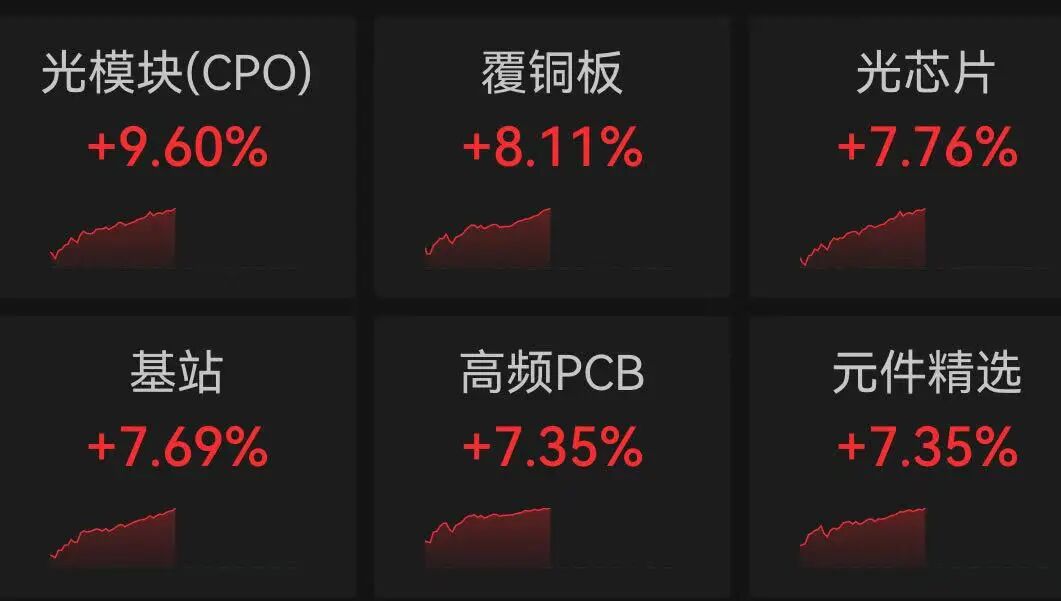
超3300股飘红,AI产业链集体大爆发,寒武纪涨超10%
2 1 Shi Ji Jing Ji Bao Dao· 2025-09-11 04:04
Group 1 - The A-share market showed mixed performance on September 11, with the Shanghai Composite Index rising by 1.12%, the Shenzhen Component Index increasing by 2.63%, and the ChiNext Index gaining 4.31% to surpass 3000 points, with a total trading volume of 1.5 trillion yuan [1] - The AI industry chain stocks experienced a significant surge, with sectors such as CPO, PCB, and copper-clad laminates leading the gains [2] - The Nvidia industry chain index rose over 4%, with notable individual stock performances including Industrial Fulian reaching a historical high with a market cap exceeding 1.17 trillion yuan, and other companies like Huagong Technology and Cambrian Technologies also seeing substantial gains [4] Group 2 - OpenAI reportedly signed a deal to purchase $300 billion worth of computing power from Oracle over approximately five years, leading to a 36% surge in Oracle's stock price and a market cap increase of about $250 billion in one day [4] - The growth potential of the computing power industry chain is being re-evaluated in the A-share market, with leading companies showing a positive correlation between performance and stock prices, indicating a robust demand driven by global AI infrastructure expansion [4][5] - Domestic internet giants, including Alibaba, Tencent, and Baidu, reported a combined capital expenditure of 55.012 billion yuan in Q1 2025, reflecting a year-on-year growth rate of 99.38%, as they increase investments in AI-related businesses [6]



OpenAI“千亿级赌注”加码:绑定甲骨文、联姻博通,巨债压身豪赌“星际之门”
贝塔投资智库· 2025-09-11 04:02
Core Viewpoint - OpenAI is aggressively expanding in the artificial intelligence sector, highlighted by a $300 billion infrastructure procurement contract with Oracle and a previous partnership with Broadcom for AI chip development, indicating a significant capital investment and strategic ambition [1][2]. Group 1: Partnership and Contracts - OpenAI's contract with Oracle is part of its "Stargate" data center construction plan, representing one of the largest cloud service contracts in history, significantly exceeding OpenAI's current revenue [1]. - The collaboration aims to build 4.5 gigawatts of data center computing capacity, equivalent to the power generation of two Hoover Dams or the electricity consumption of approximately 4 million American households [1]. Group 2: Financial Implications - Oracle's cloud service agreement is expected to generate over $30 billion in revenue by fiscal year 2027, with increasing revenue as more data center infrastructure comes online [2]. - OpenAI's annual revenue is approximately $10 billion, which is less than one-fifth of its annual operating costs of $60 billion, raising concerns about its financial sustainability [2]. Group 3: Risks and Challenges - OpenAI has not yet achieved profitability and is incurring significant losses, with projections indicating it may take until 2029 to become profitable, requiring an estimated expenditure of $44 billion [3]. - The partnership with Oracle places a substantial portion of Oracle's future revenue at risk, as it heavily relies on a single client, potentially leading to increased debt to meet AI chip demands [2]. - OpenAI's aggressive expansion strategy, supported by substantial debt and partnerships, faces sustainability challenges amid increasing competition and tensions with major investor Microsoft [3].