中国有色集团

Search documents
“十五五”国资改革重点明确:加强战略重组 推动科技创新
Di Yi Cai Jing· 2025-11-04 13:43
Core Insights - The core focus is on invigorating various business entities to accelerate the construction of a high-level socialist market economy and enhance high-quality development momentum over the next five years [1][3][6] Group 1: National Strategy and Economic Development - The State-owned Assets Supervision and Administration Commission (SASAC) emphasizes the importance of optimizing the layout and structure of state-owned enterprises (SOEs) during the 14th Five-Year Plan period [2][7] - The "15th Five-Year Plan" aims to deepen the reform of state-owned assets and enterprises, enhancing the core functions and competitiveness of SOEs [6][9] Group 2: Industry and Technological Innovation - The focus is on promoting strategic and professional restructuring of SOEs to avoid redundant construction and disorderly competition, while enhancing innovation resource integration [4][8] - Central enterprises are expected to invest in strategic emerging industries with an annual growth rate exceeding 20% during the 14th Five-Year Plan [4][5] Group 3: Collaboration and Market Dynamics - The SASAC encourages collaboration among various ownership types to leverage complementary advantages and foster mutual development [3][6] - The "共链行动" initiative has facilitated over 2,500 events and signed more than 11,000 cooperation agreements to enhance the integration of small and medium-sized enterprises into the industrial chain [5][6] Group 4: Governance and Structural Reform - The "15th Five-Year Plan" outlines the need for a modern enterprise governance mechanism, focusing on problem-oriented approaches and data-driven insights [6][9] - The restructuring efforts aim to shift from scale-based to quality and efficiency improvements, enhancing the core competitiveness of enterprises [8][9]
“十五五”国资改革重点明确:加强战略重组,推动科技创新
Di Yi Cai Jing· 2025-11-04 13:27
Core Insights - The Chinese government emphasizes the importance of nurturing emerging industries and optimizing the structure of state-owned enterprises (SOEs) to drive economic growth during the 14th Five-Year Plan period [1][4][6] Group 1: Economic Strategy and Development - The State-owned Assets Supervision and Administration Commission (SASAC) aims to enhance the vitality of various business entities as a key task for the next five years [1] - The focus will be on optimizing the layout and structure of state-owned economies, with an emphasis on strategic and professional restructuring to avoid redundant construction and disorderly competition [1][6] - The "14th Five-Year Plan" period saw a significant investment growth in strategic emerging industries, with an annual increase of over 20% in investments from central enterprises [4][5] Group 2: Innovation and Technology - The government encourages SOEs to strengthen their role as innovation entities, promoting the integration of innovation resources and enhancing the overall innovation capability [4][5][8] - There is a push for the development of high-tech industries such as new information technology, new energy, and high-end equipment, which are expected to drive significant economic impact [4][5][9] Group 3: Structural Reform and Optimization - The "15th Five-Year Plan" outlines the need for deeper reforms in SOEs, focusing on enhancing core functions and competitiveness [6][7] - The restructuring efforts include merging similar enterprises to improve efficiency and reduce competition, while also enhancing the resilience and competitiveness of industrial chains [8][9] - The SASAC reported that over 70% of the revenue from central enterprises is generated in sectors critical to national security and the economy [7]
广西有色金属关键金属产业高质量发展大会暨项目投资洽谈会在南宁召开 陈刚葛红林韦韬等出席并讲话
Guang Xi Ri Bao· 2025-11-04 02:14
Core Viewpoint - The conference held in Nanning aims to promote the high-quality development of the non-ferrous and critical metals industry in Guangxi, emphasizing collaboration and investment opportunities in this sector [1][2]. Group 1: Industry Development - Guangxi is recognized as a significant region for non-ferrous and critical metals in China, with these industries being vital to the local economy [2][3]. - The local government is addressing issues in the non-ferrous metals industry through various initiatives, including a ten-year investigation into illegal mining and pollution, and the establishment of a comprehensive development zone for critical metals [2][3]. - The focus is on advancing the industry towards high-end, intelligent, green, large-scale, and park-based development, with significant progress already made [2]. Group 2: Investment Opportunities - The conference highlighted Guangxi as a "future track" for investment in non-ferrous and critical metals, particularly in high-end materials [2]. - There is a strong call for collaboration in areas such as deep processing of non-ferrous metals, new material research, recycling of metals, and high-end equipment manufacturing [2][3]. - The government is committed to creating a favorable business environment and enhancing administrative efficiency to support enterprises operating in Guangxi [4]. Group 3: Strategic Initiatives - The conference included the release of the "15th Five-Year Plan" for the innovative development of the critical metals industry in Guangxi, along with supporting policies [5]. - A total of 35 key projects in the non-ferrous and critical metals sectors were signed, covering nine types of critical metals and various non-ferrous metals [5]. - Experts emphasized the need for Guangxi to transition strategic minerals into critical metals and to leverage its resource advantages for sustainable development [4][5].
从“十四五”积淀到“十五五”启航!国有经济布局优化和结构调整持续推进
Hua Xia Shi Bao· 2025-10-30 09:13
Core Insights - The core objective of the "15th Five-Year Plan" is to strengthen, optimize, and expand state-owned enterprises (SOEs) and state capital, enhancing their core functions and competitiveness [1][5] - The plan builds on the achievements of the "14th Five-Year Plan" and aims to address complex internal and external environments while supporting China's modernization strategy [1][2] Summary by Sections Reform and Development - The "15th Five-Year Plan" reform blueprint is based on the solid foundation laid during the "14th Five-Year Plan," with many central enterprises nearing completion of their reform goals by the end of 2025 [2][3] - As of Q3 2023, the national reform task completion rate has generally exceeded 80%, with some regions surpassing 90% [3][5] Investment and Structural Adjustment - Central enterprises have begun transforming their investment strategies, with investments in strategic emerging industries exceeding 40% of total investments for the first time, and nearly 30% of their revenue coming from these sectors [2][3] - Over 800 billion yuan has been invested in upgrading old equipment and digital transformation, establishing 120 smart factories [3][4] Core Functions and Competitiveness - The focus of the "15th Five-Year Plan" is on optimizing the layout and structure of state-owned capital, enhancing the core functions of SOEs, and improving their competitiveness [5][6] - Key areas for improvement include technology innovation, governance efficiency, and strategic alignment with national priorities [4][6] Strategic Focus Areas - SOEs are expected to concentrate their capital in sectors critical to national security and economic lifelines, such as defense, energy, and telecommunications [6][7] - There is a push for strategic mergers and professional integration to avoid homogenized competition and internal conflicts, aiming to create globally competitive enterprises [7][8]


全力打好年度“收官战”!多家央企部署四季度工作,冲刺全年目标
Hua Xia Shi Bao· 2025-10-22 06:14
Core Viewpoint - Central enterprises are intensifying efforts to meet annual targets, with multiple companies holding economic operation analysis meetings to strategize for the fourth quarter [1][2]. Group 1: Economic Performance - In the first three quarters, most central enterprises have shown resilience against multiple pressures, achieving a dual focus on quality and efficiency [2]. - China Resources Group reported a revenue of 651.4 billion yuan and a profit of 64.3 billion yuan in the first three quarters, both exceeding the average growth rates of central enterprises [2]. - State-owned enterprises' total revenue reached 5.396 trillion yuan from January to August, marking a year-on-year growth of 0.2%, the first positive growth rate of the year [4]. Group 2: Strategic Initiatives for Q4 - Central enterprises are formulating precise action plans for the fourth quarter, emphasizing "stabilizing growth, deepening reform, and preventing risks" [5]. - The State Power Investment Corporation aims to enhance efficiency through specific measures such as increasing electricity generation and reducing costs [5]. - Major project construction and strategic layout are identified as key growth drivers, with a focus on advancing significant projects in renewable energy and resource management [6]. Group 3: Reform and Innovation - The current year marks a critical phase for deepening reforms among central enterprises, with many focusing on enhancing operational efficiency and innovation [6]. - The State-owned Assets Supervision and Administration Commission emphasizes the importance of technology and industry orientation to strengthen core functions and competitiveness [7][8]. - Central enterprises are aligning their strategies with the "14th Five-Year Plan" while simultaneously planning for the "15th Five-Year Plan," ensuring a balance between immediate goals and long-term development [9].

刚果(金)确定今年底前的钴出口配额分配方案
Shang Wu Bu Wang Zhan· 2025-10-14 15:49
Core Insights - The Congolese government announced a distribution plan for cobalt export quotas for the remainder of the year, marking the end of an eight-month cobalt export ban that began in February [1] Group 1: Export Quota Details - The new export quotas will take effect on October 16 and will be allocated based on each company's total export volume over the past three years [1] - Approximately 18,000 tons of cobalt can be exported by mining companies for the remainder of this year, with annual export limits set at 96,600 tons for both 2026 and 2027, which is less than half of last year's production [1] Group 2: Major Companies and Their Quotas - China Molybdenum, the world's largest cobalt producer, has been approved to export 6,500 tons of cobalt by the end of 2025, accounting for 36% of the total quota [1] - It is projected that China Molybdenum will export 31,200 tons of cobalt in 2026, representing 27% of its total production in Congo last year, which was 114,000 tons, over 40% of global production [1] - Glencore and Eurasian Resources, the second and third largest cobalt producers globally, have been granted export quotas of 3,925 tons and 2,125 tons, respectively, making up 22% and 12% of the total quota [1] - Other Chinese mining companies, including Huagong Mining, Huayou Cobalt, China Nonferrous Metal Industry Group, Minmetals Resources, Zijin Mining, and Jinchuan Group, along with some other local producers, have also received export quotas proportionally [1]

东方钽业:下游市场驱动业绩提升,定增扩产战略获投资者聚焦
Zheng Quan Shi Bao· 2025-09-18 17:47
Group 1 - The company has been actively communicating with investors since the release of its semi-annual report on August 25, with a total of 103 institutional meetings held by September 16, indicating strong investor interest in its performance and future plans [1] - The company plans to raise 1.2 billion yuan through a private placement, with significant support from its actual controller, China Nonferrous Metal Group, and its controlling shareholder, China Nonferrous East Group, which together account for about half of the total funds raised [2] - The company has signed a procurement contract with Taboca for approximately 3,000 tons of iron niobium tantalum alloy raw materials, with an estimated procurement amount of 540 million yuan, enhancing its supply chain autonomy [2] Group 2 - In the first half of 2025, the company achieved operating revenue of 797 million yuan, a year-on-year increase of 34.45%, and a net profit attributable to shareholders of 145 million yuan, up 29.08% year-on-year, driven by strong demand in downstream markets [3] - The high-temperature alloy market has seen rapid growth due to increased demand from gas turbines, aerospace engines, and automotive turbochargers, contributing to the company's performance [3] - The semiconductor sector has experienced explosive growth in demand for tantalum target materials and high-purity tantalum ingots, driven by advancements in AI and computing chips, with the company achieving breakthroughs in production technology [3] Group 3 - The tantalum capacitor market is showing signs of recovery due to the resurgence of the consumer electronics market, while the superconducting materials market is also expanding due to advancements in high-tech fields [4] - The company is constructing a new wet metallurgy production line to address outdated equipment and insufficient capacity, which is expected to enhance its production capabilities [4] - The company aims to establish a "three-tier product hierarchy" strategy to ensure supply chain security and competitive advantages, focusing on raw material supply, core products, and future growth points [4]

国务院国资委:推动董事会建设走深走实
Zheng Quan Ri Bao Wang· 2025-09-11 12:45
Core Viewpoint - The State-owned Assets Supervision and Administration Commission (SASAC) emphasizes the importance of enhancing the governance structure of central enterprises through effective board management and the integration of external directors' expertise [1] Group 1: Board Governance - The SASAC has organized a seminar focused on the work of central enterprise boards, highlighting the need for a scientific, rational, and efficient board structure [1] - The seminar featured discussions on the implementation of Xi Jinping's important discourse regarding the establishment of a modern enterprise system with Chinese characteristics [1] - The role of external directors is underscored, with a focus on leveraging their diverse perspectives and expertise to improve board functionality [1] Group 2: Planning and Responsibilities - The seminar addressed the preparation of the "14th Five-Year Plan," emphasizing the need to clarify the responsibilities and boundaries of different governance entities [1] - There is a call to balance group control with the governance of subsidiary boards, enhancing the supervisory role of boards [1] - The quality of external director teams is to be strengthened, and the practical implementation of subsidiary boards is to be promoted [1] Group 3: Participation and Contributions - Representatives from five central enterprises, including China Electronics Technology Group and China Southern Power Grid, participated in the seminar, sharing insights and experiences [1] - The SASAC's planning department provided a specialized report on the "14th Five-Year Plan" during the seminar [1] - The event included participation from various stakeholders, including external directors, board secretaries, and SASAC officials [1]
聚变高端金属材料研发联合实验室第二次工作会议暨超导材料高端学术论坛召开
Zheng Quan Shi Bao Wang· 2025-08-18 09:09
Core Viewpoint - The meeting focused on the development of advanced superconducting materials and the strategic positioning of China Nonferrous Metal Group in cutting-edge technologies and future industries [1] Group 1: Company Initiatives - China Nonferrous Metal Group is leading the charge in frontier technologies, taking on tasks related to superconducting materials and controllable nuclear fusion as part of the State-owned Assets Supervision and Administration Commission's future manufacturing initiatives [1] - The company’s subsidiary, China Nonferrous (Ningxia) Oriental Group Co., Ltd., is positioned among the global leaders in low-temperature superconducting materials, with a project to produce 500 niobium superconducting cavities set to make it the largest manufacturer of radio frequency superconducting cavities worldwide [1] Group 2: Collaborative Efforts - A high-temperature superconducting engineering center has been established in collaboration with Songshan Lake Materials Laboratory, guided by Academician Zhao Zhongxian, to focus on the research and industrialization of high-temperature superconducting materials [1] - The meeting aimed to enhance cooperation and exchange among various parties to promote breakthroughs in the research and application of superconducting materials [1]
要跟中国对着干?中国学者提醒:刚果(金),别断送发展机遇
Sou Hu Cai Jing· 2025-07-02 13:47
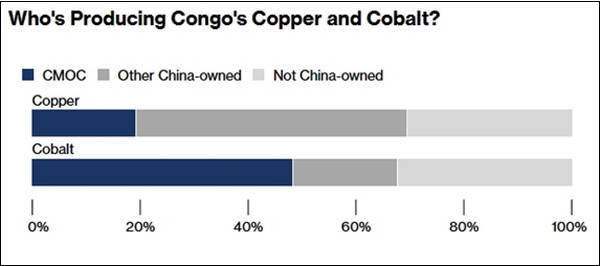
Core Viewpoint - The recent mineral agreement between the U.S. and the Democratic Republic of the Congo (DRC) aims to counter China's dominance in the critical mineral supply chain, particularly in copper and cobalt production [1][6]. Group 1: China's Dominance in DRC's Mining Sector - Chinese enterprises dominate the cobalt and copper projects in the DRC, accounting for 76% of the new production capacity added in the past seven years [2][4]. - The DRC has become the second-largest copper producer globally, surpassing Peru, with production expected to continue growing, potentially reaching its peak by 2028 [1][4]. Group 2: U.S. Involvement and Strategic Interests - The U.S. is seeking to diversify the DRC's partnerships in mineral extraction to reduce reliance on China, as indicated by the recent peace agreement signed between Rwanda and the DRC [6][7]. - The agreement includes provisions for opening up mineral resources to U.S. investments, focusing on integrating critical mineral supply chains [6][7]. Group 3: Future Prospects and Challenges - The demand for copper is projected to surge over the next 25 years, marking the beginning of a "copper century," with the DRC and Zambia identified as having significant export growth potential [4][6]. - Despite the potential, there are concerns that U.S. interest in large projects in the DRC remains low, which could hinder the country's economic transformation if it excludes Chinese investments [1][6].