
乐聚机器人

Search documents
乐聚展厅战略的“进与守”
机器人大讲堂· 2026-02-13 06:04
Core Viewpoint - The article emphasizes that the exhibition hall remains a valuable scene for the company, with the launch of the "Kua Fu" exhibition hall version 3.0 in early 2026, showcasing a commitment to refining this setting rather than rushing to prove capabilities in more complex areas [2]. Group 1: Product Development and Features - The "Kua Fu" exhibition hall version 3.0 focuses on "social intelligence," enabling robots to interact appropriately in various social contexts, such as maintaining polite distances and recognizing VIP visitors [4]. - The core pain point in visitor reception is not merely navigation but making visitors feel valued. The robots can now recognize important clients and greet them personally, enhancing the visitor experience significantly [6]. - Innovations such as a one-meter follow function allow visitors to explore at their own pace, transforming the robot's role from a leader to a companion, thus reducing psychological burdens during human-robot interactions [6]. - The deployment and operational aspects have been simplified, making the robots user-friendly for operational staff rather than requiring specialized teams for maintenance [8]. Group 2: Market Potential and Strategy - The market evaluation for exhibition hall scenarios should be grounded in the actual capacity of existing facilities, with core markets including museums and technology centers that have a clear demand for new technologies [10]. - The broader commercial market represents a strategic value where robots can transition from being mere exhibits to functional commercial devices, particularly as hardware costs decrease [12]. - The company has established benchmark cases across 23 provinces, which enhance its resource acquisition capabilities in industrial and research sectors, demonstrating the strategic value of these spillover effects [14]. Group 3: Competitive Advantages - The company has built trust through benchmark cases validated by high-profile events, making it difficult for competitors to replicate this level of credibility quickly [15]. - The first-mover advantage in scene data collection allows the company to refine its algorithms and interaction strategies, creating a positive feedback loop that is hard for newcomers to match [15]. - Collaborations with leading universities and industry players have strengthened the company's technological foundation and application in various sectors, enhancing its competitive edge [17][18]. Group 4: Challenges and Future Outlook - Despite advancements, challenges remain in flexibility and interaction capabilities, with current robots still exhibiting rigid movements and limited scripted actions [19]. - The dialogue capabilities of the robots need to evolve beyond basic responses to meet increasing visitor expectations for depth and personalization in interactions [21]. - The exhibition hall strategy serves as a pragmatic approach to mitigate technological uncertainties, allowing the company to establish a presence and generate revenue while preparing for broader commercial applications [22]. - The future success will depend on the company's ability to leverage accumulated interaction data and trust resources to expand into more diverse commercial service areas [24].


一台晚会能办成什么样,取决于机器人
Guan Cha Zhe Wang· 2026-02-12 01:13
【文/观察者网专栏作者 心智观察所】 2月8日晚八点,上海。200多台机器人在镁光灯下翩翩起舞,与演员黄晓明同台变魔术,和开心麻花的 喜剧演员搭档演小品,还有一台名为"精灵·璇"的仿生机器人,用逼真到令人恍惚的面部表情唱了一首 《未定义的关系》。这是由上海智元机器人主办的全球首个大型机器人晚会《机器人奇妙夜》,被网友 戏称为"机器人春晚"。 整场晚会通过美洲、中东、东南亚等地同步直播,50分钟的时长虽然不长,却创下了多个行业纪录:首 个机器人小品、首个机器人魔术、首个人机共舞华尔兹。智元机器人首席运营官邱恒在演出后说了一句 颇有分量的话——"这可能会是人类理解机器人能力的'ChatGPT时刻'。" 这句话或许稍显大胆,但它折射出的行业自信并非没有来由。就在不久前,百度"文心Moment大会"的 具身智能分论坛上,来自傅利叶、开普勒、加速进化、乐聚机器人和地瓜机器人的五位行业代表围坐一 堂,对具身智能产业的现状与走向进行了一场坦率而深入的讨论。一场晚会与一次圆桌,一个在台前展 示能力的极限,一个在幕后剖析产业的真实。 两者叠加在一起,恰好拼出了当下中国具身智能产业最完整的截面:技术正在加速成熟,商业化的轮廓 隐 ...


乐聚机器人与上电科签署战略合作协议
Bei Jing Shang Bao· 2026-02-09 14:53
北京商报讯(记者 陶凤 王天逸)2月9日,乐聚机器人宣布,与上电科旗下上海机器人产业技术研究院 签署战略合作协议。双方将聚焦人形机器人产品检测认证、行业标准制定等领域,驱动产业向更可靠、 更智能、更高效迈进。 ...
IDC:2025年全球人形机器人出货量接近1.8万台 同比增长约508%
Zhi Tong Cai Jing· 2026-02-09 05:50
Core Insights - The global humanoid robot market is set to reach a significant scale in 2025, with an expected shipment of nearly 18,000 units, representing a year-on-year growth of approximately 508%, and sales revenue projected at around $440 million [1] - Chinese manufacturers are leading the market with a robust manufacturing system, rapid iteration capabilities, and cost advantages, establishing a dominant position globally [2] - The market is primarily driven by bipedal humanoid robots, which contribute 66.3% of the total sales revenue, with full-sized bipedal robots accounting for 41.6% of the sales [3] Market Dynamics - In 2025, the demand for humanoid robots is mainly driven by applications in entertainment, education, and data collection, emphasizing display effects and interactive experiences [4] - The industry is transitioning from one-time hardware sales to a model that includes Robot as a Service (RaaS), operational services, and a platform ecosystem, creating conditions for scalable applications and sustained revenue [6] Technological Advancements - Humanoid robots are advancing towards engineering and scalable applications, with a focus on enhancing intelligent collaboration capabilities [7] - The integration of upper limb dexterity and the fusion of cognitive models are key breakthroughs that will enhance autonomous operations and human-robot collaboration [7]

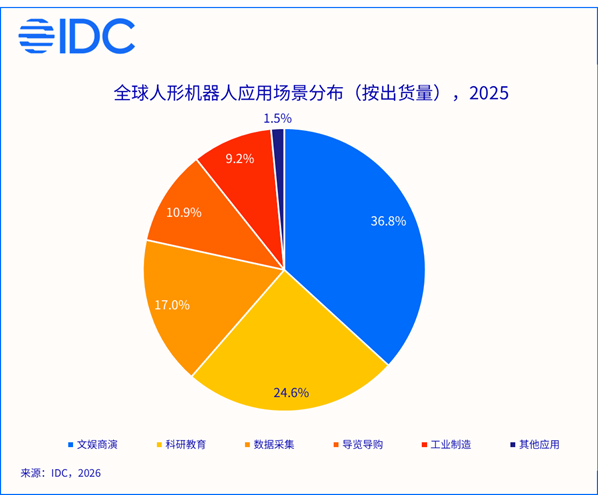
2025年全球人形机器人出货量近1.8万台 智元、宇树等中企产品占据主导
Feng Huang Wang· 2026-02-09 04:50
Core Insights - The global humanoid robot shipment is projected to reach nearly 18,000 units by 2025, representing a year-on-year growth of approximately 508%, with a market size of around $440 million [1] - Cumulative order volume is expected to exceed 35,000 units during the same period [1] Company Landscape - Chinese companies dominate the shipment volume, with Zhiyuan Robotics and Yuzhu Technology each shipping around 5,000 units [1] - Other companies such as Leju Robotics, Accelerated Evolution, and Songyan Power shipped approximately 1,000 units each [1] - Companies like Galaxy General, UBTECH, Zhongqing Robotics, and Stardust Intelligence shipped between 400 to 1,000 units [1] - Emerging companies including Xingdong Jiyuan, Magic Atom, Beijing Humanoid Robot Innovation Center, Xinghai Map, Mojia Zhichuang, and Zhujiji Power achieved shipments of over 100 units [1] - In contrast, international firms like Apptronik and Figure AI are still in pilot testing phases, with shipment volumes in the tens [1] - Tesla's humanoid robot is expected to begin large-scale production in 2026 [1] Product Form Factor - Bipedal robots (including full-size and small-to-medium size) contribute to 66.3% of market sales [1] - Full-size humanoid robots account for the highest sales proportion at 41.6%, with Zhiyuan Robotics leading in this segment [1] Industry Analysis - IDC analysis indicates that Chinese manufacturers hold a first-mover advantage in the current stage of humanoid robot commercialization due to a complete industrial chain, rapid iteration capabilities, and cost advantages [1] - Future industry competition is expected to shift from hardware sales to dimensions such as technical services and ecosystem development [1]

氪星晚报 |腾讯混元AI Infra核心技术开源;小米:辽宁营口SU7起火事故系车内遗留火源引燃周边可燃物所致
3 6 Ke· 2026-02-04 13:02
Group 1: Company Updates - Gong Youliang, the director and executive vice president of South Mining Group, plans to reduce his stake by up to 1%, amounting to 2.0172 million shares, due to personal funding needs [1] - Changan Automobile reported January sales of 134,701 units, a year-on-year decline of 51.14%, with new energy vehicle sales at 36,621 units, down 45.74% [1] - Yum China achieved fourth-quarter revenue of $2.82 billion, an 8.8% year-on-year increase, with adjusted earnings per share of $0.40, surpassing estimates [3] - Toyota plans to increase hybrid vehicle production by approximately 30% by 2028, targeting 6.7 million units, compared to a production plan of 5 million units for 2026 [4] - Panasonic announced the establishment of a Chief Artificial Intelligence Officer position to enhance AI application in customer solutions and internal operations [5] Group 2: Financing and Investments - Cloud Data Infrastructure provider "Yunqi Technology" completed a Series B financing round led by ALC Capital, with total funding exceeding 700 million yuan [6] Group 3: New Products and Innovations - Tencent's Mix Yuan AI Infra team launched an open-source high-performance LLM inference core operator library, HPC-Ops, which improved model inference performance by 30% for Mix Yuan and 17% for DeepSeek [7]




EPFL《Science》子刊重磅!斑马鱼幼体仿生机器人ZBot,解密鱼类翔游机制
机器人大讲堂· 2026-02-02 07:49
在瑞士 日内瓦 湖的湖水中,一条"鱼"正以独特的节律游动着:它猛地摆尾几下,然后舒展身体静静滑行, 如此循环往复。 这不是普通的鱼,而是一条长约80厘米的"钢铁小鱼"——ZBot,一台受斑马鱼幼体启发的仿生机器人。 为什么斑马鱼幼体备受科学家关注? 01. 在生物学研究中,斑马鱼幼体可以说是个"明星选手"。 它们身体几乎透明,科学家可以直接观察其大脑活动;体积小巧,易于在实验室大规模饲养;更重要的是, 它们拥有完整的神经网络,能执行从简单反射到复杂决策的各种行为。 最引人注目的是它们的游泳方式。 通过深入研究它的游动规律,来自瑞士洛桑联邦理工学院(EPFL)研究团队在Science Robotics上发表的最 新研究揭开了一个困扰生物学家多年的谜题:为什么这么多水生动物都采用这种"爆发-滑翔"的游泳方式? 这种间歇性游泳策略在自然界中广泛存在, 从仅几毫米长的幼鱼到长达十几米的鲸鱼,都在不同程度上采用 类似模式。 生物学家提出了多种假说来解释这一现象:有人认为滑翔阶段有助于稳定方向、提升感知能力;更多人相信 这能提高能量效率,因为直尾滑翔减少了水的阻力。但这些假说难以在活体动物中直接验证,更无法系统性 地测试 ...

一廊串联 三城驱动 多圈联动青岛全力打造科创走廊
Xin Lang Cai Jing· 2026-02-01 03:51
Core Insights - Qingdao is actively developing a Science and Technology Innovation Corridor, aiming to become a significant innovation hub in Northern China, covering an area of approximately 190 square kilometers [1][2] Group 1: Infrastructure and Development - The corridor will feature a 53-kilometer coastal road as its main axis, promoting cross-departmental, cross-regional, and cross-industry collaboration [1] - The spatial layout includes "one corridor linking, three cities driving, and multiple circles interacting," which aims to enhance regional innovation resource integration [1] Group 2: Innovation Ecosystem - The corridor has become the most concentrated area for innovation resources in Qingdao, housing 1 national laboratory, 8 national key laboratories, 8 universities, 21 provincial-level new R&D institutions, and 998 high-tech enterprises [2] - The northern region, known as Blue Valley, includes over 50 national-level research institutions and universities, contributing to significant research advancements [2] Group 3: Industry Growth - The Smart Industry City in Laoshan District has established parks for virtual reality, artificial intelligence, and marine biomedicine, with over 280 key enterprises, including industry leaders [1] - The Qingshui East Road Innovation Street in Licang District has attracted 8 specialized parks, 3 research institutes, and 223 technology companies [1]
青岛全力打造科创走廊
Xin Lang Cai Jing· 2026-01-31 22:37
Core Viewpoint - Qingdao is actively developing a Science and Technology Innovation Corridor, aiming to become a significant innovation hub in Northern China, covering an area of approximately 190 square kilometers [1] Group 1: Development Plans - The Science and Technology Innovation Corridor will feature a spatial layout of "one corridor linking, three cities driving, and multiple circles interacting" to enhance regional innovation resource coupling [1] - The corridor will be centered around a 53-kilometer coastal road, with key innovation engines located in Laoshan District, Licang District, and Blue Valley Marine Science and Technology City [1] Group 2: Current Achievements - The Qingdao Science and Technology Innovation Corridor has become the most concentrated area for innovation resources in Qingdao, housing 1 national laboratory, 8 national key laboratories, 8 universities, 21 provincial-level new R&D institutions, and 998 high-tech enterprises [2] - The northern Blue Valley area includes over 50 national-level research institutions and universities, such as the Laoshan Laboratory and the National Deep Sea Base [2] Group 3: Future Goals - By 2025, the Laoshan Laboratory aims to achieve globally influential research results in deep-sea environments, underwater hydrogen energy, and tectonic movements, with expectations to obtain 64 national invention patents and 15 software copyrights [2]
一廊串联 三城驱动 多圈联动 青岛全力打造科创走廊
Jing Ji Ri Bao· 2026-01-31 22:09
Core Viewpoint - Qingdao is actively constructing a Science and Technology Innovation Corridor, aiming to become a significant innovation hub in Northern China, covering an area of approximately 190 square kilometers [1][2] Group 1: Corridor Structure and Goals - The corridor will feature a spatial layout of "one corridor linking, three cities driving, and multiple circles interacting" to stimulate regional innovation resources [1] - The "one corridor linking" aspect will create a central axis for innovation, while "three cities driving" will serve as innovation engines, focusing on Laoshan District, Licang District, and Blue Valley [1] - The initiative aims to foster integrated development and promote resource connectivity through six ecological circles, including innovation sourcing and talent cultivation [1] Group 2: Current Developments and Achievements - The Qingdao Science and Technology Innovation Corridor is currently the most concentrated area for innovation resources in Qingdao, housing 1 national laboratory, 8 national key laboratories, 8 universities, 21 provincial-level new R&D institutions, and 998 high-tech enterprises [2] - The northern Blue Valley region includes over 50 national-level research institutions and universities, such as the Laoshan Laboratory and the National Deep Sea Base [2] - By 2025, the Laoshan Laboratory aims to achieve globally influential research results in deep-sea environments and related fields, with expected outcomes including 64 national invention patents and 15 software copyrights [2]